Why can't McDonald's outperform KFC in China?
1
Let me start with a question: across the globe, who is the undisputed top player in the Western fast food industry?
There is no doubt that the answer is McDonald's.
On a global scale, McDonald's is indeed the larger operator. In 2025, McDonald's operated 45,356 restaurants worldwide with system-wide sales of approximately 139.4 billion US dollars; during the same period, KFC had 33,897 restaurants globally with system-wide sales of around 36.4 billion US dollars. Judging from the overall global size alone, McDonald's is clearly in the lead.
However, the situation is completely reversed in China.
More than 30 years after the golden yellow "M" entered the Chinese market, it has never surpassed the white-haired old man in the white suit in terms of store scale and terminal sales volume for a long time, and the gap is quite significant.
Many people think this is just a trivial competition between two hamburger chains, and even many people in shopping malls in Beijing, Shanghai and Shenzhen feel that the two brands are evenly matched.
Don't be naive. As of the second quarter of 2026, the official data submitted by McDonald's China to the SEC shows that it has 8,114 stores.
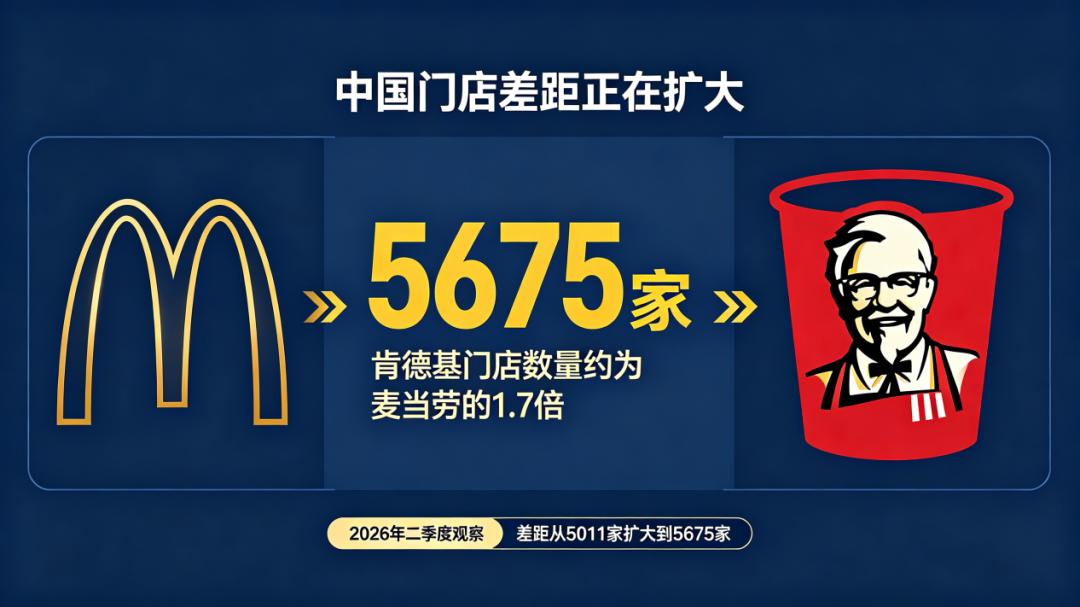
Figure | Source from the Internet
That looks pretty impressive, right? But in the same period, KFC had 13,789 stores in China, a full gap of 5,675 stores. The number of KFC stores is exactly 1.7 times that of McDonald's.
Not only in terms of store count, Yum China's 2025 SEC annual report directly describes KFC as "the leading and largest QSR brand in China by system sales"; the 2026 industry report from Euromonitor International also shows that Yum China maintains its leading position in China's limited-service restaurant market by sales, driven mainly by KFC.
In terms of coverage, KFC has officially disclosed as of the second quarter of 2026 that it has entered more than 2,700 "cities" across China; McDonald's official disclosure in 2025 shows that it covers more than 280 "prefecture-level cities".
Although these two statistical calibers are different and you cannot directly divide 2700 by 280, it is at least clear that KFC has deeply penetrated a large number of lower-tier cities and county-level markets.
What's more notable is that McDonald's China is not slacking off at all.
Since CITIC and Carlyle took over the business and renamed it "Golden Arches" in 2017, the number of McDonald's stores across China has surged from 2,500 to the current 8,114 at full throttle.
In the past year alone, McDonald's added a net of 887 new stores.
Opening nearly 900 stores a year, an average of two to three per day, this speed is so fast that it almost makes the cement mixer on the construction site overheat.
But if you look back, KFC has not been idle either.
In Q2 2026, KFC added a net of 335 stores in a single quarter; more dramatically, even though McDonald's added 887 new stores in the past year, the gap in store numbers between the two brands has expanded from 5,011 to 5,675. McDonald's stepped on the accelerator hard, but the gap widened by another 664 units instead.
Moreover, in its Q2 2026 financial report, McDonald's reported that same-store sales in its "International Developmental Licensed Markets" segment increased by 1.9%, but the company specifically noted that same-store sales in the Chinese market recorded negative growth.
By contrast, KFC not only posted positive same-store sales growth for existing outlets, but also saw transaction volume rise by 4%, with restaurant profit margin even rising against the trend to 17.1%.
This is quite a surreal situation.
Why is McDonald's, which is unbeatable all over the world, still unable to catch up with KFC even after pushing its expansion speed to the limit in China?
2
When many people analyze this issue, they like to put forward several classic unfounded arguments based on intuition.
The first claim is that KFC is cheaper.
Just check the third-party market data. Data from Jimu Food Eye cited by Guojin Securities in 2024 shows that the average per-person order at KFC was about 34 yuan, while that at McDonald's was about 28 yuan.
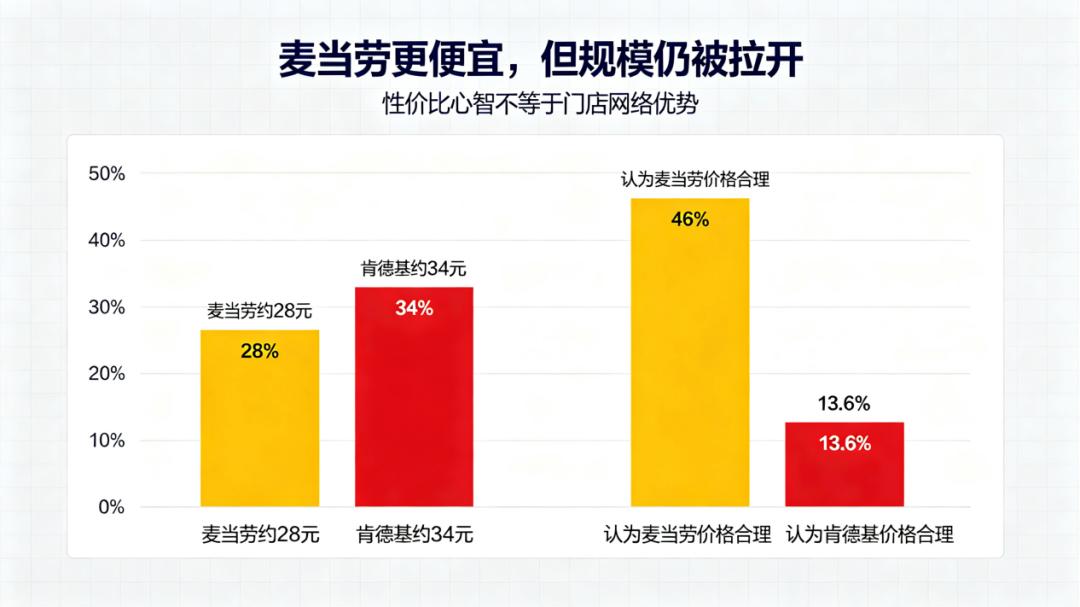
Figure | Source from the Internet
KFC is a full 6 yuan more expensive than McDonald's!
Over the years, with its 13.9-yuan "1+1 Value Combo" and the "Big Burger Feast" set starting from 22.9 yuan, McDonald's has long firmly established its image as the go-to brand for budget-friendly meals.
In a 2023 online consumer survey conducted by CBNData and DT Finance, 46% of respondents considered McDonald's reasonably priced, while only 13.6% held the same view for KFC.
When it comes to the perception of extreme cost-effectiveness, McDonald's completely outperforms KFC.
The second claim is that Chinese young people prefer KFC more.
A previous online consumer survey by CBNData and DT Finance shows that 61.2% of the respondents in the sample chose McDonald's, while only 28% chose KFC; further breakdown by age shows that post-90s and post-00s respondents also prefer McDonald's more.
Of course, this is not a nationally representative sample survey, and we cannot conclude that "60% of Chinese people love McDonald's", but it at least shows that among young, internet-savvy consumers, McDonald's brand appeal is not weak at all.
Social media is full of enthusiastic fans of the "McDonald's Devotees" community, how many people have you seen calling themselves "KFC Devotees" all the time?
The third claim is that McDonald's has a poor supply chain and its ingredients are not localized.
This is completely nonsense.
McDonald's procures nearly 800,000 tons of food and raw materials involving more than 400 categories in China every year, with a local procurement rate of over 90% by procurement value; since 2018, McDonald's and its suppliers have cumulatively invested more than 120 billion yuan to build the Chinese supply chain. Its supply chain has long been highly localized.
The fourth claim is that McDonald's fails to adapt to local conditions and is not down-to-earth.
Just take a look at McDonald's menu this year: it has launched basil stir-fried pork, tom yum, curry chicken steak, and even meat bone chicken and seafood burgers.
With a strong cost-effectiveness perception, no rejection from young consumers, a highly localized supply chain, nearly 900 new stores opened per year, and an increasingly localized menu, its scale is still completely outperformed by KFC.
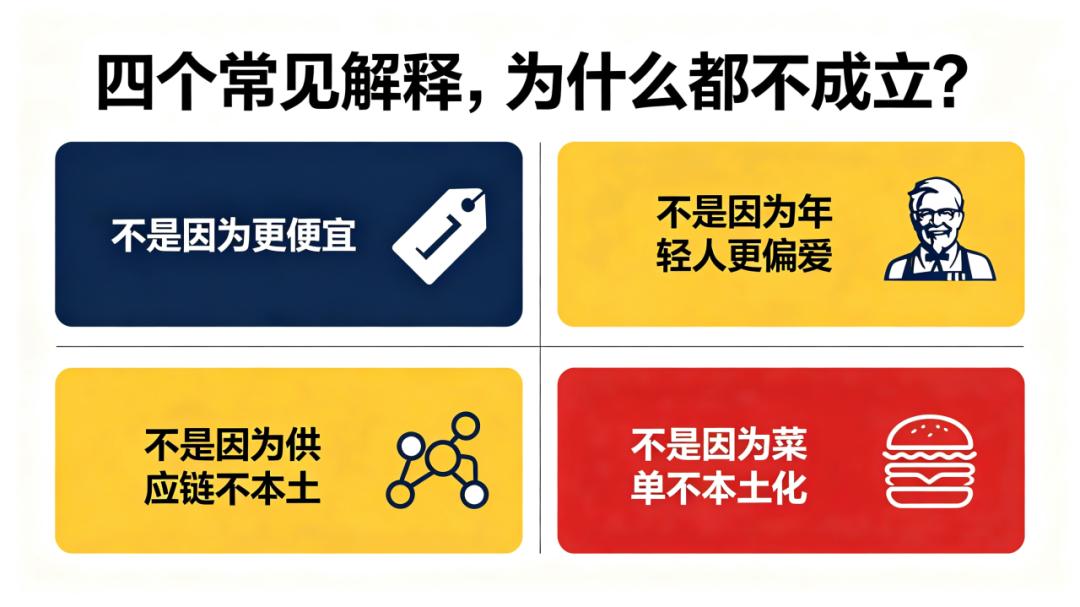
Figure | Source from the Internet
Since none of these reasons hold up, where exactly does the problem lie?
3
Let's first break down the city distribution structure using the third-party store database from Jimu Food Eye at the end of 2025.
To clarify, there are statistical caliber differences between this database and the total number of official stores of the two companies, so we will focus on the "distribution structure" here, and do not treat every absolute store number as the SEC-caliber figure.
Under this third-party statistical caliber, KFC has 2,182 stores in first-tier cities, while McDonald's has 2,185 stores.
The two are almost completely tied, and McDonald's even leads by 3 stores!
Another securities firm's report citing data from Jiuzhong Zhongtai also shows that in T1 cities, about 55% of the stores of KFC and McDonald's have outlets of the other brand within a 500-meter radius. In big cities, the two brands often compete head-to-head.
If you only live in office buildings in Beijing, Shanghai, Guangzhou and Shenzhen all your life, scroll through Xiaohongshu every day, and eat the 13.9-yuan value combo at noon, you will naturally have the illusion that "McDonald's and KFC are evenly matched".
But first-tier cities never represent the whole of China. The cruel watershed that truly determines the outcome officially starts from the second-tier and lower cities.
Under this third-party caliber from Jimu Food Eye, KFC leads by about 867 stores in new first-tier cities; leads by about 1,303 stores in second-tier cities; in third-tier and lower cities, KFC has about 4,491 stores while McDonald's has about 2,200 stores, a gap of nearly double.
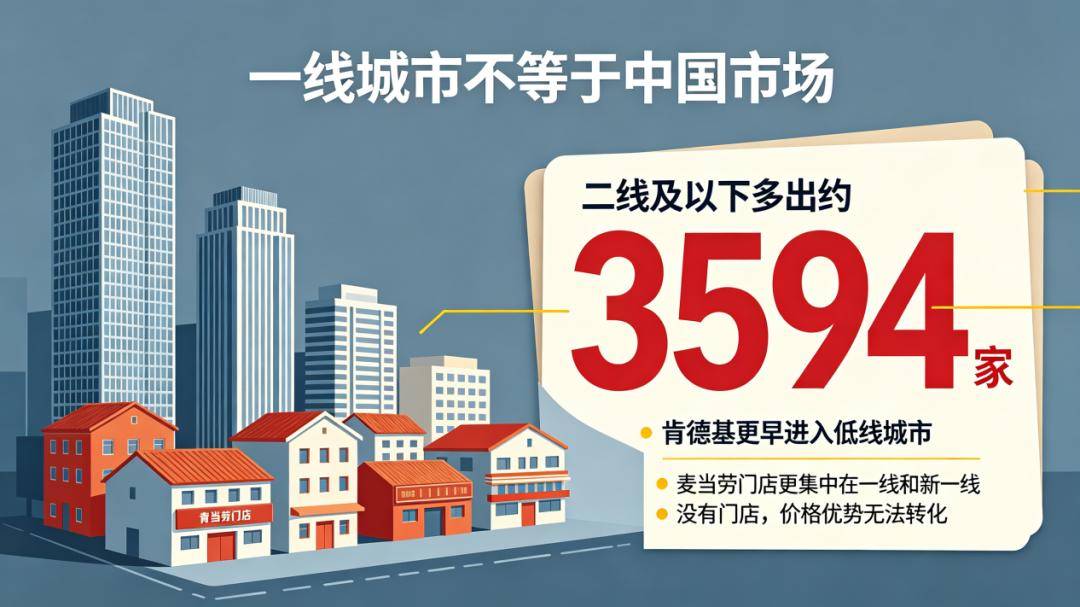
Figure | Source from the Internet
In second-tier cities and third-tier and lower cities alone, KFC has about 3,594 more stores than McDonald's in this third-party database.
Moreover, the structure presented by this data is very distinct: McDonald's is more concentrated in first-tier and new first-tier cities, while more than one-third of KFC's stores are located in third-tier and lower cities. The specific absolute numbers may vary with different database calibers, but the trend that KFC has deeper penetration in lower-tier markets is consistent with the official expansion strategies of the two companies over the years.
For example, in Shanghai, the choice facing office workers may be "Should I go to McDonald's or KFC for lunch downstairs today?"
In many lower-tier cities and county-level markets, KFC often appears much earlier than McDonald's. Consumers do not even face the choice between "KFC or McDonald's", because there is no McDonald's there at all.
At this point, even if McDonald's cuts the price of its value combo further, its price advantage must be based on the premise that there is a store near the consumer.
4
Some people may ask at this point: Is McDonald's stupid? Why not open stores in county-level markets?
This brings us to the underlying logic of the "store economics" of the two companies.
Many people think that opening a store is just renting a storefront, but Yum China's investor materials clearly show that a classic standard KFC store covers an area of about 170 square meters, with a capital expenditure of about 1.6 million yuan.
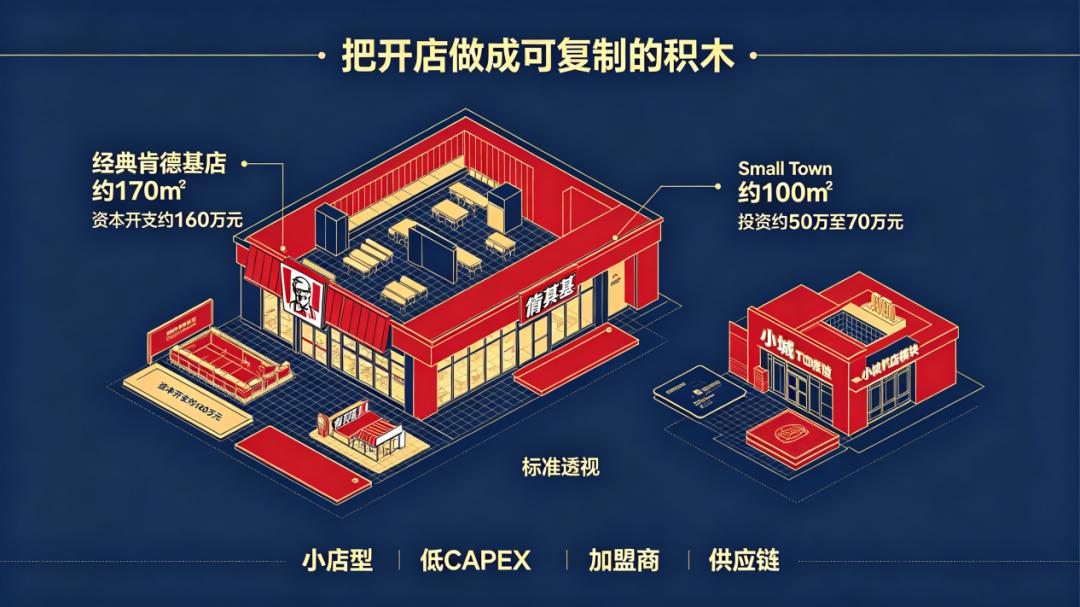
Figure | Source from the Internet
But what if the population density, consumption power and rent structure of a small city cannot support the return of a large standard store? The traditional approach is to change the location, or simply give up the market.
In order to continue to expand into lower-tier markets, KFC has specially developed the Small Town store model: covering an area of about 100 square meters, the capital expenditure is reduced to 500,000 to 700,000 yuan; the even lighter Small Town Mini model can achieve an investment of about 500,000 yuan, which is about one third of that of traditional stores.
Yum China discloses that the average payback period for new KFC stores is about two years, while the target payback period for Small Town franchise stores is about 2 to 3 years.
For small cities that could hardly support a large standard store before, KFC can enter with a much lighter model. Not only is its store size flexible, KFC is also accelerating expansion using franchisees' capital and local resources.
In 2025, about 37% of KFC's net new stores came from franchisees; in Q2 2026, 152 of the 335 net new stores were contributed by franchisees, accounting for 45%.
Small store sizes, low CAPEX, franchisee participation and a nationwide supply chain have allowed KFC to turn store opening into an increasingly standardized and modularized system: locations that could not support a standard store before can now support a KFC outlet.
5
If small store models help KFC cross geographical boundaries, its product line continues to break the boundaries of "what Western fast food should sell".
McDonald's has been increasingly localized in recent years, but its core menu still revolves around the system that McDonald's is best at: hamburgers, chicken, snacks and coffee.
In China, KFC relaxed its boundaries much earlier. In addition to fried chicken and hamburgers, it also sells rice, congee, fried dough sticks, soy milk, desserts, coffee, and even launches local breakfast and regional dishes.
In 2002, KFC started selling preserved egg and lean meat congee;
In 2003, the Old Beijing Chicken Wrap was launched;
In 2008, KFC launched fried dough sticks nationwide; at that time, McDonald's stated in media interviews that it had no plans to launch fried dough sticks;
By 2021, KFC launched Wuhan hot dry noodles from local testing to limited national sales, selling more than 1 million bowls in the first week of launch!
A fried chicken brand from Kentucky, USA, sold one million bowls of hot dry noodles in China in a single week. This is no longer just localization, it is almost an unorthodox cross-border magic trick.
What's even more impressive is KFC's full-day all-hour product strategy layout.
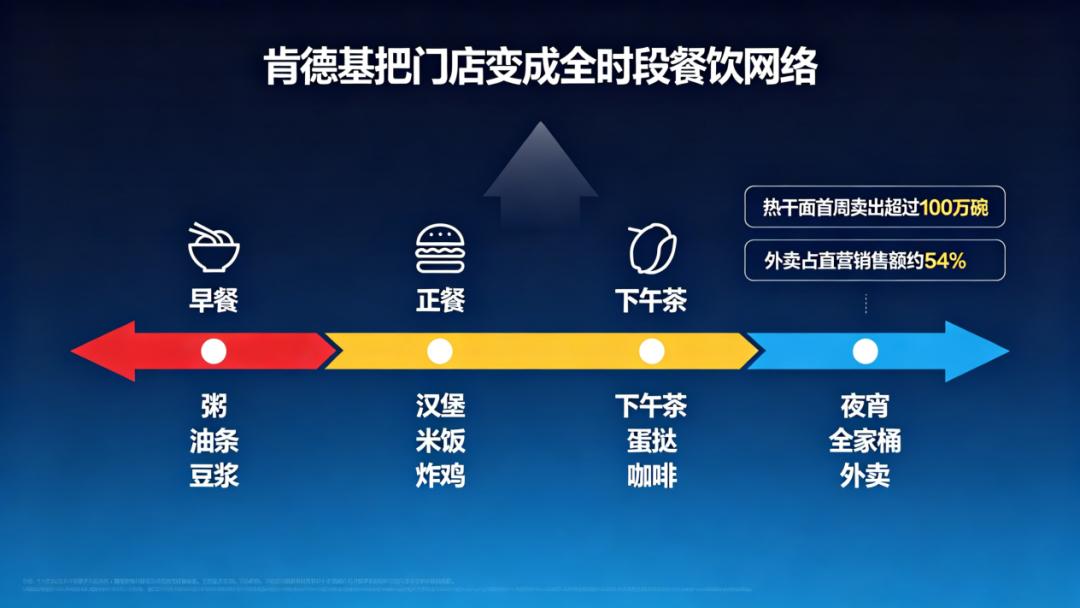
Figure | Source from the Internet
At 7 a.m., it sells congee, fried dough sticks, sesame seed cakes, soybean pudding and coffee;
At 12