Thanks to everyone who uses GPT-6 to generate 3D content, burning their own tokens in exchange for a full global reset.
Cyber father Tibo is here to bring everyone warm (reset) warmth (reset) again!!
The reason is simple: the whole internet is using GPT-6 Astra to play with 3D, and the quota is burned out very quickly...
This time it is a global reset for all paid subscriptions, which is expected to arrive at around 18:00 US Pacific Time the same day (around 10:00 a.m. Beijing Time on the 8th).
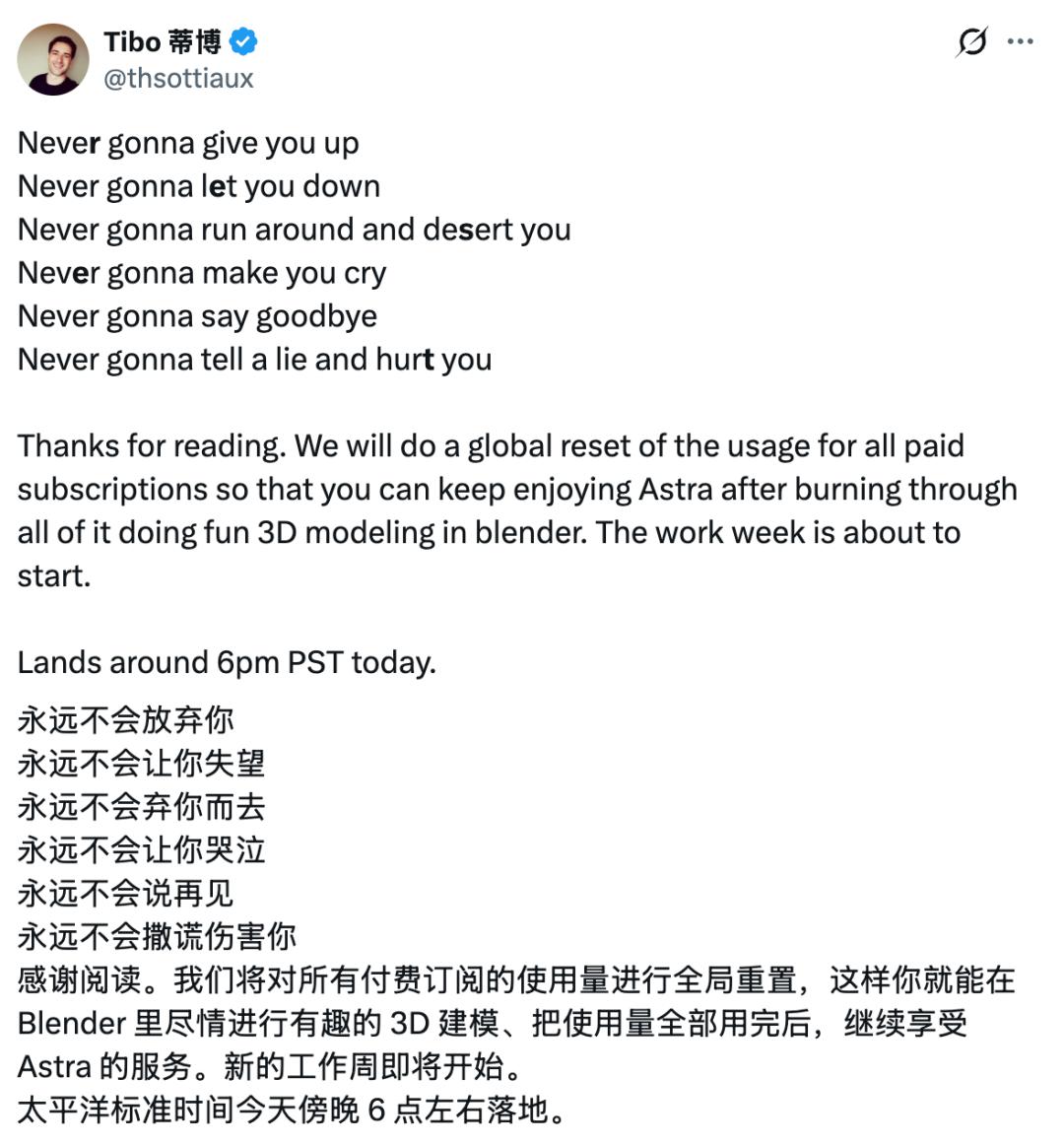
This time, the man even hid the word "reset" in the lyrics of *Never Gonna Give You Up*...
Have to say Tibo, your tricks are getting more and more fancy

Someone in the comment section summed it up accurately:
a reset a day keeps Claude away.

There's no way around it. 3D has become the most popular gameplay across the whole internet since GPT-6 Astra was launched.
In the past two days, I have been completely flooded with all kinds of 3D gameplay cases made by Astra...
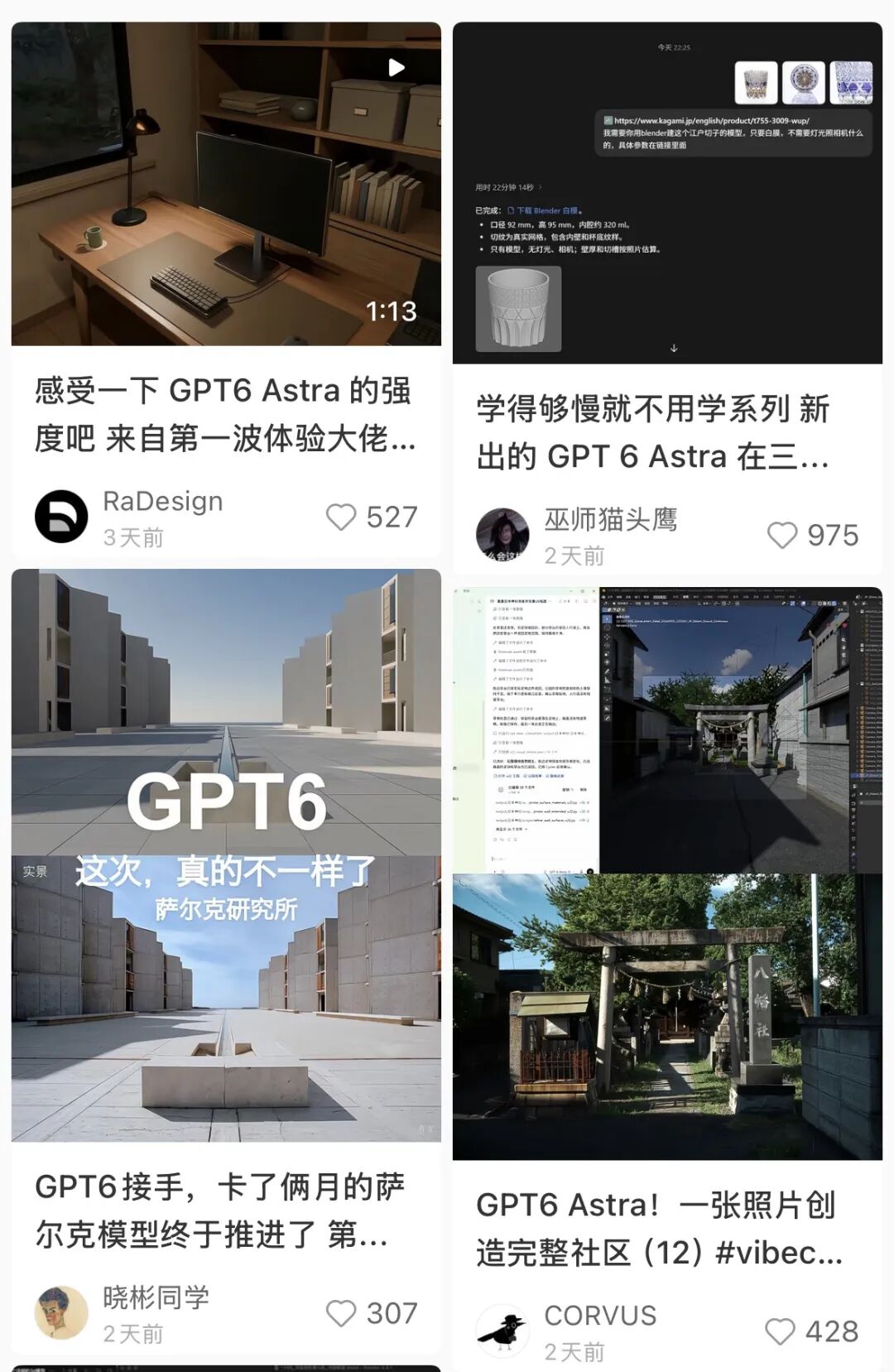
Directly operate Blender for modeling, develop games, generate textures, build 3D web pages...
And the effects are all! Extremely! Stunning!
The whole internet is shocked and stunned...
There are 4 main ways to play 3D with GPT-6 so far
I have briefly summarized the wildly popular 3D gameplay of GPT-6, which can be roughly divided into 4 types:
The first type: modeling from images, directly converting photos or drawings into editable assets.
This is also the most common type, which asks Astra to reconstruct 3D objects in Blender based on photos, sketches or engineering drawings.
For example, this netizen found a drawing of an old-fashioned steam train and asked Astra to reconstruct it in Blender according to the drawing.
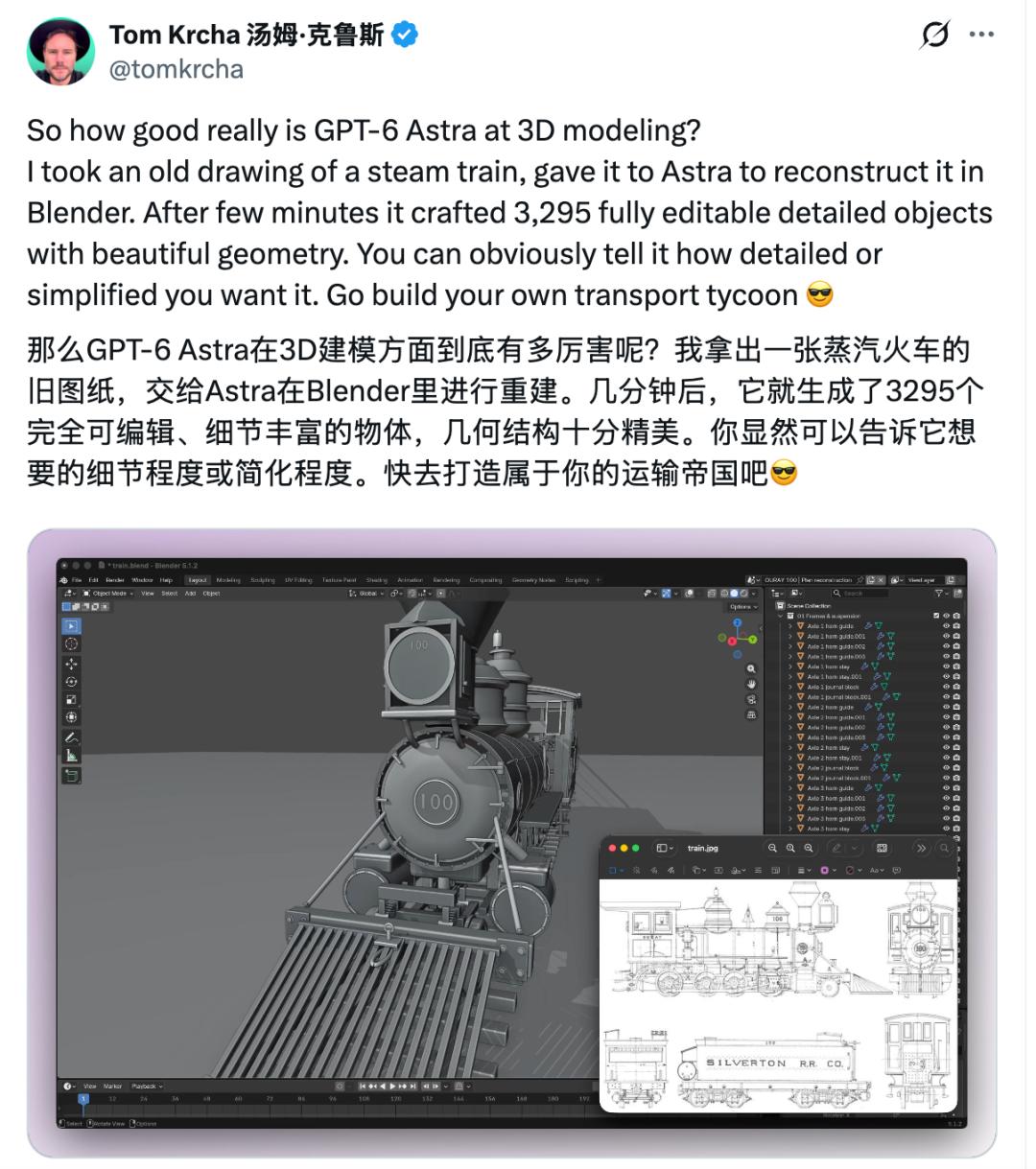
It only took a few minutes for Astra to deliver a train model consisting of 3295 independent objects.
In addition, the wheels, boiler, chimney and cab can be further edited, and the detail level of the model can be adjusted as required.
More importantly, Astra does not move the mouse or drag vertices in the Blender interface like a human.
It writes Python scripts, uses code to create geometric structures, and then makes further modifications based on the rendering results. Later when the author asked it to disassemble the train into parts, Astra could also handle it directly.
The second type: use Astra to complete a full 3D scene workflow.
After processing single objects, some people directly pushed Astra's modeling scale to an entire city.
For example, a South Korean netizen raised a rather bold question: Can Astra turn a real city into a 3D world?
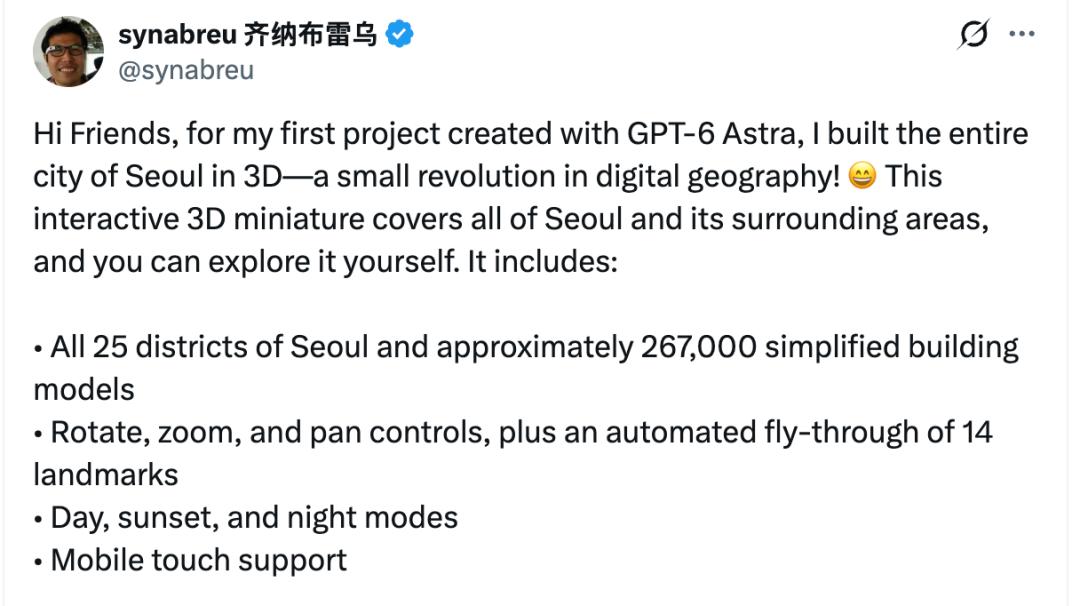
43 minutes later, a "Mini Seoul" that can be directly opened in the browser was launched.
This project covers all 25 districts of Seoul and surrounding areas, including approximately 267,000 simplified building models.
Users can rotate, zoom, and drag the screen, and can also automatically fly over 14 landmarks, switch between daytime, dusk and night, and operate via mobile phone touch screen.
The entire scene is rendered using Three.js. Astra also completed data processing, scene generation, interactive functions and launch deployment.
This netizen said that he did not design the workflow in advance, only gave the initial idea, and the subsequent data pipeline was basically built automatically by Astra.
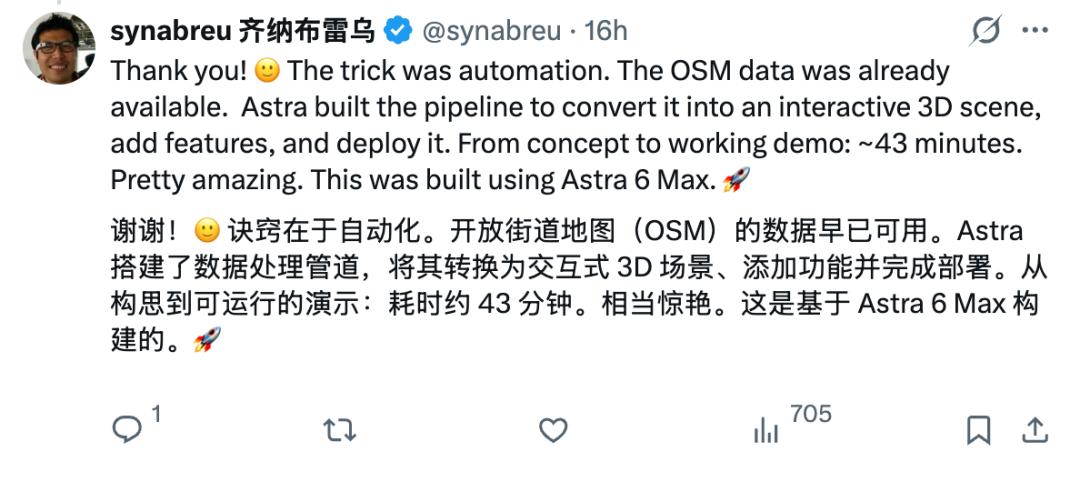
However, after careful review, in this case, Astra mainly reads public map data such as OpenStreetMap, and generates simplified geometries based on building outlines and heights.
Buildings without height information use estimated values, and the terrain and building heights are uniformly scaled up by 4 times for clearer viewing in the browser.
The author also clearly stated that this is more of a stylized miniature city model rather than a surveying-level digital twin.
Even so, Astra's capability to process real map data into an explorable and deployable 3D web page in less than an hour can be said to be quite amazing.
As for the cost, the author said that he used the $100 Pro plan and Astra Max, and when he continued to iterate to v1.4, he had already used up all his Astra quota.

The third type: directly advance to making 3D games.
There are also a huge number of cases of this type, which is to directly ask Astra to make 3D games.
For example, this netizen used Astra to make a 3D game Demo in a cyber wasteland style.
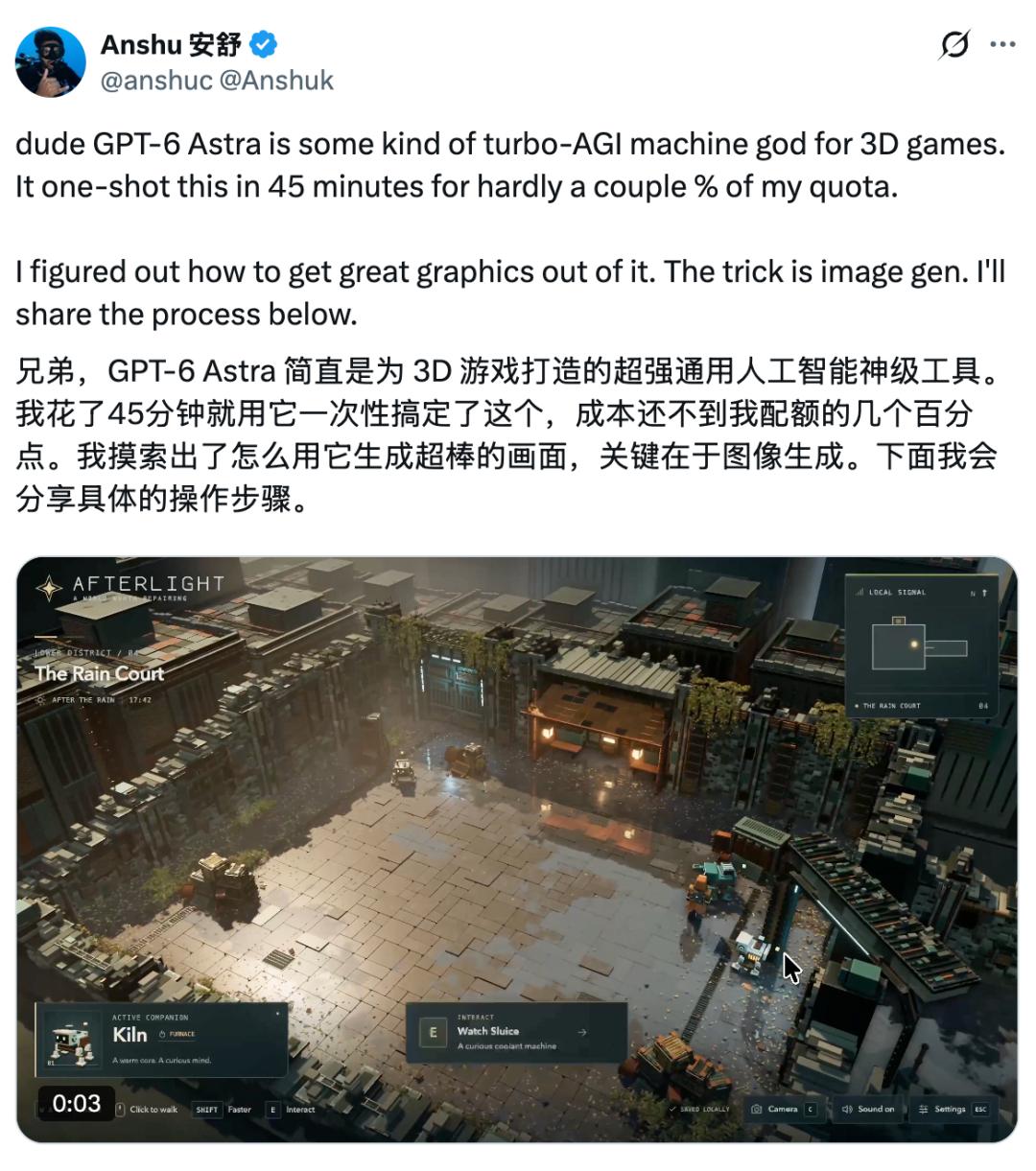
Rain hits the metal ground, the wet ground reflects the lights, robots walk through the staggered buildings, and the atmospheric effect is immediately presented.
There is a map name in the upper left corner, the area can be viewed in the upper right corner, and character information, interaction prompts, camera and sound options are made at the bottom.
At first glance, it really looks quite decent~
According to his introduction, the entire Demo was generated by Astra at one time, which took 45 minutes and only consumed a few percent of the weekly quota (the plan is Pro 20×).
The key to making the picture get rid of the "AI plastic feel" is to first let Astra call the image generation tool to draw the target art style, then continuously adjust the game screenshots against the concept map until the picture is close enough, while maintaining 60fps operation.
Later, he let Astra run all night to add a complete gameplay loop, weather effects, Blender models, and a group of procedurally generated robotic birds.
This is the result after 8 hours, the cost is 50% of the weekly quota, you can experience it carefully:
Then the last type is interactive education, anatomy and mechanical visualization.
Some netizens demonstrated a set of 3D models of human cells:
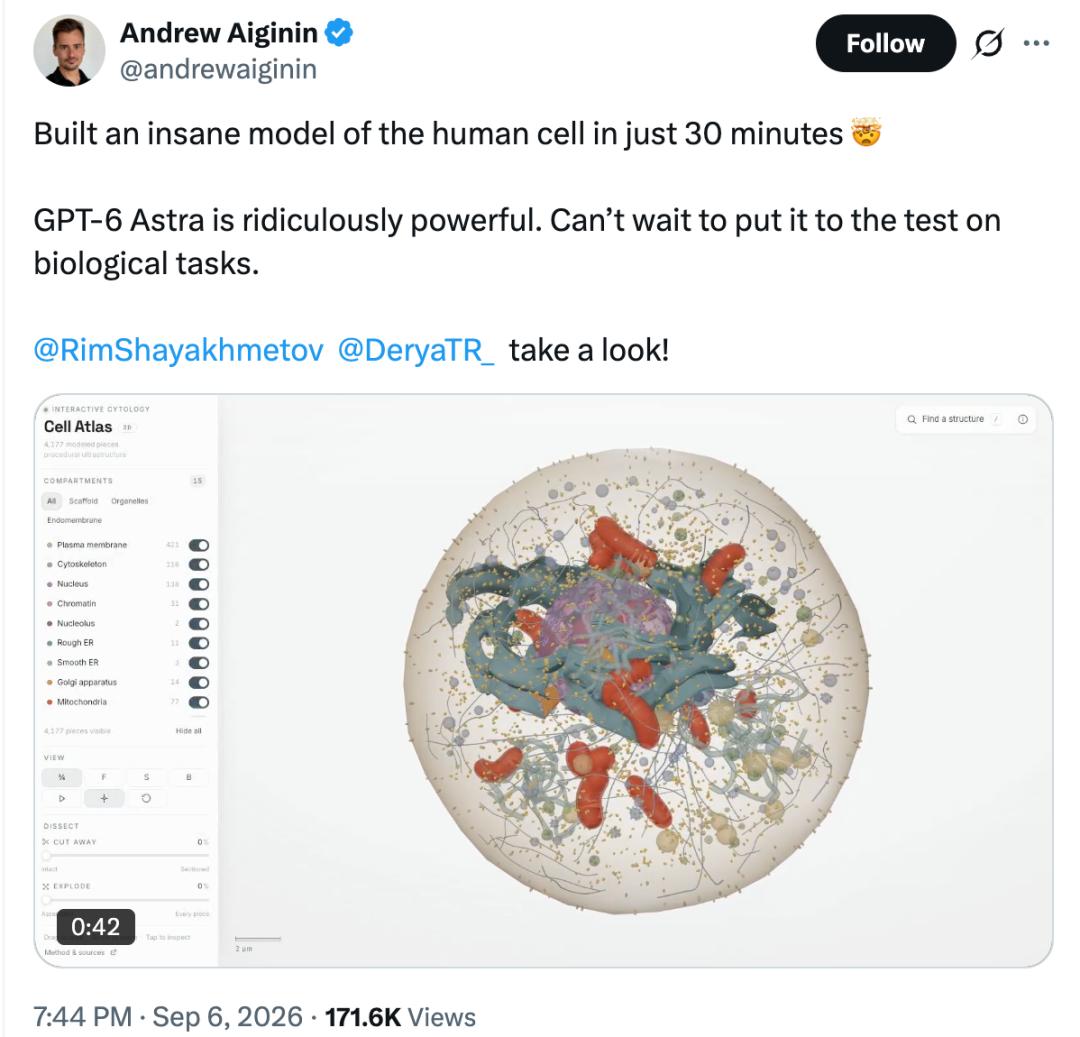
The entire project was completed by GPT-6 Astra in 30 minutes. Structures such as the nucleus and mitochondria are placed in the same 3D scene, which can be rotated for viewing.
Laymen like us can't see the gold content, but professionals have already certified it...
Medical researcher Derya Unutmaz shared his first-hand experience: I was completely stunned.
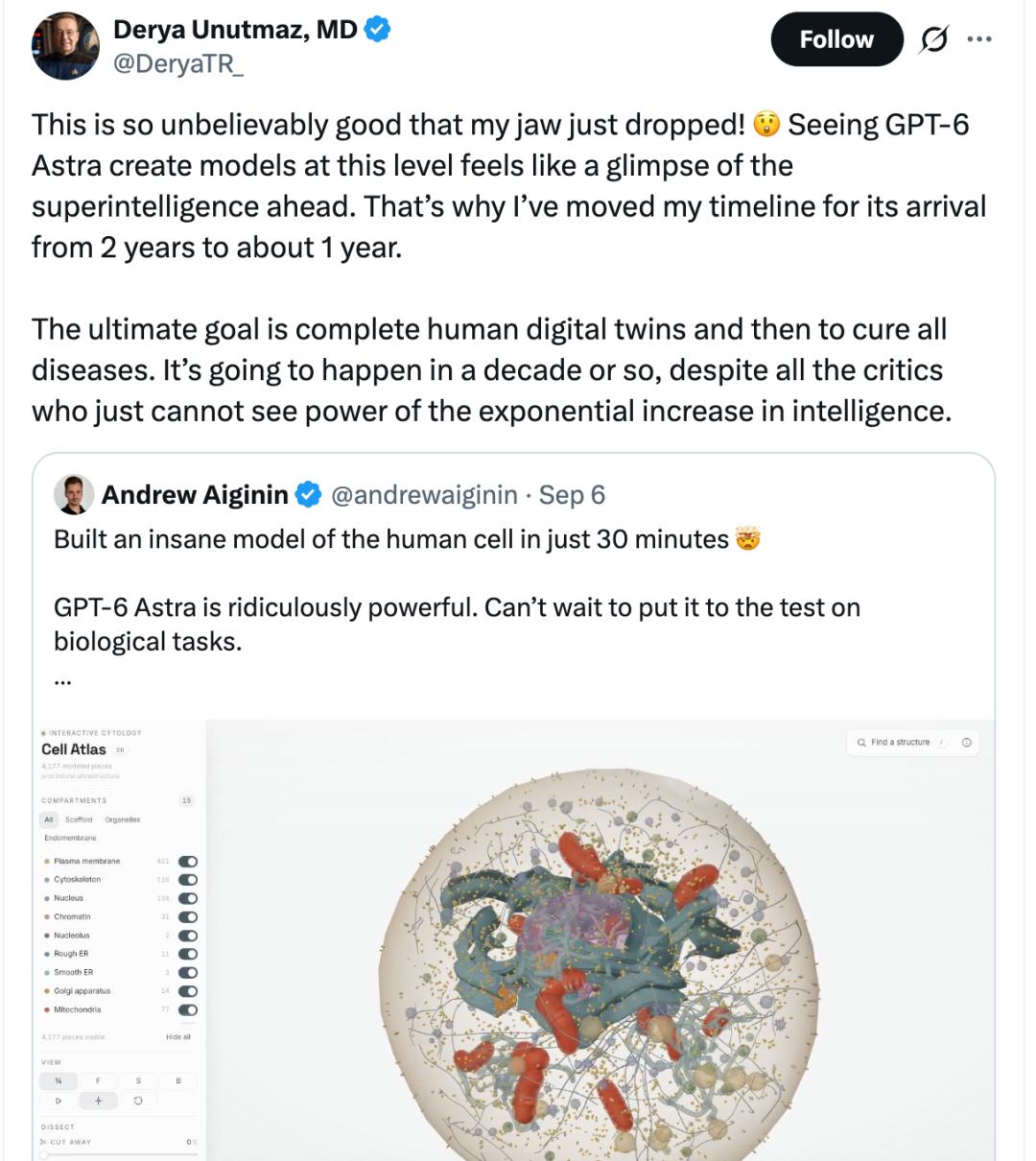
He said that after seeing this demo, he felt that superintelligence might arrive in just one year, whereas he previously estimated it would take two years.
He even envisioned human digital twins, and even using it to cure diseases.
So after seeing so many cases, you will find that the real powerful part of Astra is that it can shuttle back and forth between Blender, Three.js and Unreal Engine, and connect the workflow by itself.
It is no wonder that some people believe that open and programmable software like Blender may become more popular in the Agent era. Because the interface is open enough and the scripting capability is strong enough, it can be called by AI more conveniently.
Although it consumes a lot of quota, Tibo also fully supports it: to let everyone have fun playing 3D, reset quickly!
OpenAI is almost becoming a "reset company"...
Tibo's reset button is like Doraemon's pocket, it never runs out...
The resets are especially frequent around the release of GPT-6 Astra (doge).
When Astra was not yet available to all paid users, he promised that for every day that the launch was delayed, a self-activatable reset card would be issued as compensation.
When Astra was pushed ahead of schedule, he gave Plus, Pro and Business users a full round of reset cards.
Now that everyone has almost used up their 3D quota, he announced again:
Reset! All reset!
No one stops!
Nowadays, websites dedicated to counting Tibo's reset records are everywhere.
Some track when the last reset was, some predict when the next reset will come, and some set dedicated reminders.
Average waiting time, maximum interval and reset heat map have all been made...
"When will Tibo reset" has become a kind of community weather forecast.
So now, it is no longer a problem for ordinary people to do 3D modeling, Astra will arrange everything properly for you.
The question is: Tibo, when will you reset again?
Reference links:
[1]https://x.com/thsottiaux/status/2097043464538264003
[2]https://x.com/tomkrcha/status/2095756085890310311
[3]https://x.com/synabreu/status/2096557555086725159
[4]https://x.com/DeryaTR_/status/2096670056067268847
[5]https://x.com/anshuc/status/2096584624432374151
This article is from the WeChat official account "QbitAI", author: Ting Yu, published with authorization from 36Kr.