Capable of generating outputs in as fast as 20 seconds and supporting access to GPT-6 Astra: Our hands-on test of Qunhe Lux3D reveals that the decisive competitive edge in 3D generation may not lie in geometry.
Input one image, output one 3D model.
AI has been capable of doing this for two years. Its speed keeps increasing, and geometric accuracy keeps improving. But if you import the generated model into Blender and rotate it around, you will most likely frown: metals do not look like metals, ceramics do not look like ceramics, and every surface appears to be coated with a layer of matte paint.
The newly released 3D generation model Lux3D by Manycore Tech is designed to solve exactly this problem. The model comes in two editions: Standard Edition and Express Edition. By inputting an image or a piece of text, it outputs complete assets including 3D Gaussian splatting, Mesh grids, and assets with PBR materials.
The minimum pricing for a single model is approximately 0.07 yuan, with full-platform SDK and MCP interfaces provided, which is quite rare in the 3D generation track. This also clearly indicates that it was never designed for casual creator use from the very beginning.
Therefore, I got hands-on with it as soon as possible. The following are the actual test details.
Materials, Workflow, Engineering: Full In-Depth Actual Test
PBR material is the core highlight of this Lux3D release, and it is the key indicator that the official team prioritizes promoting.
Its full name is Physically Based Rendering. It is far more than simply applying colors to the model: it tells the rendering engine what material the surface of the object is made of, as well as its metallicity, roughness, transparency, refraction and glossiness. The combination of these parameters determines whether the same shade of gray represents steel, plastic or cement under different lighting conditions.
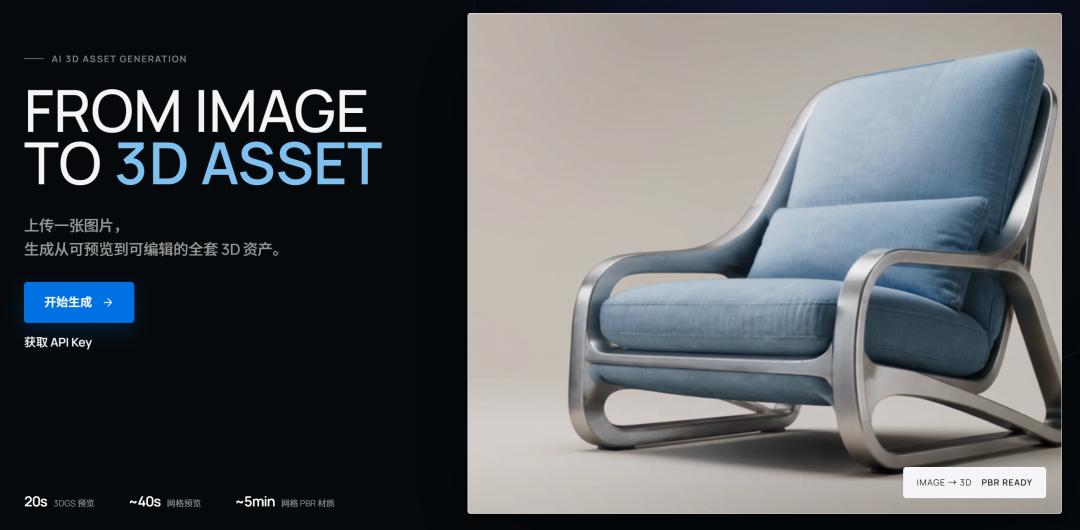
There are good reasons why materials are the focus of this release. After two years of fierce competition in the 3D generation track, it is difficult to create gaps in geometric performance: the outlines of generated models are getting more and more similar, but the surfaces often look obviously fake at first glance. Almost all such problems come from the material layer. By starting with material optimization this time, Manycore Tech is exactly addressing the industry's existing shortboard.
With this understanding, its pipeline design becomes very logical. Lux3D's generation process is a three-layer progressive pipeline, where material processing is the final step and also the most critical step. This is the most intuitive difference between Lux3D and most "one-click model generation" products on the market.
After uploading an image or entering a text description, the system first outputs a 3D Gaussian preview to quickly verify whether the overall appearance meets expectations. 40 seconds later, the Mesh grid preview is generated, and the model starts to have an editable topological structure. Then comes the material baking process, which truly "bakes" colors and physical properties into the grid, and finally the PBR finished product is obtained.
In traditional workflows, if a 3D artist is not satisfied with the generated result, they can only re-run the entire process. However, being able to filter out directionally wrong results at the Gaussian preview stage means that the most computationally expensive high-precision generation step in batch tasks is only allocated to objects that have been verified. Manycore Tech has clearly defined the positioning of its two editions on its product page: the Express Edition is for fast preview and batch screening, while the Standard Edition is for high-quality delivery of key assets. Screening first and then refining is a factory-oriented mindset, not a demo-oriented mindset.
When it comes to actual testing, we also focused our main attention on materials.
The first set of materials I used was an old-fashioned copper pot. I chose it for a reason: the dark copper color of the oxidized pot body, the bright copper color of the polished spout, and the rattan texture on the handle — three different textures on a single object, which is a very challenging test for material recognition capability.
We can see from the preview that the oxide layer has a sense of hierarchy: the dark part is not a lump of brown, and the transition of oxidation depth can be clearly observed. The reflection on the pot body is consistent with the reflection logic of real metal. The texture of the rattan handle is also generated, but a closer look shows that the woven texture looks like it is "pasted" on the surface, rather than having real concave-convex structure.

The next test object is a celadon bowl. The difficulty of this task lies in the translucent feeling of the glaze surface. The reason why celadon is celadon is not that it is coated with green paint, but that the glaze layer has a certain transparency, and the light penetrates the glaze and then reflects back to present a translucent color. For the celadon bowl generated by Lux3D, you can see the gloss of the glaze flowing when rotating the bowl, and the detail that the glaze layer at the rim of the bowl becomes thinner and the color becomes lighter is also presented.
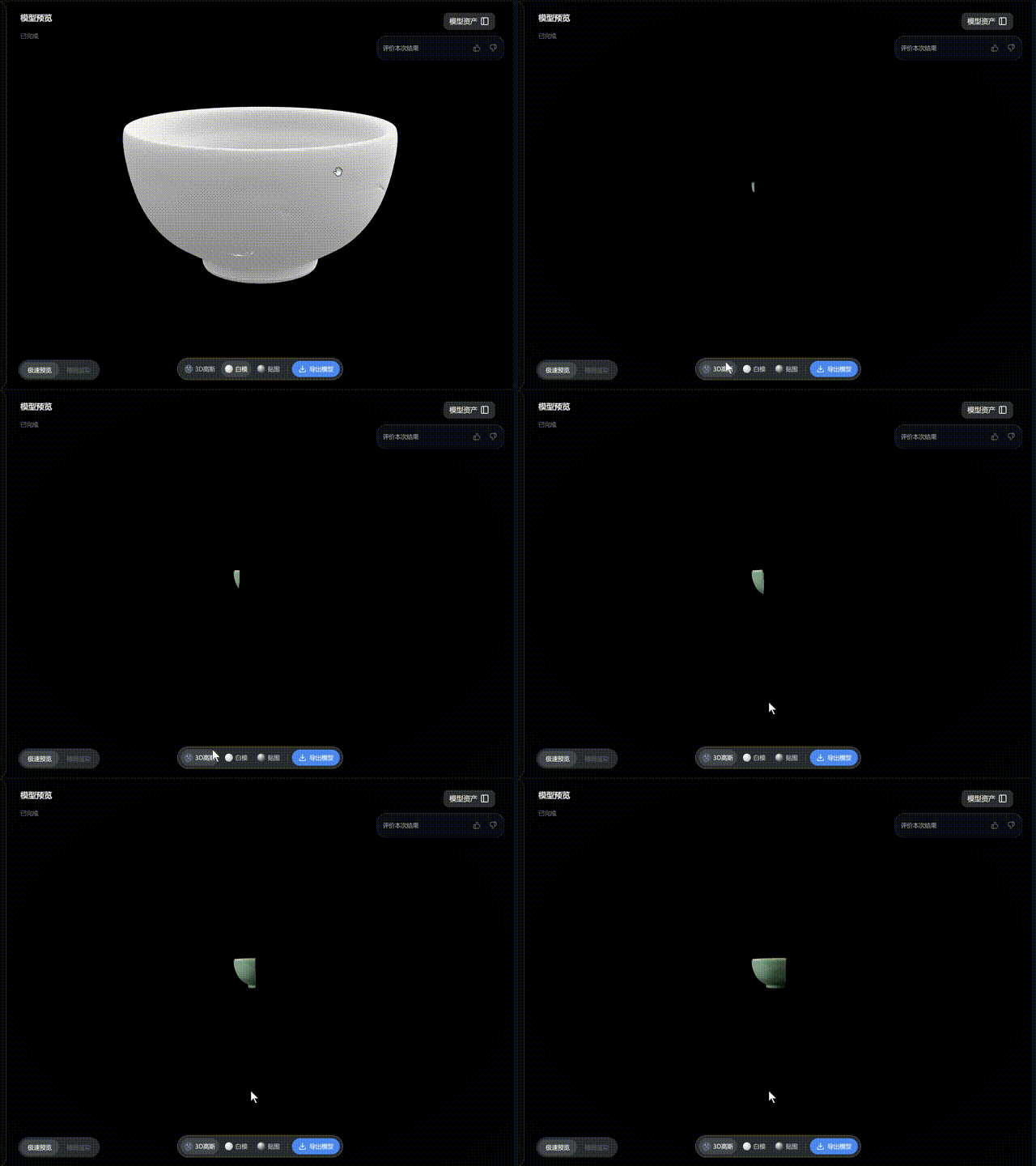
Now mainstream 3D generation models have generally started to supplement PBR capabilities, but Lux3D obviously puts materials in a more core position this time. Compared with products that only focus on generating outlines, it further emphasizes the restoration of physical properties such as metallicity, roughness, and transparency.
Then I added another set of test materials: a fabric sofa and a trendy collectible figure.
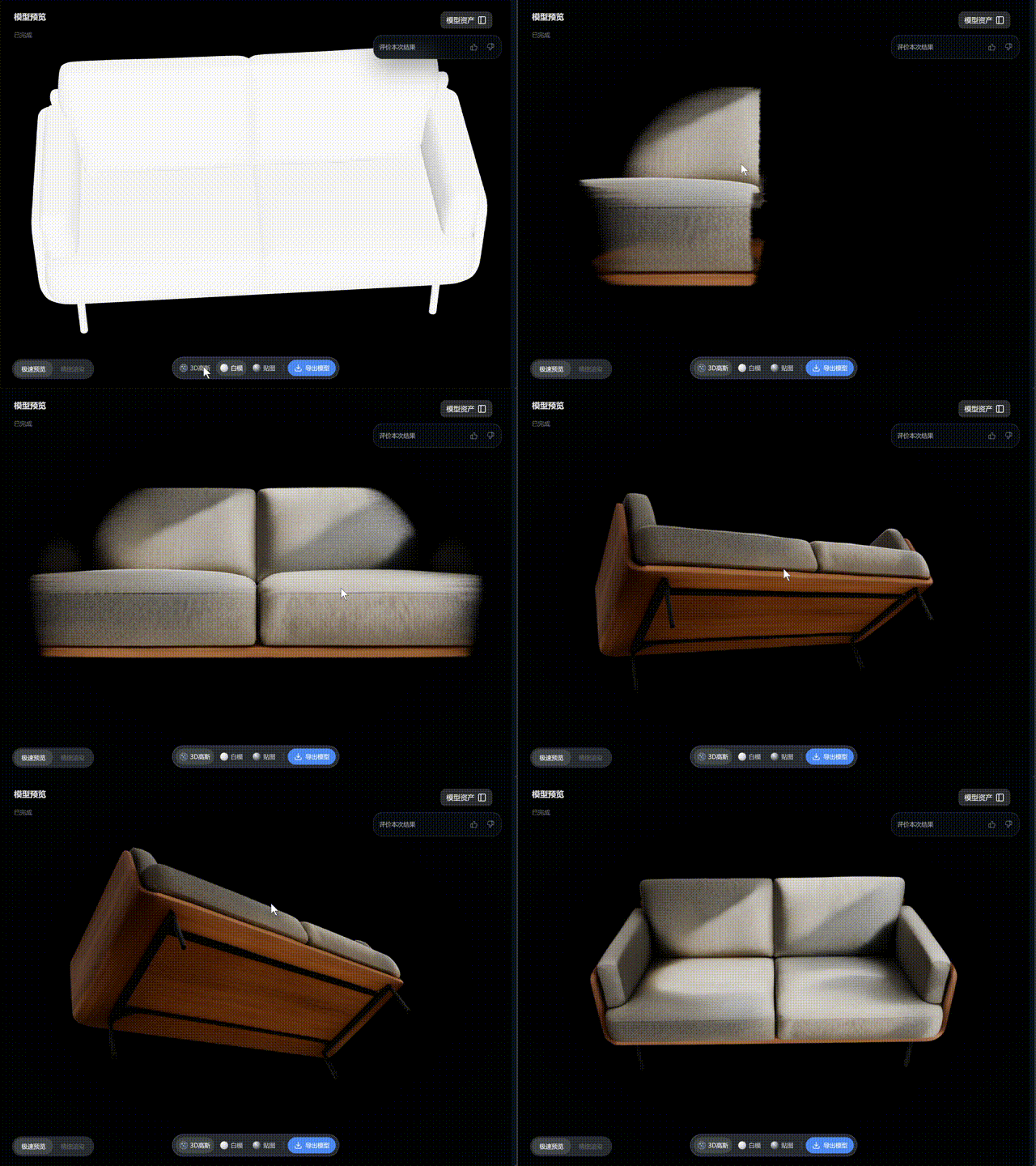
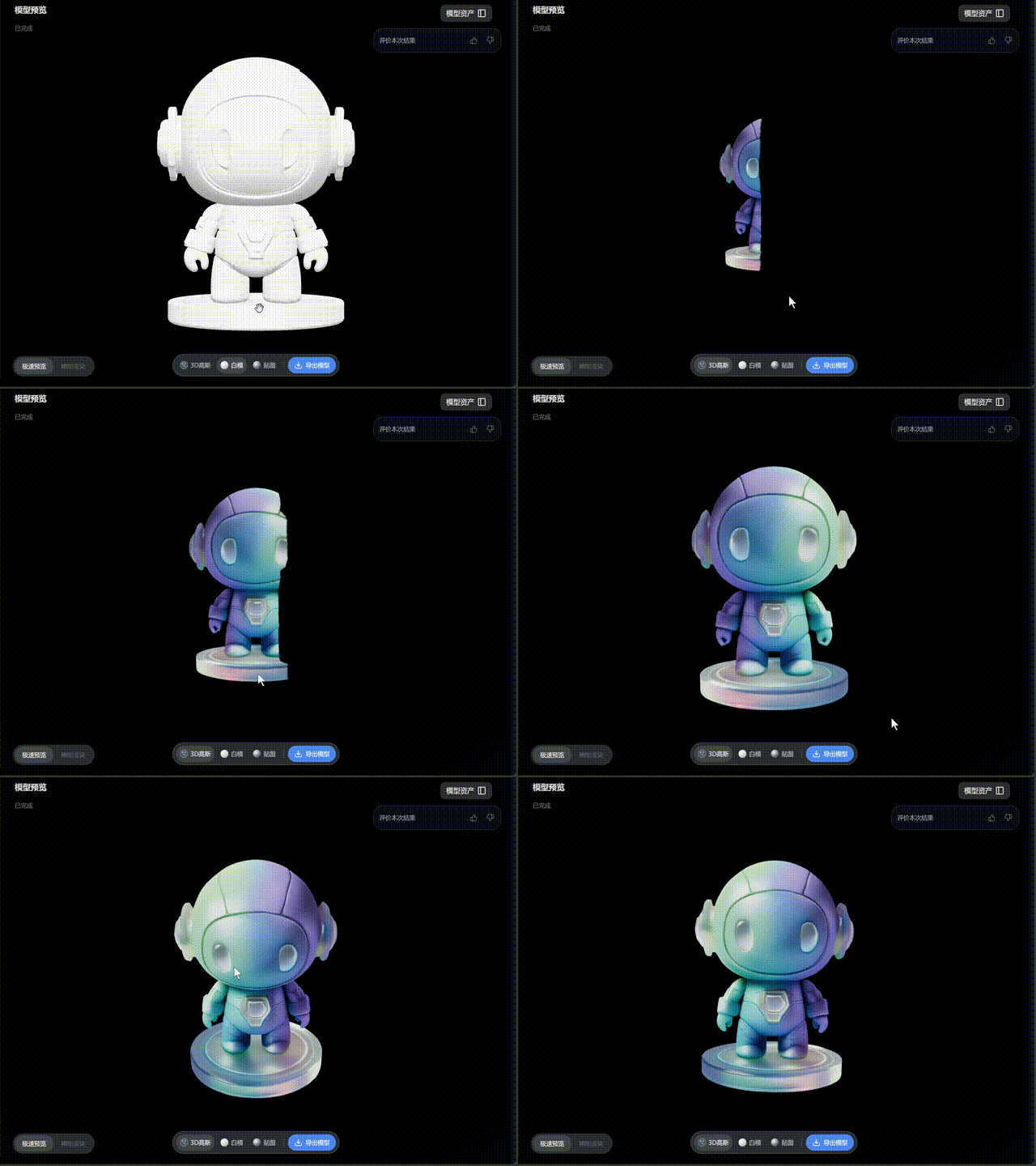
The dull luster on the fabric surface is the easiest part to get wrong: too much luster makes it look like leather, too little luster makes it look like plastic. With the warm solid wood frame and the cold hard metal legs, one piece of furniture has three materials with very different textures. The trendy collectible figure, on the other hand, tests the transition effect of gradient spraying and the hierarchy of translucent parts.
If any layer is not processed properly, the asset will look obviously fake once imported into the rendering engine. The material baking of Lux3D does output a complete set of physical parameters, with metallicity, roughness, transparency and normal map as independent channels, rather than a single pasted base color texture.
According to the actual test results, the performance of the sofa is stable, and the three textures of fabric, solid wood and metal are all presented correctly.
The gradient effect of the trendy collectible figure is basically smooth.
Materials are indeed the most solid part of this version, but there is still a gap before it can be imported into the rendering engine without further inspection: complex patterns and fine textures are still partially lost. The official coverage category list also implies its current boundary: it does not include characters and scenes, which is a completely different market segment from the creator market targeted by Tripo and Meshy.
I also tested the text-to-3D function. Pure text description can generate decent results, but its controllability is obviously not as good as image-to-3D. For some unclear details in the text, the model can only make up the content by itself.
Lux3D provides three sets of SDKs for Python, TypeScript and Java, with ComfyUI plugin launched simultaneously, as well as an MCP interface. This means that AI coding tools such as Cursor and Claude Code can directly call Lux3D, embedding 3D asset generation into automated workflows.
For example, the recently viral GPT-6 Astra can seamlessly connect with Lux3D: creators can use the official Skill of Lux3D to call GPT-6 Astra to plan tasks and create assets, then use Lux3D to generate them quickly in batches, and finally import the results into Blender for assembly and rendering. Through this Harness mode, an interactive game can be completed quickly. It is reported that the official plugin of Lux3D will soon be launched on Codex, and this code-driven technical pipeline will be further simplified.
However, the currently supported export formats include GLB, PLY and ZIP packages, while USDZ, OBJ and FBX are still on the roadmap. Teams that want to directly connect to industrial pipelines need to pay attention to this point. All speed and cost data are official figures, and the actual cost varies according to versions and parameters. The 0.07 yuan price refers to the conversion value of the lowest tier.
Why Manycore Tech Can Achieve This, While Others Cannot
Looking only at the function list, Lux3D seems to be following the path that Tripo and Meshy have already explored. But when you place it in the overall business layout of Manycore Tech, you will see something different.
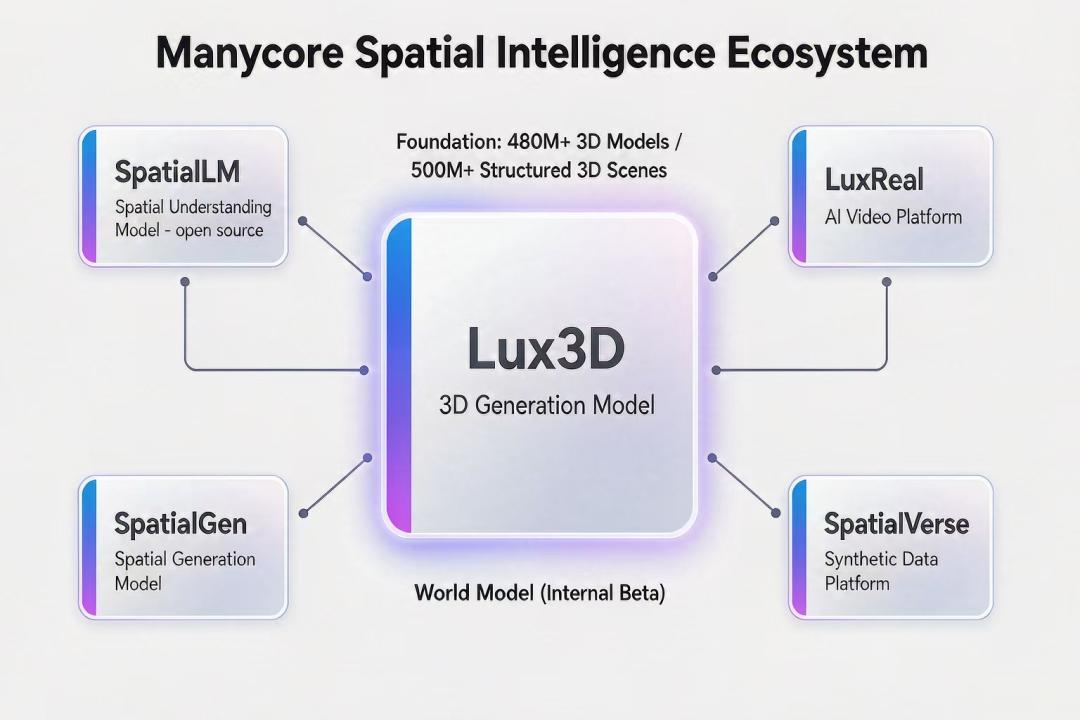
Manycore Tech has accumulated more than 480 million 3D model assets and 500 million structured 3D spatial scenes. These are not simple internet image corpora, but structured 3D data precipitated from long-term spatial design, modeling, material configuration and rendering processes.
This is the fundamental difference between Lux3D and pure generative 3D models. The training data of most 3D generation models comes from internet images, which mostly tell you what an object looks like, while structured 3D assets contain richer information such as geometry, materials and spatial relationships.
Manycore Tech itself is also one of the largest e-commerce 3D production scenarios in China. Its data comes from the spatial design business accumulated by Kujiale for many years. When designers configure furniture, select materials and perform rendering in Kujiale, every operation step generates 3D data with physical annotations.
Therefore, the reason why Lux3D achieves higher material accuracy than other products is not that its algorithm is exceptionally advanced, but that the training data itself contains the correct answers. This is a unique advantage that no other company has.
Zhou Zihan, Chief Scientist of Manycore Tech, publicly stated that Manycore Tech takes the explicit 3D path, which generates not pixels, but the real 3D world.
There is a lot of information behind this statement.
Currently there are two paths for 3D generation. One is implicit representation, which uses intermediate representations such as NeRF and voxel. Its generated results look good but are difficult to edit. The other is explicit representation, which directly outputs Mesh, point cloud or 3D Gaussian splatting, with the advantages of being editable, exportable and connectable to downstream workflows.
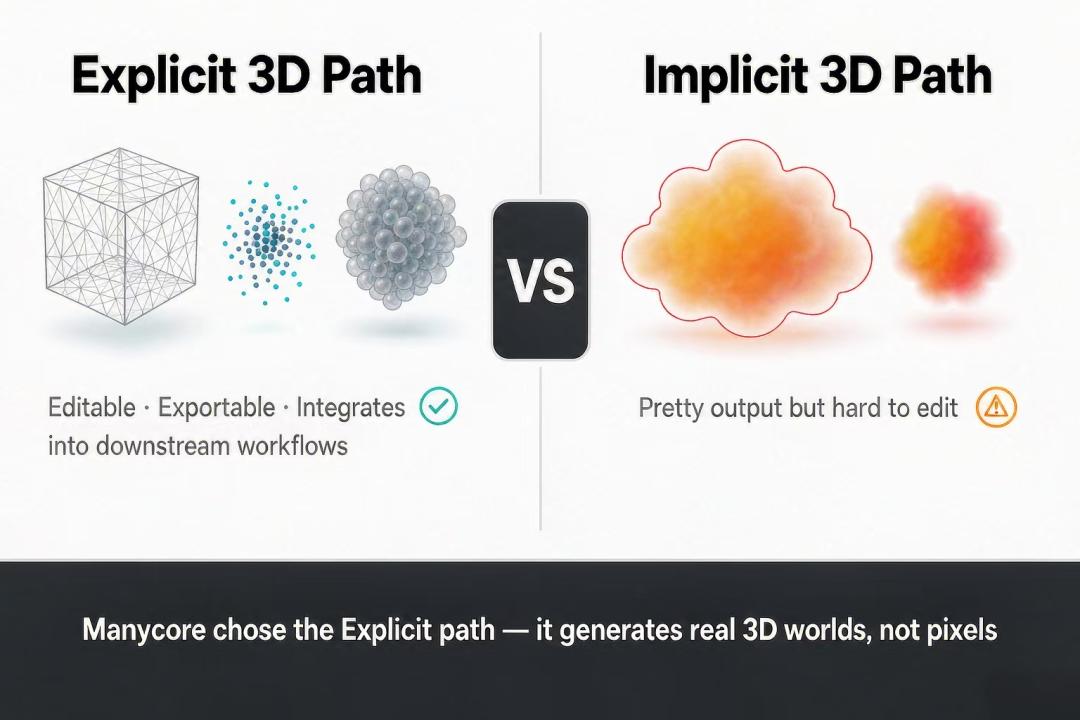
The implicit path may have a higher upper limit and more realistic rendering effect, but the explicit path has stronger engineering usability. The choice of Lux3D to take the explicit path means that "showing off technical skills" is not its original intention, and "practicality" is what it pursues.
This choice is consistent with Manycore Tech's business logic. What Manycore Tech wants to build is not just a 3D generation toy for casual C-end users, but 3D assets that can be imported into production workflows for B-end customers. Such assets must be editable, exportable and support secondary processing, which cannot be achieved by implicit representation.
From this perspective, Lux3D is not an independent 3D generation tool, but a component of Manycore Tech's spatial intelligent infrastructure strategy. It is connected to the AI video platform LuxReal on the upper layer, the open-source spatial understanding model SpatialLM and spatial generation model SpatialGen on the lower layer, and the synthetic data platform SpatialVerse on the side. Lux3D is responsible for completing the 3D asset generation layer. Manycore Tech also plans to add dynamic asset capabilities in the next step, so that the generated objects can have component relationships, motion logic and interactive attributes, and further connect to embodied intelligence training and real-world simulation.
Business data also confirms the correctness of this path. The recently disclosed semi-annual report shows that Manycore Tech's revenue from new AI applications and new products surged 177% year-on-year in the first half of the year, and the orders of its synthetic data business SpatialVerse in the first half of the year have exceeded the total of last year. Its customer list includes many leading embodied intelligence companies. The daily average Token consumption counted since mid-July is about 2.4 billion.
In the capital market, Manycore Tech has also reached a new milestone. On September 4, the Shanghai Stock Exchange announced that MANYCORE TECH (00068.HK) would be included in the Stock Connect program, which officially took effect on September 7. The simultaneous arrival of several milestones in technology, business and capital market in a short period of time has also made the narrative of Manycore Tech's transformation from a "spatial design software" provider to a "spatial intelligence" company more complete.
The Real Battlefield of 3D Generation Has Just Begun
Lux3D's performance on materials has raised the passing line of AI 3D generation, but this step is far from enough.
Geometry is the admission ticket, material is the passing line, and batch processing and integration are the decisive factors — which are exactly the areas that Lux3D has fully bet on in the past three years.
As for whether it can truly "break through" from the market share of Tripo and Meshy, it is too early to draw a conclusion: third-party benchmarks are absent, character and scene categories are still blank, and the ecosystem is still in its early stage. But at least its intention to push 3D generation from the "demo stage" to the "pipeline stage" is very clear.
When one giant enterprise develops, all industries thrive. When 3D assets become cheap enough to be priced by weight, not only modelers will be affected: the training grounds for embodied intelligence, product showcases for e-commerce, and prop libraries for games are all waiting for this pipeline to be fully operational.
Those who know how to swim will reach the new continent first.
At present, Lux3D's performance on common materials such as metals, ceramics and plastics has reached a level where the generated results can be used without secondary modification. But there is still obvious room for improvement for complex materials, transparent materials and self-luminous materials. In terms of geometric accuracy, when encountering objects with complex structures such as machinery composed of multiple parts, the judgment of the relationship between parts is not accurate enough.
However, the real value of Lux3D does not lie in what it has achieved now, but in that it reveals that the competitive focus of 3D generation is shifting.
In the past two years, the competition dimensions of AI 3D were speed and geometric accuracy. The one that generates models faster and outputs cleaner meshes is the winner. Tripo follows exactly this path, which can generate models in 0.5 seconds, achieving extreme speed.