With zero new commercial supply in Q2 and slumping foot traffic, the "quality upgrading of existing commercial stock" in Fuzhou has become a matter of extreme urgency.
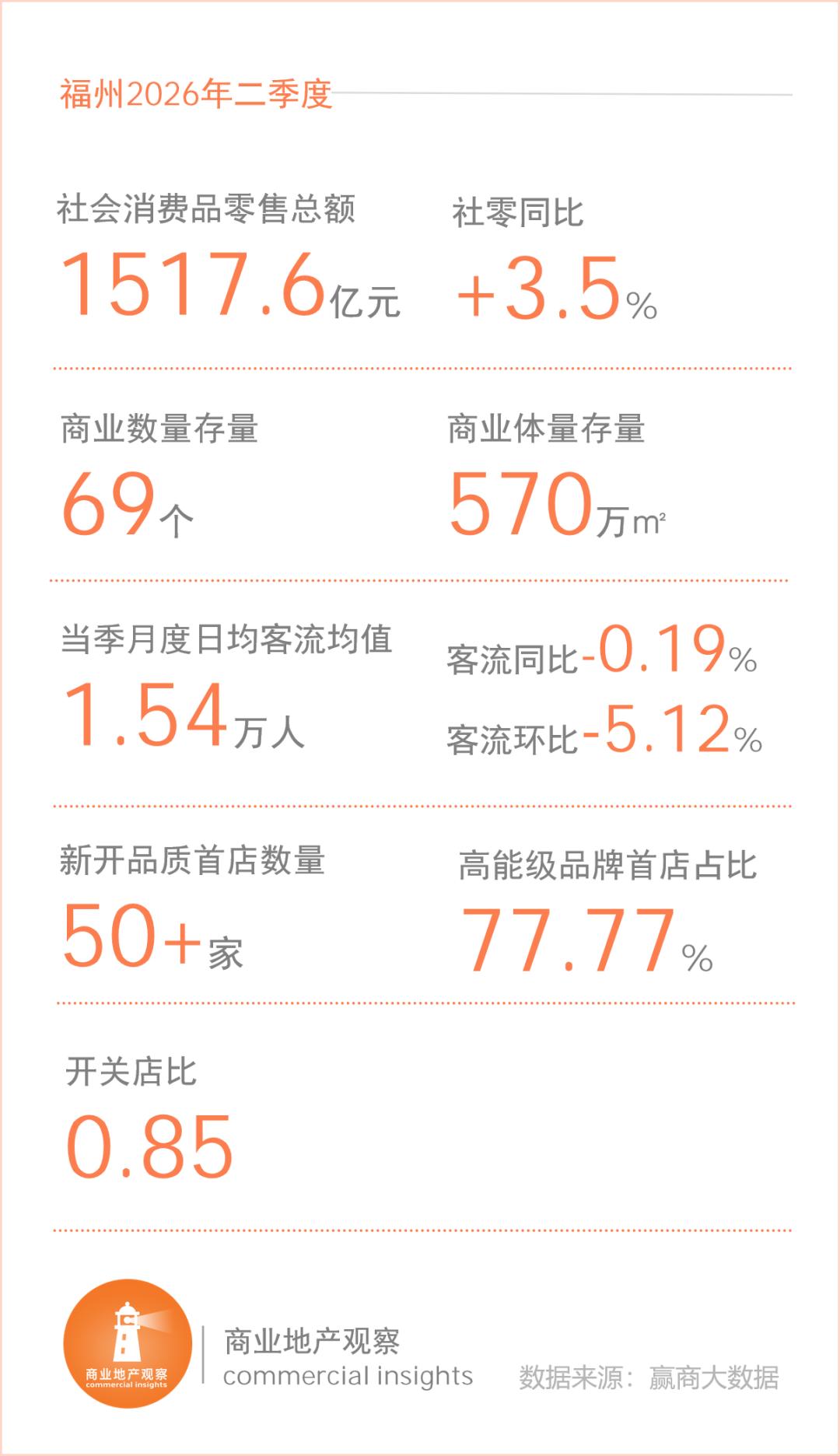
In the second quarter of 2026, the overall performance of Fuzhou's commercial market remained stable. The total retail sales of consumer goods increased by 3.5% year on year. In addition, several sets of data on the commercial side are worth noting: the commercial market still maintains zero new supply; the footfall of existing commercial facilities decreased by 5.12% month on month and dropped slightly by 0.19% year on year; the ratio of newly opened stores to closed stores continued to decline, and the store closure speed was higher than the store opening speed. On the whole, Fuzhou's commercial market is in a period of in-depth adjustment and will still face pressure in the short term.
Q2 Highlights>>>In Q2 2026, the total retail sales of consumer goods in Fuzhou saw a slight year-on-year increase; no new commercial projects were launched in this quarter; the average daily footfall of commercial facilities declined; the ratio of store openings to closures dropped; although the number of first stores showed a strong growth momentum, there was still an imbalance in the energy level structure of first stores.
01
Commercial Overview
In the second quarter, the total retail sales of consumer goods across Fuzhou reached 151.76 billion yuan, representing a 3.5% year-on-year increase. Compared with the 157.94 billion yuan driven by the peak Spring Festival consumption season in the first quarter, the figure in the second quarter fell slightly month on month, with no large gap. On the whole, the total retail sales of consumer goods of the whole city in the first half of the year accumulated to about 309.70 billion yuan, and the overall consumption market maintained stable operation.
In terms of the performance of stock/increment, Fuzhou's commercial market continued the "zero new supply" trend in the second quarter, with no new commercial projects entering the market. By the end of the second quarter, there were a total of 69 existing commercial projects across the city, with a total commercial GFA of 5.7024 million square meters. Against the background of zero incremental supply, Fuzhou's commercial market has fully entered the stock competition stage, where content innovation and in-depth operation of customer groups have become the main theme of industry development.
In terms of footfall performance, the overall footfall of commercial projects in Fuzhou faced certain downward pressure in the second quarter. The average monthly daily footfall in this quarter was 15,400 people, representing a slight year-on-year drop of 0.19% and a month-on-month decrease of 5.12%. This month-on-month decline was mainly due to the concentrated implementation of the Spring Festival long holiday and various consumption promotion policies in the first quarter, which led to the intensive release of consumer demand and pushed up the footfall base; while in the second quarter, although supported by small long holidays such as Qingming Festival and May Day, the explosiveness and sustainability of consumption were not as good as that of the Spring Festival, resulting in a natural correction of footfall.
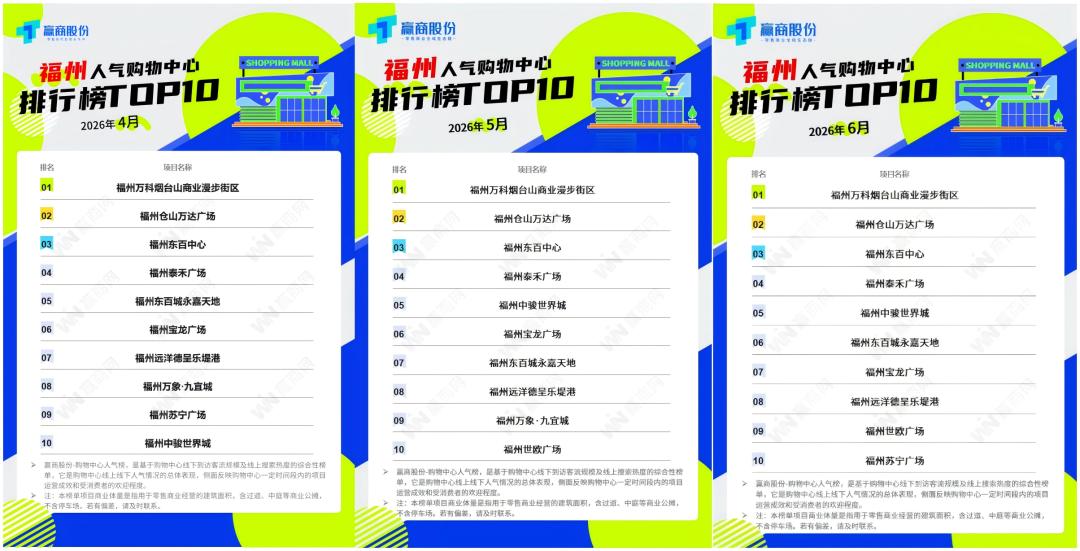
In the second quarter, the head effect of Fuzhou's commercial market was prominent, and the core commercial matrix showed extremely strong footfall attraction. According to the "Ranking of Popular Shopping Malls from April to June 2026" released by Winshang Co., Ltd., the four benchmark projects of Fuzhou Yantaishan Commercial Walking Block, Fuzhou Cangshan Wanda Plaza, Fuzhou Dongbai Center and Fuzhou Taihe Plaza performed particularly well, ranking firmly in the top of the popularity list of each month in the second quarter, which deservedly formed the "first echelon" of Fuzhou's commercial market.
At the same time, projects including Fuzhou Baolong Plaza, Fuzhou Yuanyang Dechen Ledi Port, Fuzhou Dongbaicheng Yongjia Tiandi, Fuzhou Zhongjun World City and other projects showed steady market competitiveness, ranking in the top 10 for three consecutive months. The overall popularity list presents an obvious echelon pattern of "stable head and robust waist".
02
Brand Store Openings and Closures
In the second quarter, Fuzhou's commercial market was under overall pressure, with the ratio of store openings to closures dropping to 0.85, further down from 0.98 in the first quarter, and the scale of brand store closures expanded to some extent.
By business type, the retail and child-parent formats saw the most significant contraction, with their store opening-to-closure ratios dropping sharply to 0.8 and 0.7 respectively from 1.15 and 1.33 in the first quarter, shifting from expansion to contraction.
The lifestyle service format also faced operational pressure, with its store opening-to-closure ratio falling to 0.75 from 1.0 in the first quarter, and the scale of closed stores exceeded that of newly opened ones.
The catering format performed relatively stably, with the store opening-to-closure ratio remaining at 0.95, the same as that in the first quarter, and the dynamic balance of supply and demand replacement was basically maintained.
Although the culture, sports and entertainment format was still in the contraction range, its store opening-to-closure ratio rebounded to 0.57 from 0.22 in the first quarter, and the downward pressure was eased, showing certain signs of bottoming out and stabilizing.
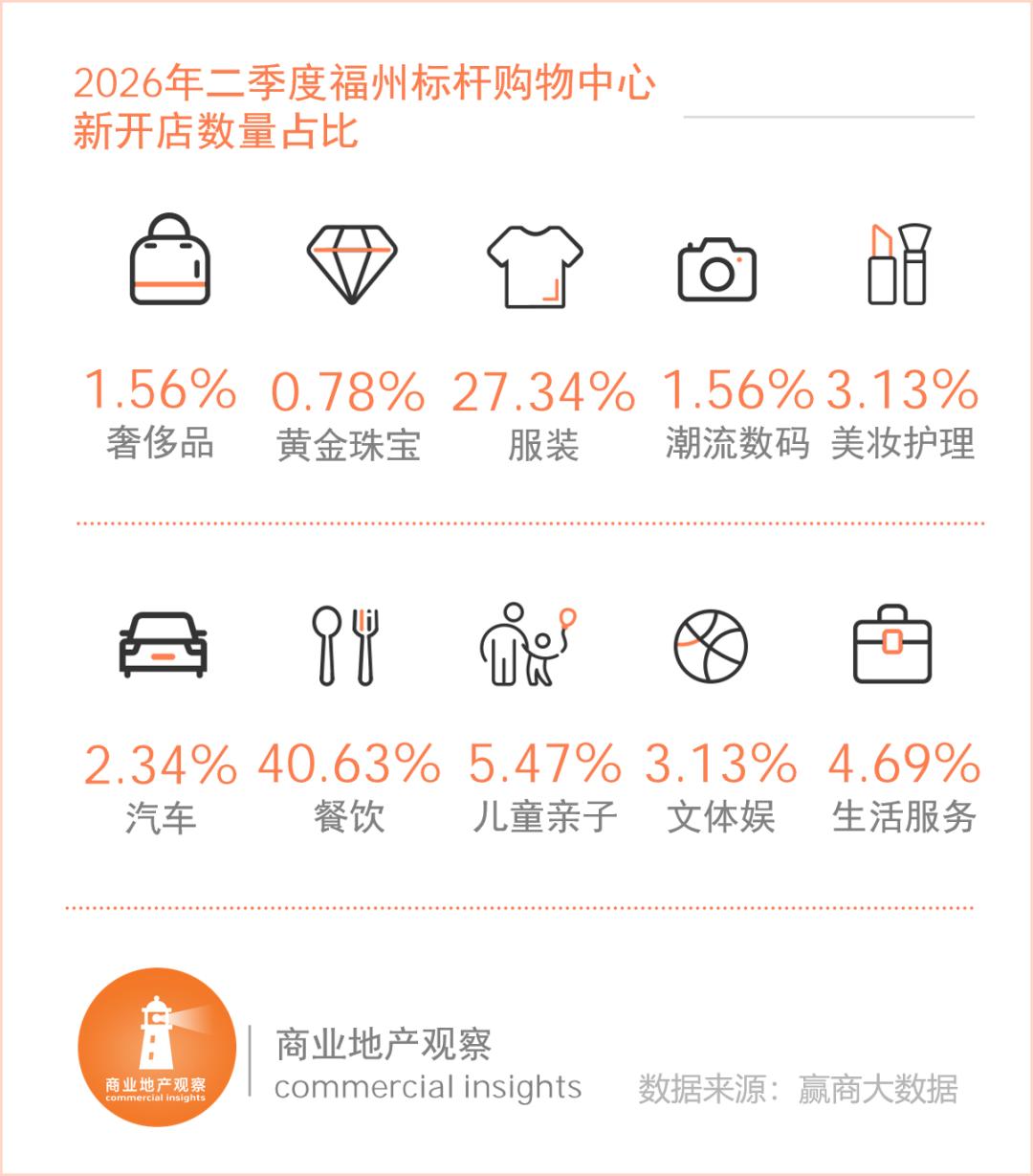
Among the newly opened stores in the second quarter of 2026, retail and catering accounted for 44.53% and 40.63% respectively, basically the same as those in the first quarter (45.45% and 40.40%). This indicates that in the current expansion and adjustment of physical commerce, retail and catering, as the two core main formats, still maintain a solid market position and balanced structure.
In terms of brand energy level, high-energy-level brands (brands of grade B and above, excluding ungraded brands, the same below) accounted for more than 77% of the newly opened stores in Fuzhou in the second quarter. Specifically, S-grade brands accounted for 3.51%, A-grade brands 29.82%, B-grade brands 43.86%, while C-grade and D-grade brands accounted for 21.05% and 1.75% respectively.
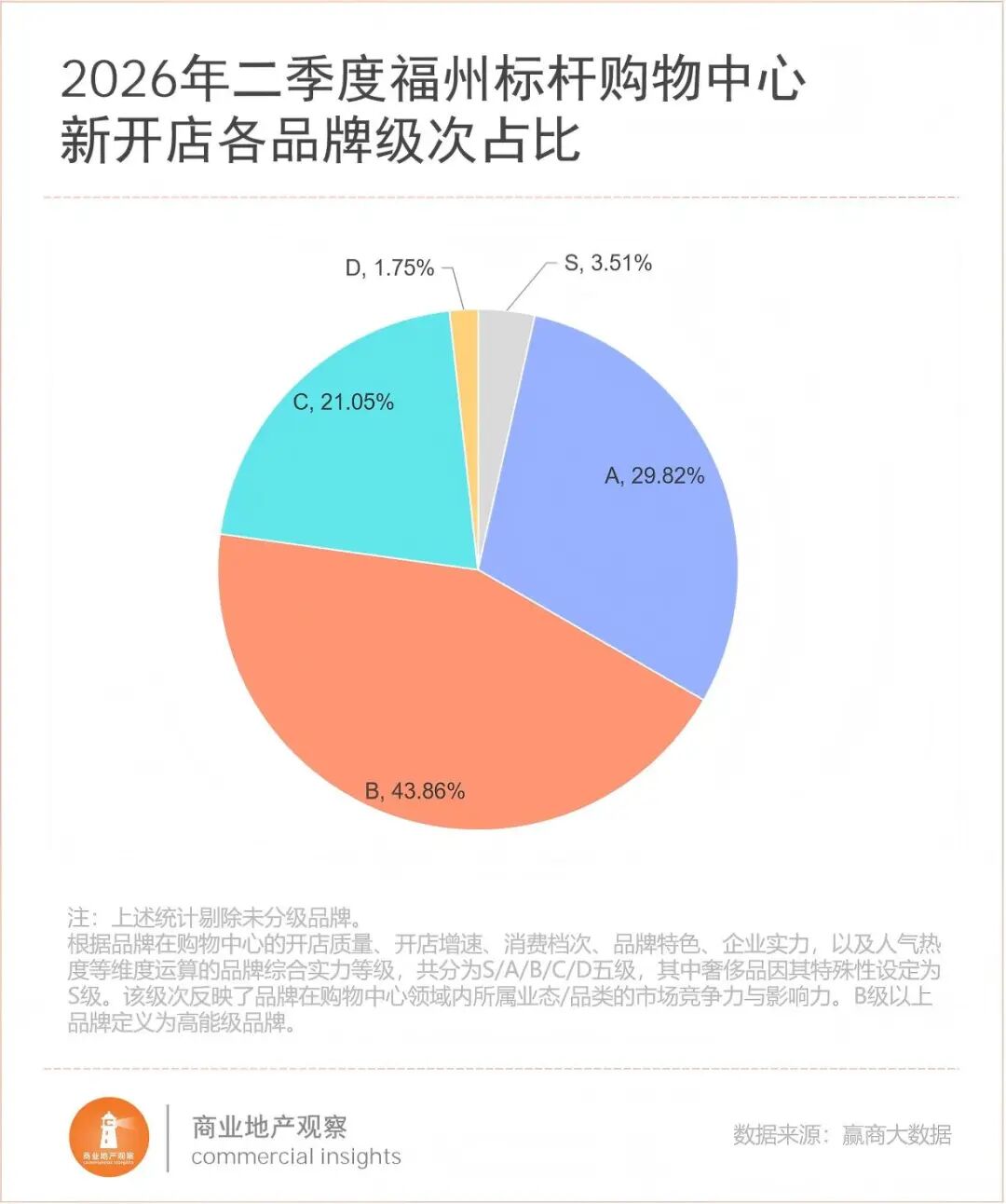
The nearly 80% proportion of brands above grade B not only reflects the strong siphon effect of core business districts on high-quality resources, but also proves that current stock commercial operation tends to introduce high-energy-level brands to stabilize customer groups and improve the overall brand tone.
03
First Store Map
In the second quarter, the first store economy in Fuzhou remained hot, with more than 50 high-quality first stores at municipal and provincial levels landing during the period; combined with more than 30 first stores in the first quarter, Fuzhou introduced a total of more than 80 high-quality first stores in the first half of the year, achieving a strong year-on-year growth of over 50%.
In terms of the level of first stores, among the high-quality first stores landed in Fuzhou in the second quarter, provincial first stores accounted for 39% and municipal first stores accounted for 61%, while national-level and regional-level first stores have not yet been covered.
In terms of format distribution, retail and catering accounted for 45% and 43% respectively, and the two formats still contributed the largest share of high-quality first stores. The child-parent format accounted for 8%, and the culture, sports & entertainment format and lifestyle service format each accounted for 2%. This indirectly reflects that there are opportunities for differentiated breakthrough in experience-oriented and service-oriented formats for subsequent commercial projects.
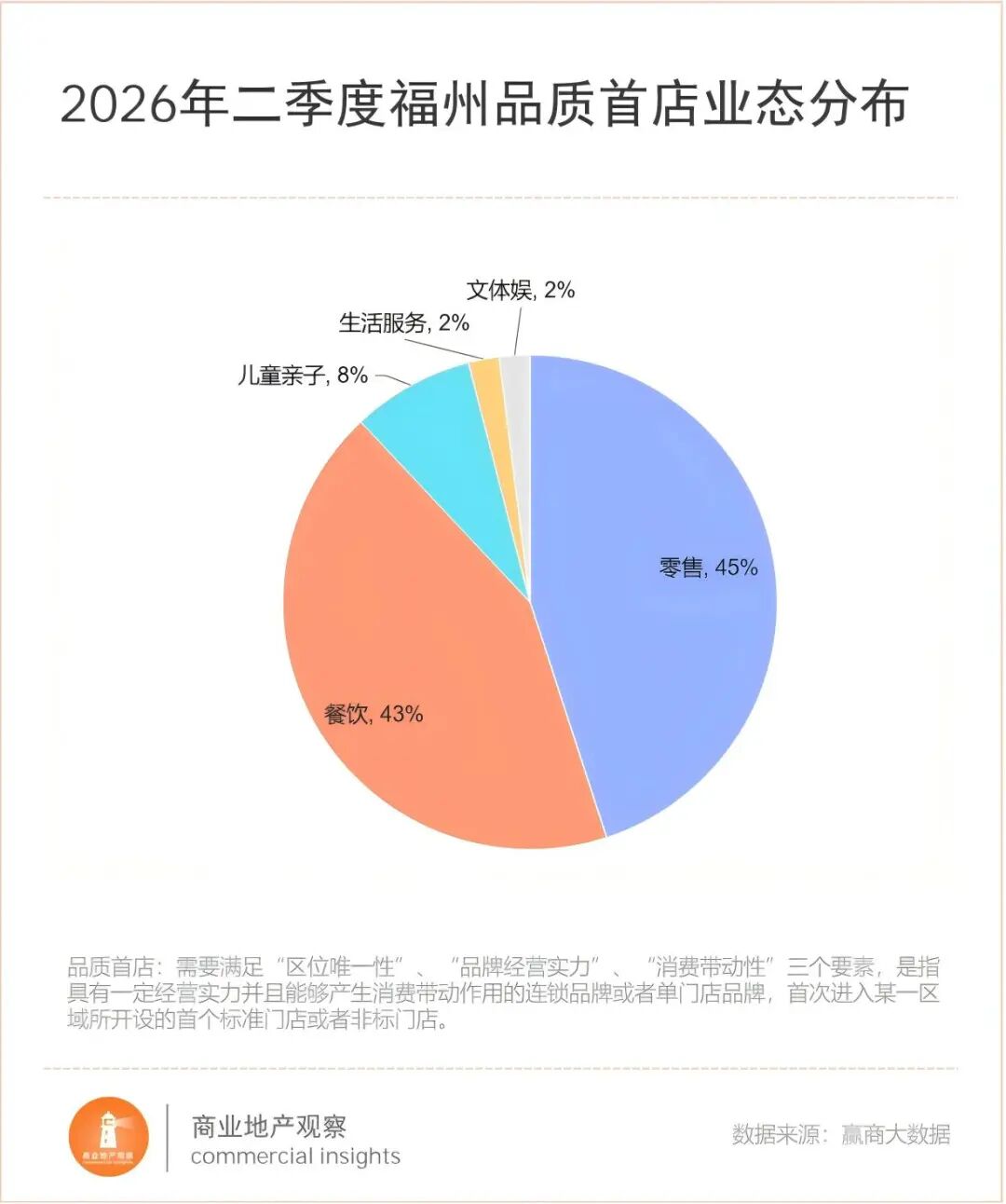
In terms of brand level, high-energy-level brands accounted for 77.77% of the high-quality first stores introduced in the second quarter, of which A-grade brands accounted for 44.44% and B-grade brands 33.33%, indicating that the "gold content" of Fuzhou's first store economy is improving.
04
Commercial Outlook
Facing the macro trend of slowing incremental supply, Fuzhou's commercial market still needs to make in-depth efforts in "improving the quality of stock" to explore solutions to break through the current situation. With the arrival of the traditional peak consumption season in the second half of the year, coupled with the brand adjustment and event promotion of major shopping malls around nodes such as anniversary celebrations, Fuzhou's commerce is expected to usher in a new round of consumption boom and vitality release.
In terms of format mix, the foundation of retail and catering is relatively solid, but there is still a gap in the experience economy. As the demand of young customer groups for "emotional value" and "local culture" continues to rise, major commercial complexes can use non-standard content such as curatorial exhibitions, markets, independent designer brands and social spaces to build new advantages of differentiated competition through differentiated supply.
In terms of first store economy, Fuzhou has achieved a significant increase in the number of high-quality first stores introduced, but to cross the energy level bottleneck of lacking regional first stores and national first stores, the investment attraction strategy urgently needs to shift from "wide net casting" to "precise targeting" — upgrading from providing space to building a business ecosystem to stimulate the first-choice willingness of brands; and formulating differentiated support standards in policy support to truly make high-level first stores "willing to come, able to stay and thrive".
The second half of Fuzhou's commercial development is still worth looking forward to.
First stores, first releases and original creations are deeply integrated with urban consumer life, forming an ecological closed loop that creates new supply, connects new brands and stimulates new consumption, and has become the core engine driving the continuous evolution of urban commerce. In October this year, Winshang will hold the "2026 Urban Consumption Ecology Conference & Retail Industry Innovation Development Forum" in Beijing, where three heavyweight reports including the "Annual First-release Economy Development Report" will be released on site. Please stay tuned.
This article is from the WeChat official account "Commercial Real Estate Watch", author: Zheng Xiaoqing, authorized by 36Kr for release.