QuestMobile 2026 Smartphone Market Research Report
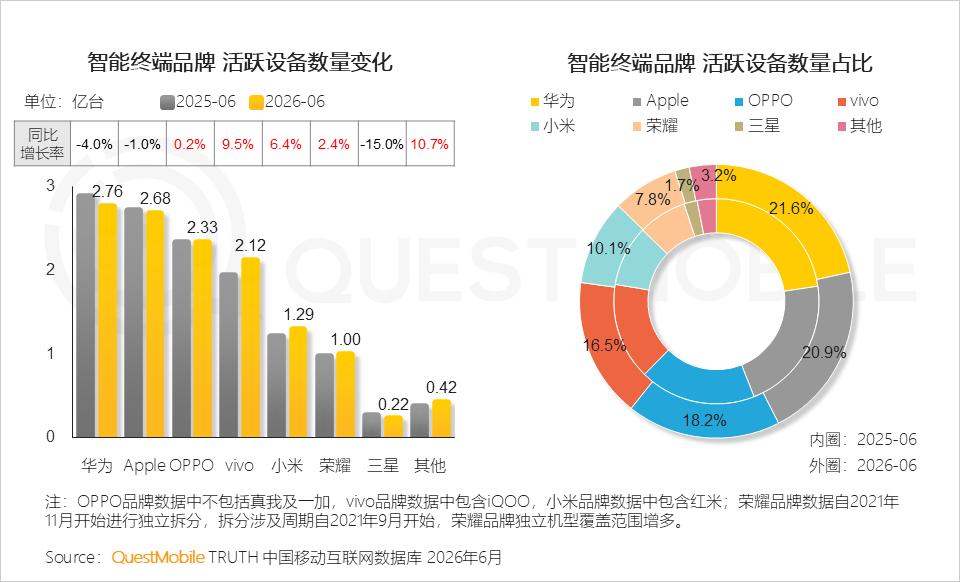
Today we are sharing the 2026 Smartphone Market Research Report. According to data from QuestMobile, as of June 2026, the monthly active device counts of Huawei, Apple, OPPO, vivo, Xiaomi and Honor are 276 million, 268 million, 233 million, 212 million, 129 million and 100 million respectively. Among them, the year-on-year growth rates of vivo and Xiaomi reach 9.5% and 6.4% respectively, while Huawei and Apple see a year-on-year decline of 4.0% and 1.0% respectively.
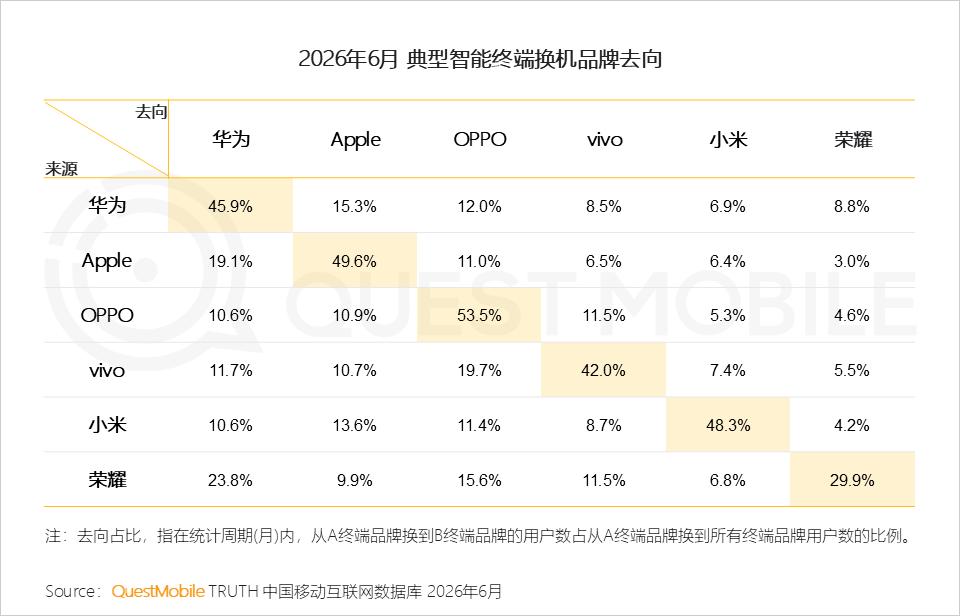
Behind this ebb and flow, on the one hand, the fierce competition in the stock market drives user flow between different brands. For example, the proportion of Honor users, vivo users and Xiaomi users switching to Huawei reaches 23.8%, 11.7% and 10.6% respectively; two-way high-end penetration and flow are formed between Huawei users and Apple users, with mutual device switching rates reaching 15.3% and 19.1% respectively.
These potential device-switching users are affected by multiple factors. For example, leading industries including comprehensive e-commerce, instant messaging and short videos form the "infrastructure" and traffic base for users to get to know mobile phones, with their monthly active user penetration rates all remaining above 95%; AIGC is becoming a new channel for users to recognize and evaluate mobile phones; while the second-hand transaction market supports users' demands for "differentiated mobile phone purchase" and "low-cost device switching".
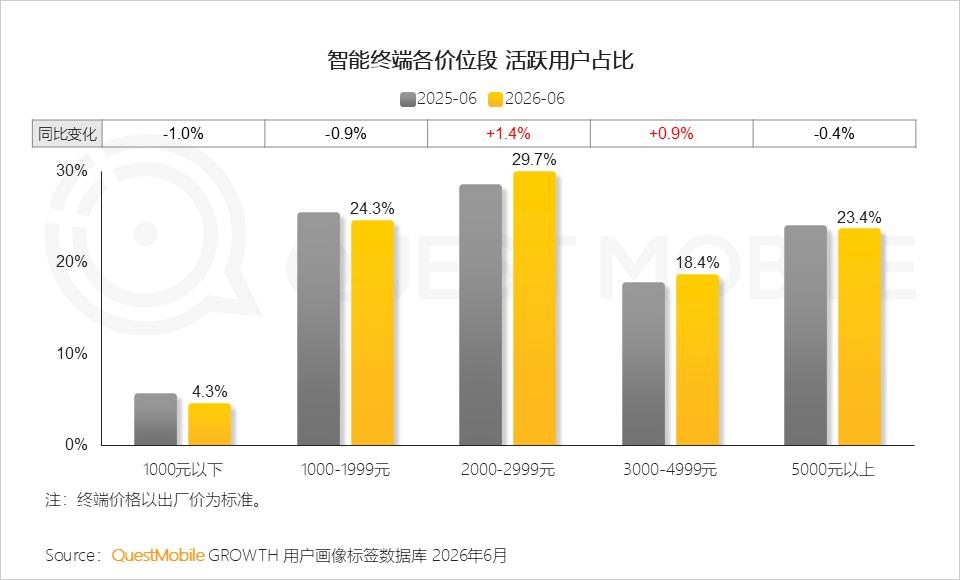
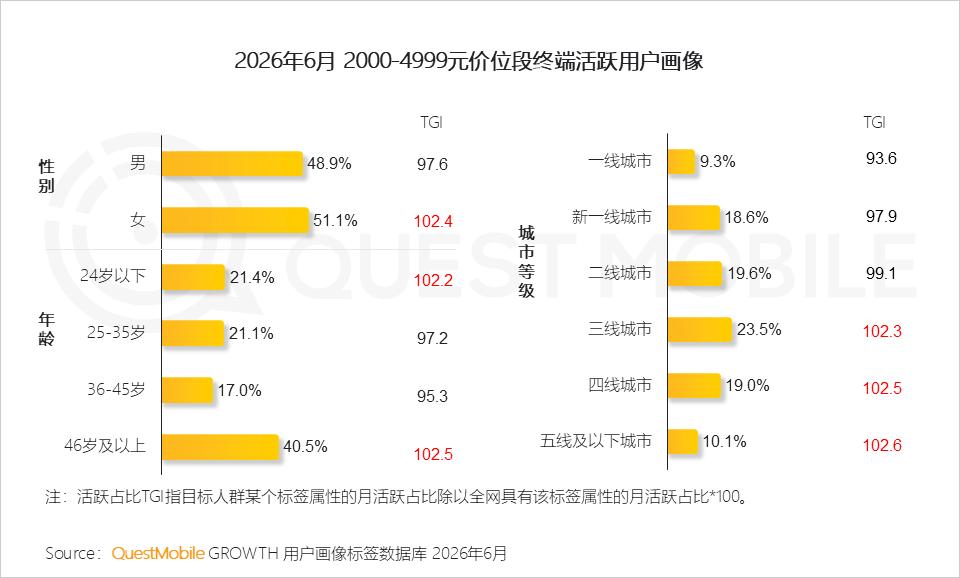
On the other hand, there is a matching relationship between differentiated user positioning and price ranges. For example, against the backdrop of decline in the low-end, mid-low-end and ultra-high-end segments, the active proportion of smart terminals in the 2000-yuan to 4999-yuan range reaches 48.1%, up 2.3% year on year, forming the resilience of the consumer market! Behind this, the driving force of the "national subsidy" policy cannot be underestimated, and the change in user age structure deserves more attention: users aged 46 and above in this price range account for 40.5%, and users from tier-3, tier-4, tier-5 and lower-tier cities account for 52.6%, who can be called the absolute main force.
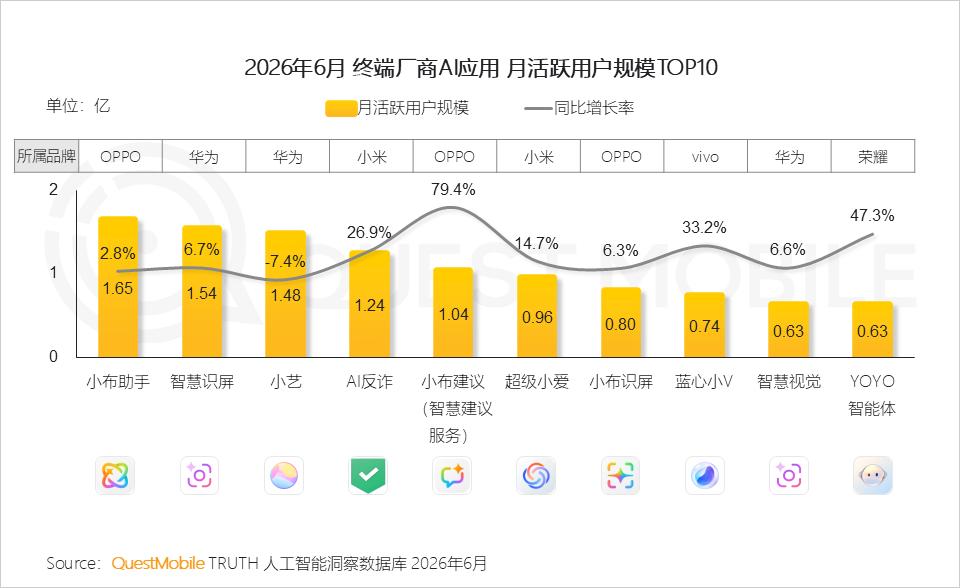
New changes have taken place in the AI field: end-side intelligence has become the entry point connecting users and the intelligent ecosystem. On the one hand, basically all mainstream mobile phone manufacturers have completed the filing of large models for end-side generative AI services; on the other hand, the monthly active user scale of core manufacturers' intelligent applications has exceeded 100 million, and some players even have two applications with over 100 million MAUs, such as OPPO (Xiaobu Assistant, Xiaobu Suggestion) and Huawei (Smart Screen Recognition, Xiaoyi).
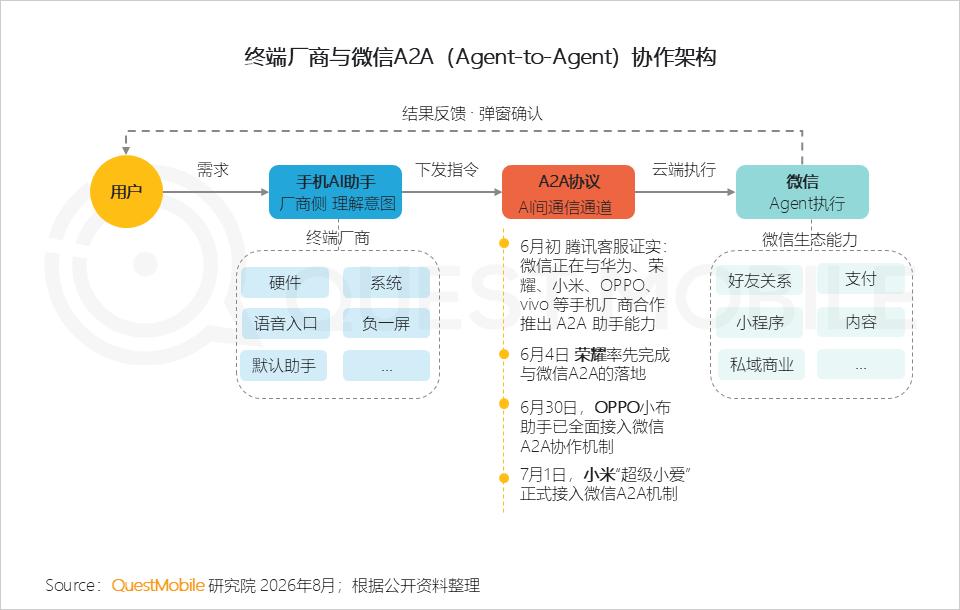
Under the A2A (Agent-to-Agent) protocol mechanism, the terminal AI of mobile phone manufacturers is breaking through the limitations of system tools, forming in-depth penetration and collaboration with super applications of internet manufacturers, previewing the "mobile application mode in the AI era". At the same time, the coopetition relationship between different large manufacturers and mobile phone manufacturers will completely change the future industrial ecosystem structure...
The 2026 smartphone market has entered the deep-water zone of refined operation in the stock market, and the growth logic has shifted from "national subsidy-driven device switching" to the multi-dimensional game of "technology iteration + ecosystem binding + precision marketing"; Huawei and Apple hold the high-end market, vivo and Xiaomi tackle the mid-tier market, while AI and Agent reshape the boundaries of products and marketing.
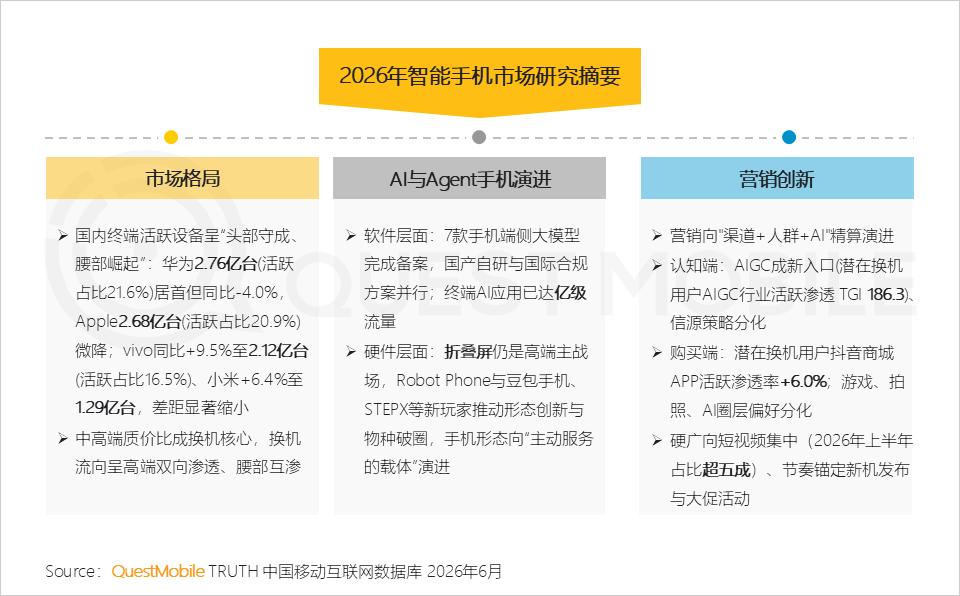
I. The smartphone market enters the period of refined stock operation, the market share of Huawei and Apple declines
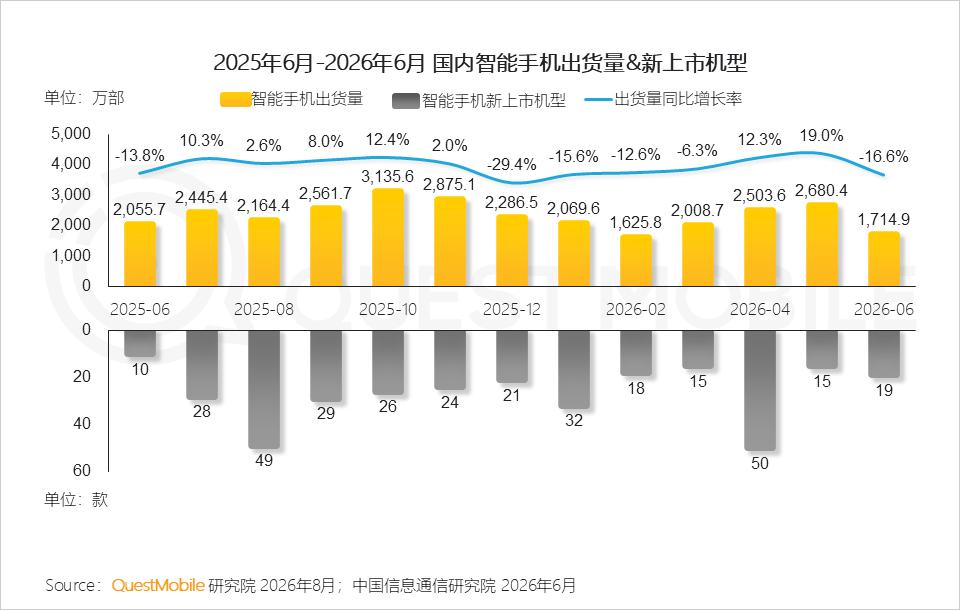
1. Affected by combined factors including component cost pressure and weak terminal consumption, China's domestic smartphone market in the first half of 2026 presents a drastic fluctuation trend of "low at first, then rising, then falling back", and the recovery foundation is not yet stable.
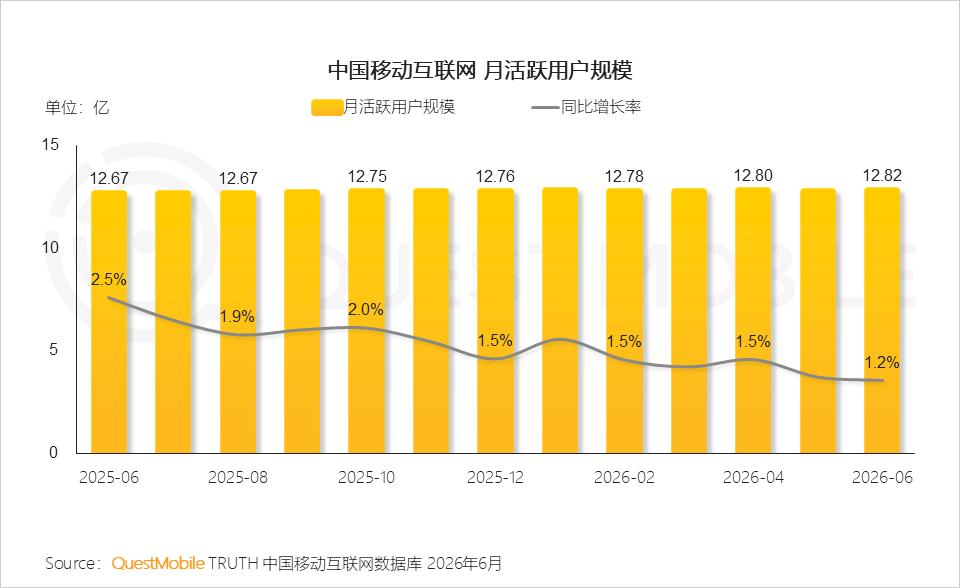
2. The total number of active mobile internet terminal devices has reached 1.282 billion, with the scale growth rate continuing to slow down. The market has fully entered a device replacement cycle dominated by stock renewal.
3. China's smart terminal active device market presents a trend of "leading brands maintaining their positions, mid-tier brands rising". Huawei and Apple still rank top two but their market share shrinks year on year, and vivo and Xiaomi become the main growth engines.
According to data from QuestMobile, as of June 2026, Huawei ranks first with 276 million units and a 21.6% market share, but its share drops 4.0% year on year; Apple follows closely with 268 million units and a 20.9% share, with a slight year-on-year decline of 1.0%; vivo delivers an outstanding performance, its active devices increase 9.5% year on year to 212 million units, and its share rises to 16.5%, significantly narrowing the gap with top-tier brands; Xiaomi grows by 6.4%, with its scale expanding to 129 million units and a 10.1% share, firmly securing its position in the top 5.
4. Under the combined influence of multiple factors including stock competition, rationalized consumption and national subsidy policy, the cost-performance ratio of mid-to-high-end products has become the core consideration for device switching.
According to data from QuestMobile, as of June 2026, the active proportion of smart terminals in the 2000-2999 yuan and 3000-4999 yuan price ranges increases by 1.4% and 0.9% respectively.
5. Mid-to-high-end models in the 2000-4999 yuan price range are the main choice for middle-aged and elderly users and users in sinking markets.
According to data from QuestMobile, the age preference of active terminal users in the 2000-4999 yuan price range presents an "M-shaped" feature: the TGI of young users under 24 years old and middle-aged and elderly users over 46 years old are both greater than 100. Meanwhile, users from tier-3 and lower-tier cities also show obvious preference for this price range.
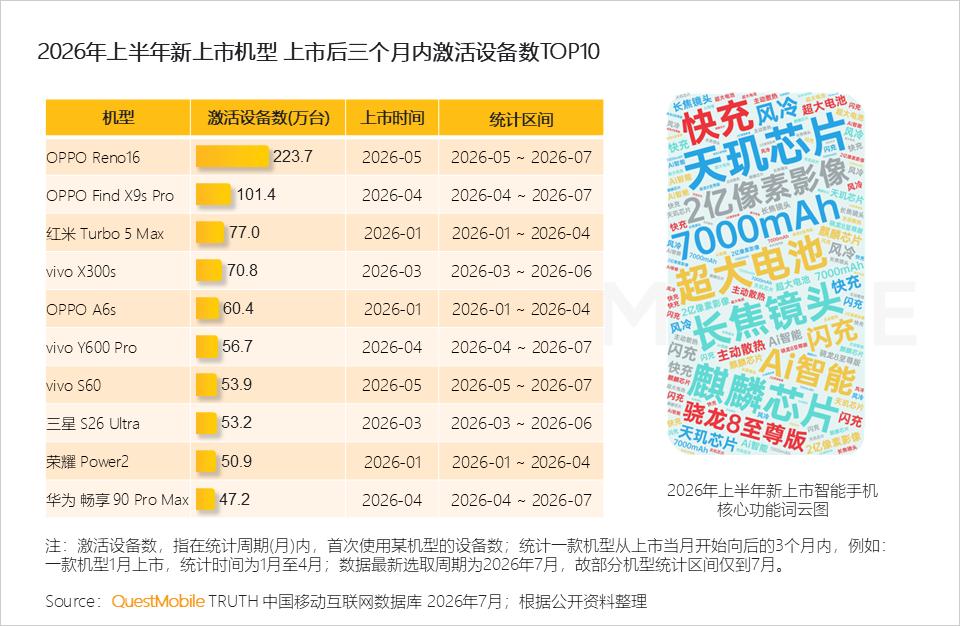
6. Among the new models launched in 2026, OPPO and vivo occupy the main market share with their strong product matrices. At the same time, product technology is iterating rapidly towards ultra-large capacity batteries, high-performance domestic chips and AI intelligence.
7. Competition in the stock market intensifies, and the brand moat differs significantly. Huawei and Apple form two-way high-end penetration, the retention rate of OPPO's own brand exceeds 50%, OPPO and vivo penetrate each other, Xiaomi's user loss mainly flows to Huawei and Apple, and the user flow rate from Honor to Huawei reaches 23.8%.
II. Dual-line evolution of AI layout: end-side capability implementation and hardware form innovation
1. End-side intelligence: AI evolves from capability to ecosystem
1.1 Domestic manufacturers focus on independent R&D of end-side technologies, while international brands leverage compliance to implement relevant services, marking that the AI competition of smartphones has shifted from simple competition of model parameters to all-round deep-water competition centered on independent controllability, end-side practical effect and compliant experience.
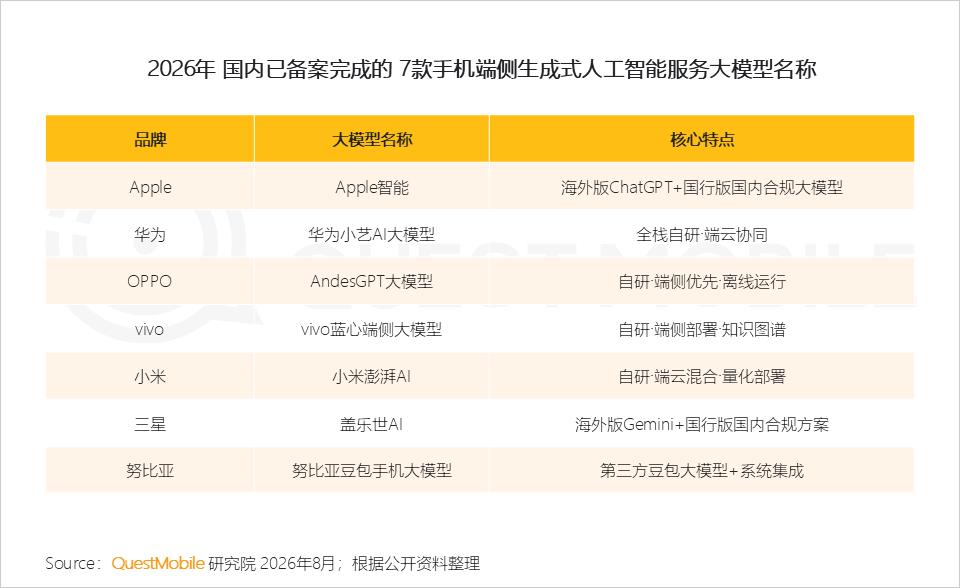
1.2 On the user service side, multiple AI applications from terminal manufacturers have achieved 100-million-level traffic, becoming important entry points connecting users and the intelligent ecosystem.
1.3 Through the A2A protocol mechanism, terminal AI assistants are breaking through the limitations of single system tools, carrying out in-depth penetration and collaboration inside super application ecosystems such as WeChat.
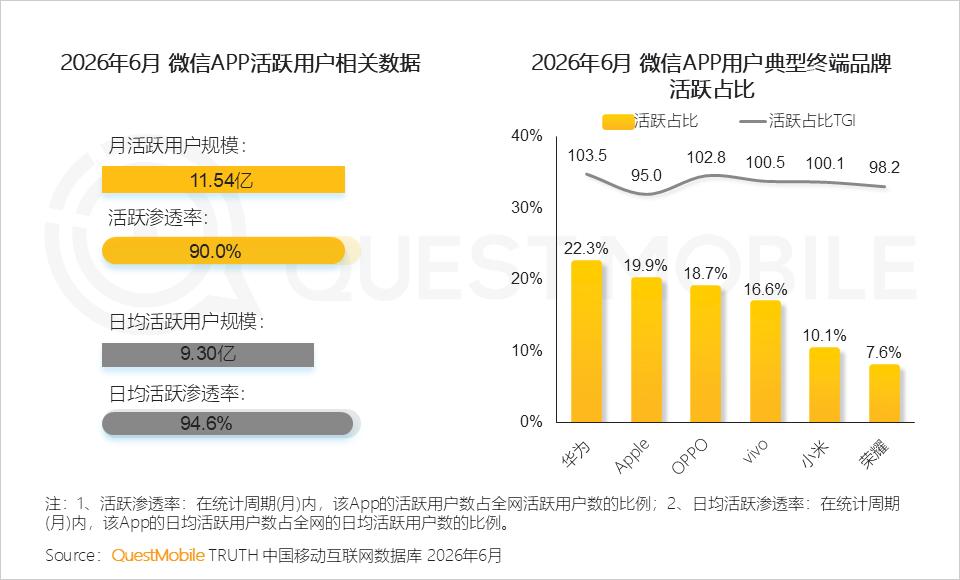
According to data from QuestMobile, as of June 2026, the monthly active user scale of WeChat APP reaches 1.154 billion, and its national active penetration rate hits 90.0%, consolidating its position as a national-level application. Among them, users of brands including Huawei and OPPO account for a high proportion of active users with TGI exceeding 100, highlighting the deep binding between terminals and WeChat ecosystem, which provides a core user base for the implementation of the A2A protocol.
2. Terminal form: foldable phones are popular, with form innovation and new species entering the market
2.1 The supply of new models shrinks, and the prices of models on sale generally rise. The mobile phone industry as a whole shifts from scale expansion to profit priority.
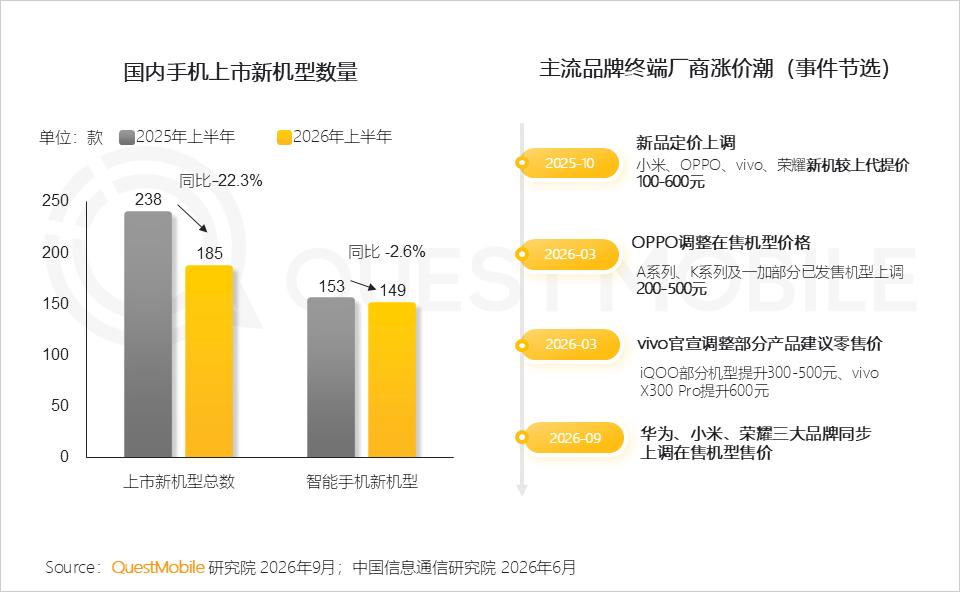
2.2 From the perspective of hardware form, foldable phones have become the core battlefield for the current smartphone market to compete in the high-end track.
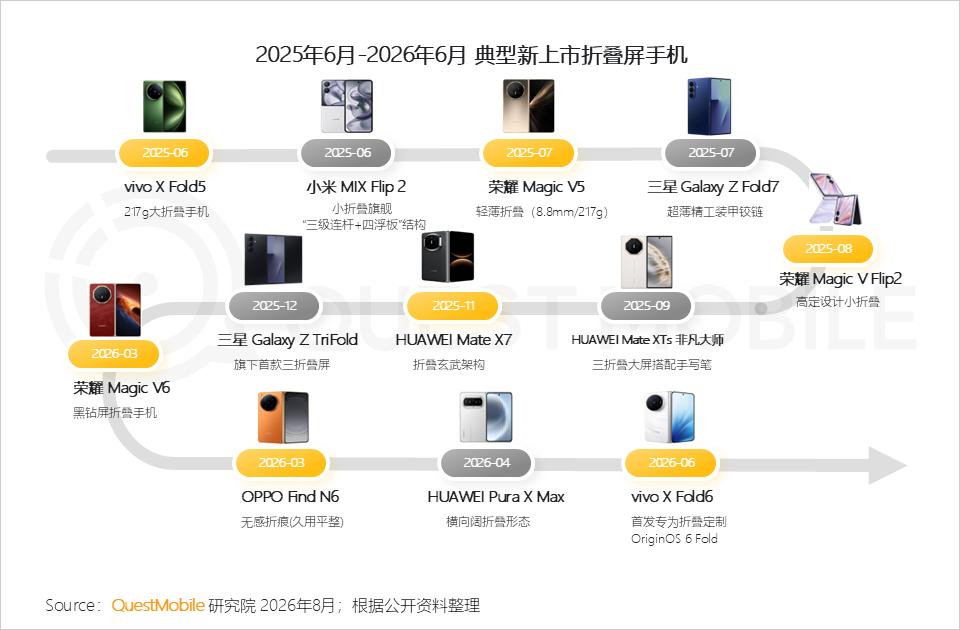
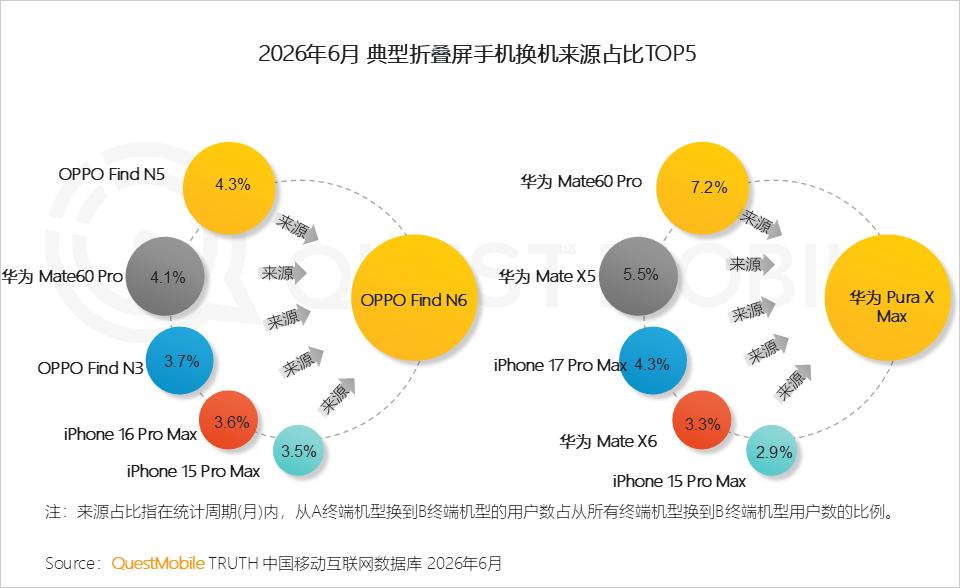
2.3 High-end bar flagship phones are becoming an important source of increment for foldable phones.
According to data from QuestMobile, in June 2026, among the device switching sources of OPPO Find N6, apart from the demand for self-brand model renewal, iPhone Pro Max series and Huawei Mate series both appear with high frequency. The device switching sources of Huawei Pura X Max are also mainly concentrated in Huawei Mate series and iPhone Pro Max series, reflecting that foldable phones are becoming the mainstream upgrade choice for high-end bar phone users.
2.4 Users' high penetration rate in the AIGC field lays a solid user base and market acceptance premise for Honor to launch innovative concept products such as Robot Phone.
