The era of free AI came to an end in the summer of 2026.
In the summer of 2026, changes in Beijing's office buildings are unfolding quietly. Previously, employees would open their computers and immediately launch Lark, DingTalk or WeCom, but now more and more people click on an AI icon first — asking it to write weekly reports, sort out meeting minutes, and generate a one-page PPT in one go. Behind this trend are four major tech giants making intensive moves within two months: in June, Doubao launched paid services, and in August, Qwen Work, Baidu Kuku AI, and ByteDance's Doubao Work were launched one after another.
The feature list looks bustling, but there is an unspoken cost that no one wants to explicitly mention behind it. Every call to AI is burning real money, and over the past two years, Chinese users have been conditioned by the "universal free" model to firmly believe one thing: AI should not charge fees. 2026 has become the year when these four products collectively face this arithmetic problem for the first time.
First, let's get a clear picture of the cards on the table. The table below is not a financial report, but the respective starting points, entry points of the four products, and how they plan to collect revenue —
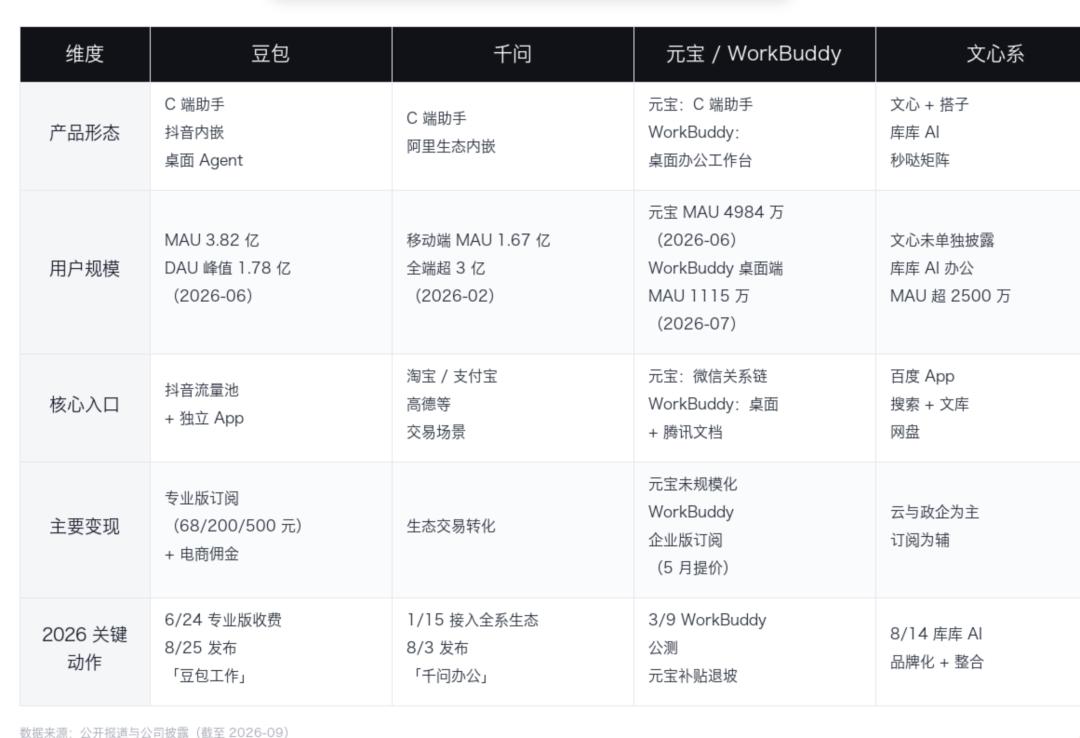
This table outlines four completely different commercialization paths: some rely on subscription tiering, some rely on transaction commission, some rely on embedding tools into workflows, and some rely on matrix coverage. Behind these paths are different solutions and confidence of each company for the difficult problem of "whether AI should charge fees".
Doubao: Scale is both armor and weakness
Doubao is one of the Chinese AI products with the most extreme scale. Data from QuestMobile shows that its monthly active users rose from 345 million in March to 382 million in June, a year-on-year increase of 172.1%, ranking 16th on the overall list of China's mobile Internet; On June 25, the day after the professional version subscription was launched, the daily active users hit a historical peak of 178 million, making it the only independent AI application in China with over 100 million daily active users at that time. In a Citi survey, Doubao's user penetration rate in domestic AI applications has reached 79%.
But scale is both armor and weakness. In March 2026, Doubao's average daily Token call volume reached 120 trillion, and exceeded 180 trillion in June, an increase of more than 1500 times compared with the initial launch in May 2024. For a free product, every increase in users means a thicker bill — the scale has not diluted the cost, but only magnified it.
On June 24, Doubao launched the professional version with three tiers of continuous monthly subscriptions at 68 yuan, 200 yuan, and 500 yuan. There was a considerable public backlash, and the users had reasonable grounds: before that, Doubao meant "free and sufficient for most people". The value anchor has been fixed by two years of universal free use, and the main Doubao product sells "stronger models and more usage times" — a comparable capability that users can also choose not to buy.
What really made ByteDance see a way out is another product line. The monthly revenue of the Seedance series of video generation models has exceeded 1 billion yuan, with a gross profit margin of about 70%. It does not sell capabilities, but deliverable finished products.
Doubao's answer was unveiled on August 25 — the launch of the Agent product "Doubao Work" for productivity scenarios. It has an independent desktop client, and also opens an entry in the Lark sidebar. It can write documents, make spreadsheets, generate PPT, and read Lark documents, meeting minutes and knowledge bases within the enterprise under authorized scope; The pricing adopts a dual-track system for individuals and enterprises. The personal version follows the three-tier pricing of the professional version, while the enterprise version is sold by seats and supports additional purchase of AI usage packages, with 30-day subscription rights given upon release.
To support this product, ByteDance completed a rare high-density organizational restructuring within one month: at the end of July, the Lark product team was merged into Doubao, the Lark GTM team was integrated into Volcano Engine, and on August 24, the TRAE and Coze teams were fully merged into the Doubao system.
Doubao has nearly 400 million monthly active users, but C-end users will not automatically become enterprise customers. Once entering enterprises, organizational relationships, permission security, and procurement chains are all waiting. The real test for Doubao Work is not functions, but translating "chatting habits" into "workflow dependence".
Qwen: Hide AI in a transaction
If Doubao is struggling with "how to get users to pay", Qwen never even asks this question — it makes AI a pre-link of transactions directly.
Qwen's explosive growth is rare in the history of Chinese AI. QuestMobile data shows that its mobile monthly active users increased from 166 million in March to 167 million in June, with a year-on-year increase of 5792.9%, jumping from fifth place in last December to second place. Alibaba's financial report reveals that as of February, the total monthly active users of Qwen across all terminals (App+Web+PC) has exceeded 300 million.
Its cold start was not built from scratch. On November 26, 2025, Qwen was deeply integrated with Quark AI browser, which has 110 million installations on the PC side. These existing users directly became Qwen's first wave of traffic.
The real turning point was on January 15: the Qwen App was fully connected to Alibaba's entire ecosystem including Taobao, Alipay, Taobao Flash Purchase, Fliggy, and AutoNavi. As a result, it assisted users to complete nearly 200 million orders during the Spring Festival, and nearly 130 million users experienced AI shopping for the first time through Qwen's agents.
The end point of most AI assistants is a text suggestion, and users still have to execute it by themselves; Qwen's end point is a completed order. Its revenue does not come from subscriptions, but from the transaction itself — there is no need to convince users to "pay for AI" at all.
On August 3, Qwen completed its office product layout: "QwenWork" was launched for public beta, integrated from three products QoderWork, MuleRun and Wukong, and connected to the new flagship Qwen3.8, with preliminary access to DingTalk IM; On August 18, it was connected to WeCom, thus completing full coverage of the three major collaborative platforms of DingTalk, Lark and WeCom. Its core selling point is called "organizational-level Skill" — after senior employees complete a complex task, they can precipitate the whole process into a skill with one click and share it with the whole team.
Qwen is the only one among the four products that does not need to answer "why users pay for AI", because it quietly shifts this problem to the existing transactions.
Yuanbao and WorkBuddy: Two paths for Tencent
This is the most worthy set of comparisons to analyze. In 2026, Tencent launched two AI products with completely opposite development directions at the same time.
The beginning of Yuanbao's story was very aggressive. During the Spring Festival, Tencent invested 1 billion yuan in red envelopes, trying to replicate the "WeChat Red Packet moment". The short-term data was extremely bright: Yuanbao's daily active users exceeded 50 million, monthly active users reached 114 million, the daily active users on New Year's Eve reached 45.04 million, the total number of lottery draws in the main venue exceeded 3.6 billion, and the number of AI tasks completed by users through the "Creation" column exceeded 1 billion.
But the tide receded faster than expected. QuestMobile shows that the monthly active users of Yuanbao's independent App dropped to 57.35 million in March, and further dropped to 49.84 million in June, failing to enter the 100 million user camp. Morgan Stanley's tracking data is more straightforward: after the Spring Festival, Yuanbao's average daily usage duration dropped by 32% compared with January, and the average daily usage after three weeks was only 6.5 minutes.
What does 6.5 minutes mean? It shows that Yuanbao has not been embedded in any daily workflow — users "remember to ask a question occasionally", not "open it as the first thing when going to work". The red envelopes only bought downloads and a one-time trial, not usage habits.
Tencent has a third product under grayscale testing on the C-end: WeChat native AI assistant "Xiaowei", based on the self-developed WeLM, which has been deployed in 16 high-frequency entrances including official account AI summary, Moments AI comment, AI writing assistant, and scan. But according to actual test feedback, it is still a "60-point assistant" at present — it basically has zero hallucinations when summarizing group chats and extracting information, and is sufficient for short-link tasks; once the instruction exceeds three steps, such as asking it to order a takeaway within 50 yuan, it will still get stuck.
WorkBuddy takes another path. It launched public beta on March 9, 2026, and by June, its PC-side visits reached 20.97 million times (Analysys Analysis), ranking first among similar domestic products, exceeding the sum of ByteDance's TRAE IDE domestic version (12.79 million times) in second place and Alibaba's QoderWork (7.88 million times) in third place. According to Citi's data, its cross-platform monthly active users exceeded 20 million, and daily active users exceeded 13 million; according to the July list of AI Product List · Desktop List, WorkBuddy's desktop monthly active users reached 11.1523 million, ranking first among AI office agents.
Why can it retain users? Three supporting points: take over local files, directly upload, read, organize and even modify local documents; output structured results, generate meeting minutes with directories, to-do spreadsheets, and complete review PPT with one sentence, and the deliverables are editable; have bounded permissions, with local access and permission control coexisting — which is the premise for it to enter government agencies and state-owned enterprises.
The technical side provides strong support. The official version of Hunyuan Hy3 was released in July. According to Tencent's disclosure, in real scenarios such as WorkBuddy and CodeBuddy, the Agent task success rate increased from 72% to 90%. This 18 percentage point increase directly translates into better user experience — users can feel that "it finishes the work more often".
What is interesting is its commercialization attitude: the enterprise version has raised prices in May, but the management clearly stated that "no commercialization KPI is set for the team, and it is still in the investment stage". Among the four products, it is the only one that does not monetize actively during the growth period.
Tencent verified the same thing with two products: the retention of AI comes from workflow embedding, not from subsidies. Yuanbao has 1 billion yuan in red envelopes and WeChat social connections, while WorkBuddy has no traffic support at all, but the latter wins.
Kuku AI, Baidu Dabazi and Miaoda: Baidu's three cards
Wenxin is the one with the most delicate situation among the four. It is one of the earliest invested basic large models, but its ranking has indeed dropped in this round of model competition. On August 18, at the financial report conference call, Robin Li clearly stated that he wants to make Wenxin large model "return to the first echelon of basic large models". Baidu has recently recruited Sun Tianxiang, a Fudan doctor born in 1997, to serve as the head of the Basic Model R&D Department (BMU).
But Baidu's real move is to build a matrix at the product layer, rather than focusing on a single point at the model layer.
After completing the integration of the AI office product line in August 2026, three products with clear positioning were formed: Baidu Dabazi, a professional office intelligent platform focusing on continuous processing of complex tasks, its MAU in July increased by 1063.79% month-on-month, ranking first in the growth rate list, with desktop MAU of 6.743 million; Kuku AI (GenFlow), for general office scenarios, focusing on "cross-device, cross-time" all-weather automation, its office MAU exceeds 25 million, and Baidu claims it ranks first in the AI office track; Miaoda, no-code application generation, which directly generates usable applications through natural language. According to Sullivan data, its market share is 33.4%, ranking first in the industry.
This is a route opposite to Tencent's: Tencent adopts single-product combat (WorkBuddy dominates the market alone), while Baidu adopts matrix coverage (three products cover office demands of different granularities). The advantage of the matrix is wide coverage and large total user volume, at the cost of scattered brands and high user cognitive cost.
A set of data best illustrates Baidu's product situation: in the second quarter of 2026, Baidu's core new AI business revenue was 12.5 billion yuan, accounting for 50% of general business revenue, but when broken down — intelligent cloud infrastructure was 7.3 billion yuan (year-on-year +50%, GPU cloud +283%), AI native marketing services were 2.6 billion yuan, and the real "AI application" revenue on the product side was only 2.5 billion yuan, with a year-on-year increase of only 3%.
In other words, the bulk of Baidu's AI revenue comes from selling computing power, not selling products. This is essentially the same problem as the other three companies, except that Baidu has shown it clearly in its financial report.
Baidu's other card is in government and enterprise sectors: self-developed Kunlun chip, Wenxin large model, and Paddle framework form a full-stack closed loop. Baidu discloses that currently 100% of systemically important banks and 80% of central SOEs choose Baidu Intelligent Cloud; according to statistics of intelligent hyperparameters, in the first half of 2026, the total winning bid amount related to large models of five major domestic AI cloud manufacturers was about 2.044 billion yuan, and Baidu Intelligent Cloud ranked first with 1.385 billion yuan, accounting for nearly 60%.
Desktops become the new battlefield
Arrange the actions of the four companies into the same timeline, and the context becomes clear: WorkBuddy public beta on March 9, Doubao professional version on June 24, Qwen Work on August 3, Kuku AI on August 14, Qwen Work accesses WeCom on August 18, Doubao Work on August 25. All four products have been launched, and the track pattern has taken shape. According to July data, the total monthly active users of domestic AI office desktop terminals is about 30 million, WorkBuddy (11.1523 million) and Baidu Dabazi (6.743 million) together account for about 60%, and according to the user scale estimation of traditional office software, AI office still has about 20 times room for growth.
Office is one of the few scenarios where AI can complete the closed loop independently. Chat, search, and content generation only "give suggestions", while office tasks have clear deliverables — a document, a spreadsheet, a PPT. The deliverables are verifiable, so the value can be priced. This logic has been proven in AI programming: code results can be automatically verified, users can immediately perceive efficiency improvement, and office scenarios are just its natural extension.
More critically, office entrances are migrating. In the past, employees opened documents, IM or email first. In the future, they may open the agent first, and the AI will call various tools. When the agent becomes the first stop after turning on the computer, DingTalk, Lark, and WeCom will retreat from the entrance to the background, and become capability modules called by AI. The transfer of entrance means redistribution of power, and no one wants to fall behind.
The first half of the year is about who has more users, and the second half is about who can finish the work. Hunyuan Hy3 increased WorkBuddy's task success rate from 72% to 90%, indicating that the new core indicator is "task success rate" — users do not care how large your model is, only care whether the work is done this time. This indicator will reshuffle the industry: the model competition is not over, it just moved from the front stage to the back stage. Only the company whose model is more stable in long-link tasks can get the real pricing power for its next-generation products.