Fully aware that the "burn-after-reading" feature has never gained much traction, why does Xiaohongshu insist on giving it a try?
Recently, Xiaohongshu has launched the internal test of a new feature: "Post Moments".
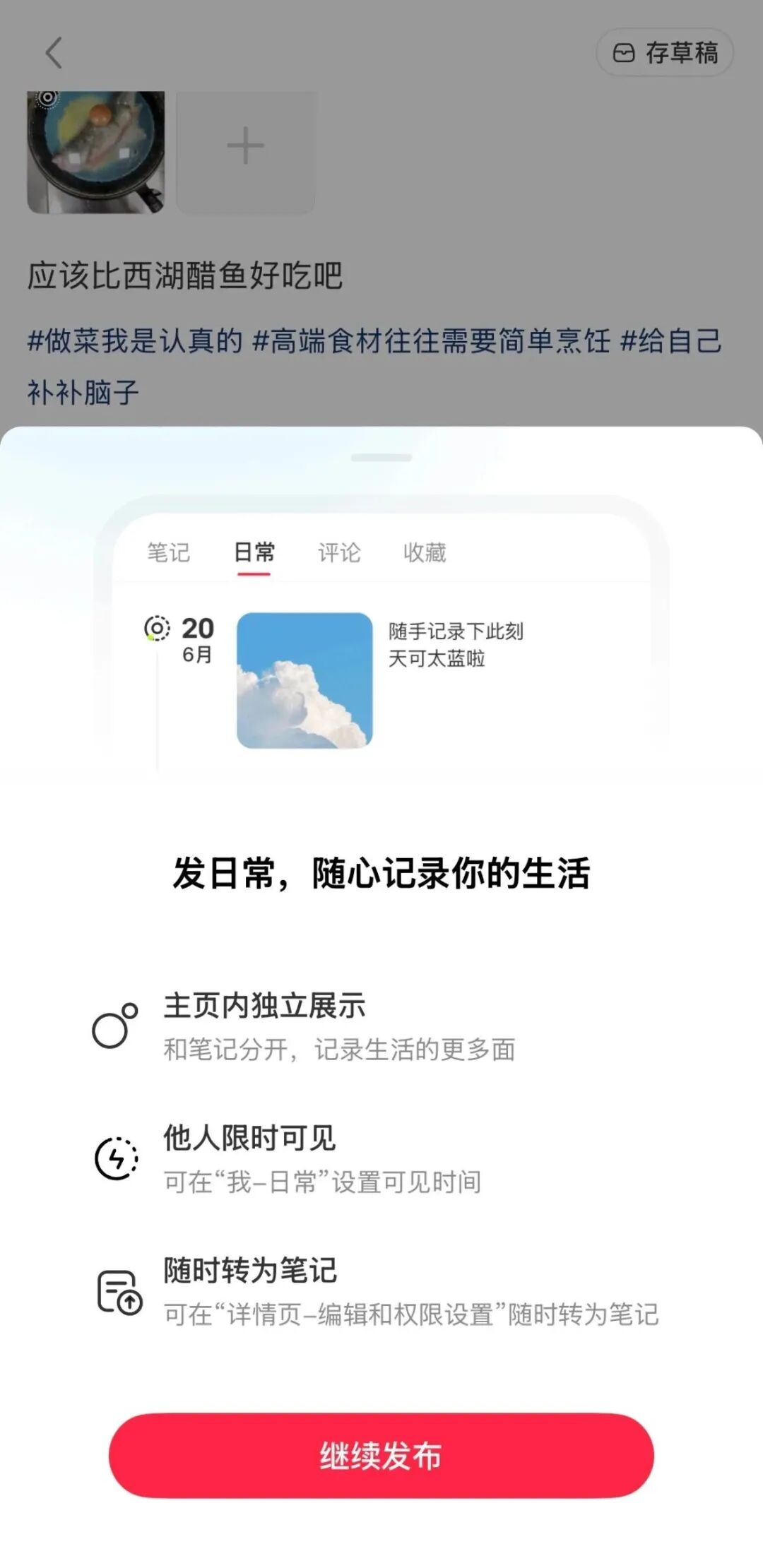
Users participating in the test will see two parallel options on the publishing page, "Post Notes" and "Post Moments". After selecting "Post Moments", the content supports permission settings such as "Visible for 3 days", "Visible only to followers" and custom groups. After publication, it will be independently displayed on the user's homepage for three days and automatically hidden when the period expires.
Xiaohongshu's official response stated: "The platform has recently launched the Post Moments feature, which is still in internal test, aiming to encourage more ordinary users to share their daily lives authentically."
From the perspective of product form, "Post Moments" is surprisingly similar to WeChat Moments, both supporting the 3-day visibility setting and the limited-time display rule. But there is a key difference after closer inspection: the "3-day visibility" of WeChat Moments is a time lock applied to the entire account, limiting how far back friends can view historical posts; while Xiaohongshu makes "Moments" an independent content type, each piece of content will be removed from display after three days, and retains the entry to convert it into a formal note at any time, thus forming an intermediate content state between "instant sharing" and "long-term notes".
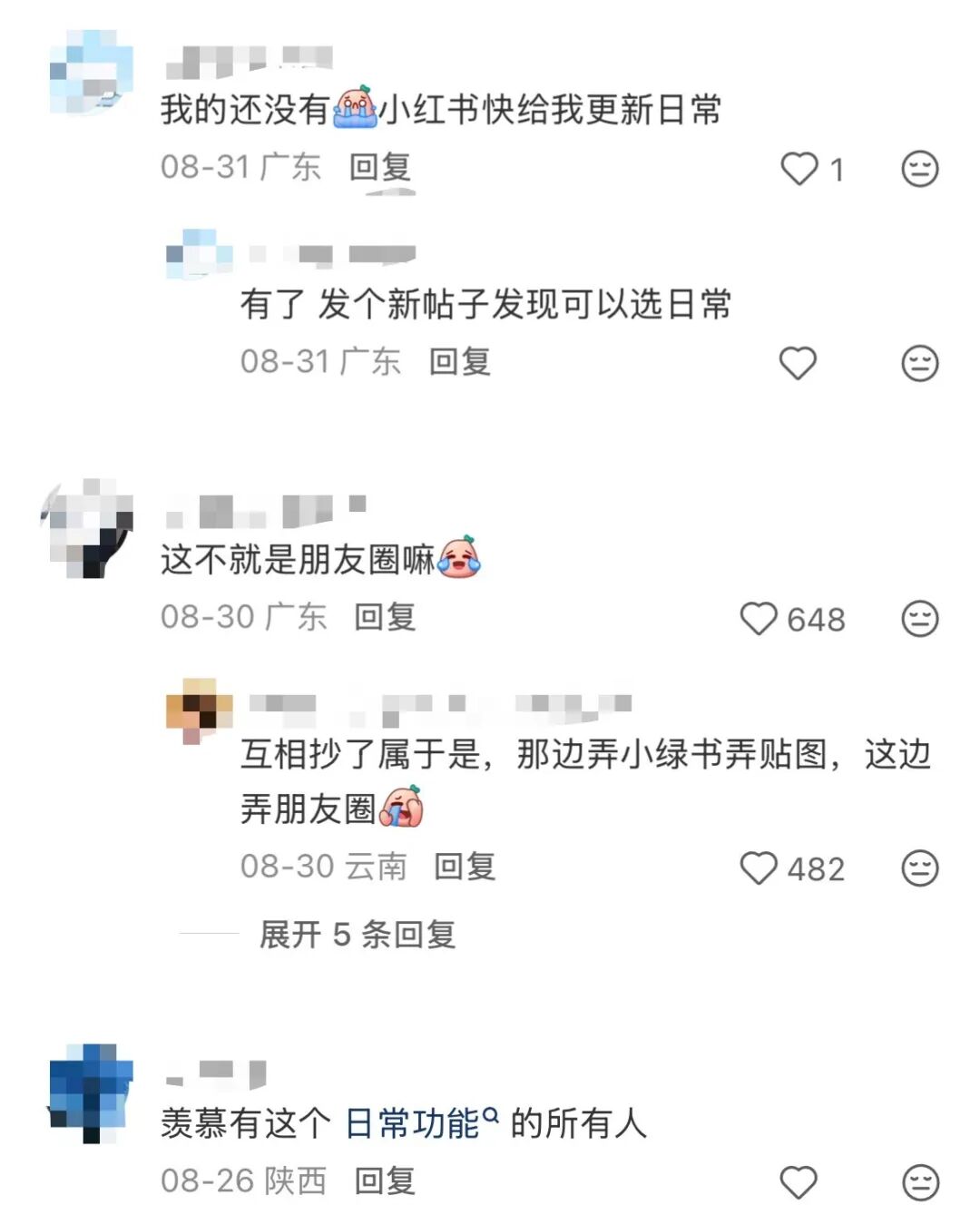
This reminds people of an old question: from Snapchat's "Snapchat" to Instagram's "Stories", from Douyin's "Moments" to Kuaishou's "Shuoshuo", such "disappearing after posting" features emerge in endlessly, but never become really popular. Since they never become a hit, why are platforms still scrambling to develop such features one after another?
01
The Era of Fading Willingness to Share
What Exactly Do Users Need?
Over the past year or more, major platforms have taken exceptionally frequent actions around "WeChat Moments-like" features.
Last October, Douyin carried out a major upgrade to the "Moments" module in its app, adding a more prominent creation entry, supporting users to post image-text or video content, and enabling limited-time display settings of 24 hours, 3 days and 7 days. At the same time, Douyin is also developing an independent social app named "Haihai". On the Kuaishou side, the "Shuoshuo" feature was re-launched in early 2025 after a short period of closure for debugging, with its positioning also focusing on sharing updates among acquaintances. Even Qzone has updated the interface of its "Shuoshuo" feature.
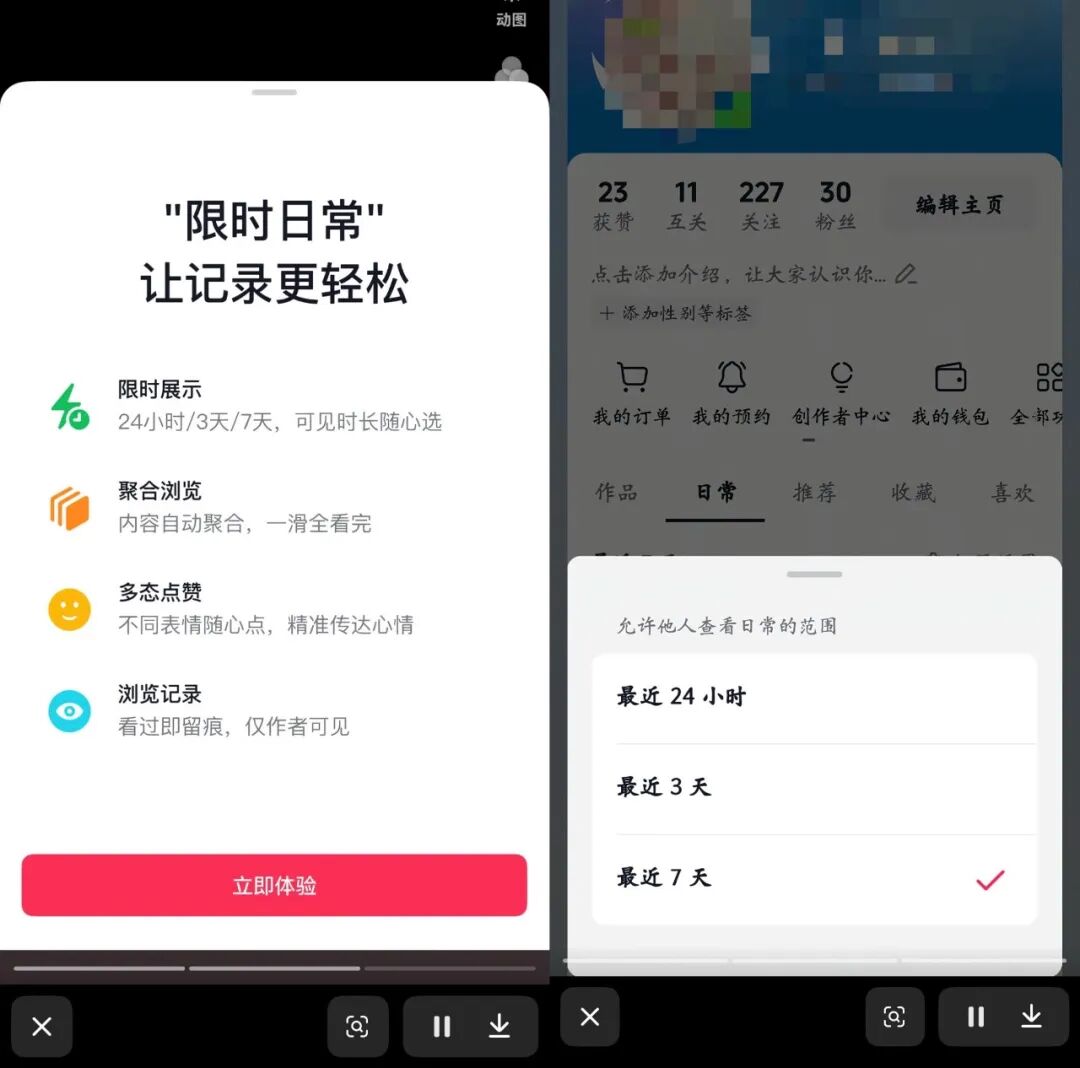
From short video platforms to established social products, from image-text communities to algorithm recommendation platforms, all parties are unanimously doing the same thing: providing users with a space to "post something casually and interact with acquaintances".
What this reflects behind the scene is the collective anxiety of the entire Internet industry about "social interaction".
Why? Because users' willingness to share is visibly disappearing.
This is not an exaggeration. As early as last year, various reports showed that nearly one third of social media users posted less content than a year ago, and this trend is even more obvious among Generation Z.
From the perspective of "Klue", the reasons why people are less willing to post are complicated, but the core can be summed up in several points:
Bloggers and brand accounts keep raising the "social standards" with highly polished content;
Algorithms make it increasingly difficult for ordinary users' content to be seen;
More essentially, in the online environment where content is easily screenshot and judged publicly, more and more people have clearly realized the cost of excessive exposure.
Simply put, sharing has changed from an instinctive behavior to something "stressful". Every time you post content, you have to consider whether it is polished enough, whether it will be embarrassing to be seen by acquaintances, whether it will be misinterpreted by strangers, and whether it will affect your image in others' minds.
This pressure is particularly prominent on platforms like Xiaohongshu. Xiaohongshu's user portraits are mostly from first- and second-tier cities, with a high proportion of female users, and its content puts more emphasis on experience, aesthetics and lifestyle recognition. A note needs a cover, title, body text, tags... The cost of publishing a piece of content is much higher than taking a casual photo and posting it on WeChat Moments.
The final result is that most people only browse but do not post. We cannot get the exact number of "silent users" among Xiaohongshu's 400 million monthly active users, but judging from the discussion density across the platform, the number will not be small.
02
Lower the Threshold to "One-tap Posting"
Retain the Social Connections
For platforms, users' reluctance to post is a fatal problem.
Xiaohongshu has more than 400 million monthly active users and 170 million daily active users, but the net increase of monthly active users in the past two years is less than 40 million. The user pool has hit the ceiling, and the increment brought by new user acquisition is getting smaller and smaller. For a community that relies on user content supply for development, its growth story can only be found in the stock of existing users. Among them, turning browsers into publishers is the lowest-cost path.
The "Post Moments" feature is exactly a tool that tries to remove these thresholds. The 3-day visibility setting can accommodate a casual photo taken on the commute, a takeout meal, or a random complaint; after posting, users do not need to worry that the content will stay on their homepage permanently and affect the style or positioning of their personal homepage.
Industry insiders' analysis of this internal test basically focuses on lowering the psychological threshold for posting, activating silent browsing users, increasing UGC supply, and making up for the shortboard of semi-private domain social interaction.
To put it more bluntly, the platform wants you to post more, even trivial content. The existence of "burn-after-reading" features allows users to say those trivial words, activating the vast majority of users who are "forced" to stay silent.
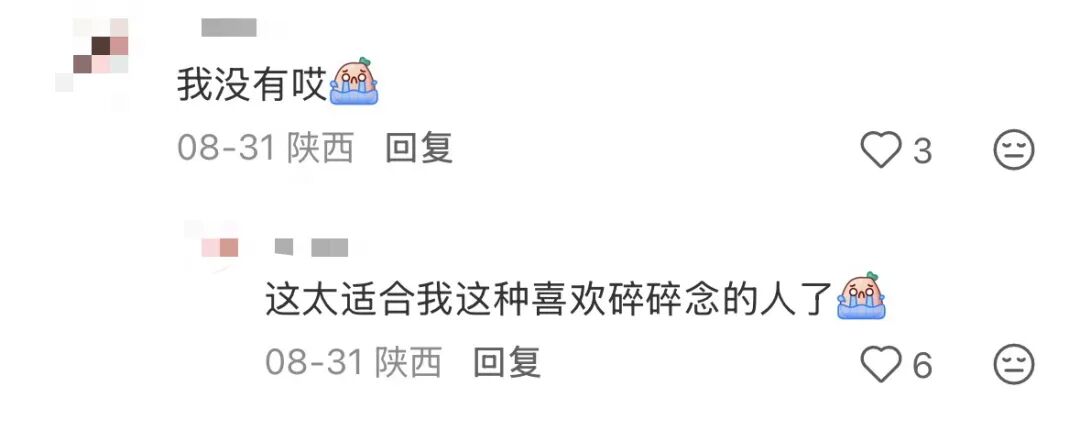
In fact, WeChat has provided indirect proof before: the "3-day visibility" feature of WeChat Moments has been used by more than 200 million people for a long time, which shows that users' demand for "controlling the visible range of their posts" is real and huge.
Xiaohongshu brings this set of control logic forward to the publishing stage, and makes it more detailed. For example, "Visible only to followers" leaves a private domain channel for bloggers; "Custom groups" leaves a space for users who share the same interests; "3-day visibility" is the last layer of guarantee for all users, so even if you post wrong content, it will not be archived permanently.
There is also an easily overlooked detail: the "Moments" content on Xiaohongshu can be converted into a formal note with one click. Users can post without any burden, and if a piece of content gets good responses, they can convert it to a formal note with one click without reposting. This gives the right back to users to "post casually first, and then decide whether the content is worth keeping".

But lowering the threshold is only the first level of consideration, and the second level is what the platform really wants: to retain social connections.
It will be clearer if we put the "Post Moments" feature into the sequence of Xiaohongshu's actions in the past two years: testing the "Nearby" feature at the beginning of the year, testing the "Chat" feature in the middle of the year, and testing the "Post Moments" feature in August. The three steps together form a path for the public domain content community to move towards semi-private domain social interaction.
What Xiaohongshu lacks has never been content, but connections. Content has boundaries, but connections do not. Once the connections between bloggers and fans, between users with the same interests, and between people nearby are precipitated, the commercial link from content recommendation to conversion relies on connection density rather than content density.
What the platform is really betting on is not the action of "burning" the content, but the probability of social connection precipitation behind the "burning" mechanism.
However, the establishment of this logic has a prerequisite: users really post their daily lives here, and their posts can get responses. But the "limited-time content" path has been full of hardships in the past ten years, so where does Xiaohongshu's confidence come from?
03
The "Burn-after-reading" Feature That Has Been Tried Repeatedly Despite Failures
Why Does Xiaohongshu Dare to Bet on It Again
Looking back at the products that tried to make breakthroughs in the "burn-after-reading" direction, almost all of them failed, but the reasons for their failures are different.
Laiwang was once Alibaba's most anticipated social product, and QQ Flash Photo was Tencent's key product. The two players with the strongest acquaintance social connection chains finally faded out of sight quietly. The problem does not lie in resources, but in scenarios — because in acquaintance social interaction, communication naturally requires the ability to retrieve historical records, and "burning" the content will only cause trouble for communication.
Public domain platforms such as Douyin, Kuaishou and Weibo have taken another detour. They rely on algorithm recommendation to drive content consumption, without the support of strong connection chains, and most users open the app just to browse the recommended feeds.
The only scenario where the "burning" mechanism works is pure stranger social interaction. Momo's "burn-after-reading" feature has the highest user acceptance, because it accurately meets the psychological burden of strangers when breaking the ice.
But Xiaohongshu is obviously not following this path.
Its connection chain is exactly in the blank area between "acquaintances" and "public domain", which does not have the strong social pressure of WeChat Moments, nor is it a pure public domain platform like Douyin where all content is matched by algorithms.
Users follow an account based on shared interests, aesthetics and content recognition, which is a kind of weak connection with strong interest attributes. It not only has the feedback expectation brought by the thin follow relationship, but also has no social burden of the acquaintance circle.
But this layer of relationship is not enough. Previous designs of "disappearing after limited time" such as Instagram Stories and Douyin Moments only solved the problem of "how to disappear". The content disappears, but the expression cost paid by users is also cleared, which is a huge waste for creators.
Xiaohongshu's "convertible to formal note" mechanism provides a channel for secondary precipitation of content. It makes "burning" no longer the end of the content, but the starting point of a formal note. This is a solution that none of its predecessors in history has ever provided.
But objectively speaking, it is still unknown whether Xiaohongshu's "interest-based connection chain" is strong enough to support the interactive feedback required by the "Moments" feature, and whether the "Post Moments" feature can finally operate successfully.
Then why is Xiaohongshu still willing to invest repeatedly in this direction that "predecessors have not made a success"? The answer is simpler than you think: it can afford the loss.
Compared with those independent apps in the early days that would shut down completely if their products failed, Xiaohongshu only needs to add a button on the publishing page to test the new feature. If it fails, it can just remove this entry. The so-called repeated attempts after repeated failures are not industry obsession after all, but the result of cost structure.
When a platform grows to a certain size and its trial and error cost is low enough, it is willing to keep betting on the possibility that "it might succeed".
04
Conclusion
Looking back, the "Post Moments" feature on the surface is another follow-up of Xiaohongshu to the classic product form of "burn-after-reading", but if we examine it in the context of Xiaohongshu's product evolution, we will find that its real significance goes far beyond that.
It is Xiaohongshu's active decompression of its own problem of over-heavy content. When the cost of publishing a note gets higher and higher and the psychological burden gets heavier and heavier, the platform needs to provide users with an expression space where "they do not need to put in too much effort".
Of course, the launch of the feature is just the beginning. Whether users are really willing to post their daily lives here and whether they can get enough responses after posting are the key to determining the final direction of this feature.
If a unique interactive atmosphere different from that of formal notes can be developed in the "Moments" section, what Xiaohongshu gains will be far more than just a new feature.
This article is from the WeChat official account "TopKlout Klue", author: 77, published with authorization from 36Kr.