Bottled water has lost its money-making superpower.
Selling bottled water was once considered a highly lucrative business. As a rigid-demand category with extremely high profit margins, many industry giants could easily reap huge profits with little effort. However, in the first half of 2026, the landscape changed drastically: major bottled water giants collectively fell into a growth predicament. C'estbon recorded a revenue loss of 410 million yuan in half a year, while Master Kong, Uni-President and Nongfu Spring also faced tough operating conditions. From the perspective of the overall industry market, both sales volume and revenue of packaged drinking water declined in the first half of the year.
01
Peak season fails to deliver expected performance, bottled water sees sluggish sales
In the FMCG sector, there was once a widely recognized "cash printing machine rule": selling water is a great business, as it falls into the rigid-demand category and boasts extremely high profit margins. After all, people can choose not to drink milk tea, but they cannot survive without water.
However, since 2026, packaged drinking water has seen sluggish sales, and industry giants can no longer make easy profits effortlessly.
With the release of semi-annual reports of several major beverage giants, Caijing World spotted this fact in their financial statements. As the largest segment in the beverage market, the packaged drinking water market has a sufficiently large scale, but it is losing its previous strong cash-generating capability.
Packaged drinking water is the core business of China Resources Beverage, accounting for 88.7% of its total revenue in the first half of 2026. The packaged water products of China Resources Beverage are mainly under the "C'estbon" brand, along with other brands including "C'estbon Dew", "Benyou" and "Jialinshan". C'estbon is also the leading player in the purified water market. Now, C'estbon's dominant position in the purified water market has begun to shake.
In the first half of 2026, the packaged drinking water products of China Resources Beverage generated a revenue of 4.838 billion yuan, about 410 million yuan less than the same period of the previous year, down 7.86% year on year. The company stated in its financial report that the sales volume of its products has declined.
C'estbon is indeed facing sluggish sales. Broken down by product categories, the revenue of its small-specification bottled water products (with a capacity of no more than 1 liter) reached 2.878 billion yuan, down by about 10%; the revenue of medium and large-specification bottled water products (with a capacity between 1 liter and 15 liters) hit 1.73 billion yuan, down 5.4%; the revenue of barreled water products (with a capacity of 18.9 liters) stood at 230 million yuan, remaining flat with the same period of the previous year.
With the decline of its core segment, C'estbon is getting anxious and announced that it will launch aggressive expansion. "At present, the market is in the stage of stock competition, and taking offensive actions is our only choice," Gao Li, Chairman of China Resources Beverage, stated recently at the performance meeting.
Another major packaged water giant Master Kong also sees its packaged water segment shrinking.
Master Kong's packaged water products mainly include purified water, Hot Water, alkaline water and other categories. In the first half of 2026, the revenue of Master Kong's packaged water segment dropped 4.9% year on year to 2.259 billion yuan.
As the leading player in the "cooked water" niche market, Master Kong launched the differentiated product "Hot Water" in 2020, which expanded its market size, but now this product is also facing sluggish sales.
Even Uni-President, which has a relatively small market share in the packaged water market, is encountering sales stagnation. In the first half of 2026, the revenue of Uni-President's segments including packaged water and coffee reached 496 million yuan, down 1.1% year on year.
▲ Image source / Caijing World
As the leading player in the packaged drinking water market, Nongfu Spring has a wide product layout, with product lines covering natural water, purified water, mineral water and other categories. In the first half of 2026, Nongfu Spring's drinking water business generated a revenue of 9.641 billion yuan, with a year-on-year growth of only 2.1%.
Although this segment is in the recovery stage, its revenue scale has not returned to the peak level yet, and its growth rate is far lower than the 10.7% recorded in the same period of the previous year.
2023 was the peak of Nongfu Spring's drinking water business: the revenue of this segment exceeded 10 billion yuan in the first half of the year, reaching 10.442 billion yuan, accounting for 51% of Nongfu Spring's total revenue and being its largest core business; its full-year revenue hit 20.262 billion yuan, up nearly 11% year on year, accounting for 47.5% of the total revenue, far exceeding the 29.7% proportion of the tea beverage segment.
In 2024, Nongfu Spring's packaged water business shrank amid public opinions, with a decline of 21.3%, generating a revenue of 15.952 billion yuan, 4.31 billion yuan less than that in 2023, and its revenue proportion even dropped to 37.2%. On the contrary, led by the Oriental Leaf product line, the tea beverage segment surged by more than 32%, with its revenue proportion rising to 39%, instantly becoming the largest core business of Nongfu Spring.
Since then, Nongfu Spring has shifted its business focus, and the top driving force supporting the company's performance is no longer its drinking water business.
In 2025, although Nongfu Spring's drinking water business resumed growth, with revenue rising 17.3% to 18.709 billion yuan, it still failed to reach the 2023 level, and was further outpaced by the tea beverage segment. The gap in their revenue proportion widened from 1.8 percentage points in the previous year to 5.5 percentage points. In the first half of 2026, its drinking water business only saw a slight increase, which is almost equivalent to stagnation.
As non-listed companies, packaged water giants including Ganten and Wahaha have not disclosed their semi-annual sales data. However, they are also likely facing tough operating conditions, as all industry players are engaged in fierce head-to-head competition, and the overall industry market is declining.
Data from Nielsen, a renowned market research and data analysis firm, shows that from January to June 2026, the sales volume of China's packaged drinking water market dropped 4.9% year on year, and the sales revenue fell 7.3% year on year, with both sales volume and revenue declining simultaneously.
02
Losing pricing power amid the price war
Packaged water sees sluggish sales, does that mean people stop drinking water?
The answer is obviously no. Many analysts attribute the decline of packaged water sales to weather conditions, which is far too simplistic. The core reason lies in the systematic change of consumers' demand structure: the pursuit of health, diversified usage scenarios and cost-effectiveness jointly restrict consumers' purchasing decisions. Meanwhile, the ongoing price war has made market competition increasingly fierce.
First of all, amid the continuous price war, homogenized competition has intensified, and the original price band of packaged water has been broken through.
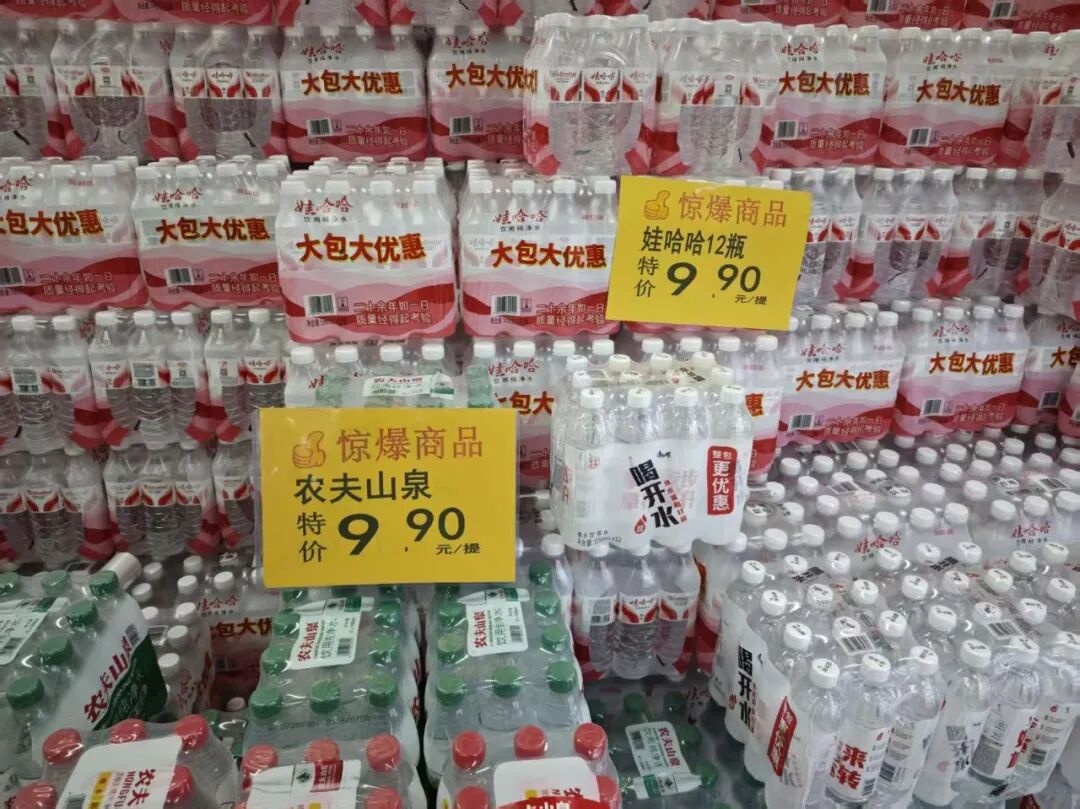
In 2024, affected by public controversies, Zhong Shanshan, founder of Nongfu Spring, launched the green-packaged Nongfu Spring purified water in a fit of anger to expand the product line, and quickly promoted it to the market. This product has very strong promotion efforts in the terminal market, with the selling price of a whole case being only 8.9 yuan in some terminal channels, equivalent to 0.74 yuan per bottle, directly squeezing the profit space of competing products at the price end.
Up to now, the green-packaged purified water of Nongfu Spring is still sold at a low price, which can be seen everywhere in supermarkets of all sizes. However, it has triggered internal competition with Nongfu Spring's high-priced core product, the red-packaged natural water. At the same time, giants including Wahaha, C'estbon and Master Kong were also passively involved in a new round of endless price war.
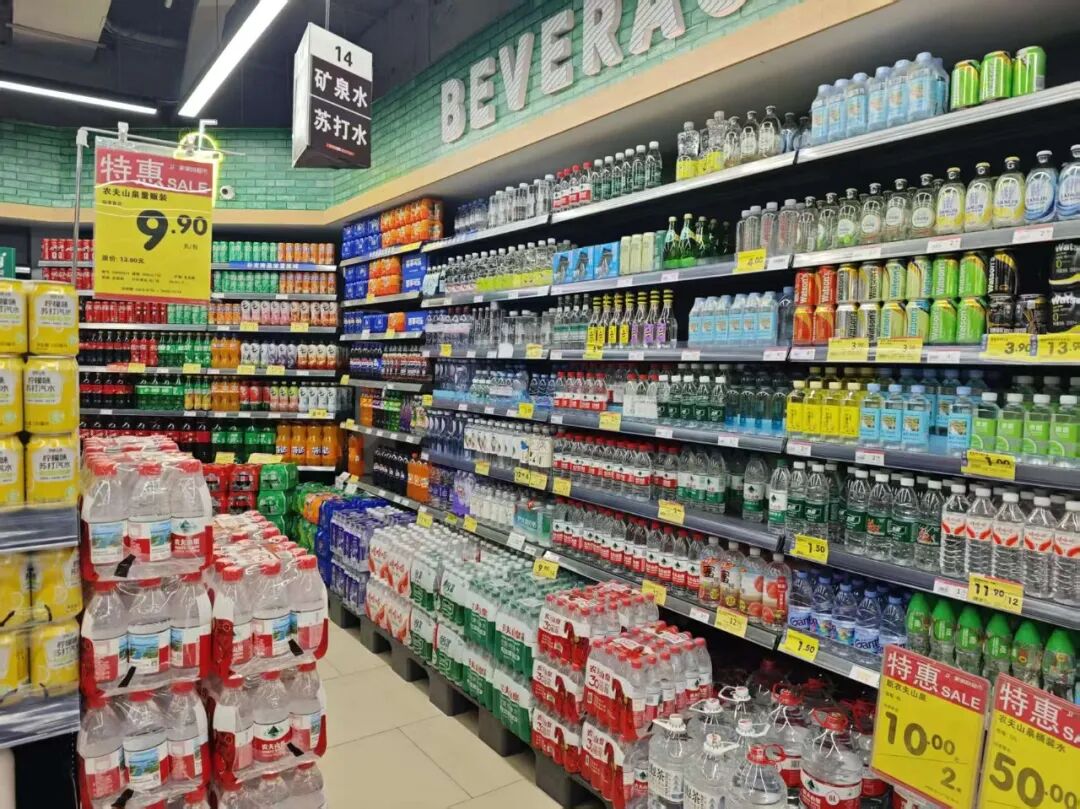
Common small-packaged core products of packaged drinking water in the market, such as Nongfu Spring, C'estbon, Wahaha and Hot Water, were all positioned in the same price band at the very beginning, with a retail price of 2 yuan per bottle. After years of "water war", this summer, the 2-yuan water has turned into 1-yuan water.
▲ Image source / Caijing World
On September 4, on Tmall Supermarket, the price of 24 bottles of C'estbon purified water is about 28 yuan, and the price of 24 bottles of its sub-brand Benyou is only 17.9 yuan; the price of 24 bottles of Wahaha purified water is less than 30 yuan.
In summer, Caijing World noticed in some supermarkets in Beijing that the retail price of about 500ml purified water of Wahaha and C'estbon is only 1.2 yuan, and the retail price of Master Kong purified water is even as low as 0.8 yuan. The price of a whole case is even cheaper: the price of 12 bottles of Wahaha purified water is 11.9 yuan, and some supermarkets sell it for 9.9 yuan, which is less than 1 yuan per bottle.
In the price war, the 2-yuan water also pulled Ganten down from its "aristocrat of water" positioning, with its retail price even dropping to 2.2 yuan.
Secondly, new products keep emerging, leading to increasingly serious product homogenization. Consumers are sensitive to prices, have low brand loyalty, and pay more and more attention to product quality. There is not only fierce competition between competing products from different brands, but also competition between multiple products within the same enterprise.
"Many unknown brands or private-label products have appeared in supermarkets, which are often sold at a very low price of 8 or 9 yuan for a large pack of 24 bottles," one consumer said. In addition, the private-label products launched by major supermarkets have good quality and low prices.
This is a new phenomenon in the packaged water industry: the overall market is shrinking, but the number of brands in the market is increasing. In addition to well-known beverage giants such as Nongfu Spring, China Resources Beverage, Ganten, Wahaha, Runtian and Quan Yangquan that keep making efforts, more and more private brands have emerged, including Sam's Club, Pang Donglai, East Buy, Freshippo, Yonghui and 7FRESH.
Consumers have more and more brands to choose from. For leading giants in the industry, this is diluting their competitiveness.
Nongfu Spring, China Resources C'estbon, Ganten, Wahaha and Master Kong are still the top 5 players in the industry, and their market share has been expanding in recent years. The problem is that all players are fighting in the same price band, and they have gained market share but failed to form corresponding leading pricing power.
No one wins in the price war. Digging deeper, the biggest enemy of packaged water actually comes from outside the track. "When I go out in summer, I basically drink the lemonade from Mixue, which tastes good, has ice cubes, and I can choose less sugar or no sugar," one consumer said.
Other beverages outside the packaged water category are also eroding this market. Alternative drinks such as sugar-free tea, ready-to-drink tea and coffee have brought a dimensionality reduction strike to the packaged water industry. For many consumers, bottled water is no longer the only choice to quench thirst. They prefer to drink flavored beverages with low sugar or sugar-free options, which balance health benefits and emotional value.
This is also the main reason why Oriental Leaf has maintained strong growth. In the first half of 2026, although the growth rate of Nongfu Spring's tea beverage segment slowed down slightly, it still achieved a revenue of over 13.1 billion yuan, with a growth rate of over 30%, driving the overall performance growth of the company.
Moreover, new products keep emerging in the beverage market, such as various electrolyte water and health-preserving water, which are priced in the original price band of packaged water. For example, a number of tea beverage products launched by Baixiang are sold at only 1.9 yuan in some supermarkets, leaving no room for packaged water to survive.
In addition, the product life cycle of packaged water is also evolving. In the past, beverage giants could make profits just by expanding their scale. Now, after the consumption volume reaches a certain level, the industry has entered the stock competition stage, shifting from "expanding the whole cake" to "splitting the existing cake".
As a result, contradictions have emerged in the packaged water industry: even the leading players in the industry only form scale barriers relying on their channel advantages and investment, but fail to fully convert these advantages into premium capability.
This article is from the WeChat official account "Caijing Tianxia WEEKLY", written by Zhang Xiangyang, and 36Kr publishes it with authorization.