Is Audi practicing "double standards" again? FAW gets the "Four Rings" logo, while SAIC is only left with letter badges.
On the evening of September 7, 2026, "Auto-Car" under *Caijing* released an exclusive report stating that Audi's plan to reallocate brand resources in the Chinese domestic market has been basically finalized — SAIC Audi will only operate the "letter" logo (AUDI) in the future, while the "Four Rings" logo will be fully assigned to FAW Audi.
This news does not come out of nowhere. As early as March this year, there were once widespread market rumors that "SAIC Audi will be merged into FAW Audi". However, the rumor at that time was quickly explicitly denied by Gernot Döllner, Global CEO of Audi. Later from May to June, the rumor of "north-south segmented governance" continued to spread.
However, the real foreshadowing took place last week. On September 3, the Audi Innovative Technology Center (AITC) was officially inaugurated in Shanghai. This joint venture, in which SAIC Motor holds 49% of the shares, Audi AG holds 41%, and Volkswagen China holds 10%, is built exclusively for the AUDI brand, with full capabilities of complete vehicle development and end-to-end full-stack layout.
It needs to be clarified that this exposure is not official and has not been confirmed (or denied) for the time being. In addition, even if the final adjustment plan is confirmed, there is still a long way to go before it is actually implemented. There is no clear timetable for the launch, and details such as production and sales ownership and after-sales support are still pending negotiation. Because at the media communication meeting last Wednesday (September 2), the statement of Werner Eichhorn, President of Audi China, on the north-south brand adjustment still admitted that it is "a very important step", but "there is no information to disclose at present".

Figure 丨 Faced with media follow-up questions, Werner Eichhorn made this expression...
Therefore, synthesizing information from all sources and various official statements, the Auto Commune believes that the current status of the north-south Audi brand adjustment is that the internal "general tone has been basically set", but the detailed rules are still pending the official announcement that has not yet arrived. The significance of this report is not to confirm anything specific, but that some things have "finally been acknowledged".
01
Adjustment, why choose now?
The major adjustment Audi is making at this moment can be regarded as a passive response under threefold heavy pressure. The most intuitive pressure comes from sales volume.
In the first half of 2026, Audi Group delivered 736,900 vehicles globally, a year-on-year decrease of 7.2%. Specifically in the Chinese market, the delivery volume was 233,000 vehicles, a year-on-year decrease of 19%, and the decline was nearly 2.6 times the global average. In the same period, Mercedes-Benz's sales in China fell by 28%, BMW's fell by 20.4%, and the combined decline of BBA's sales in China in the first half of the year exceeded 22%. Data from the China Automobile Dealers Association shows that the market share of luxury cars has dropped from 13.7% in 2023 to 11.3% in January 2026. The Chinese market, which was once regarded as a growth engine by BBA, is deteriorating rapidly.
But the deeper contradiction is that the development trends of the two north-south joint ventures have completely diverged.
From January to July this year, FAW Audi's cumulative sales exceeded 220,000 units, more than 8 times that of SAIC Audi. However, FAW Audi has registered year-on-year declines for 6 consecutive months since January, and the sales of its core main models A6L and Q5L have fluctuated significantly this year. In contrast, SAIC Audi has achieved significant growth in the same period, but the increment mainly comes from three pure incremental models A5L Sportback, E5 and E7X that were launched after August last year — a considerable part of which exactly comes from the Four Rings A5L that is about to be reassigned.
On the one hand, the fuel vehicle base is facing problems, on the other hand, the new energy increment is climbing, and the problems faced by the two systems are completely different. Under the current situation, continuing to manage with the same set of resource allocation logic will only delay both sides.
The "unnecessary" losses under the original system are another problem. FAW Audi A5L and SAIC Audi A5L Sportback compete head-to-head, one focuses on space comfort, the other focuses on fastback sportiness, and their price bands directly overlap. One brand, two teams, two dealer networks, resulting in high coordination costs and marginal benefits falling to freezing point. In particular, the two forcibly separated systems have shown a trend of waging price wars with each other to compete for sales.
Some sources point out that Audi has not considered more radical solutions, such as the direct merger of north-south Audi. But it involves asset restructuring of two state-owned enterprises, local tax revenue, employment and state-owned assets assessment, which is bound to involve huge obstacles in practice.
The "brand segmentation" scheme exposed in this news is essentially a feasible solution with the least disturbance. Under this mode, the equity of both parties can remain unchanged, and only the product line can be precisely divided. In this way, it not only stops unnecessary internal friction, but also bypasses the most difficult asset restructuring work.
If the news is finally officially confirmed, at least for the solution itself, the author believes that it can basically achieve orderly adjustment, and it is also the solution with relatively minimum cost.
02
Gains and losses of north-south Audi
If the overall framework of the final adjustment plan is exactly as shown in this exposure, then what kind of situation will north-south Audi face respectively under this "minimum feasible solution" system?
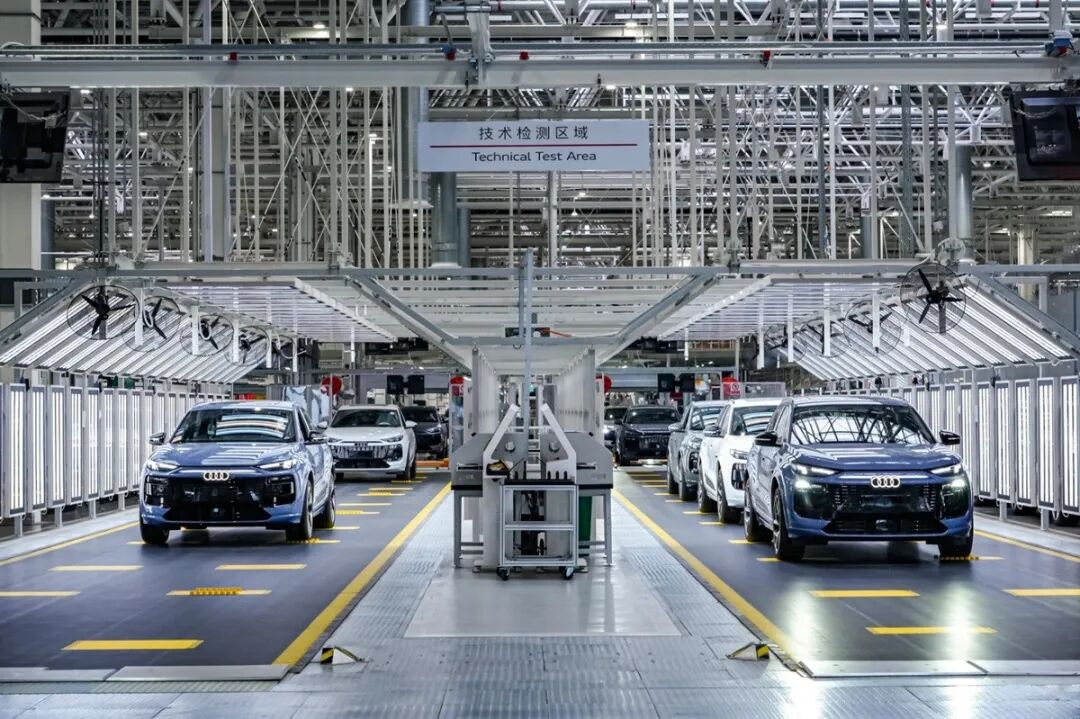
Figure 丨 FAW Audi's new energy products are inherited from the "Four Rings" system, with a solid foundation, but it still needs to cultivate recognition in the Chinese domestic market
The full ownership of the "Four Rings" by FAW Audi is obviously a major positive. After all, although the four letters of AUDI are clear, the "Four Rings" logo has long been deeply rooted in the hearts of the people and has huge appeal. Especially after nearly 40 years of entering the Chinese market, the accumulated vehicle parc of over 10 million units can only be called by one party from now on, and the problem that terminal prices have been kidnapped by internal games for many years has been completely cut off from the institutional level at one time.
However, for major brand adjustments of north-south joint ventures, there is no such thing as only benefits without costs. For FAW Audi, since it has obtained the complete "Four Rings" logo, it must bear the after-sales cost of SAIC Audi's existing users in the short and medium term. In the long run, the current positioning of the "Four Rings" logo in the product system also means being burdened with the brand's shackles in the fuel vehicle system. How to continue to break through in the new energy field is the most urgent problem, after all, the fuel vehicle base is currently in a state of continuous shrinkage.
The cost paid by SAIC Audi, on the other hand, may be underestimated by the outside world. Its Four Rings models A5L Sportback, A7L, Q6 and Q5 e-tron accounted for about half of total cumulative sales from January to July this year, and A5L alone accounted for 30%. After cutting off this part, short-term sales will almost be halved.
But calculating from another perspective, the AUDI brand's E7X achieved 4,017 units of delivery in its first month on the market, 3,007 units in July, and the cumulative sales volume reached 10,434 units by the end of August, becoming the first luxury pure electric model to exceed 10,000 sales within 100 days. When a new brand can achieve monthly sales of more than 4,000 units for a single model, the psychological threshold of cutting half of the old sales will be greatly lowered. But SAIC Audi's real confidence actually comes from AITC.
In this R&D entity named after Audi, SAIC becomes the single largest shareholder with 49% of the shares — although the German side's total shareholding of 51% still holds the controlling right, this weight is unprecedented among transnational automakers' joint R&D entities in China. AITC will fully take over the product definition and complete vehicle R&D functions for all future AUDI brand models. A team of about 300 people will jointly develop 4 new AUDI models based on the ADP 2.0 intelligent digital platform, and the first model is planned to be launched in 2028. The power to define Audi's Chinese electric vehicles is shifting from Ingolstadt to Shanghai.
Of course, if everything finally develops in the direction of the scheme in this exposure, then two practical issues must also be paid enough attention to.
First, SAIC Audi currently has about 220 full-function user centers covering more than 100 cities. A considerable number of these stores were built by investors from the FAW Audi system. When the upfront investment has not been recovered and the after-sales revenue is lost after the Four Rings models are reassigned, clear plans are needed for store construction compensation, inventory digestion, rebate adjustment, and personnel resettlement.
The second is residual value anxiety. SAIC Audi's current trend of "clearing inventory" is very obvious. Luxury brands have sensitive pricing credibility issues, and how to properly handle this is a severe test for the operation team. In addition, there is an invisible red line, the *Anti-monopoly Guidelines for the Automotive Industry* issued in 2019 has clear regulations on geographical restrictions and customer restrictions between suppliers and dealers, and dividing sales rights by brand is very easy to touch sensitive areas at the operational level.
In the past two decades, the north-south dual joint venture and dual-car strategy has been the standard practice for transnational automakers. Volkswagen has Passat and Magotan, Toyota has Corolla and Levin. In the incremental market, this is a sharp tool to achieve maximum coverage at the lowest cost. But the premise for this model to work is that the market is growing, joint ventures have premium capabilities, and dealers can make profits.
But the reality in 2026 is that the new energy penetration rate has exceeded 60% for three consecutive months, while the share of Chinese domestic brand passenger vehicles has reached 71.8%. A McKinsey survey shows that 50% of consumers refuse to pay a premium for transnational brand electric vehicles. In the stock game, the "one fish, two eats" strategy from 20 years ago has turned into a situation where brands are snatching food from themselves.
Audi is obviously the first enterprise to upgrade its dual joint venture model from product segmentation to brand segmentation. The reason why this choice is worth being optimistic is that it conforms to the essence of division of labor — considering that the user overlap between the "Four Rings" and the "letter" brands is actually very limited, the segmentation will not cause large-scale customer loss, but allow each side to focus on its own track. This is also the most solid cornerstone of the scheme in commercial logic.
On the more positive side, the signal released by this adjustment is to increase investment rather than shrink.
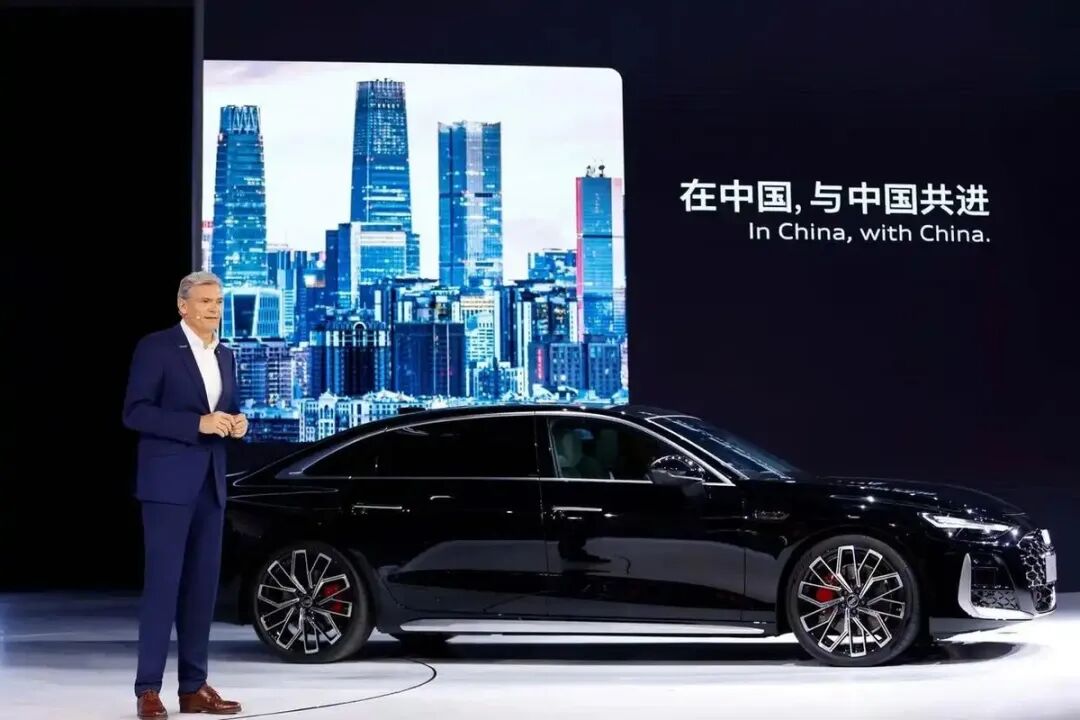
Figure 丨 It can be confirmed again that this is no empty talk
Transnational automotive groups have not left China, but are redefining China's position — from a sales market to a source of innovation. On the same day, the first model Freelander 8 of the new brand Freelander incubated by Chery and Jaguar Land Rover was officially launched, BMW stopped production of old "fuel-to-electric" models, and Mercedes-Benz leveraged Geely's technical architecture, all pointing to the same direction, that is, to use China's supply chain, intelligent ecology and R&D speed to feed back the global market.
In the end, the author believes that no matter whether the final model of this adjustment is as revealed in this exposure, Audi's success or failure in China ultimately depends on two things — first, whether SAIC Audi can complete the R&D closed loop of "China definition, global standard" before 2028, and then whether FAW Audi can stabilize the price system and dealer confidence of the Four Rings brand.
To put it bluntly, this is a gamble that trades time for space. But the author believes that time is on Audi's side, as long as it really hands over decision-making power to the Chinese team.
This article is from the WeChat official account "Auto Commune" (ID: iAUTO2010), author: Poinko, editor: He Zengrong, published with authorization from 36Kr.