Energy Storage: When Will It Transition From "Pseudo-Growth" to "Genuine Growth"?
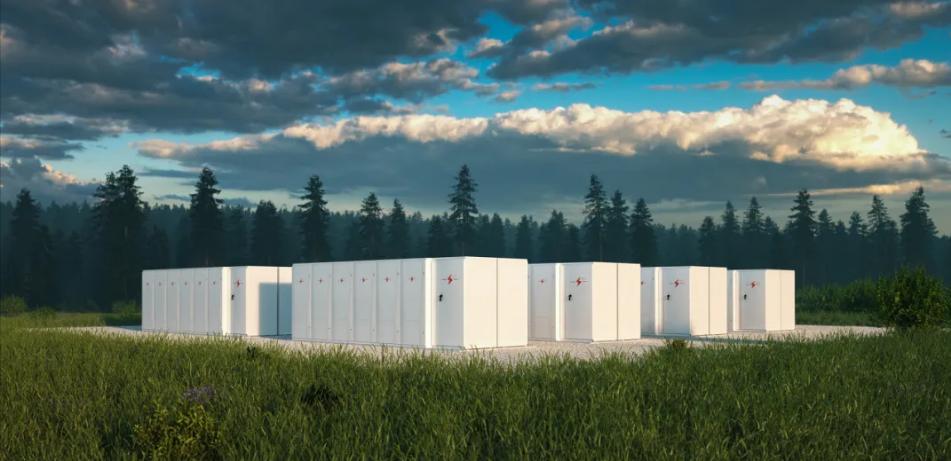
Energy storage is arguably the sector in the new energy track that has most easily led to "cognitive illusions" over the past five years.
Statistically, this industry has never stopped growing at a high rate. In 2021, domestic policies defined energy storage as the core link of the new power system. In 2022, the European energy crisis detonated demand for residential energy storage. In 2023, global installed capacity continued to climb. By 2026, global installed demand for energy storage is expected to reach 588.2GWh, a year-on-year increase of 62%; the market expectation will exceed 1TWh in 2028.
However, looking back on the investment experience of the past few years, the vast majority of participants have mixed feelings. The sector has experienced multiple rounds of drastic pricing logic shifts, with valuations falling from 100x PE to less than 20x. From September 2022 to the first half of 2025, the maximum drawdown of the energy storage index exceeded 60%, a large number of individual stocks fell by more than 70%, and many investors who entered the market at the high point in 2021 have not yet unwound their positions.
In the past year, leading utility-scale energy storage player Sungrow Power and leading residential energy storage player Deye Co., Ltd. have both taken investors on a roller coaster ride, with a far from satisfactory experience.
Why does an industry dressed in the fine clothes of a growth sector deliver such dismal long-term returns to investors and show such prominent cyclicality? More critically, at the point of 2026, the market has repeatedly tried to embrace energy storage again. Is there an essential difference between the logic of this round and that of 2021 and 2022?
01
Lessons from History: The Number Trap Behind High Growth
To understand the current investment value of energy storage, we must first answer a question: Why was it a "pseudo-growth" sector before?
1. Overly high starting point leads to valuation overdraft
Like other new energy industries, China's energy storage industry is leading the world in development. 2021, as the first year of the launch of the energy storage sector, essentially stems from the resonance of top-level policy design and performance verification by industry leaders.
Since April 2021, the state has successively launched a series of policies including the guiding opinions on the development of new energy storage and the improvement of the time-of-use electricity price mechanism. The guiding opinions officially issued in July put forward the goal of achieving a cumulative installed capacity of 30GW by 2025.
This is the first time the market has seen a clear industrialization goal, and the capital's valuation method for the energy storage track has shifted from thematic concepts to pricing based on high growth in the next three years.
However, the valuation at this stage has seriously overdrawn future growth. At the beginning of 2022, Sungrow Power's PE was 89x, and Deye's PE was 79x. PE of 70-80x means that the market has fully overdrawn the high growth of the next three to five years.
Another valuation indicator, PB, also exceeded 10x. For the manufacturing industry, a PB exceeding 10x means that the industry has very high barriers, and enterprises can continue to make huge profits (a representative case is TSMC, whose current PB is above 10x).
At the beginning of 2022, the energy storage sector corrected by about 20%, but the outbreak of the Russia-Ukraine conflict rekindled faith in the energy storage industry. What the market saw was that European electricity prices soared, demand for residential energy storage and distributed solar-storage systems exploded, enterprises deploying in the European market entered a stage of rising volume and profit, and under the background that new energy had cooled down, energy storage became the last bastion of group holding, and stock prices hit new highs.
But after September 2022, the main contradiction of the industry turned to overcapacity, sluggish overseas demand, and high inventory, which eventually led to simultaneous decline in volume and profit, and the energy storage index went all the way down. The market realized belatedly that energy storage is not a sector that can make money continuously, but a "cyclical stock" that only profited from a round of supply-demand mismatch.
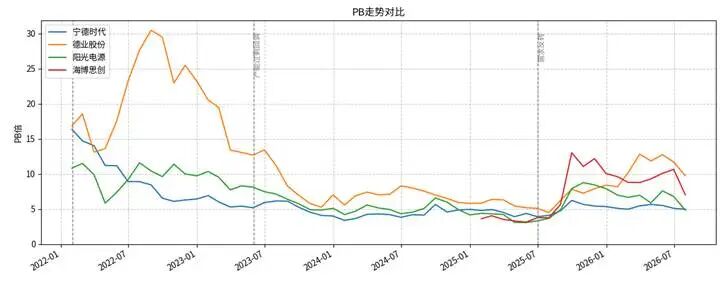
Figure: Changes in valuations of representative energy storage companies, Source: Wind
2. The GWh-only theory overestimates the market growth capacity
The first half of 2023-2025 is the most difficult period for energy storage investors. The shipments continue to increase at a high rate, but the feedback is a falling stock price.
Research institutions are accustomed to measuring industry prosperity by installed capacity, but energy storage is different from photovoltaic modules or lithium batteries. Its product form, price system and business model determine that high growth in installed capacity does not necessarily translate into revenue and profits for industrial chain companies.
In fact, the price of energy storage systems has experienced "halving and halving again" in the past two years. From 2022 to 2024, the price of energy storage systems fell from more than 1.5 yuan/Wh to less than 0.6 yuan/Wh, a drop of more than 60%. In essence, this conforms to the first principle of the development of the energy storage industry. Only by continuously reducing costs can the industrial chain achieve greater economy and higher shipment volume.
In this process, the profit model of enterprises has been broken, and a large number of links have actually experienced the process of "growing shipments, falling unit prices, and under pressure on gross profit". Market research is accustomed to using GWh to measure industry growth, but if the short-term price drop exceeds the increase in volume, industry revenue may grow, but profits will shrink significantly instead.
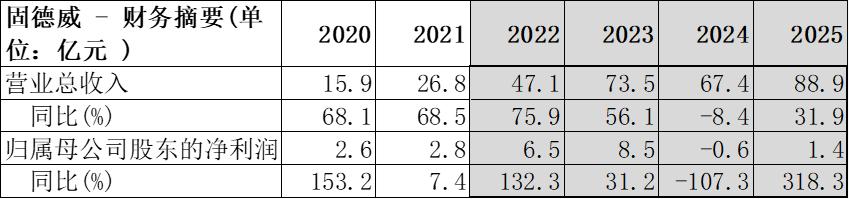
Figure: Representative residential energy storage leader 2022-2025, revenue surges while profits plummet, Source: Company financial reports
To make matters worse, the sharp fluctuation of lithium carbonate prices further amplifies this uncertainty: for every 10,000 yuan/ton increase in lithium price, the corresponding cell cost increases by about 0.6 cents/Wh; when lithium carbonate exceeds 180,000 yuan/ton, the IRR of ordinary domestic energy storage projects may fall below 6%, and the demand side will be suppressed immediately.
3. Leading industry companies have not formed a stable profit model
When the market discusses energy storage, it often confuses utility-scale energy storage, residential energy storage, and commercial & industrial (C&I) energy storage, and measures them with a unified GWh growth rate and valuation framework. But in fact, these three types of energy storage have very different customer attributes, product forms, business models, and competitive landscapes, and are essentially three completely different businesses (similar to the difference between household air conditioners and central air conditioners).
Utility-scale energy storage is a toB grid business, with customers mainly being grid companies, new energy power generation enterprises and independent energy storage investors. The project scale is usually above 100MWh, with extremely high requirements for product stability, safety and cycle life, and high price sensitivity.
Therefore, the business model of utility-scale energy storage is highly dependent on the policy environment and grid relationships. Generally, the entire industrial chain needs to be covered, and system integrators need to integrate multiple links such as cells, PCS, transformers, and EMS. Due to the large project scale and relatively high degree of standardization, utility-scale energy storage has the most intense price competition, the lowest gross profit margin, and relatively poor cash flow.
Residential energy storage is a toC consumer business, with customers being household users and strong consumer attributes. The product form is usually an integrated or split unit of "photovoltaic inverter + battery pack", used for self-generation and self-use, peak-valley arbitrage and power backup. The core competitiveness of residential energy storage lies in channels and brands, not just pure product performance.
Sales of residential energy storage in mature markets such as Europe and Australia are highly dependent on local installer and distributor networks, which is why the residential energy storage market pattern is relatively scattered but the gross profit margin of each company can remain at a high level of 35%-50% — channel barriers and brand premium support profitability.
However, when residential energy storage in Europe exploded in 2022, a large number of photovoltaic inverter enterprises crossed into the energy storage field, and industry thresholds were diluted in a short period of time. After the high prosperity in 2022, Europe entered a channel inventory digestion period, and residential energy storage chain companies were generally under pressure from 2023 to 2024.
C&I energy storage is a to-smallB project business, which can be understood as an upgraded version of residential energy storage. Its customers are small and medium-sized enterprises, between utility-scale energy storage and residential energy storage. The product form is usually energy storage cabinets of dozens of kWh to several MWh, used for peak-valley arbitrage, demand management and power backup.
The outbreak period of C&I energy storage lags behind residential energy storage by 2-3 years, due to the high degree of non-standardization of projects, longer enterprise decision-making cycles, and the upfront investment of a single project is dozens of times that of residential energy storage. However, the unit value of C&I energy storage is dozens of times that of residential energy storage, and the batteries are basically 100% self-equipped, providing strong growth support for small energy storage companies. In the first half of 2026, the proportion of C&I energy storage of companies such as Deye and Ginlong has reached 35%-40%, and it is expected to exceed 50% in 2027.
From the perspective of the industrial chain, competition is also fierce, and the market share of leading enterprises changes repeatedly amid turmoil. While CATL, Sungrow Power and other companies have a solid position, in the cell link, followers such as Hithium and Sunwoda are rapidly eroding market share at a growth rate of 50% or even more than 100%; in the system integration link, the CR10 is only about 60%, and the competition intensity is much higher than that of the cell end.
For a high-growth industry where neither the industrial chain nor downstream applications have formed a stable pattern, the valuation anchor is easily erratic: when looking at the growth space, 80x is considered reasonable, and when looking for a profit model, 20x is considered expensive.
02
What is the current industry logic? It is generally smooth now
After three years of adjustment and clearance, the growth logic of the energy storage industry has truly started to run smoothly in the second half of 2025. The core driving force is no longer short-term factors such as policy subsidies or short-term shocks from the energy crisis, but the rigid demand of the power grid brought by the continuous increase in the proportion of wind and solar power generation, and the resonance of demand in multiple regions around the world, that is, returning to its original story — source-grid-load-storage — storage is the last short board of the power system.
1. The proportion of wind and solar power increases, and the grid is short of flexible resources
From global experience, the systematic increase in energy storage demand is affected by the proportion of VRE (wind power + photovoltaic), which roughly presents four stages: when the proportion of VRE is less than 10%, the system can still rely on existing thermal power for regulation; when the proportion is 10%-20%, the fluctuation of wind and solar power begins to impact the power grid substantially, and energy storage enters a growth period; when the proportion is 20%-80%, the system is highly dependent on energy storage to achieve intraday balance, entering a period of rapid growth; when it exceeds 80%, the regulation demand shifts to a longer scale, and long-duration energy storage such as hydrogen energy begins to occupy a greater proportion.
The inflection points of different countries vary according to the basic conditions of the system: China and the United States have experienced the high-growth inflection point around 15%; Europe, due to strong cross-border interconnection and a high proportion of gas, has delayed the inflection point to about 20%; Asian, African and Latin American countries, due to weak power grids and insufficient flexibility, will enter the rapid growth stage in advance even if the VRE proportion is relatively low.
Therefore, the macro background for the rapid reversal of energy storage expectations recently is that global power grid investment has lagged behind power source investment in the past five years. In reality, the power grid needs more energy storage, but it has been delayed because energy storage is still expensive. At the same time, the cost of solar-storage systems has decreased by more than 70% in the past 10 years, and the improvement of economy has laid the foundation for the outbreak of demand.
CATL predicted in its mid-year financial report communication that the compound growth rate of the lithium battery industry in the next 5 years can reach 20-30%, and the main high growth will come from energy storage.
2. Domestic market: mainly depends on the realization of the business model of utility-scale energy storage
The domestic energy storage market ushered in a key policy inflection point in 2025. In January 2025, Document No. 136 clearly stated that "mandatory energy storage allocation" has withdrawn from the historical stage; and Document No. 114 was officially issued in January 2026, which for the first time clarified the capacity tariff mechanism for grid-side independent new energy storage at the national level, with a compensation standard of 165-370 yuan/kW·year.
The capacity tariff is equivalent to a stable basic annual salary, which usually covers 20%-30% of the total investment cost of the project. On this basis, the revenue model of independent energy storage has shifted to a diversified structure of "capacity tariff + spot arbitrage + auxiliary services". In provinces with rich resources such as Northwest and North China and mature spot markets, the project IRR can reach 6%-10%, which has the economic value of independent investment.
This marks the real maturity of China's utility-scale energy storage market. When energy storage projects can recover their investment and obtain reasonable returns through market-oriented revenue, the growth of demand no longer depends on policy compulsion, but is endogenous growth driven by economy, and the logic changes from short-term to long-term.
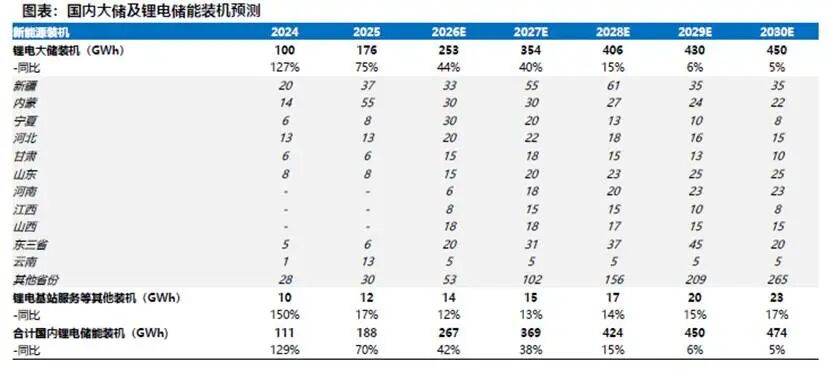
Source: Soochow Securities
3. Resonance of multiple overseas markets
Europe is the region with the most advanced new energy development in the world second only to China, and is undergoing a transformation from the dominance of residential energy storage to the all-round development of utility-scale energy storage, residential energy storage and C&I energy storage.
As the proportion of wind and solar power generation in Europe exceeds fossil energy for the first time, negative electricity prices occur frequently, and the demand of the power grid for flexible resources increases sharply. The driving force of utility-scale energy storage is the shortage of grid flexibility and negative electricity price arbitrage. Under the implementation of dynamic electricity prices, the payback period of C&I energy storage with zero