Swapped Lives: The 15-Year Fork in the Road Between Moderna and BioNTech
The innovative pharmaceutical industry never lacks plot twists, but few are as perfectly symmetrical as this pair.
On August 19, 2026, Moderna and MSD announced that the Phase III INTerpath-001 study of the personalized neoantigen vaccine intismeran (mRNA-4157) in combination with Keytruda met both the endpoints of recurrence-free survival and distant metastasis-free survival. This is the first mRNA cancer therapy in human history to achieve positive results in a randomized Phase III trial. On that day, Moderna's stock price posted its best trading day since its listing.
Nine days later, on August 28, BioNTech and Genentech, a subsidiary of Roche, quietly terminated the Phase II trial of BNT122 in the adjuvant treatment of ctDNA-positive colorectal cancer. The reason was stated in the review opinion of the independent data monitoring committee: the number of deaths in the vaccine group was numerically higher than that in the observation group. BNTX fell by 8.4% that day.
Nine days, the same scientific question, two diametrically opposite answers.
The capital market quickly digested these two events as "one wins, one loses". But if you zoom out, you will find a more interesting picture: these two companies, which once stood side by side at the peak of the industry due to their COVID-19 vaccines, are moving in each other's direction in the sixth year after the pandemic dividend fades: BioNTech is increasingly resembling a traditional multinational pharmaceutical company, while Moderna is increasingly taking on the appearance of its former German rival.
They did not move towards victory or failure respectively. They moved towards each other.
01
A window that was closed from the very beginning of design
The story of BNT122 had an exceptionally brilliant start.
In 2019, the Balachandran team at Memorial Sloan Kettering Cancer Center took a near-all-in move: for patients with pancreatic cancer after surgical resection, they first administered one dose of atezolizumab, then eight doses of mRNA vaccines customized according to each patient's tumor mutations, followed by mFOLFIRINOX chemotherapy, and finally a booster shot.
34 patients were enrolled, 28 underwent surgery, 19 were vaccinated, and only 16 finally completed the full course of the vaccine.
These 16 people supported the confidence of the entire field of personalized mRNA cancer vaccines. The interim results published in *Nature* in 2023 showed that 8 out of 16 people (50%) induced high-intensity neoantigen-specific T cells; the median recurrence-free survival of responders was "not reached", while that of non-responders was only 13.4 months. The T cells amplified by the vaccine could account for up to 10% of all T cells in peripheral blood.
In 2025, CloneTrack tracking found that the average estimated lifespan of these T cell clones was 7.7 years.
At the AACR Annual Meeting in April 2026, the six-year follow-up data was even more striking: 7 out of 8 responders (87.5%) were still alive, and the median recurrence-free survival was still "not reached"; only 2 out of 8 non-responders (25%) were alive, with a median overall survival of 3.4 years. Six years later, the CD8+ T cells in the responders still remembered the original neoantigen.
In the entire history of mRNA therapy, this is probably the most impressive set of data.
Then, the randomized controlled trial began to speak.
BNT122 has advanced a total of five randomized or late-stage trials. In 1L melanoma (IMCODE001), compared with Keytruda monotherapy, the PFS endpoint was not met. The high-risk muscle-invasive urothelial carcinoma (IMCODE004) trial was phased out in early 2026. The adjuvant NSCLC (GO41836) trial was withdrawn due to enrollment time issues. The ctDNA-positive colorectal cancer (BNT122-01) trial was terminated on August 28, 2026.
Four failures, one withdrawal. Only the adjuvant pancreatic cancer (IMCODE003) trial remains, with the primary completion date scheduled for December 2029, and this trial uses the regimen of BNT122 combined with atezolizumab (PD-L1 monoclonal antibody) plus chemotherapy, not monotherapy.
The off-the-shelf vaccine BNT111 on the same platform also failed to escape the fate: although the preset ORR endpoint was reached in melanoma, the response rate in combination with cemiplimab was only about 18%, and the company decided not to advance it further.
So what exactly is the disillusionment?
It is not the mRNA platform. BNT122 has proven again and again that it can induce strong, durable, polyclonal neoantigen-specific T cells - this point has never been overturned from beginning to end.
What is disillusioned is an assumption: "mRNA vaccines can cure cancer on their own."
Looking back, a detail that has been repeatedly mentioned and repeatedly ignored is hidden in the 16-patient data: it is an intra-group comparison (responders vs. non-responders), not a randomized control. Those who can generate immune responses may already be the group with better prognosis. Özlem Türeci, CMO of BioNTech, explained after the failure of the colorectal cancer trial that colorectal cancer is an "immunologically cold tumor".
But the real design problem lies in the control group of the BNT122-01 trial: the vaccine monotherapy is compared with active surveillance, without any PD-1/PD-L1 inhibitor combined throughout the process. In a group of post-operative patients with positive ctDNA, a vaccine that requires T cell coordination to take effect is used to single-handedly challenge an immunosuppressive microenvironment.
This window has been closed since the day the blueprint was drawn.
02
Change one variable, change the outcome
Moderna did almost the same thing, only changing one variable.
Intismeran is also an mRNA customized based on tumor sequencing, and is also used for post-operative adjuvant therapy. The difference is that it has been fully combined with pembrolizumab from the first day. Its coding capacity is 34 neoantigens, while BNT122 has 20. The indication it selected is melanoma - a hot tumor; while the colorectal cancer where BNT122 suffered the worst failure is a cold tumor.
In January 2026, the five-year follow-up data of KEYNOTE-942 was released: compared with Keytruda monotherapy, the combination of intismeran and Keytruda reduced the risk of recurrence or death by 49% (HR=0.510), and the risk of distant metastasis or death by 59% (HR=0.411). The median recurrence-free survival of responders was not reached, and that of non-responders was 13.4 months.
13.4 months. Exactly the same as the non-responders in the Phase I BNT122 pancreatic cancer trial back then. The same number, one side is the control group of the failed trial, the other side is the control group of the successful trial.
The difference does not lie in the molecule, but in the matching.
At this point, the new common sense of the industry has emerged: personalized mRNA vaccines are responsible for providing the "target list", and checkpoint inhibitors are responsible for releasing the "brake". Without either half, the other half cannot function. BNT122 went into battle as a bare monotherapy in colorectal cancer, while Moderna never let intismeran appear alone in the indication most similar to melanoma.
BioNTech obviously also learned this lesson. It did not abandon mRNA, but integrated mRNA into a larger combination, which the company calls "novel-novel combination".
The most illustrative set of data comes from the 2026 ESMO Breast Cancer Congress: the TROP2 ADC (BNT325/DB-1305) from DualityBio combined with pumitamig as first-line treatment for triple-negative breast cancer, among 30 patients, the unconfirmed ORR was 83.3%, the confirmed ORR was 76.7%, and the disease control rate was 96.7%. Lesion shrinkage was observed in all evaluable patients. At the WCLC in the same period, the first global data of pumitamig combined with B7-H3 ADC in lung cancer was also unveiled.
And the most impressive off-the-shelf data comes precisely from Moderna itself: mRNA-4359 encodes both PD-L1 and IDO1, combined with Keytruda as first-line treatment for advanced melanoma, with an ORR of 83% in 12 patients, including 2 complete remissions; among patients with PD-L1 negative (TPS<1%), the ORR is still 67%.
83% vs 83%. Two companies, two completely different technical routes, hit the same number.
They are actually answering the same question: how to make the immune system receive two signals at the same time - "who to attack" and "attack without restraint".
03
Scientists start businesses, platforms coordinate resources
To understand why these two companies swapped positions, we have to go back to the starting point.
The starting point of BioNTech is a persistent belief.
Uğur Şahin moved to Cologne, Germany with his mother at the age of four, and his father worked in a Ford factory. Özlem Türeci was born in Siegen, Germany, her father was a surgeon, and the clinic was run at home. The two met at a hospital in Humboldt, got married in 2002, and they were still in the laboratory on the morning of their wedding day before going to register in the afternoon.
In 2001, they co-founded their first company Ganymed with immunologist Christoph Huber, which was sold to Astellas for more than 1.4 billion US dollars in 2016. In 2008, they founded BioNTech in Mainz, with a seed round of financing of 180 million US dollars from the Strüngmann brothers, MIG Fund and Helmut Jeggle.
Their belief is simple and stubborn: every patient's tumor is genetically unique, so the treatment must be personalized.
This idea was almost heretical in 2008. At that time, mRNA was just sentenced to death by the mainstream academic circle: it was too unstable, degraded instantly after entering the body, could not be delivered into cells, and might cause fatal inflammation. The couple placed their bet on a Hungarian scientist who was almost ignored - Katalin Karikó. She discovered that as long as one nucleoside in mRNA is chemically modified, it can prevent it from triggering immune inflammation. In 2013, Karikó joined BioNTech. In 2023, she won the Nobel Prize.
The starting point of Moderna, on the other hand, is a deduction.
In the spring of 2010, Derrick Rossi, a Harvard stem cell biologist, published a paper in *Cell Stem Cell*: using chemically modified mRNA to reprogram human fibroblasts into iPSCs while avoiding the attack of the immune system. The referral chain started immediately. Rossi found his Harvard colleague Timothy Springer, and Springer referred him to Robert Langer of MIT. After a two-hour long conversation, Langer dropped a sentence: "This technology can be used to make drugs, vaccines, and all other possibilities." Langer immediately passed the news to Noubar Afeyan, founder of Flagship Pioneering.
In the summer of 2010, the three met in Langer's office at MIT. What Afeyan was interested in was not stem cells, but a sharper question: can engineered mRNA itself be used as a drug? He later recalled: "One thing is clear, no one has ever done this before."
Flagship immediately launched a one-month internal exploration project numbered LS18. In September 2010, LS18 was renamed Moderna (Modified + RNA) - this portmanteau happens to contain the word "moderna".
Afeyan has another sentence that basically defines the fate of this company: "From day one, we were focused on building a platform that could produce dozens or even hundreds of drugs."
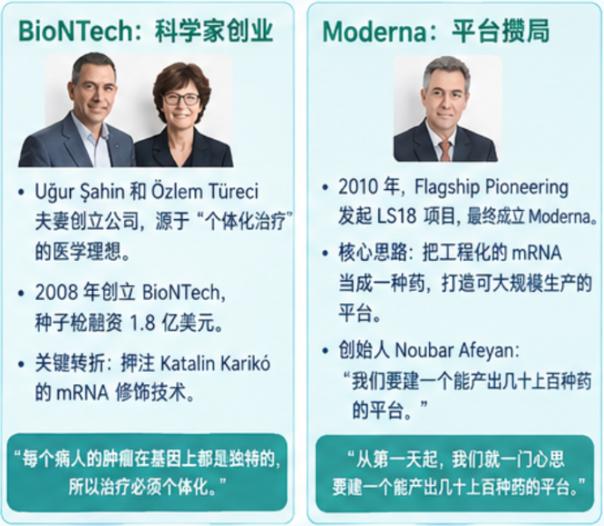
The initial fork is right here:
BioNTech started from "a specific medical ideal", wanting to customize a manual for each patient. Moderna started from "a machine that can produce products repeatedly", building the platform first, firmly believing that drugs will grow out of it on their own.
One walks from right to left, the other walks from left to right.
04
You move towards my starting point, I move towards your origin
The pandemic poured a torrent of cash into both companies - Moderna's peak revenue exceeded 18 billion US dollars, and BioNTech's net profit in 2021 was 10.293 billion euros - which also pushed both paths to a turning point. Then they began to move towards each other's origin.
BioNTech began to coordinate resources.
Almost all the assets it acquired are not originally developed by itself: in November 2023, it paid a down payment of 55 million US dollars to introduce the non-Greater China rights and interests of the PD-L1/VEGF bispecific antibody PM8002 from Wuxi Biologics? No, Pumi Bio; at the end of 2024, it paid 800 million US dollars in advance to acquire Pumi Bio wholly; in June 2025, it sold half of the rights and interests of this drug to BMS, receiving a 1.5 billion US dollar down payment with a total maximum amount of 11.1 billion US dollars. In terms of ADC, in April 2023, it paid 170 million US dollars in advance to introduce two ADCs from DualityBio, later added to three, and then obtained HER3 ADC from YL Bio. In January 2023, it acquired the AI company InstaDeep (down payment of about 362 million pounds), and in February 2025, it acquired Biotheus.
By 2026, BioNTech's oncology pipeline has three pillars: next-generation immunomodulators, ADCs, and mRNA cancer immunotherapies. Pumitamig has launched 7 key trials, and the annual goal is to expand the number of Phase III trials to 15.
At the same time, it is contracting: closing the Tübingen and Marburg sites, laying off about 1860 people, completely exiting the independent production of COVID-19 vaccines and transferring it to Pfizer, which is expected to save about 500 million euros per year before 2029.
The most meaningful scene took place on March 10, 2026. Şahin and Türeci announced that they will step down at the end of the year to found a third company, a "next-generation mRNA company". BioNTech will provide the new company with specific mRNA rights and technologies in exchange for minority equity, milestone payments and royalties.
This is essentially an open separation: separating the cash-burning early R&D from the commercial operation that requires stable cash flow. Şahin said that the company is "ready to advance its mission and develop into a commercial multi-product company".
To put it bluntly: BioNTech no longer needs the founders. It needs a CEO with decades of experience in multinational pharmaceutical commercial operations.
On the other side, Moderna began to develop specific drugs.
Bancel is still in office. From 2011 to 2026, fifteen years. At the Science Day in June 2026, he divided the pipeline into three Horizons: Horizon 1 is marketed and late-stage assets (infectious disease vaccines, intismeran, rare diseases); Horizon 2 is emerging modalities in clinical development (cancer antigen therapies, T cell engagers, cell therapy enhancers, MS tolerance therapies); Horizon 3 is future modalities that will enter first-in-human trials by the end of 2027 (in vivo CAR-T mRNA-6007, in vivo CAR-M).
The platform has also been reorganized into three pillars: mRNA science, delivery science, and advanced manufacturing. For the first time, delivery is mentioned at the same level as mRNA itself.
It also launched the AI platform "Lucy". Bancel's original words are very interesting: "We have been doing mRNA for 15 years, and we feel that we are just getting started... We don't have to be the smartest, but we must be