The market value of 1.2 Unitree Robotics equals the combined market capitalization of NIO, Li Auto, XPeng and Leapmotor. China's new car-making forces have generated a total revenue of over 170 billion yuan in half a year, so why are they still not well favored by the market?
"Selling cars has long ceased to be a profitable business." When talking about the investment experience in 2026, an investor who requested anonymity repeatedly expressed his emotion to the reporter of National Business Daily. The automotive stocks he holds have continued to record floating losses, and his words are full of helplessness towards the stock price performance, as well as confusion about the valuation logic of the automotive industry.
As the 2026 semi-annual reports of major domestic listed automakers are released intensively, a set of contradictory phenomena has become increasingly prominent: many automakers maintain growth in sales volume and revenue, with hundreds of thousands of production and sales volumes every half year and revenue as high as tens of billions of yuan, but the market value given by the capital market is lower than that of robotics enterprises with revenue of only more than 1 billion yuan, and even lags behind large model companies that are still in the stage of large losses.
A clear inversion has emerged between production and sales scale and enterprise market value. This has prompted many automakers to try to step out of traditional complete vehicle manufacturing and deploy new businesses such as intelligent driving, AI large models, and humanoid robots, but the capital market still prices automakers according to the low gross profit standard of the manufacturing industry. Many automotive practitioners can't help but wonder: Is this old valuation paradigm no longer keeping up with the real changes in the industry?
Unitree Technology's market value is close to the sum of "NIO, XPeng, Li Auto, Leapmotor"
Since 2026, the market value of major domestic listed automakers has generally declined. Data shows that by the end of August, the market value of 12 listed complete vehicle companies was lower than that at the end of 2025, among which Seres, XPeng and Changan Automobile decreased by 59.0%, 43.4% and 40.4% respectively.
What is more noteworthy is that the market value trend is not synchronized with the operating scale. Among the 12 listed complete vehicle companies, 6 still saw year-on-year revenue growth in the first half of the year. Among them, NIO and Leapmotor's revenue increased by 85.8% and 57.2% respectively, but their market value decreased by 19.0% and 24.5% respectively.
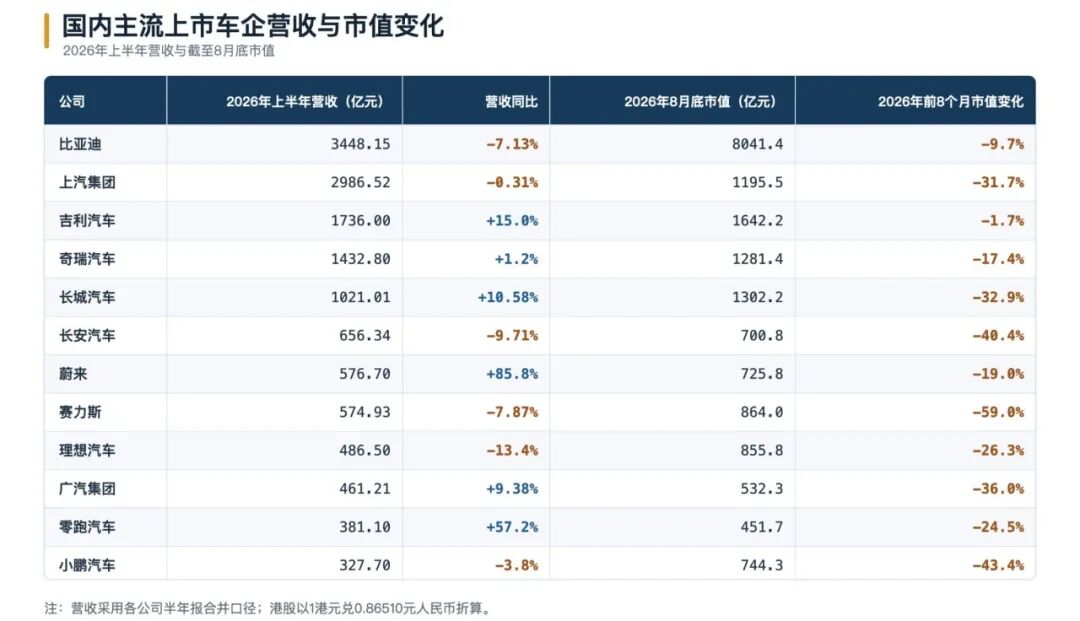
Image source: National Business Daily reporter Sun Lei, produced by
If we only look at business scale, automakers are not short of revenue. In the first half of 2026, the revenue of BYD, SAIC Motor, Geely Auto, Chery Automobile and Great Wall Motors all exceeded 100 billion yuan. Looking at "NIO, XPeng, Li Auto, Leapmotor" again, NIO delivered 191,100 vehicles and achieved revenue of 57.67 billion yuan; XPeng delivered 166,000 vehicles and achieved revenue of 32.77 billion yuan; Li Auto delivered 193,500 vehicles and achieved revenue of 48.65 billion yuan; Leapmotor delivered 356,500 vehicles and achieved revenue of 38.11 billion yuan. The four companies delivered a total of about 907,000 vehicles in half a year, achieving a total revenue of about 177.2 billion yuan.
Such a huge operating scale has not brought corresponding capital market pricing. By the end of August, the Hong Kong stock market value of NIO, XPeng, Li Auto and Leapmotor was about HK$83.9 billion, HK$86 billion, HK$98.9 billion and HK$52.2 billion respectively, totaling about HK$321 billion, equivalent to about 277.8 billion yuan.
In contrast, by the end of August, Unitree Technology's A-share market value was about 228.5 billion yuan. Although it has shrunk by nearly half compared with the market value of about 444.9 billion yuan at the opening of its first trading day after listing, only 1.2 times of Unitree Technology is equivalent to the sum of the market value of the four companies of "NIO, XPeng, Li Auto, Leapmotor" in the same period. Public data shows that Unitree Technology achieved revenue of 1.152 billion yuan and a comprehensive gross profit margin of about 56% in the first half of 2026; in 2025, it sold 23,000 quadruped robots and 5,215 humanoid robots, and the annual sales volume of robots was only about 3% of the sales volume of "NIO, XPeng, Li Auto, Leapmotor" in the first half of this year, but its market value is about 3 times that of NIO, XPeng or Li Auto, and 5 times that of Leapmotor.
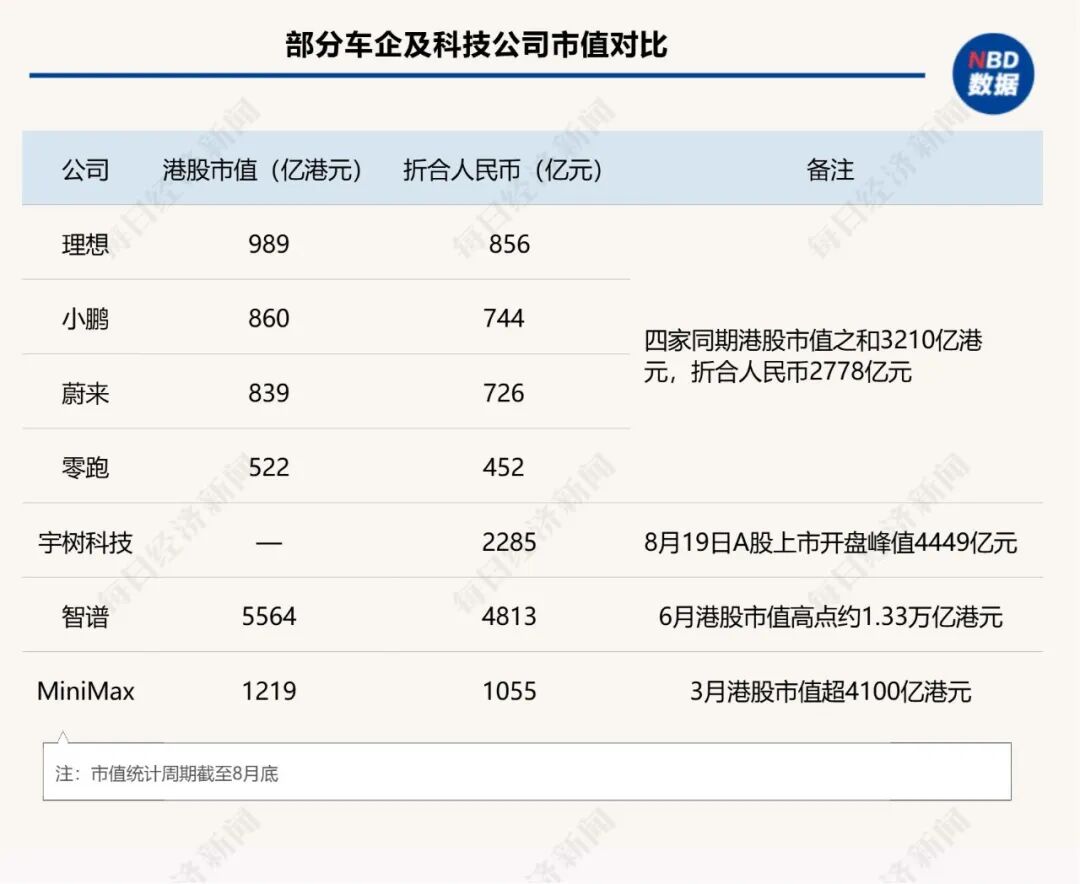
The market value difference between large model companies and automakers is also obvious. MiniMax's revenue in the first half of the year was 116.6 million US dollars, equivalent to about 800 million yuan, which is only about 1/220 of the total revenue of the four automakers, with a gross profit margin of 17.9%, and the adjusted net loss in the same period was 293 million US dollars. By the end of August, its market value was about HK$121.9 billion, down about 70% from the peak of over HK$410 billion in March, but still higher than the four automakers. Zhipu AI's total revenue in 2025 was 724 million yuan, and the annualized recurring revenue (ARR) of its MaaS API (Application Programming Interface) platform by March this year was about 1.7 billion yuan; by the end of August, its market value was about HK$556.4 billion, down about 58% from the high point of about HK$1.33 trillion in June. ARR is not confirmed accounting revenue, but it centrally reflects the capital market's expectation of future recurring revenue.
Automakers have an absolute advantage in revenue and product sales volume, but the result of market value comparison is almost inverted. Although the number of users and Token call volume of large model companies cannot be directly compared with automobile sales volume, technology enterprises have obtained higher valuations with smaller current revenue and delivery scale, and this pricing difference has been very obvious.
Why does the capital market "discount" automakers?
Regarding the decline in the market value of automakers, Cao He, President of Quanlian Auto Dealer Investment Management (Beijing) Co., Ltd., said in an interview with reporters, "One is the reason of the overall market, and the other is the expectation for the future automotive market." The former affects the overall risk preference of the market, while the latter directly determines how high a valuation investors are willing to give to automotive companies.
Zheng Yun, Global Senior Partner of Roland Berger and Head of Automotive Business in Asia, summarized this change as: "The essence of the rise in automakers' revenue and sales volume while the market value falls is the switch of valuation logic: the capital market is shifting from giving growth premium to pricing according to earnings quality and cash flow." In his view, the penetration rate of domestic new energy vehicles is already at a high level, the industry has shifted from incremental dividends to stock game, and the growth of automakers comes more from seizing the market share of competitors, so the marginal return of expansion will decline accordingly.
Zheng Yun believes that the problem faced by automotive companies is not the lack of revenue, but whether new sales volume can bring corresponding profits and cash flow. The price war continues to squeeze the profit per vehicle. While sales volume expands, capital expenditure, depreciation and channel subsidies are also rising; capacity expansion and factory construction, as well as intelligent driving R&D, will cause a large amount of funds to be deposited in fixed assets, inventory and accounts receivable. As a result, some companies may see a decline in net profit margin while expanding their scale, and even new businesses fail to generate free cash flow. He emphasized that if the book profit is not converted into operating cash flow, the support of revenue scale itself for valuation will also be limited. Data from the National Bureau of Statistics shows that from January to June 2026, the automotive manufacturing industry achieved operating revenue of 5,189.32 billion yuan, a year-on-year increase of 1.8%; the total profit was only 195.35 billion yuan, a year-on-year decrease of 19.5%, which also provides a footnote for the industry pressure of "increasing revenue without increasing profit".
Li Auto is an example. According to the company's disclosure, by the end of June 2026, its cash reserve was 87.5 billion yuan; by the end of August, Li Auto's market value was about 85.6 billion yuan, and the cash reserve was about 1.02 times of the market value, but its free cash flow in the second quarter was still negative 1.3 billion yuan. Cash reserve and market value are not indicators of the same caliber that can be directly subtracted, but it can be seen that the huge cash balance has not brought corresponding valuation premium to Li Auto.
Talking about this phenomenon, Zheng Yun said, "Cash is only a safety cushion, not a source of value". More cash only means stronger risk resistance; if the main business's profitability is weak, the return on invested capital is low, and cash cannot be invested in high-return businesses, the market may still discount it, and even regard it as a "value trap". In his view, evaluating automakers can not only look at the book cash, but also make a comprehensive judgment combining indicators such as the real gross profit margin of complete vehicles, the matching degree between operating cash flow and net profit, free cash flow, return on invested capital, working capital turnover and cash use efficiency. Investors will also pay attention to whether the profitability per vehicle and brand premium ability can be stabilized, whether capital expenditure will continue to erode profits, and whether globalization, software and service revenue can be realized.
In addition to profitability and cash flow, the uncertainty of the future competitive landscape is also affecting the valuation of automakers. Zheng Yun mentioned that the automotive industry is still in the knockout stage, and it is difficult for the market to judge which companies can finally survive and maintain long-term profitability. In this case, the capital market no longer easily gives high multiples for "possible in the future", but tends to price according to the visible returns of the manufacturing industry.
At the same time, robotics companies are following another set of pricing logic. Although Unitree Technology's revenue scale is not large, its gross profit margin of about 56% means that for every yuan of revenue obtained, the gross profit that can be retained at the current stage is higher than that of most automakers. The interim performance of UBTech, a humanoid robot enterprise listed on the Hong Kong stock market, in 2026 shows that the company achieved revenue of 1.269 billion yuan and a net loss of 339 million yuan in the first half of the year, among which 921 full-size embodied intelligent humanoid robots were sold; by the end of August, UBTech's market value was still about HK$42.7 billion. Zheng Yun believes that the current valuation of the complete vehicle sector has been suppressed, and automobiles are regarded as a mature hardware manufacturing industry; humanoid robots are defined as the next generation of general-purpose AI hardware, so the capital market has given a growth valuation higher than that of traditional complete vehicles.
Cao He believes that at present, the robot industry is still a capital-driven industry, with wider application fields and longer industrial cycles than automobiles, and it may continue to expand new application scopes. Compared with automotive companies that have been priced according to visible profits and cash flow, robot and large model companies are still in the early stage of the industry, and capital is more willing to price their growth space and business models in advance.
Collective deployment of robots
Automakers are looking for new valuation increments
Under this valuation differentiation, automakers' concentrated deployment of robots objectively provides a new valuation dimension for the capital market. Zheng Yun believes that humanoid robots and intelligent vehicles are highly homologous, and the overlap of related technologies and capabilities between the two industries is estimated to reach 60% to 70%.
In terms of specific capabilities, Zheng Yun mentioned that autonomous driving algorithms can be migrated to robot environment perception and motion planning, automakers' mature electric drive supply chain, million-level mass production and quality control system can help robots reduce costs, and automakers' own factories can become the earliest verification scenarios for applications such as inspection, assembly and handling. This judgment also echoes McKinsey's research: key links of humanoid robots such as motors, harmonic reducers, power electronics, batteries and sensors are highly adjacent to the new energy vehicle industry chain. In Zheng Yun's view, automakers' deployment of robots is exactly the spillover of existing "physical AI" capabilities to another type of carrier.
The similarity of industrial capabilities also makes automotive talents an important source of embodied intelligence entrepreneurship. According to incomplete statistics, former senior executives and technical leaders of Li Auto have founded 5 embodied intelligence companies: Jiet Power, Kunlun Xing, Xieyue Intelligence, Heyu Robot (Ngorongoro) and Wujie Power. Most companies are still in the stage of R&D, product verification or small-batch delivery, with very limited public revenue; but roughly estimated according to public and market financing standards, the total valuation of the 5 companies in the latest round is close to half of Seres' market value of 86.4 billion yuan by the end of August. In the view of some investors, this reflects that capital is willing to price the combination of "automotive talents + embodied intelligence track" in advance, but still requires listed complete vehicle companies to prove profits and cash flow first.
However, Cao He believes that whether automakers' development of robots can directly increase their own market value is "two different things". At the present stage, the robot track itself is a hot spot in the capital market. Compared with the automotive industry with a mature business model and relatively clear growth boundary, robots still have large room for imagination and are easier to gain capital favor.
Zheng Yun calls the robot business a "valuation option" for automakers: even if it does not contribute profits in the short term, it may change the company's capital market narrative, extend it from an automobile manufacturing company to a "physical AI" or robot company, and open up new valuation space.

Image source: XPeng official website
The independent financing of XPeng's robot business further reflects this capital consideration. On August 24, XPeng announced that its robot business had raised more than 900 million US dollars, with a post-investment valuation of more than 6.3 billion US dollars, which was about 60% of XPeng's overall market value at that time. XPeng clearly stated in the announcement that independent financing is conducive to reflecting the value of the robot business separately, attracting investors different from those of the intelligent vehicle business, and obtaining development funds without relying on the balance sheet of the listed company. Some brokerages have separately included the value of robots into XPeng's sum-of-the-parts valuation, and the possibility that automakers' valuation methods shift from single complete vehicle valuation to "automobile + robot + Robotaxi" is emerging.
Reshaping pricing logic
It is not simply to uniformly increase the price for the "robot story"
In the industry's view, as automakers deploy in the robot field, it is time to re-examine their valuations. However, it should be noted that "re-examination" does not mean simply increasing the valuation multiple, nor does it mean that as long as a robot is released, it can transform from a manufacturing enterprise to a technology platform.
Xiaomi's recent stock price performance is an example. It once obtained a platform-based stock value premium relying on "Phone × AIoT" and "full ecosystem of people, vehicles and homes", and its intelligent electric vehicles, AI and other new businesses also achieved operating profit of 900 million yuan for the first time in 2025; but by the end of August, Xiaomi's stock price still fell by more than 50% from the intraday high of about HK$60 in the past year. In the first half of 2026,