All DJI-affiliated enterprises are telling a story of "taming uncertainty".
This is a set of engineering methodologies that converge complex, dynamic, and unstable physical systems into reliable, mass-producible, and deliverable products.
Over the past few years, engineers, product managers and business leaders who left DJI have become the most recognizable team in China's hardware entrepreneurship landscape.
Statistics from Narrowcast AI on 30 DJI-affiliated enterprises that have received investments since 2025 show that, categorized by their currently disclosed core product directions, nearly 60% of these enterprises are engaged in robotics or embodied intelligence, while the rest are distributed in fields including outdoor intelligent equipment, consumer electronics, energy systems and personal manufacturing.
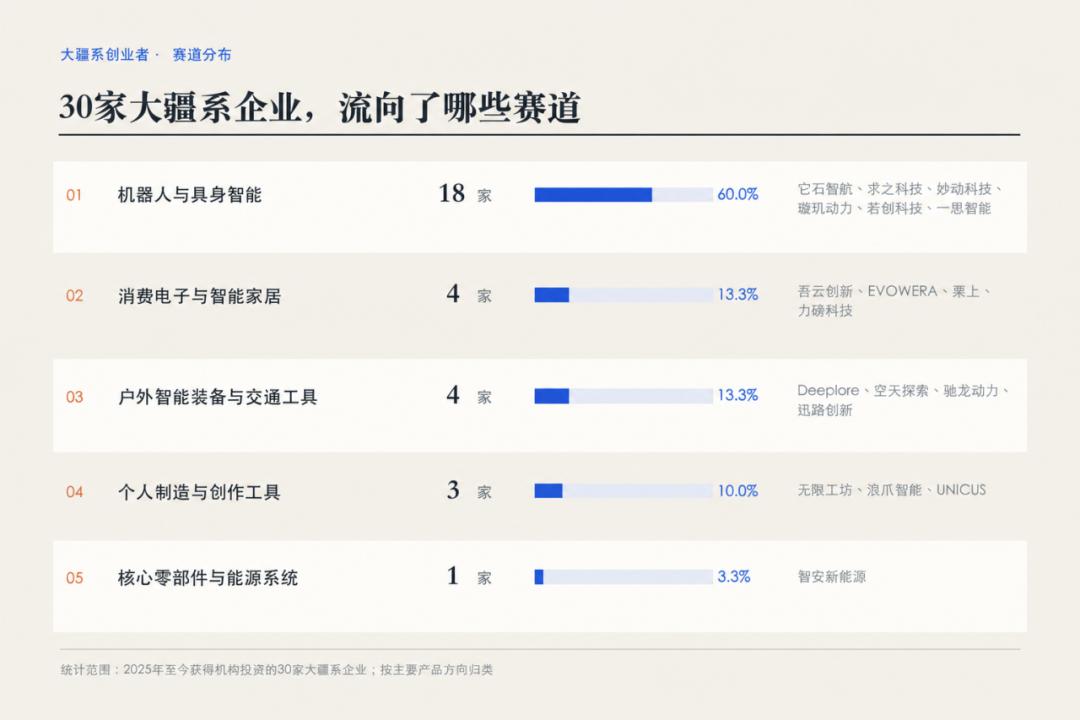
Under the unified label of "DJI-affiliated enterprises", there are two types of enterprises at different stages: one group has already proven that users are willing to pay for their products, and clear-cut specific categories such as capsule dishwashers and automatic tufting guns have generated scaled revenue; the other group has just secured capital bets on their teams and technologies, and has not officially launched products yet, or lacks actual sales data.
A trend emerging in 2026 is that capital is increasingly inclined to assign extremely high valuations to some DJI-affiliated teams even before their products enter mass production. Its Zhihang has raised a total of more than 697 million US dollars in financing, Qizhi Technology has raised more than 200 million US dollars, and Miaodong Technology has also obtained huge investment in the early stage of its entrepreneurship.
Catalyzed by large models, AI is accelerating its way out of the digital world, bringing an explosive wave of hardware reconstruction for embodied intelligence and various AI-native terminals. In this grand AI expansion targeting the physical world, capital is more determined to invest in a kind of "industrial pragmatism" derived from DJI — which is exactly a set of engineering methodologies that converge complex, dynamic, and unstable physical systems into reliable, mass-producible, and deliverable products.
With the endorsement of earlier DJI-affiliated startups such as Bambu Lab and EcoFlow, capital is looking for DJI-affiliated entrepreneurs who master this set of methodologies to innovate hardware experiences, and complete the closed commercial loop from technology to product, and from product to user payment.
01
What DJI outputs is the capability to tame uncertainty
UAVs are inherently dynamic and unstable systems. Perception, flight control, motors, structures, energy, communication and software must collaborate in real time, while simultaneously meeting the requirements for weight, battery life, cost, safety and mass production.
What is trained in such a product system is not just individual technical experts, but a group of people who are accustomed to finding optimal solutions under multiple constraints. After leaving DJI, they usually enter new physical product categories along the technical modules they were once responsible for.
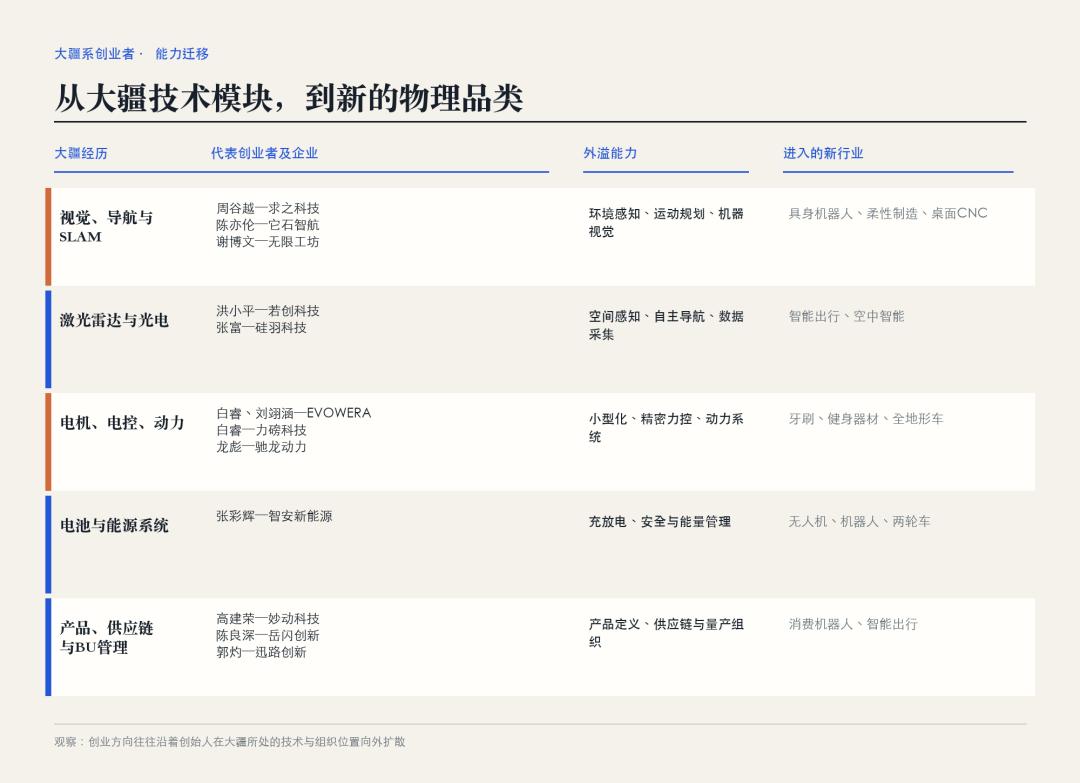
Illustration by Narrowcast AI
For example, Hong Xiaoping, founder of Ruochuang Technology, built the optoelectronics department from scratch at DJI and was in charge of the LiDAR product line. After starting his own business, he did not continue to manufacture LiDAR, but developed personal intelligent mobility equipment. He reorganized vehicle-grade perception, SLAM and motion control capabilities into a product similar to a wheelchair, but trying to break away from the definition of medical devices.
Similar migration has also taken place in other companies. Zhang Caihui, former head of the battery and charger module at DJI, founded Zhi'an New Energy, extending the UAV energy management experience to robots, two-wheeled vehicles and water area equipment; Bai Rui, who was once responsible for motor control, first applied precision servo motors to electric toothbrushes, and later entered the home intelligent fitness equipment sector; Long Biao, core R&D lead of DJI's E-bike project, chose to develop electric all-terrain vehicles after starting his own business.
These products belong to different industries, but the problems faced by entrepreneurs are similar: how to make perception, control, power and structure work stably in the real environment, and strike a balance between cost, reliability and user experience.
In Hong Xiaoping's view, the important part of DJI's culture is "thinking with first principles" and "not blindly following authorities". He believes that all product designs must serve mass production. Advanced technology does not mean using the most cutting-edge components, but making technologies work stably under realistic conditions of cost, craftsmanship and supply chain.
Therefore, to understand a DJI-affiliated company, we need to see what role it played within the DJI system: whether it was responsible for an algorithm module, a power system, or a complete product line; and whether it has truly gone through the whole process from R&D, supply chain to mass production and delivery. This can better explain whether this company has the capability to tame the uncertainty of hardware.
02
Scenarios are the entry point for complex technologies to turn into products
At the product level, the 30 enterprises are basically moving along the same path — instead of creating demands out of thin air, they turn originally professional, complex or poorly experienced scenarios into products that ordinary people can use directly.
Infinite Workshop tries to turn industrial 5-axis CNC into a personal creation tool; Langzhua Intelligence automatically generates weaving patterns via AI, compressing the work that would take professional pattern makers several days to just a few minutes; Lishang shrinks traditional dishwashers into no-installation products suitable for families of 1 to 3 people.
Guo Zhuo, founder of Xunlu Innovation, said that their priority is to develop "new features that solve high-frequency pain points in users' main usage paths", rather than chasing "trends that users will only use a few times".
Xie Mingzuo, founder of Lishang, said that precisely because the team has no experience in the dishwasher industry, they are willing to "use first principles to re-deconstruct this problem", then break down and reorganize the original elements, and verify the solution with users. Xie Bowen, founder of Infinite Workshop, also summed up his product intuition as: "A good product should not make users think too much."

This path of "productizing complex scenarios" is also adopted by DJI-affiliated entrepreneurs in the field of embodied intelligence.
Its Zhihang takes wire harness manufacturing as its first scenario, because this work has long been difficult to automate, and there are clear industrial customers and demand for cost reduction. Ruochuang Technology does not directly manufacture humanoid robots, but starts from the personal mobility scenarios of the elderly and people with mobility difficulties, not only solving the problem of whether the device can move, but also addressing the issues of safety, navigation and automatic driving on complex road surfaces.
The AI tennis robot of Yisi Intelligent does not let the robot really play against humans, but adopts the scheme of "serving instead of playing", allowing the robot to move quickly to different positions to serve, simulating the rhythm and spatial changes in real rallies. This not only retains the training value, but also avoids the cost and reliability problems brought by mechanical ball catching.
It can be seen from this that the scenarios introduced by DJI-affiliated enterprises will meet at least four conditions: the problem is specific enough, the payer is clear, the effect can be measured, and the product can be delivered repeatedly. Only in this way can they quickly acquire the first batch of users willing to try, and have the possibility of sustainable sales. Here the scenario is where technologies first go through the tests of cost, delivery and user payment.
03
AI is the new interface for complex hardware
Scenarios answer the question of "who the product solves what problem for in the first place", while AI answers the question of "how users convey their intentions to the machine".
Traditional hardware requires humans to learn how the machine works. Users need to understand buttons, menus, parameters and operation processes, and then break down their goals into executable instructions for the device. The more complex the hardware is, the heavier this translation work will be. The reason why industrial equipment has long stayed in the professional market is not entirely due to its high price, but also because ordinary people cannot easily master it.
The most valuable part of this round of DJI-affiliated entrepreneurs' application of AI is not adding dialogue functions to hardware, but trying to make the machine understand human intentions in reverse. Users only need to express "what they want to accomplish", and AI is responsible for understanding and planning how to complete the task, which will then be realized by the hardware.
In the practices of these enterprises, AI will bring changes to hardware at roughly three levels.
The first level is perception and control. Companies such as Ruochuang and Yisi use AI to identify the environment, plan paths and control movements, so that the devices have certain autonomous action capabilities.
The second level is memory and interaction. CODE27 provides a physical carrier with long-term memory for virtual characters, while Ludens AI tries to make robots no longer just tools that accept instructions and complete tasks, but become continuously existing companions.
The third level is design and manufacturing. Langzhua Intelligence allows AI to generate weaving patterns, UNICUS enables models to convert photos and texts into manufacturable building block structures, and Infinite Workshop hopes to use algorithms to automatically generate tool paths and complete error compensation.

Product image of Langzhua Intelligence
These three paths essentially shorten the distance between human intention and physical results.
Xie Bowen believes that past manufacturing tools always required humans to understand the machine, and the next generation of creation tools should instead let "algorithms and systems adapt to humans". Therefore, to judge whether an AI hardware is viable, we need to see if it reduces operation steps, lowers professional thresholds, improves safety or efficiency, or creates a previously impossible continuous relationship.
For DJI-affiliated entrepreneurs, this is also an extension of the engineering problems they are familiar with in the AI era: In the past, they converged the uncertainty of flight and movement; now, they need to further converge the uncertainty of human intentions.
04
Globalization is also a product capability
Among the 30 enterprises, many do not target Chinese users as their first batch of target customers. Xunlu Innovation targets young families in Europe, launching a Cargo e-bike that "replaces the second car"; Deeplore starts from the global professional diving crowd; Yisi Intelligent first entered the US tennis market.
The globalization of DJI-affiliated startups is often summarized as supply chain advantages, overseas crowdfunding and channel expansion. But these are more tools for products to enter overseas markets, not the globalization capability itself.
The real globalization product capability emerges before the product is designed — whether entrepreneurs can understand the lifestyle of another market and identify real demands from it; whether they can integrate local regulations, usage environments and price systems into the product in advance; and whether they can rearrange product portfolios, costs and delivery methods according to the channel structure.
Xunlu Innovation's choice of European Cargo e-bike embodies such logic. Cargo e-bikes are a means of transportation for many young families in Europe to pick up children, do shopping and make short commutes, functioning as a "replacement for the second car". Therefore, Xunlu Innovation redesigned the power drive, perception fusion, kickstand, anti-theft and safety systems around heavy-load family mobility scenarios.
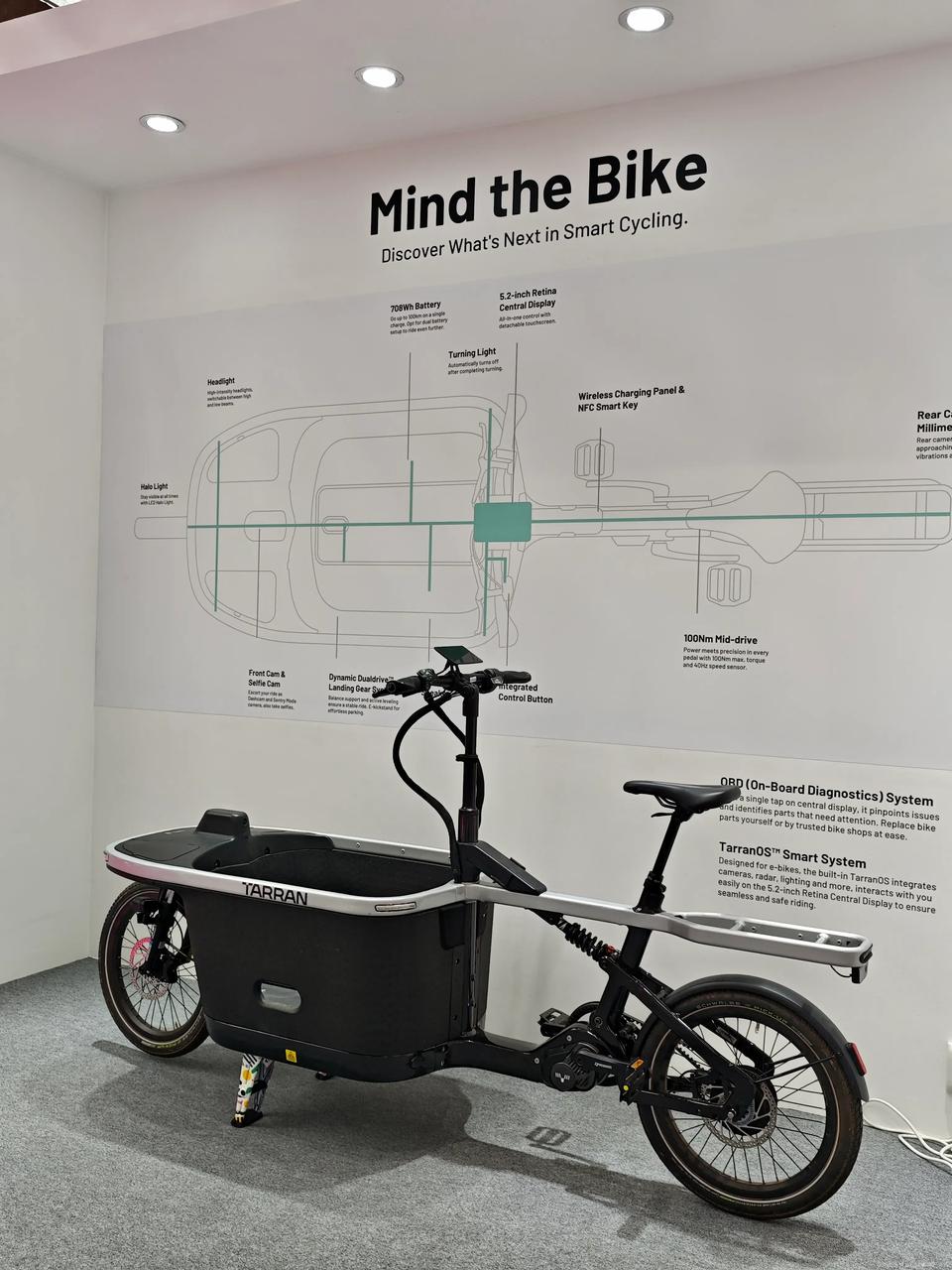
Xunlu TARRAN
The capability to truly integrate a product into the local people's life and commercial system can be called real globalization product capability. For DJI-affiliated entrepreneurs, after entering the global market, they also need to further converge the differences in culture, regulations, channels and delivery across different countries.
05
Capital is snapping up DJI's organizational memory
Traditional hardware investment usually revolves around already formed products: investors will first look at the prototype, then the mass production situation, and finally judge the market prospect. But in many DJI-affiliated projects, what investors need to evaluate first is not how well the product sells, but what the founder has successfully achieved in the past, what responsibilities he has taken in complex systems, and whether he can reorganize a team with R&D and mass production capabilities.
Among them, whether the founder has been in charge of key modules such as perception, flight control, power and supply chain, and whether he can understand the coupling relationship between various systems, determines the probability that the company can turn technical solutions into products; having gone through the complete product cycle means knowing which problems will be exposed intensively outside the laboratory; being able to quickly assemble a team will make part of the organizational capabilities that have formed tacit collaboration migrate from DJI to the new company.
This explains why capital is willing to place bets in advance before products are verified by the market. They believe that teams with the above experience can reduce the engineering risks of complex hardware, and even if the first product definition needs adjustment, they are more likely to find a new foothold.
This kind of capital investment in DJI-affiliated enterprises is more like a multi-threaded incubation program completed collaboratively. Investors including Gao Bingqiang and Qingshuiwan Fund provide support in the initial stage; HSG, Shunwei Capital and other funds provide subsequent expansion capital, betting on the growth potential of teams and categories; the entry of industrial investors such as Meituan, Alibaba, Lenovo and SAIC may bring application scenarios, supply chain resources or subsequent industrial synergy to the company.
DJI has also begun to participate in this program. Long Biao, founder of Chilong Power, was once the head of gimbal motor control and core R&D lead of the E-bike project at DJI, and entered the electric all-terrain vehicle market after starting his own business. DJI directly participated in Chilong Power's financing, shifting from talent output to limited investment and industrial synergy.
Capital can help DJI-affiliated entrepreneurs complete the first convergence faster: assemble the team, invest in R&D, and turn complex technologies into a machine that can be mass-produced. But it cannot replace the second convergence — the enterprise also needs to turn uncertain demands, costs, channels and organizations into continuous user payment and stable commercial returns.
At DJI, entrepreneurs learned to tame the uncertainty of machines; after leaving DJI, those who can continue to tame the uncertainty of the market are the ones who truly inherit DJI's most important capabilities.
This article is from the WeChat official account "Narrowcast AI", written by Li Wei, and authorized for release by 36Kr.