A Song of Ice and Fire of Rapid CAR-T
In the world of cell therapy, "speed" has always been a scarce capability.
Traditional CAR-T therapies usually take weeks from collecting T cells from patients, activating them in vitro, conducting transduction and expansion, to reinfusing them back into patients. The lengthy manufacturing cycle drives up costs and limits the widespread clinical application of CAR-T therapies. As a result, "rapid manufacturing" is highly expected to break through the industrialization ceiling of CAR-T.
By greatly shortening the in vitro culture time and preserving the "young" stemness state of T cells, it tries to significantly reduce costs and improve efficiency on the one hand, and expects to obtain stronger therapeutic effects on the other hand.
However, as Novartis and BMS successively hit the brakes, the finger of blame began to point to rapid manufacturing.
Three IEC-HS-related deaths occurred in Novartis' rap-cel, and BMS' zola-cel also actively suspended enrollment due to inflammation-related safety events. Although there is no clear conclusion on the deaths yet, some analysts have pointed out that CAR-T therapies produced through rapid production processes may pose potential safety risks.
Patients with autoimmune diseases are not in a life-or-death situation at the end stage of tumors, so their requirements for drug safety are more stringent. For this reason, this once highly sought-after technical route has begun to be re-examined in the past few years:
Is rapid manufacturing really solving problems, or introducing new variables?
01
Starting from two clinical suspensions
Autoimmunity is one of the most promising incremental markets for CAR-T after hematological malignancies.
While oncology CAR-T is limited by the solid tumor microenvironment and production capacity, autoimmune diseases such as lupus erythematosus, rheumatoid arthritis and multiple sclerosis not only have a large patient pool, but most of their core pathologies are inseparable from B cells. Replacing lifelong medication with a one-time "immune reset" is not only a high-concept idea, but also a huge business. This almost curative clinical prospect has attracted countless pharmaceutical companies and capitals to enter the track.
In the past two years, this direction has been continuously sending positive signals. Multiple CD19 CAR-T therapies have shown deep and durable B cell depletion in autoimmune diseases. Kyverna's CD19 CAR-T, the most advanced candidate, even submitted a marketing application to the FDA in May for stiff person syndrome, an autoimmune neurological disorder, and the dawn of commercialization seems to be just around the corner.
However, an unexpected sudden accident poured a basin of cold water on this rapidly heating market.
On August 31, Novartis announced the suspension of all 8 clinical studies of rap-cel in the fields of autoimmune and neurological diseases, including SLE, lupus nephritis, systemic sclerosis, ANCA-associated vasculitis, inflammatory myopathy and a variety of neuroimmune diseases. The suspension was triggered by 3 cases of serious complications recorded in the trial — patients unfortunately died due to severe immune effector cell-associated hemophagocytic syndrome (IEC-HS).
This is a systemic severe inflammatory reaction triggered by excessive immune activation during CAR-T treatment. The out-of-control immune system strikes the organs throughout the body, leading to an extremely high risk of death.
Almost at the same time, BMS also suspended the enrollment of clinical trials for its autoimmune CD19 CAR-T therapy zola-cel out of "prudent consideration", and the official disclosed reason was the occurrence of "very transient and reversible inflammatory events".
The almost simultaneous suspension by the two MNCs has once again brought the fatal risk of CAR-T to the forefront. The once fast-moving autoimmune CAR-T track has suddenly encountered a severe cold winter. After all, in this new battlefield of autoimmunity, safety is always the red line that overrides everything else.
02
Is rapid manufacturing to blame?
The recent suspensions by Novartis and BMS have also brought another risk factor to the surface — the rapid manufacturing process.
Traditional CAR-T usually requires a long preparation cycle and high cost. From activation, transduction to expansion, the entire manufacturing cycle often reaches 10 to 21 days, and it may take longer for patients from blood collection to final reinfusion.
To solve these problems, pharmaceutical companies began to try the technical path of "rapid manufacturing".
Novartis' T-Charge is exactly one of the most representative technical platforms. Its core product rap-cel adopts a shorter manufacturing process, and the production cycle can be shortened to 2 days. BMS has also taken a similar route. Behind zola-cel is the NEX-T manufacturing platform, which produces homogeneous, highly potent CAR-T cells while reducing the preparation time.
Judging from early clinical manifestations, CAR-T cells produced by rapid manufacturing are no worse in terms of in vivo expansion and therapeutic effect. Taking the Phase 1 clinical data of Novartis' rap-cel in the treatment of autoimmune diseases as an example: it not only achieves deep B cell depletion, but some patients reach clinical remission, and the duration of B cell depletion lasts for about 2 months.
However, the latest 3 deaths have brought it back to the "starting point". The strong in vivo expansion of rap-cel has instantly reversed from a "therapeutic advantage" to a "source of toxicity". An analyst at William Blair directly pointed out this point in the research report: "Rapid production may be the cause of increased cell expansion and the reported toxicity".
Although traditional in vitro culture is time-consuming, T cells experience moderate "senescence" and depletion during the process of in vitro differentiation; the reason why rapid manufacturing is "fast" is that it shortens the in vitro working period, and the T cells reinfused into patients are highly "young" with extremely strong stemness traits. These cells proliferate more vigorously and last longer after entering the body.
In tumor patients, this strong expansion is a sharp tool to wipe out cancer cells; but in autoimmune patients, the stronger expansion capability not only represents better curative effect, but also may cross the safety window and evolve into a more severe risk of acute immune activation.
From this perspective, rapid preparation not only reduces the production cycle and cost, but also brings new challenges to quality control.
03
Return to a controllable clinical risk-benefit ratio
It needs to be made clear that there is no clear investigation conclusion for Novartis' safety incident this time. It said that it will conduct a comprehensive review of the observed safety events, and evaluate them together with the independent data monitoring committee and regulatory agencies.
Severe immunotoxicity is not a new problem for CAR-T. In the oncology field, many approved CAR-T therapies have experienced immunotoxicity, and the FDA once implemented extremely strict REMS regulation on them. Although the FDA has relaxed the regulation on CAR-T at present, immunotoxicity still exists. After entering the autoimmune field, in the face of the same immune cell activation mechanism, serious adverse events are also difficult to completely avoid.
Now, Novartis and BMS have successively suspended the clinical development of autoimmune CAR-T, both of which are based on rapid manufacturing platforms. It naturally makes people associate the correlation between the two.
In fact, before that, there were already discussions in the industry about the potential safety hazards of rapid manufacturing.
A review on rapid CAR-T manufacturing published in *Journal of Biological Engineering* in March pointed out that the significant shortening of in vitro culture time may not effectively remove the non-target cell population in the initial apheresis sample, and may also allow CAR-T cells to be directly transfused back to patients when they are in a higher activation state. This may be one of the reasons for the risk of acute immunotoxicity.
As shown in the figure below, reviewing the existing data, compared with autoimmune CAR-T prepared by traditional methods, rapidly manufactured CAR-T seems to have a higher safety risk in the autoimmune field.
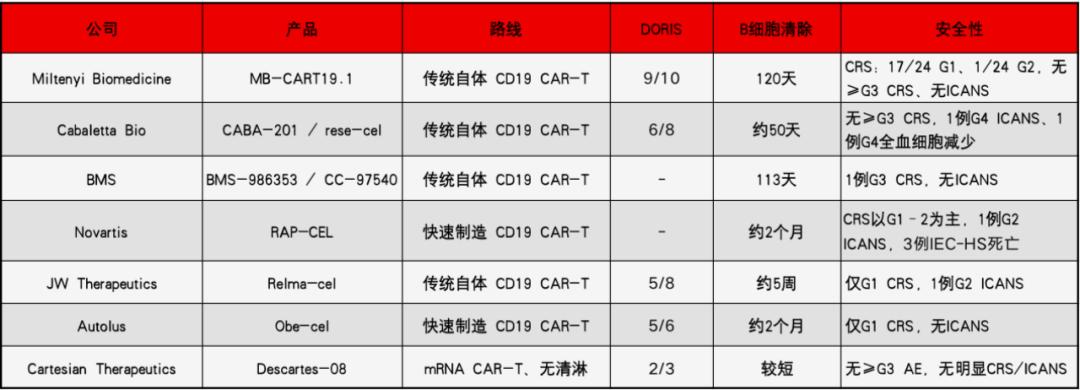
Of course, there are differences in patient baseline, medication dosage, preconditioning regimen and follow-up time between different studies, and a strict causal relationship cannot be directly determined, but these signs at least indicate one point: the negative impact of the rapid CAR-T production process on safety deserves vigilance.
This touches on the deeper logical contradiction in CAR-T therapy development: although cost reduction is the core purpose of rapid manufacturing, in the autoimmune field, it must not be based on sacrificing safety.
Tumor patients may be willing to take high toxicity to fight for survival at the critical moment of life and death, but autoimmune patients can never accept exchanging their lives for a "rapidly produced" therapy. If the cost of cost reduction and speed improvement is a higher fatal risk, this kind of technological innovation will be worthless in front of clinical practice and regulation.
This also sounds the alarm for differentiated routes such as allogeneic and in vivo CAR-T. Although some risks are reduced in terms of mechanism, there are still unknown challenges.
In the autoimmune market that is opening its arms to CAR-T, the real way to break through is to find a more precise balance among curative effect, safety and industrialization cost.
04
Summary
The ice and fire of rapid CAR-T are essentially two sides of the same coin: faster, cheaper, more accessible, and more aggressive, more dangerous, more uncontrollable.
The suspensions of Novartis and BMS do not necessarily mean that the rapid manufacturing route is not feasible. But it at least shows that in this brand new battlefield, the competition of CAR-T cannot only focus on who can do it faster. The cost and efficiency advantages brought by speed must be built on the basis of controllable safety.
This article is from the WeChat official account "Amino Observation" (ID: anjiguancha), the author is Sha Xiaowei, published with authorization from 36Kr.