Smart glasses are selling like hotcakes, but the return rate is as high as 70%.
In the first half of 2026, the omni-channel sales volume of smart glasses in China increased by 85.5% year-on-year, and sales revenue increased by 98.7% year-on-year. Against the backdrop of overall pressure on the consumer electronics industry, the smart glasses market has achieved rapid growth. Is this "false prosperity" or a "real opportunity"?
On August 24, Jia Tianrong, a reporter from *IT Times*, was a guest on the "Financial Noon Express" program of Yicai, and discussed this topic with host Tan Shuai.
Sales Volume Exceeded 900,000 Units in the First Half of the Year, High Return Rate Becomes a Hidden Concern
Yicai: The growth rate of the smart glasses market in the first half of 2026 is astonishing. How do you view this phenomenon? Is the future growth momentum sustainable?
Jia Tianrong: Smart glasses sold more than 900,000 units in the first half of the year, with a growth rate of over 85%. Against the general backdrop of overall pressure on the consumer electronics industry, this is quite unexpected. The growth rate is indeed very impressive.
I think there are several obvious structural factors behind this trend. The first one is the effort from the supply side. In the first half of the year, manufacturers significantly accelerated the pace of launching new products. According to our statistics, more than 70 new smart glasses-related products were released in the first half of the year. It is worth noting that only more than 70 products were released in the whole year of 2025. With so many new products launched intensively, the product matrix has been greatly enriched, and the functions have expanded from the previous basic use cases such as listening to music and answering calls to more practical functions including AI, photography and office scenarios, which greatly expands consumers' choices.
The second factor is policy support. This year, the national subsidy for the first time covered the smart glasses category, which has greatly boosted consumers' purchasing willingness. Smart glasses are not cheap in themselves, and they are relatively novel products. With subsidies, consumers are more willing to pay for a try.
The third factor is the price drop. With the maturity of the supply chain, larger shipment volume, plus the national subsidy, there are more and more products priced at the 1000-yuan level. For example, the latest smart glasses launched by Thunderbird are priced below 2000 yuan, which significantly lowers the threshold for early adopters.
Looking ahead, I think the industry is generally quite optimistic. According to the forecast of Luotu Technology, the annual sales volume of smart glasses in China will reach 3.2 million units, with a year-on-year growth of 120%. In the second half of the year, there are major promotion nodes such as Double 11 and Double 12, new product releases will be more intensive, and the subsidies will continue, so I think this growth is well supported.
However, apart from optimism, we also need to pay attention to one problem — the return rate. According to data from Luotu Technology, the return rate of smart glasses on e-commerce platforms has reached 30%, and some even as high as 70%. Although consumers are willing to buy them, after taking them home, many people may still regard them as digital toys that will be left unused once the novelty fades. Therefore, whether the growth can be sustained in the next stage depends on the maturity of products, and whether consumers can keep wearing them and actually use them in daily life. This is a hurdle that the industry must cross at present.
Moat Is Far From Stable, Privacy and Security Should Not Be Treated as Add-ons
Yicai: What is the current brand pattern of the market? Do leading brands have deep competitive moats? Are there still opportunities for new players?
Jia Tianrong: According to the data, Thunderbird, Rokid, Qianwen and Huawei rank top four in online sales, but their combined market share has dropped from 56% in the first quarter to 53% in the second quarter. I believe that China's smart glasses market is in a reshuffling stage of rapid growth with an undetermined pattern. Leading brands have certain first-mover advantages, but they are far from building a stable competitive moat.
For example, the core advantages of top-ranked brands are mostly concentrated in self-developed optical technology, supply chain integration, production capacity and cost control and other aspects. But as we discussed earlier, the key to building competitive barriers lies in who can truly get consumers to wear the products for a long time and launch "killer applications". Therefore, new brands and cross-sector manufacturers have full opportunities. The market is still in the knockout stage, far from reaching a final conclusion.
Yicai: What are the main categories of smart glasses on the market? What are their respective characteristics?
Jia Tianrong: There are many classification methods. From the perspective of product form, the most intuitive distinction is display-equipped and non-display. The non-display category emphasizes lightweight design and is suitable for daily wear; the display category has richer functions, but the device body is heavier.
From the perspective of technical routes, mainstream technologies are divided into three categories:
VR (Virtual Reality) glasses present 3D immersive images through displays and lenses, which are suitable for games and movie watching, but the disadvantage is that they are bulky.
AR/MR (Augmented Reality / Mixed Reality) glasses integrate virtual information with the real world, and can realize functions such as navigation, commodity recognition and spatial interaction.
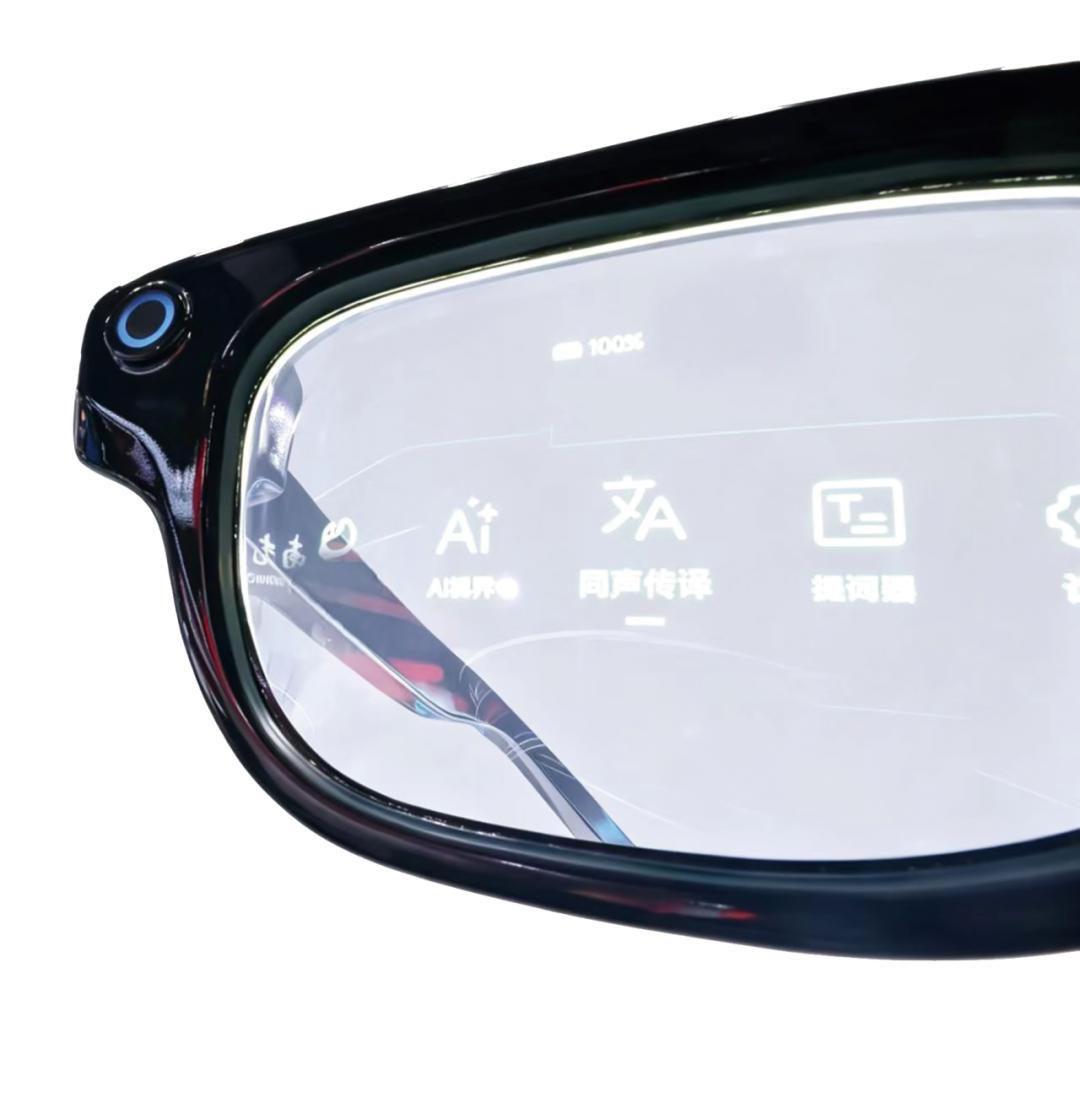
AI glasses are the category with the largest number of new products released at present, featuring functions such as AI voice interaction, intelligent Q&A, photo taking, meeting recording and real-time translation.
Of course, these categories are constantly merging. For example, AR glasses have also begun to integrate AI assistants. In the future, with technological breakthroughs, "lightweight + full-featured" glasses will be the common direction of efforts for all players in the industry.
Yicai: Behind the rapid development of smart glasses, what hidden dangers are worth paying attention to?
Jia Tianrong: The most noteworthy issue is definitely privacy. Smart glasses are equipped with cameras, and different from mobile phones, their shooting actions are more hidden, so people around can hardly notice that they are being filmed. Although regulations require the indicator light to stay on when taking photos or recording videos, there have been gray tutorials on the Internet teaching people how to block the indicator light and turn off the prompts, which has caused huge controversy.
The second problem is data security. Smart glasses collect not only photos and videos, but also voice, location, environmental data and other information. For mobile phone permissions, users usually need to authorize them one by one, but most AI glasses open all permissions unconsciously, so users have no idea what data is being collected from them.
The third problem is personal safety. When driving or walking, if there is too much information on the glasses and the AI assistant keeps prompting you with voice in your ear, it will easily distract your attention and increase safety risks.
Therefore, if smart glasses want to truly enter daily life, privacy and security issues cannot be treated as add-ons, and must be part of the product design. The industry cannot expect a single indicator light to solve all the problems.
The "Impossible Triangle" Remains Unsolved, It Is Too Early to Talk About the "iPhone Moment"
Yicai: As smart glasses evolve from "early adopter products" to "mass daily supplies", what is the direction of product and technology iteration?
Jia Tianrong: I think the core is to solve the "impossible triangle" — it is difficult to take into account lightweight design, high computing power and long battery life at the same time. The weight of mainstream products now ranges from 40g to 50g, while ordinary glasses only weigh more than 20g. Battery life is also a difficult problem. Many products may run out of power after only one hour of high-intensity use scenarios such as continuous recording.
In the future, on the one hand, the physical form of smart glasses will be infinitely close to ordinary myopia glasses, so that users will hardly feel the existence of the device when wearing it. On the other hand, the safety design system will be improved, for example, clarifying which occasions allow shooting, and how to make people being filmed clearly know that they are being recorded. We can learn from some practices of mobile phones: mandatory voice prompts for call recording, mandatory shutter sound when taking photos, etc. Of course, using more intelligent AI methods to solve these problems will be a better exploration direction.
Purchasing Suggestions: Do Not Be Led Astray by the Word "Smart"
Yicai: With a huge variety of products, how can consumers avoid traps and choose products that suit them?
Jia Tianrong: My suggestion is not to be led astray by the word "smart", but to choose a good "glasses" first.
Consumers should first clarify their core needs. If the main purpose is to listen to music and answer calls, audio smart glasses are sufficient, and there is no need to spend extra money on unused AI functions; if you love shooting Vlogs and recording life, give priority to products with strong first-person shooting functions; if you mainly use them for movie watching and games, choose display-equipped glasses.
Before purchasing, you must go to offline stores to try them on. Glasses are worn on the face, so comfort is far more important than parameters. Weight, fit of nose pads, and wearing stability can only be known through personal trial.
Make clear whether the marked battery life refers to standby time or actual use time. Some smart glasses are advertised to have a battery life of more than ten hours, but they run out of power after two or three hours of high-intensity use, and there are many traps in this part.
If you are not in a hurry, you can wait a little longer. Smart glasses are still in a stage of rapid iteration, a bit like the early new energy vehicles. Last year, AR glasses priced at four to five thousand yuan only had the function of watching movies, without even native applications, which were quite impractical. But the smart glasses I experienced at the exhibition this year are equipped with functions such as translation, photography and meeting recording, and the progress is very fast. It is expected that there will be another wave of outbreak in 2027 and 2028, and waiting for more mature products is also a good choice.
Source / Official account of *IT Times* vittimes
This article comes from the WeChat official account "IT Times" (ID: vittimes), author: Jia Tianrong, published with authorization from 36Kr.