The Second Half of Chinese Bus Industry's Overseas Expansion
When China's bus export volume settled at 78,000 units in 2025, with new energy bus exports reaching a new high of 17,645 units, people across the industry are pondering one question: After years of playing the "first half" of the game driven by electrification, are we approaching the ceiling?
The answer is no. Electrification is just the appetizer, and intelligence is the main course.
Data from iAnalysis's *2025 Global and China Autonomous Driving Bus Market Research Report* clearly shows that the global autonomous driving bus market size was only USD 1.8 billion in 2024, and it is expected to surge to USD 5.09 billion by 2029, representing a compound annual growth rate of 23.1%. The same trend applies to the domestic market, which started at RMB 1.9 billion and is projected to reach RMB 6.63 billion five years later. The report also notes that Chinese players such as Mushroom Car Alliance and WeRide have already secured leading positions in the global landscape.
In other words, the second half of Chinese buses' global expansion has quietly kicked off: the business model has shifted from selling electric buses to exporting a complete set of system capabilities for autonomous driving buses.
Review of the First Half: How Chinese Buses Penetrated the Global Market
Let's first clarify the foundation laid in the first half.
On the 2025 new energy bus export ranking list, BYD takes the first place with 4,234 units, Yutong closely follows with 4,011 units, and Zhongtong ranks third with 1,447 units, marking a year-on-year surge of 245.35%. From Peru to Saudi Arabia, from Egypt to Vietnam, Chinese electric buses are running all over the world, relying on mature three-electric systems, low-cost supply chains, and highly competitive products.
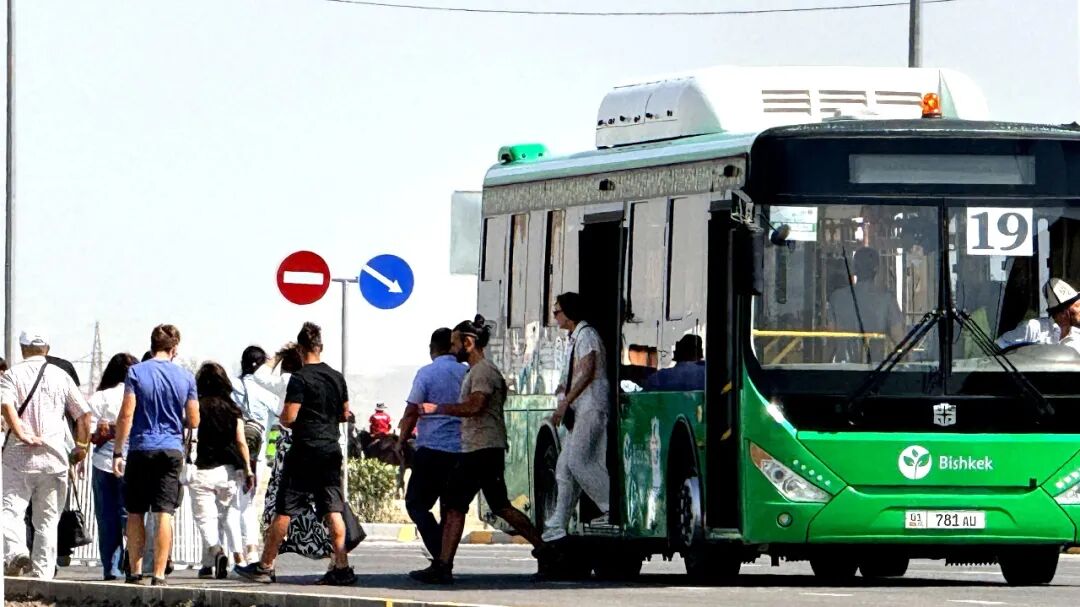
Yutong has made tremendous efforts in globalization: it has cumulatively exported more than 13,000 new energy buses, covering over 60 countries, established more than a dozen KD knock-down assembly plants in places like Kazakhstan and Pakistan, and operates over 400 overseas service outlets. BYD has gone even further: it entered high-threshold markets such as Japan and Europe at an early stage, and independently manages the entire industrial chain. In some Latin American markets, the market share of Chinese brands can reach nearly 80%. Long-established players including Golden Dragon, Golden Travel, and Higer are also gradually expanding their footprint across Asia, Africa, Latin America, and the Middle East.
However, electrification fundamentally cannot solve operational problems. Operators still need to hire drivers, the shortage of drivers persists, traffic jams remain as usual, and safety accidents still occur. These long-standing problems in public transport will not disappear automatically just by replacing diesel engines with batteries. On the contrary, as global urbanization continues to advance rapidly, these contradictions have become increasingly prominent.
Multiple practical pain points in the overseas public transport industry
The overseas public transport market is facing multiple structural contradictions, which will not disappear automatically with the electrification of vehicles, and will even continue to intensify as urbanization moves forward.
First, the labor cost of public transport drivers is rising sharply, and the global driver shortage continues to expand. In many countries in Europe and North America, the gap in public transport driver positions generally reaches 15%-25%. In many Middle Eastern cities, public transport drivers are almost entirely dependent on foreign workers, leading to continuously rising labor recruitment costs and high employee turnover rates, according to UITP. Public transport driving is a high-intensity job with early shifts, late shifts, split scheduling, and the need to deal with passenger conflicts, resulting in widespread occupational burnout. The recruitment and training losses caused by one driver's resignation can reach tens of thousands of US dollars. Singapore and many European countries are facing population aging, and the local labor force willing to engage in public transport driving is shrinking continuously. Even if a large number of new energy buses are procured, without sufficient drivers, the vehicles can only be parked idle at depots, and the advantages of hardware cannot be converted into actual transport capacity.
Second, the environmental and working conditions around the world are highly diverse, bringing complex challenges to vehicle operation. The Middle East has to cope with high temperatures and heavy sandstorms; Central Asia and Northern Europe face low temperatures and icy roads; some cities in Africa have bumpy roads and heavy dust; Southeast Asia has a hot, humid climate with abundant rainfall. Electric buses have undergone extensive hardware adaptation for different climates, but human driving behavior is difficult to standardize. Risks caused by driver fatigue in high-temperature environments, human operational errors on icy and snowy roads, and long-hour driving on mountain roads will not disappear just because the vehicle is switched to an electric one. Traffic rules vary greatly across different countries: right-hand drive with left-side traffic, roundabout traffic logic, and local drivers' driving habits all impose high requirements on drivers, leading to persistently high driver training costs in overseas markets.
Third, the pressure on public travel safety continues to rise, and human operational risks are difficult to completely avoid. Public transport vehicles are large-capacity public transport tools, and any accident will have a huge social impact. Human factors including fatigue driving, mood swings, and operational errors are important causes of global public transport accidents. Even with strict regulatory constraints, human uncertainty cannot be completely eliminated. At the same time, the certification thresholds for vehicle cyber security, functional safety, and safety of the intended functionality in overseas markets are getting higher and higher. Traditional buses can only solve the problem of vehicle hardware safety, but cannot eliminate the safety hazards brought by human driving.
Fourth, 24/7 uninterrupted shuttle services, night commuting, and suburban micro-circulation scenarios are difficult to implement. Under the traditional model, low-passenger-flow routes at night, in the early morning, and in suburban areas are restricted by driver scheduling and labor costs, making it difficult to launch public transport services that operate continuously. Many industrial parks, ports, tourist attractions, and satellite cities have demand for night shuttle services, but the passenger flow is scattered. Arranging full-time drivers for operation leads to revenues that cannot cover costs, so these routes can only be abandoned. This is a common shortcoming of public transport in many cities around the world, and relying solely on electrification cannot solve the underlying contradiction of manpower scheduling.
Fifth, the comprehensive cost of localized operation remains high, and the pressure on total lifecycle cost is prominent. Procuring electric buses is only the first step for operators. Driver salaries, social insurance, personnel training, personnel rotation, and union negotiations constitute long-term rigid expenditures. In many overseas projects, driver labor costs account for more than half of the total public transport operation costs. In some developing countries, drivers' unions have strong power, and salary and scheduling rules are subject to strict constraints, further compressing the profit margins of operators. New energy buses reduce fuel consumption, but the rigid rise in labor costs is constantly eroding the benefits brought by cost reduction.
Sixth, complex urban working conditions bring difficulties to improving riding experience. Dense urban public transport networks have a large number of stops, requiring frequent starting and stopping. Different drivers have different personal driving habits, leading to inconsistent hard acceleration, hard braking, and uneven parking distances at stops, which results in fluctuating passenger experience. For example, there are more than 5,000 bus stops across Singapore, and high-frequency starting and stopping impose extremely high requirements on parking accuracy and driving smoothness. The experience differences caused by different drivers' operations are difficult to eliminate. In addition, some cities adopt the on-demand hailing stop mode, which requires distinguishing between passers-by waving for greeting and passers-by waving to take a bus. Relying solely on human drivers easily leads to missed stops and wrong stops.
The above pain points are "human-related problems" that electrification cannot solve. Electric buses have completed the energy revolution of vehicles, but the underlying logic of operation still highly depends on drivers. The autonomous driving bus is designed to precisely solve this series of persistent problems in the industry.
Top 10 Overseas Expansion Legions: Who is Leading the Second Half?
Based on the 2025 export data and the depth of global layout, the pattern of China's top 10 bus enterprises in overseas expansion is as follows:
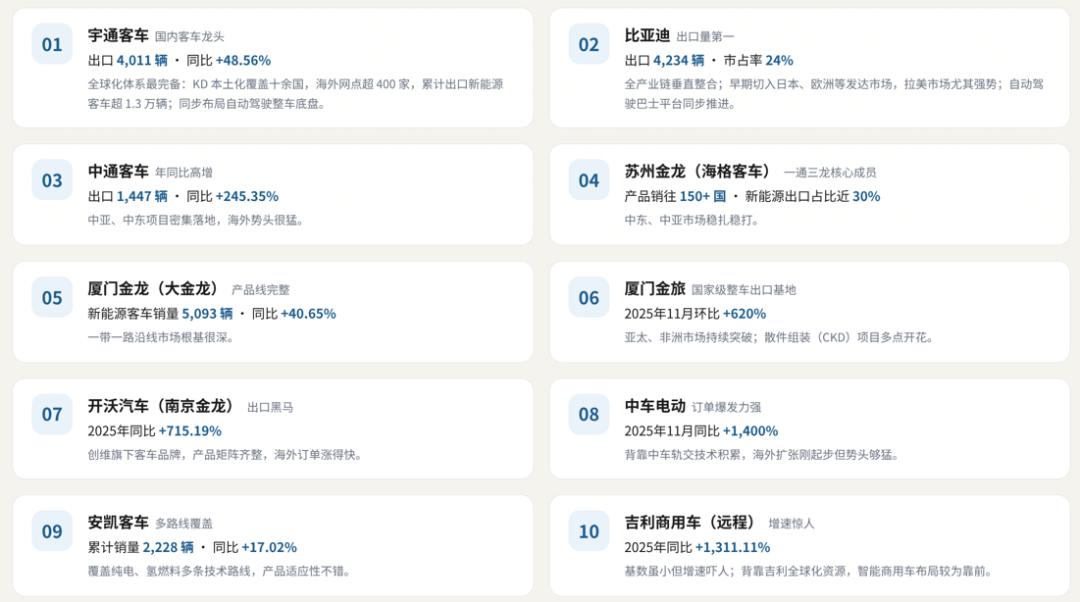
It is worth noting that a new cooperation paradigm is emerging in the industry: vehicle manufacturers and autonomous driving technology companies form a consortium to expand overseas. Yutong and BYD provide vehicle manufacturing capabilities and overseas channels, while Mushroom Car Alliance, WeRide, and QCraft provide full-stack L4 algorithms. This consortium bidding model has become a mainstream practice in high-standard markets such as Singapore.
From Selling Vehicles to Selling Solutions: Thorough Restructuring of the Overseas Business Model
The iAnalysis report defines five core competitive dimensions: full-stack technical capability, scenario implementation capability, operation and large-scale implementation capability, ecological aggregation capability, and sustainable profitability. These are not empty concepts, and some enterprises have already delivered satisfactory results overseas.
Mushroom Car Alliance, together with BYD and MKX Technologies, won Singapore's first official L4 autonomous driving bus project, standing out from a large number of global bidders. The vehicles need to obtain M1 certification, adapt the algorithm for right-hand drive, and comply with local roundabout traffic and parking rules.
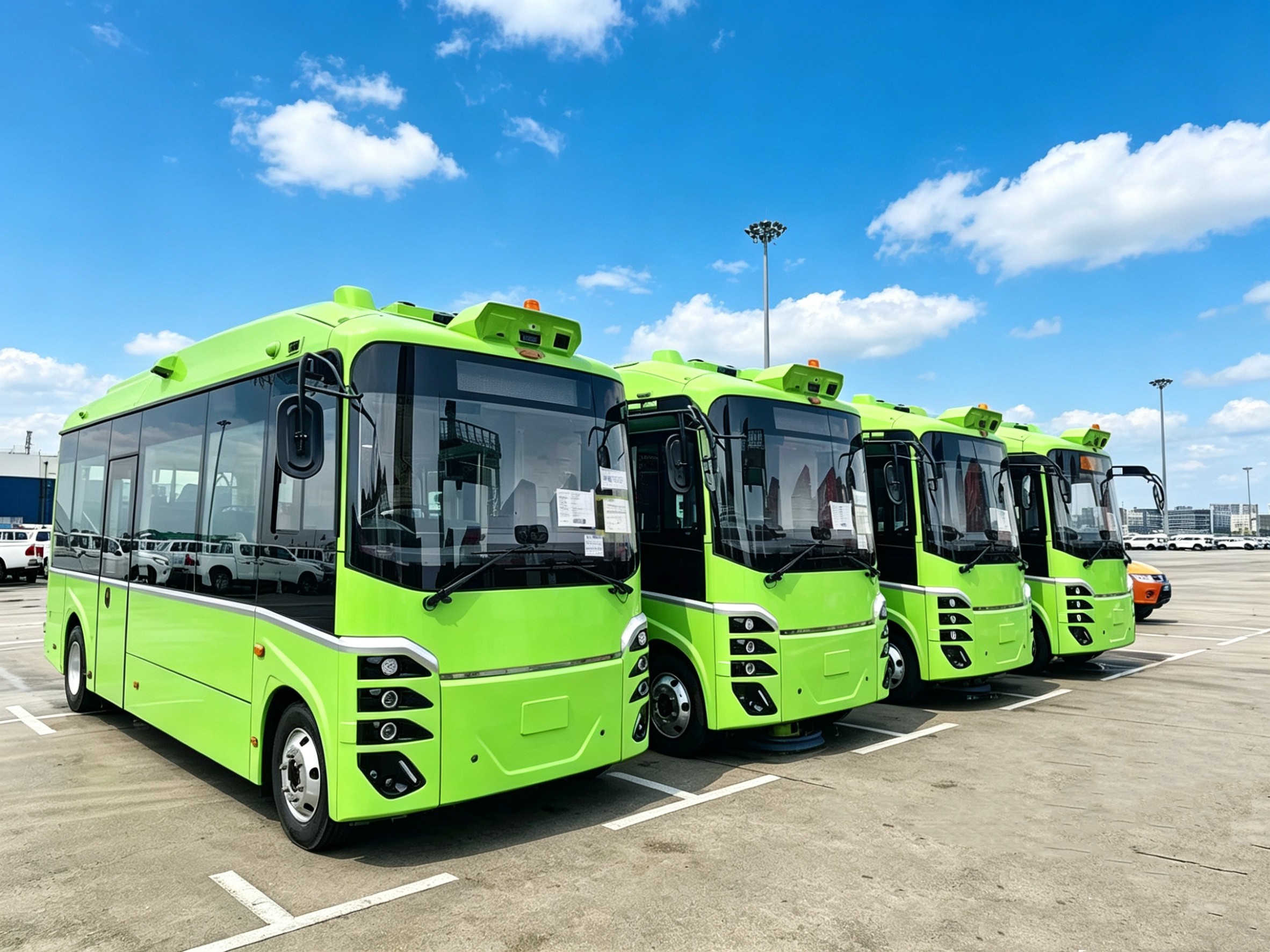
This case points to a fact: when autonomous driving buses go global, what is sold is no longer a single vehicle, but "MaaS" — Mobility as a Service. Customers purchase a packaged solution: a complete set of vehicles, algorithms, remote monitoring, operation and maintenance systems, data services, and safe operation capabilities. The business model has evolved from a one-off "cash on delivery" transaction to a long-term business model featuring service leasing and operation revenue sharing.
In the Physical AI Era, Chinese Buses Are Heading for the World
Autonomous driving buses are no longer a concept. They are becoming physical AI infrastructure that reshapes global public transport. At the technical level, the industry is promoting the combined solution of solid-state LiDAR and pure vision; at the commercial level, hardware costs are decreasing while unmanned operation capabilities are improving, and viable commercial closed loops have emerged.
The second half of Chinese buses' global expansion is the double helix of electrification and intelligence. In the first half, we exported three-electric manufacturing capabilities and cost advantages. In the second half, we will export full-stack L4 algorithms, pre-installed mass production capabilities, and a complete set of safe operation systems. When domestic autonomous driving buses drive onto public roads in countries all over the world and travel through overseas tourist resorts, Chinese commercial vehicles are completing the leap from product export to technology export, and further to standard export.
Global public transport is undergoing a once-in-a-century underlying restructuring. This time, the right to define the rules belongs to China.
This article is from the WeChat public account "Shan Zi", the author is Rayking629, and is authorized for release by 36Kr.