South Korea launches the National AI Plan for the General Public.
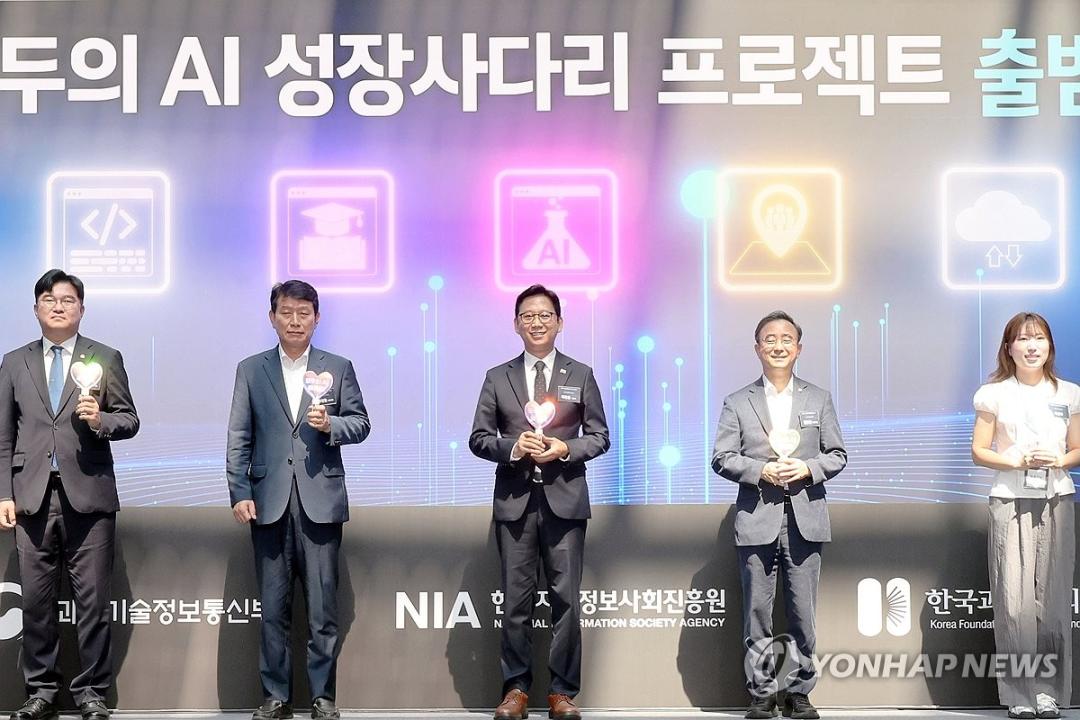
Recently, South Korea has officially launched a national AI initiative: all citizens get free, unlimited access to AI services.
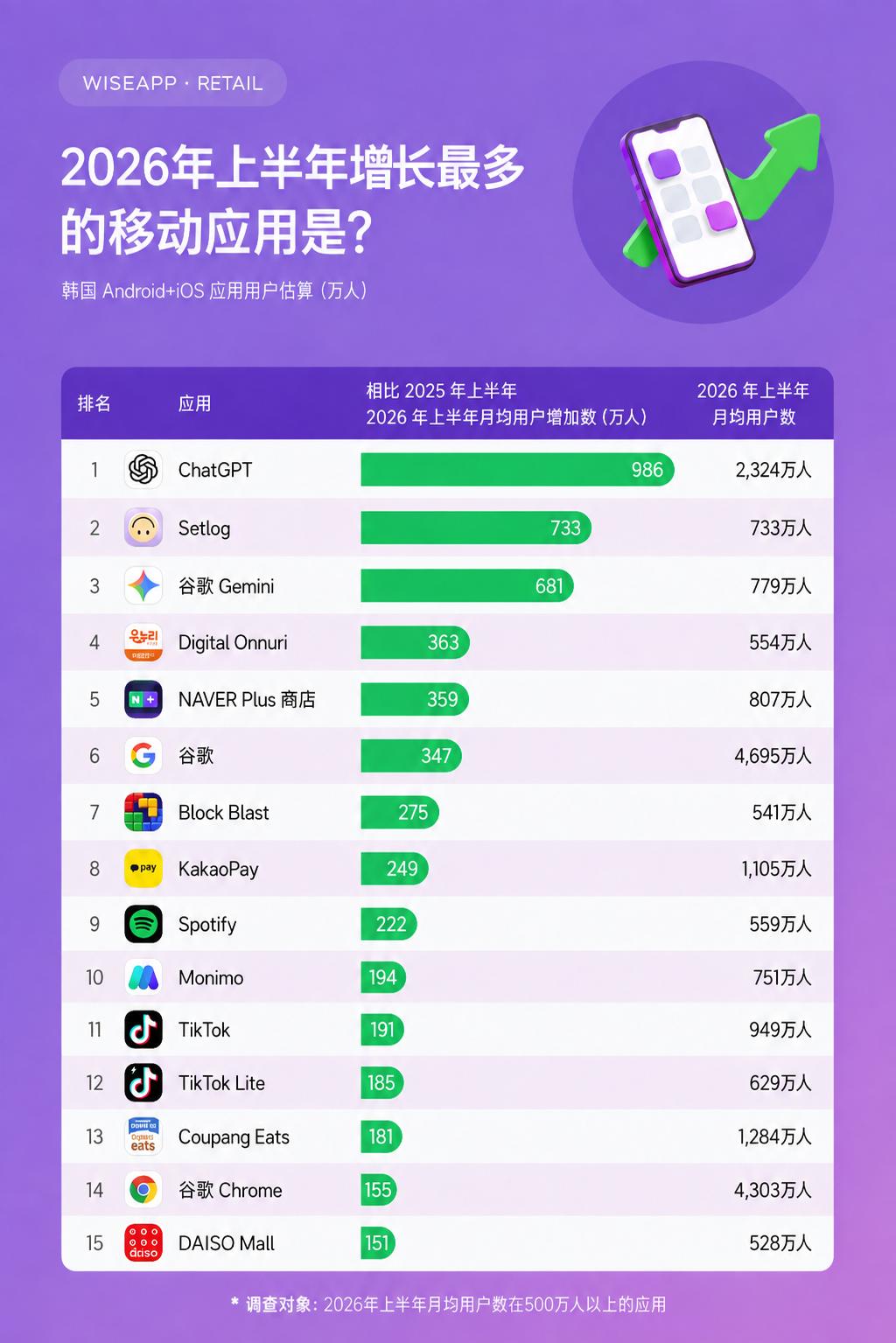
With a total population of 51 million, South Korea has 23.45 million active ChatGPT users, meaning this US product covers nearly half of the country's population.
The South Korean government is funding the initiative itself: on August 28, the Ministry of Science and ICT announced that three major alliances led by SK Telecom, KT and Kakao were selected for the "AI for All" project, which will provide free, unlimited AI services to all citizens by the end of this year, with the requirement that 80% of the service workload must run on South Korea's domestic AI models.
This is the first G20 economy to build AI as a public infrastructure.
What Should Countries Outside the US and China Do?
AI model capabilities are highly concentrated in the United States and China, while all other countries are mere consumers of AI products.
Data from Wiseapp as of April 2026 shows that ChatGPT has 23.45 million monthly active users in South Korea, followed by Gemini with 8.45 million and Claude with 2.41 million, and the top three are all foreign products.
South Korea has local AI models including LG EXAONE, SKT A.X K2 and Upstage Solar, but their user bases are several orders of magnitude smaller than those of foreign counterparts.
https://www.wiseapp.co.kr/insight/detail/1033/fastest-growing-and-most-used-mobile-apps-in-korea
Domestic AI models need real user feedback to iterate, and users will not switch from ChatGPT to a less capable product, which means data will keep accumulating on servers owned by foreign vendors.
This vicious cycle cannot be broken by the market itself.
The South Korean government has chosen an unprecedented path globally: instead of competing head-on in model performance, it leverages public finance to take control of the distribution end.
The "Basic AI Act" that came into effect in January 2026 provides a legal framework for government intervention in the AI industry. The "AI Action Plan 2026–2028" finalized in February the same year further proposed the concept of "AI-based society", positioning AI access as a fundamental civil right on a par with education.
Deputy Prime Minister Bae Kyeong-hoon described this project as "the calculator and personal computer of the AI era".
The popularization of calculators was driven by centralized procurement by schools and government agencies.
Exchanging Distribution Rights for Survival Rights: A New Type of Industrial Policy
The business logic of the "AI for All" initiative can be summarized in one sentence: the government covers the costs and provides computing power access, brings all 51 million citizens into the domestic AI ecosystem, and uses real user traffic to scale up and improve domestic AI models.
This year, the government has allocated a total of 512 NVIDIA B200 GPUs to the three alliances (one B200 is roughly equivalent to the inference computing power of 3 to 4 H200s). Starting from 2027, all operating costs will be covered by the national budget, and the free service will last at least until 2028.
However, funding and computing power are only the entry threshold. What truly shapes the ecosystem is the rule: at least 50% of the services of each alliance must run on self-developed sovereign foundational models, and the other 30% must run on models from other South Korean companies, setting a minimum 80% domestic workload requirement.
Foreign AI models are only allowed to be used in scenarios that cannot be covered by domestic South Korean models for the time being, and the government will not pay for this part of the service.
This rule forces each alliance to partner with multiple domestic model vendors, which as a side effect expands the total order pool of the entire South Korean AI industry.
The main difference between the three alliances lies in their distribution entrances.
SK Telecom (SKT) has 22.5 million mobile subscribers, focusing on "mobile AI" that can make calls and handle affairs on behalf of users, using the 688-billion-parameter sovereign model A.X K2.
Kakao has embedded AI into KakaoTalk, the messaging app used by all South Koreans, enabling users to make reservations, pay bills and submit applications directly in the chat window.
KT adopts a channel alliance strategy, connecting the Daum portal and a number of vertical apps into the same conversational entrance.
All three paths are betting on the same goal: to build AI from a mere chat tool into a public agent that can help ordinary people file tax returns, register for medical appointments and apply for subsidies, which is something ChatGPT cannot achieve at present.
The first version to be launched at the end of this year will be a general-purpose chatbot, while the real test will come in 2027.
The essence of this design is a demand-side industrial policy.
Over the past decade, the mainstream approach adopted by various countries to support domestic technology is to subsidize the supply side, that is, providing funds for chip manufacturers to build production lines and giving R&D grants to AI companies.
South Korea spends its funds on the distribution end: using public finance to create a protected user pool, allowing domestic AI models to accumulate data and iteration experience in real scenarios.
In comparison, this initiative has a larger scale, a tighter timetable, and higher requirements for consumer-end experience.
What is the Ceiling of This Experiment?
The biggest variable is the absence of Naver.
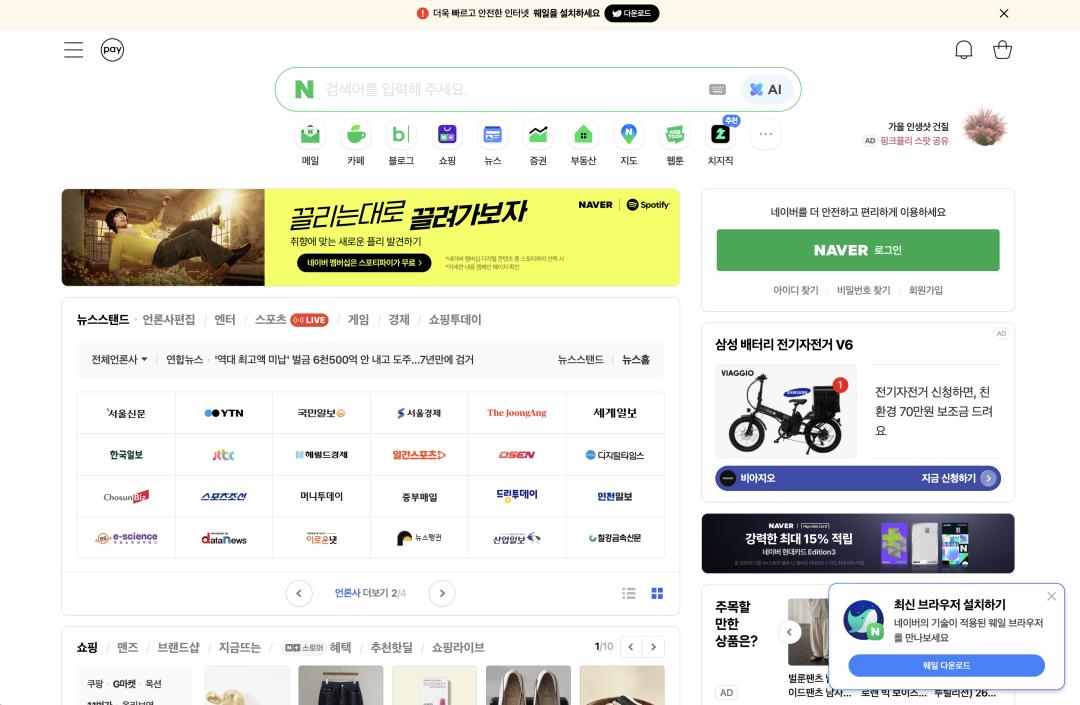
Naver is the South Korean equivalent of Google, the largest search and life service platform in South Korea that owns a full set of entrances including search, maps, shopping and payment, and is far better positioned than any other competitor to build a national AI assistant.
Surprisingly, it did not participate in the project at all.
https://www.naver.com/
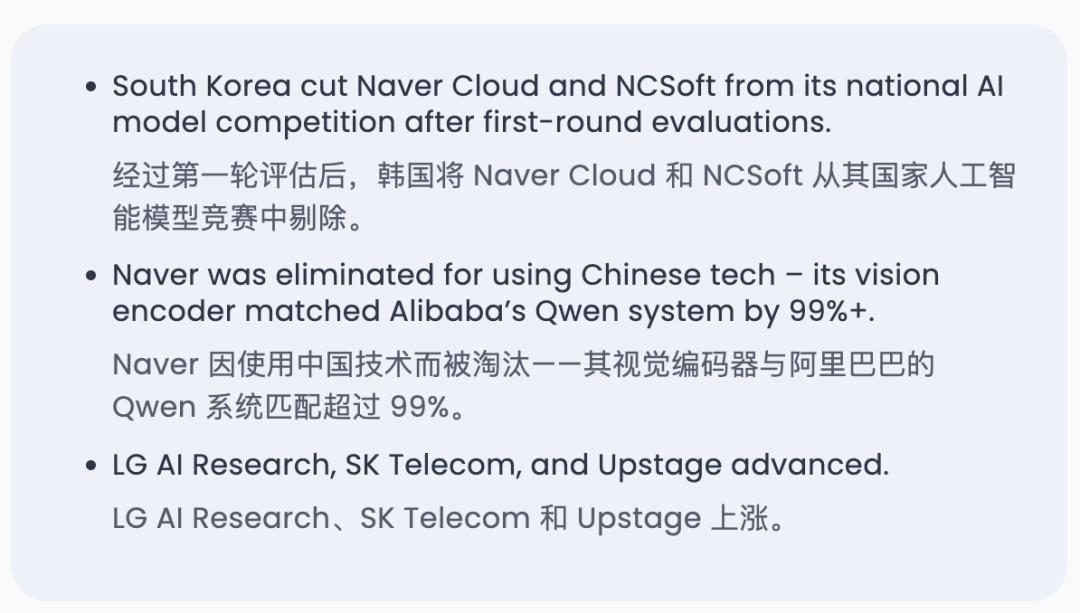
In January this year, Naver Cloud was eliminated from the government-led sovereign AI foundational model project, as the cosine similarity between the visual encoder of its HyperCLOVA X model and Alibaba's Qwen reached 99.5%, which failed to meet the independence requirement — in short, it was secretly using a wrapped version of Qwen.
https://www.cryptopolitan.com/korea-naver-ncsoft-ai-contest/
Samsung is also absent from the project.
In short, the final result is that the platforms that control the most user scenarios and the largest hardware manufacturer in South Korea are not at the table, and this national-level project is undertaken by two telecom operators and one messaging app.
User retention is another tough problem.
The basic version of ChatGPT is already free, so South Korean users will not stop using it just because a new free alternative becomes available.
Wiseapp data shows that ChatGPT was the fastest-growing app by user base in South Korea in the first half of this year, adding 9.86 million new users in six months.
The government can guide users to try the new service, but whether they will stay depends on whether domestic AI agents can deliver capabilities that ChatGPT cannot — functions deeply integrated with local government service systems such as tax filing, medical appointment registration and subsidy application are exactly what foreign products cannot access in the short term.
This is the most noteworthy part of the South Korean solution: leveraging the exclusivity of government service scenarios to improve user stickiness of domestic AI products.
512 B200 GPUs serve 51 million people, and there is a clear order-of-magnitude gap in computing power compared to what supports ChatGPT's 900 million weekly active users.
The free service is promised to last until 2028, after which the operators will need to achieve profitability on their own.
If users have already got used to free services by then, paid conversion will not be easier than it is today.
This South Korean experiment is answering a critical question for all countries outside the US and China: when domestic model capabilities cannot catch up with leading players, can taking control of the distribution end create a survival window for the local AI industry?
After the official launch at the end of this year, the first key indicator to verify is the retention rate — when free ChatGPT and free domestic AI are both available, the choice of 51 million South Korean users will prove whether this path is a replicable paradigm, or just an expensive lesson.
References: https://en.yna.co.kr/view/AEN20260828002600320
This article is from the WeChat official account "AI_era" (ID: AI_era), author: ASI Revelation; editor: Ma Ke, republished with authorization from 36Kr.