There is still no compelling reason for people to open their wallets to bring robots into their homes.

Interview | Liu Sijie, Zhang Wei, Ba Rui
Text | Liu Sijie
Editor | Zhang Wei
Cover Source | Official Website of Lexiang Technology
A highly intuitive entrepreneur is increasingly hesitant to blindly trust his own intuition.
More than half a year ago, "Future Human Lab" met Guo Renjie for the first time. He came with the aura of being a graduate of the Special Class for Young Talents at Xi'an Jiaotong University, and former CEO of the China region who once led Dreame's domestic business to a 10-billion-yuan scale. He founded Lexiang Technology at the end of 2024, and received investments from many leading domestic and international VC firms.
In front of us, he showed the state of an intuitive consumer hardware entrepreneur who firmly dived into the "rabbit hole" of household consumer robots.
Why must you focus on building household robots?
He repeatedly stated to us, "When defining products, you must draw inspiration from your own life and the lives of users."
Guo Renjie is very certain that Chinese hardware companies have reached the stage where they can define new product categories, and household robots are exactly the new entry-level consumer hardware that can enter thousands of households.
Founded for less than two years, Lexiang has publicly launched multiple robot models including M1, W1, Jupiter and N1, covering different forms such as small humanoid robots, large humanoid robots, tracked robots and wheeled-arm collaborative robots.
At the end of August, before the release of Zeroth Bridge (hereinafter referred to as Bridge), the new product of Yuandian Robotics, the household embodied intelligence brand under Lexiang Technology, we had another conversation with him.
This time, he still firmly believes in the huge market of household robots, but he is increasingly hesitant to easily judge what the first demand that enters households is. Everything is facing vast uncharted areas and blind spots. "The demands in this industry are extremely fragmented, more fragmented than I imagined," he said.
The blind spots are not only where the first rigid demand for household use lies, but also the gap between technical solutions and engineering implementation, the gap between product pricing and user acceptance... Walking through the mud with uneven steps, he described himself as: "I am more determined strategically, but tactically I increasingly dare not trust my intuition, I only trust data."
The launch of Bridge came right after this shift in mindset.
It is still a small humanoid robot, 88 cm tall, taller than the 50 cm M1. It also has certain ground operation capabilities, can perform street dance, backflips and teleoperation, and can be externally connected with hardware such as grippers, dexterous hands and navigation modules.
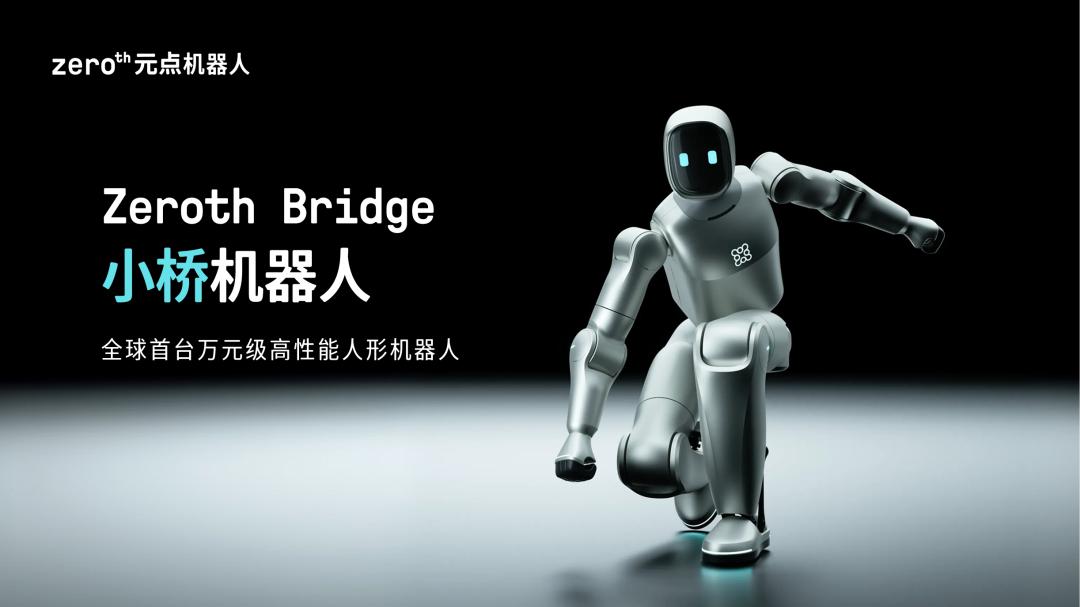
Promotional poster of Bridge
Different from M1 which is mainly oriented to family companionship and care, Bridge with an initial launch price of 8888 yuan is first sold to developers and geeks.
Released together with Bridge is OpenBridge, an open-source developer ecosystem. The relationship between this ecosystem and Bridge is equivalent to the relationship between Android and mobile phones.
In Guo Renjie's plan, Yuandian Robotics will first deliver an affordable, high-performance, trainable humanoid robot body to geeks and developers, allowing them to "push the limits" of the boundary between hardware and software. Then based on the demands that can be met within this boundary, conduct tests on the user side to find the demands that users can truly understand, value, and are willing to pay for.
The launch of Bridge follows the testing logic Guo Renjie believes in: split limited resources into many small portions, produce prototypes, and distribute them to users for testing. For C-end products, launch them to see if users are willing to pay; for developer-oriented products, provide them to developers to see if they are willing to purchase. Based on the test results, cut projects that fall below expectations, and retain products worthy of continued investment.
Bridge was developed exactly through this process.
In the "Odyssey period" of exploring the rigid demand for household robots, continuous small-scale testing is an effective action for Guo Renjie to prevent himself from drowning in the unknown.
Another unavoidable action is to build self-owned production lines starting from June. He told us he does not want to "work as a factory director", but the robot industry is still too early, there are no mass production standards, and many links are still being built manually, so he has no choice but to do so. Guo Renjie's daily life is thus split into two parts: on one hand, he makes long-term technical layouts, on the other hand, he returns to the factory to solve specific problems such as loose screws.
In this 2.5-hour conversation, we talked about more issues related to commercial implementation: specific orders, delivery, ROI, project selection, how to achieve consistency in mass production, and whether users are willing to pay. We heard more of his reviews on entrepreneurial methods.
In this early-stage robot industry, keen intuition and belief in the final destination are very important, while repeated testing to verify the combination of user demands and the boundary of robot capabilities can make the final vision land.
The following is the collation of two conversations between "Future Human Lab" (hereinafter referred to as "Future Lab") and Guo Renjie.

Guo Renjie

No Clear Rigid Demand Leads to Difficulty in Pricing
Future Lab: Which of your robots has the best sales performance now?
Guo Renjie: The best-selling model is M1, a small household humanoid robot, which accounts for about 70% to 80% of total sales. But these are mainly B-end orders. By the end of September to early October this year, we will start selling M1 to household users.
On September 2 this year, the product we released is Bridge. We prepared about 1000 units for the first batch, hoping to sell out these 1000 units first. It is a very clear product that is first sold to geeks and developers.
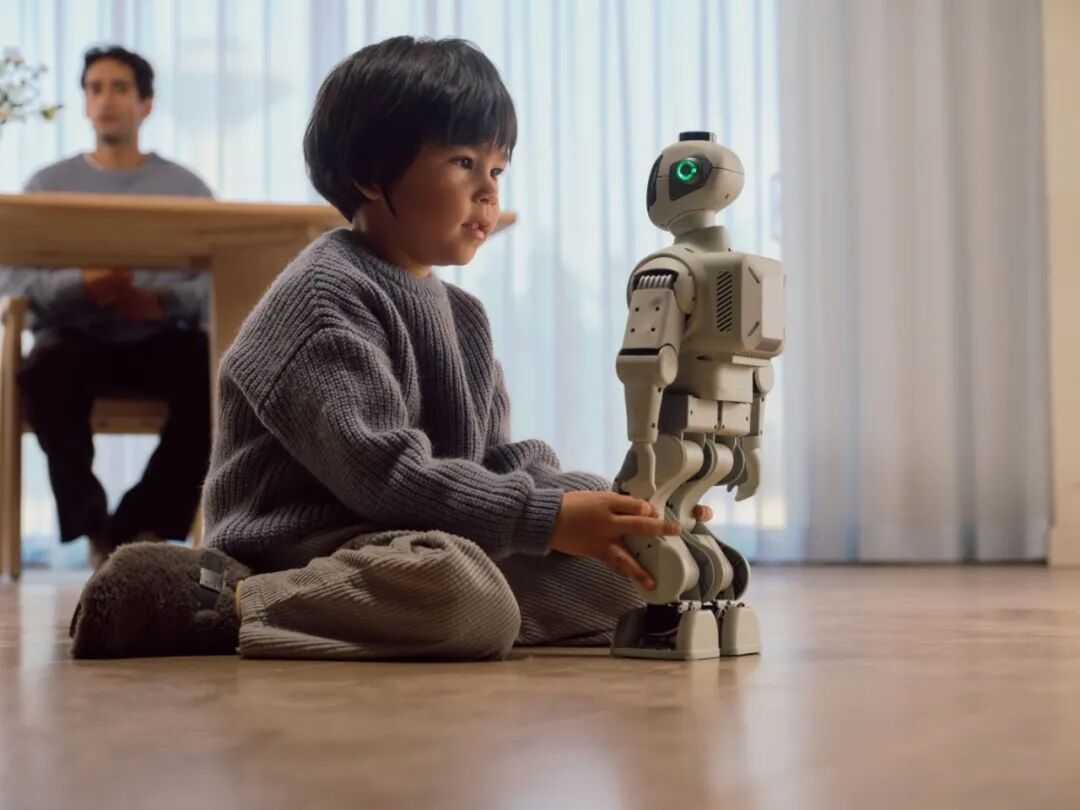
Promotional image of M1
Future Lab: Why do you sell Bridge to C-end users first, and then M1? Isn't M1 produced earlier?
Guo Renjie: The core reason is that they target different user groups. Bridge clearly positions geeks and developers as its first batch of users, so we also built the OpenBridge ecosystem, launched the "Bridge Builder Program" to co-build the developer ecosystem of Bridge with users.
The name Bridge itself intends to express "bridge to physical AI". We hope it is a bridge leading to physical AI, and everyone can train and develop based on this product.
What developers need is relatively clear: good usability, ease of use, high performance, and low price. The interface is open, and external grippers, dexterous hands and navigation modules are supported for motion development; it is light enough for a single person to operate, no professional site and hanger are required; although it is small, it has the capabilities of backflips, dancing and teleoperation.
But M1 targets household users. Household users are very picky. Poor interaction, stuck obstacle avoidance, or stepping on a cat's tail may all be magnified as serious problems. So we hope M1 will continue to run in the B-end scenario for a period of time, fully expose all problems, and after we solve all the problems, we will launch it to the C-end. Bridge targets geeks, and geeks have different expectations.
Future Lab: I think one of the big difficulties for robots to enter households may not be how high people's expectations for robots are, but after the manufacturer sets an expectation for me, how much I am willing to pay for it. Why is the pricing problem of household robots more severe? Why is it difficult to form a premium that people are willing to pay for?
Guo Renjie: The first reason is that there is no price anchor. For example, people accept that mobile phones sell for 8000 or 10000 yuan today, because a price consensus has been formed for mobile phones. When Apple first sold its mobile phones for 10000 yuan, many people found it incomprehensible, because 10000 yuan could buy a very good computer at that time.
But mobile phones at least have a bottom-line rigid demand, which is making calls. This rigid demand may be worth 2000 yuan, and then functions such as internet access, applications and identity attributes form the premium. The same is true for sweeping robots. Its core function is sweeping, so users can compare it with hiring a housekeeper. It may be difficult to sell for 20000 yuan, but when priced at 5000 yuan, users will hesitate, because the housekeeper can't come every day, only once a week, and the sweeping robot can complement the daily cleaning work.
What robots lack today is this bottom-line anchor point. For example, if a robot can help supervise children doing homework, parents will have psychological expectations: if it can reduce the quarrels between me and my children, or help me watch children more reliably, I may be willing to pay thousands of yuan. For another example, for elderly care, children want to see their elderly parents, this sense of peace of mind makes users think it is worth 8000 yuan, then it is worth 8000 yuan.
But companionship is very difficult to price. Doubao can also accompany you, and it is free. But some companion robots sell for tens of thousands of yuan, while some sell for hundreds of yuan. I believe companionship will be the largest value in the long run, but if you directly take companionship as a selling point to sell products today, how much is companionship worth? No one knows. It lacks the most basic reference. Only when you know the bottom price of this demand, can you create premium on this basis.
Future Lab: So when robots have not met a very rigid demand that people must solve, it is difficult for people to judge their value?
Guo Renjie: Exactly. Especially emotional companionship, there are too many alternatives, including low-cost and free ones. You need to let users know what problem this product solves exactly, and why it is worth the price.
So we are now exploring scenarios such as elderly care, children's habit development and learning supervision, because these scenarios have rigid demands. Not all families have these pain points, but at least there are clear groups of people who are willing to pay for these demands.
Future Lab: What demand scenarios do you still believe household robots can meet now?
Guo Renjie: Why am I so obsessed with household scenarios? Because I don't understand other demands, I don't have the relevant life experience. For outdoor scenarios, I have hardly been to those scenarios, so I can't imagine the demands. But for household scenarios, I have the first-hand experience of what is acceptable and what is not, how to design and handle problems such as noise, volume, weight and safety, because I have developed many generations of household robots at Dreame before.
At present, there are two scenarios that have passed the payment test: one is elderly care and companionship, where robots can become companions that the elderly are willing to accept, and also meet the remote care needs of their children; the other is children's habit development and learning supervision, such as reminding children to brush their teeth and correcting their sitting posture, and children are more likely to accept the robot as a "little friend". There is also the emotional companionship for single women. Some M1 internal test users will talk to the robot and make clothes for it. I think this may be a larger market, but it may need to be verified in the next stage.

Sell to Geeks First, Then Promote to Households
Future Lab: M1 also opened interfaces to developers before, why do you need to make Bridge specifically for developers?
Guo Renjie: M1 has been working with developers since February and March 2025.
At that time, reinforcement learning had just become the consensus path for motion control cerebellum. We could deploy reinforcement learning on small robots, allowing everyone to complete sim-to-real with a low-cost body. In the past, people might have to buy large motor robots from companies such as Unitree and Fourier Intelligence, which might cost 20,000 to 30,000 US dollars especially in Silicon Valley. At that time, we provided an option of about 2000 US dollars. Just like the "little duck" of Huggingface acquired by Nvidia that has been very popular in recent days, it is exactly the same thing: using a servo as the body, then using reinforcement learning to train this servo robot to extend its motion capabilities, and sell it to enthusiasts and developers. They made a duck-shaped robot, we made a humanoid robot, but the value to geeks is the same.
M1 formed some developer communities very early, such as email lists and Discord communities.
When it comes to Bridge, I summed up this model: developers themselves should be the first batch of users, and this group should be regarded as an independent market.
Future Lab: What are the differences in capabilities between Bridge and M1?