The most unassuming supporting player in the beverage category has taken the center stage at convenience stores.
The hottest summer on record is drawing to a close. Apart from the life-saving air conditioners, a once most overlooked product is stepping into the lives of more and more young people, that is, the iced cup.
In the past, ice cubes were only "supporting roles" in coffee shops or bars, responsible for cooling drinks, and few people paid for them separately. Today, this former "supporting role" has begun to have its own shelves, and has even become an independent hit in convenience stores and instant retail platforms.
Ice is evolving from a single part of drinks into an independent business.
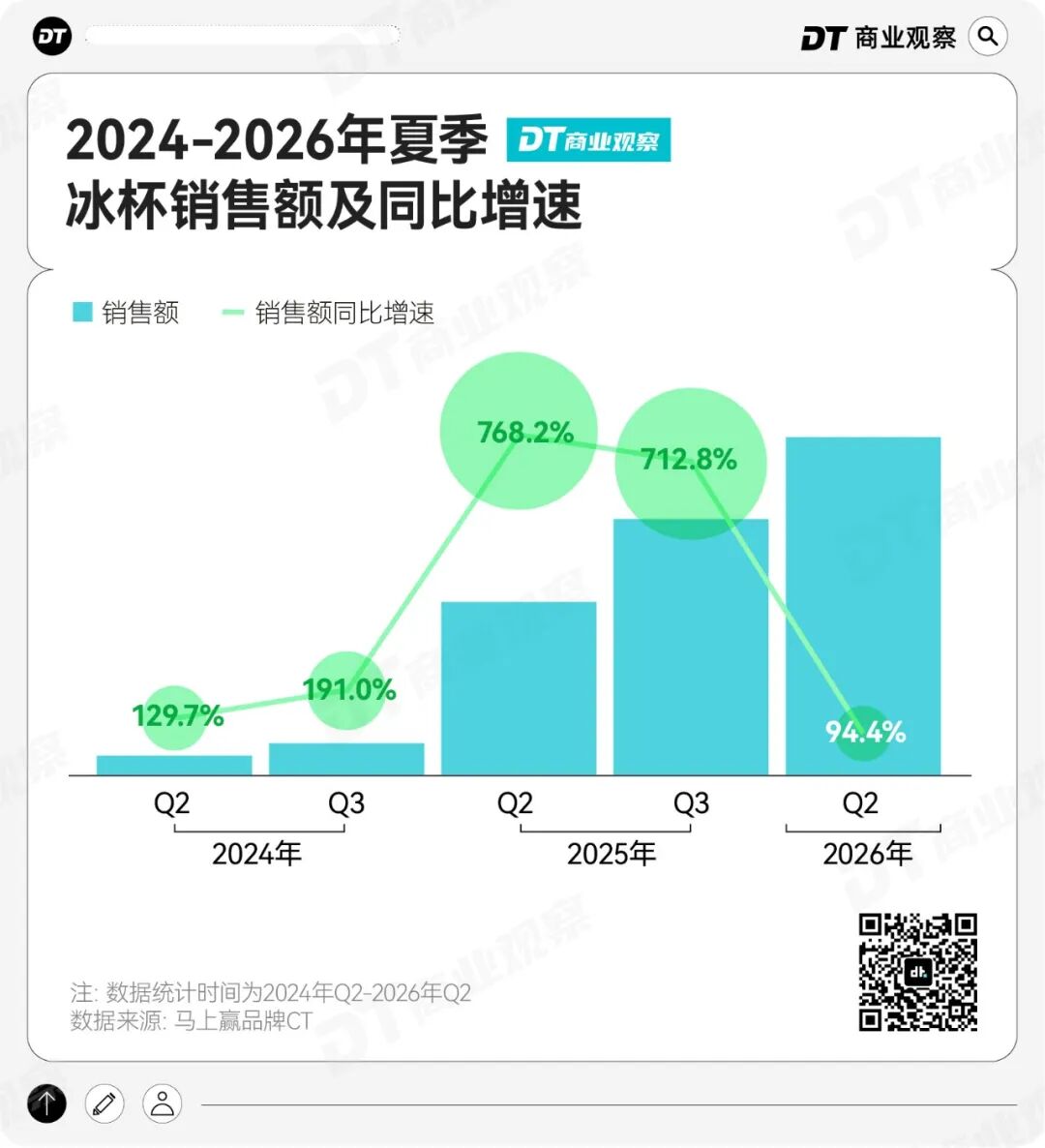
Data from Ma Shangying shows that in Q2 2025, the sales revenue of the iced cup market increased by 768.15% year on year; by Q2 2026, although the year-on-year growth rate fell back to 94.43%, the sales volume was nearly 17 times that of the same period in 2024, and almost twice that of the same period in 2025.
In other words, the explosive growth rate of the iced cup market is slowing down, but its market size is still continuing to expand.
Interestingly, the popularity of iced cups itself is counterintuitive: after all, spending a few yuan on a cup of "ice" is somewhat incomprehensible to many people. Therefore, social media is full of such doubts: why pay for ice? What's the difference between it and the ice frozen at home? Can't you just buy a cold drink directly?
Evolving from a "supporting role" in drinks to a "hit product" in convenience stores, we are curious about how iced cups became popular in the first place?
Why do consumers fall in love with buying iced cups?
At what moment would you be willing to spend five yuan on a cup of ice?
There are various answers to this question on social media.
Some people say that they do not have the conditions to freeze ice by themselves in dormitories or rental houses; some say that they have no refrigerator around when they want to drink iced drinks; others will buy a cup of ice, add coffee liquid, soda or wine to DIY their own exclusive special drink.
It seems that people are buying iced cups, but in fact, they are paying for a kind of "icy refreshing experience". It seems that an ordinary drink will immediately taste better once poured into an iced cup.
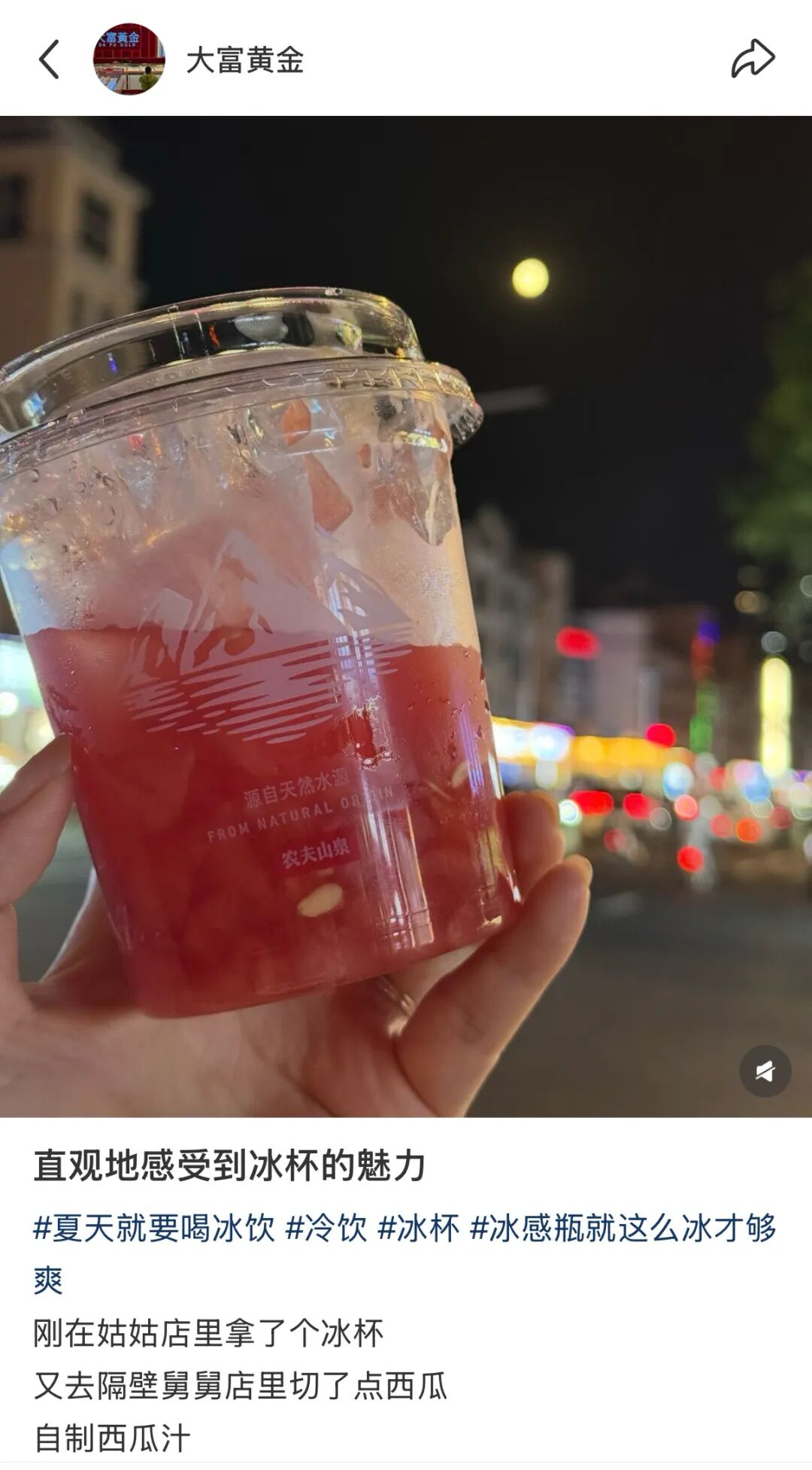
(Image source: Xiaohongshu @ Dafu Huangjin)
Data from Jiuqian shows that iced cups are entering the daily life of more and more people.
There are social butterflies who love nightlife, mixing drinks with friends in convenience stores to enjoy the slight intoxication at night; there are DIY lovers who pay attention to a sense of ritual, adding espresso and milk foam to iced cups to create various ways of playing with a cup of ice; there are also office workers who pursue efficiency and practicality, ordering a cup of ice with coffee liquid to make a cup of iced American coffee in three seconds, refreshing themselves at one sip.
They have different motivations for buying iced cups, but there is a common consumer demand behind all of them: to make the drink in their hands colder, more refreshing, and have more ways to drink.
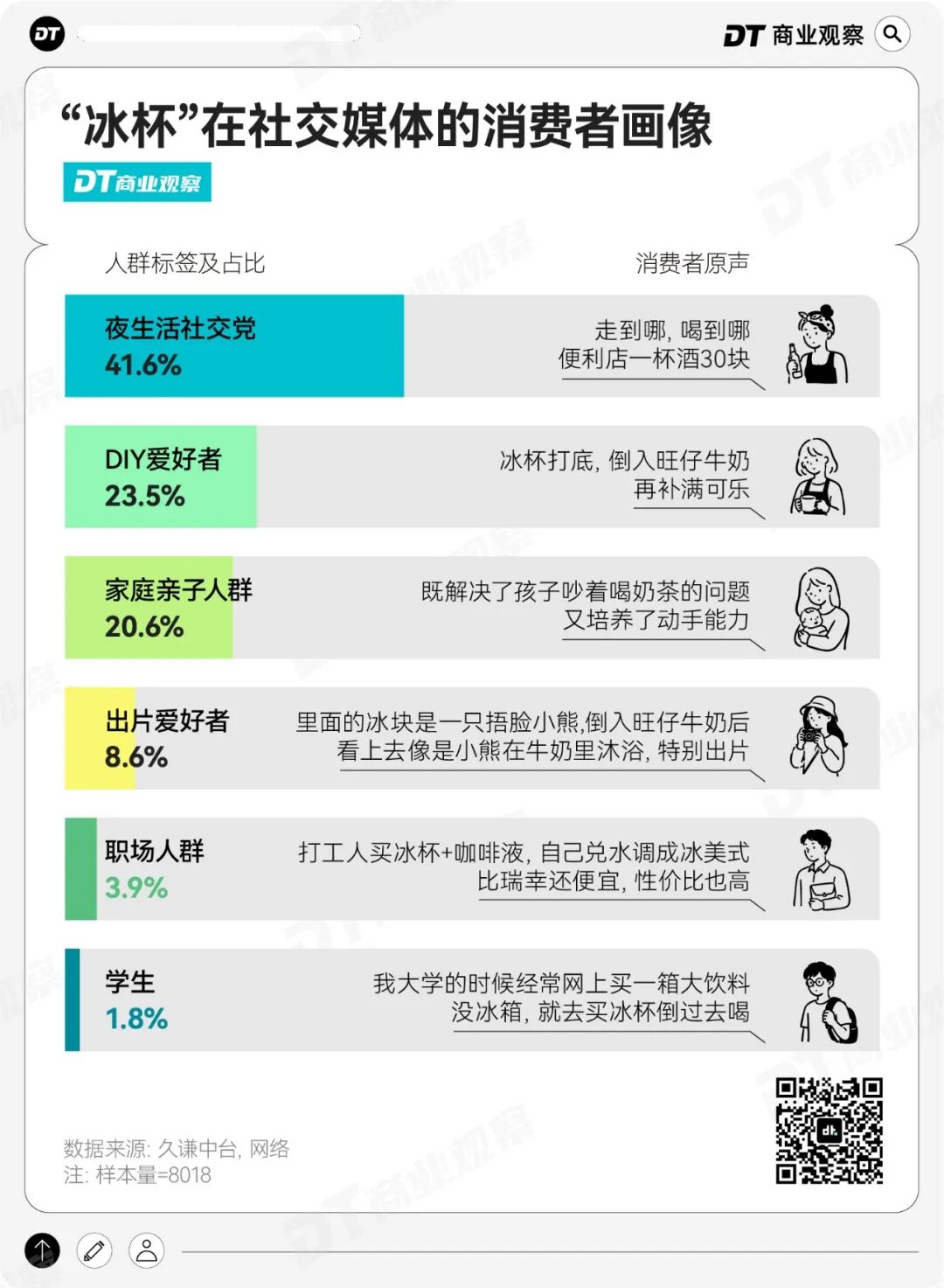
This can also be confirmed in consumer data.
Nielsen IQ consumer survey shows that 69% of consumers who buy iced cups in convenience stores use them to DIY drinks. Data from Ele.me × Taobao Flash Purchase shows that in June 2025, the order volume of iced cups increased by 267% year on year; among them, the order volume of "iced cup + wine" increased by 321% year on year, and the order volume of "iced cup + drink" increased by 261% year on year.
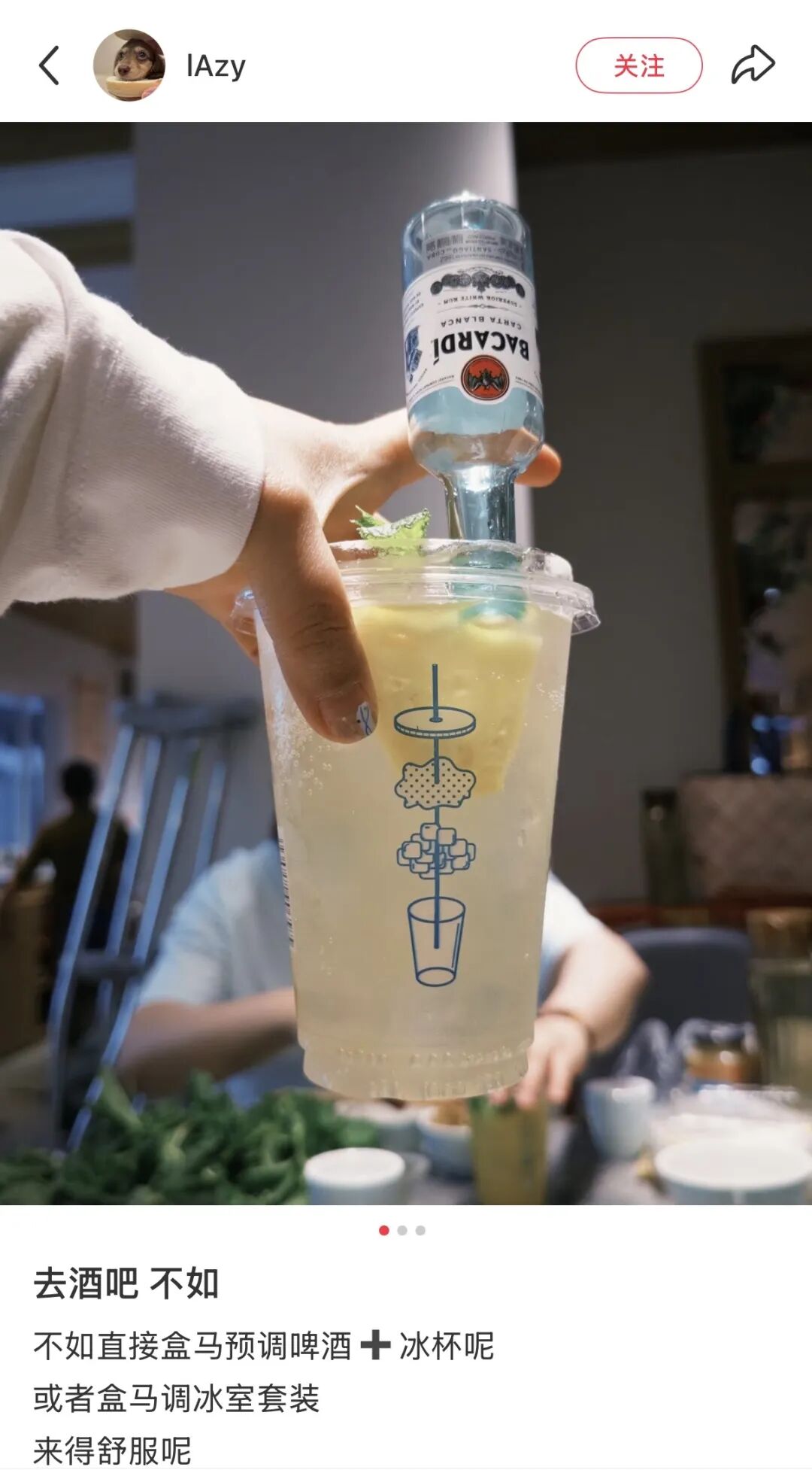
(Image source: Xiaohongshu @ IAzy)
Liao Bilin, General Manager of Binglida, once defined ice cubes as "great supporting roles". In his view, the existence of ice is not for itself, but "to make a better drink", improving the flavor, taste and drinking experience of a drink.
This is exactly the most interesting part of the iced cup business: consumers never just buy ice, but a cup of better-tasting drink.
Explosive demand forces supply evolution, making iced cups "convenient and affordable"
The growth of consumer demand is quickly transmitted to the supply side.
When more and more people get used to "buying ice", iced cups are no longer a niche seasonal business. From production, products to channels, the entire industrial chain has begun to accelerate changes.
The most obvious change is that more and more giants are entering the track.
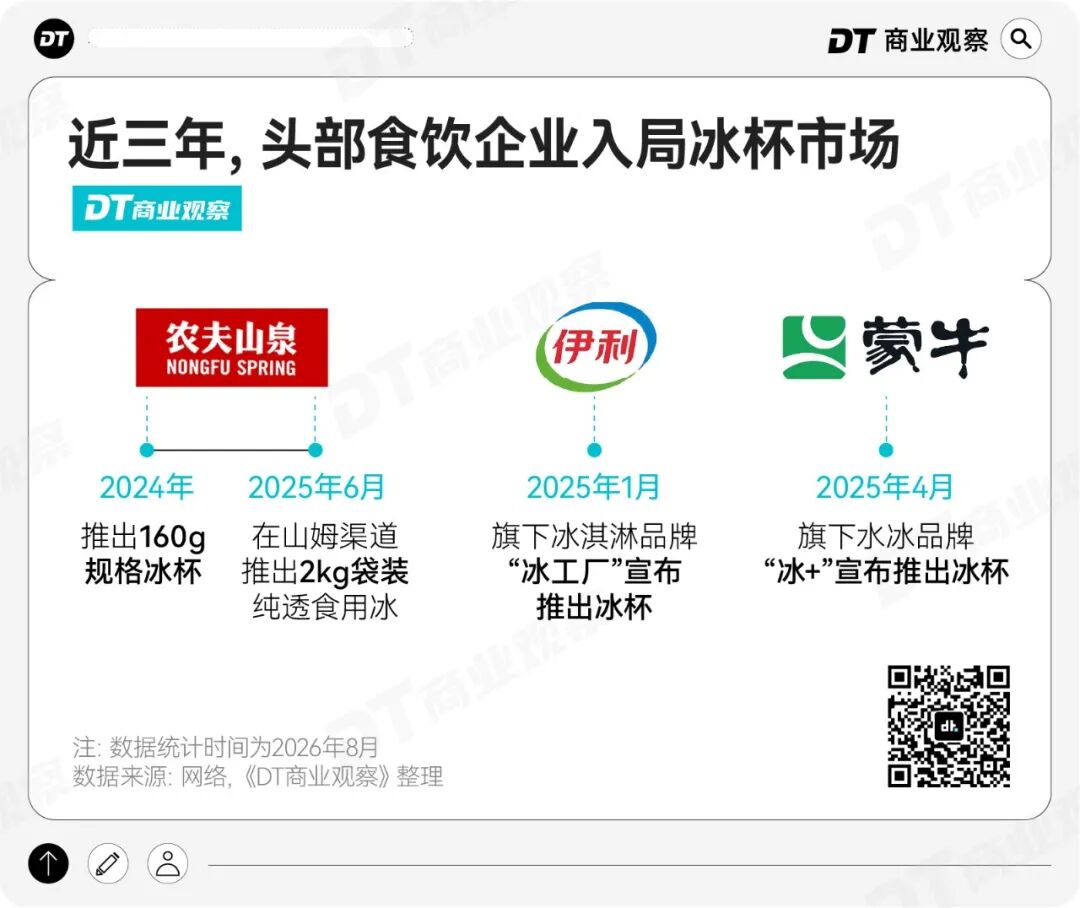
The early players in the iced cup market are mainly professional ice-making enterprises such as Binglida and Bingshimashi. From 2024 to 2025, food and beverage giants such as Nongfu Spring, Yili and Mengniu entered the market one after another, rapidly expanding channels with their mature supply chain and cold chain capabilities, and the industry pattern has also changed accordingly.
Data from Ma Shangying shows that in Q2 2024, the top 3 brands in the iced cup market in offline retail channels were still Bingjixian, Hangao Food, and Zhengzhou Lengyuan Industry and Trade. In Q2 2025, the top 3 in the iced cup market became Yili, Nongfu Spring, and Dingxi. In Q2 2026, the top 3 of the market have been firmly occupied by the three giants Yili, Nongfu Spring and Mengniu.
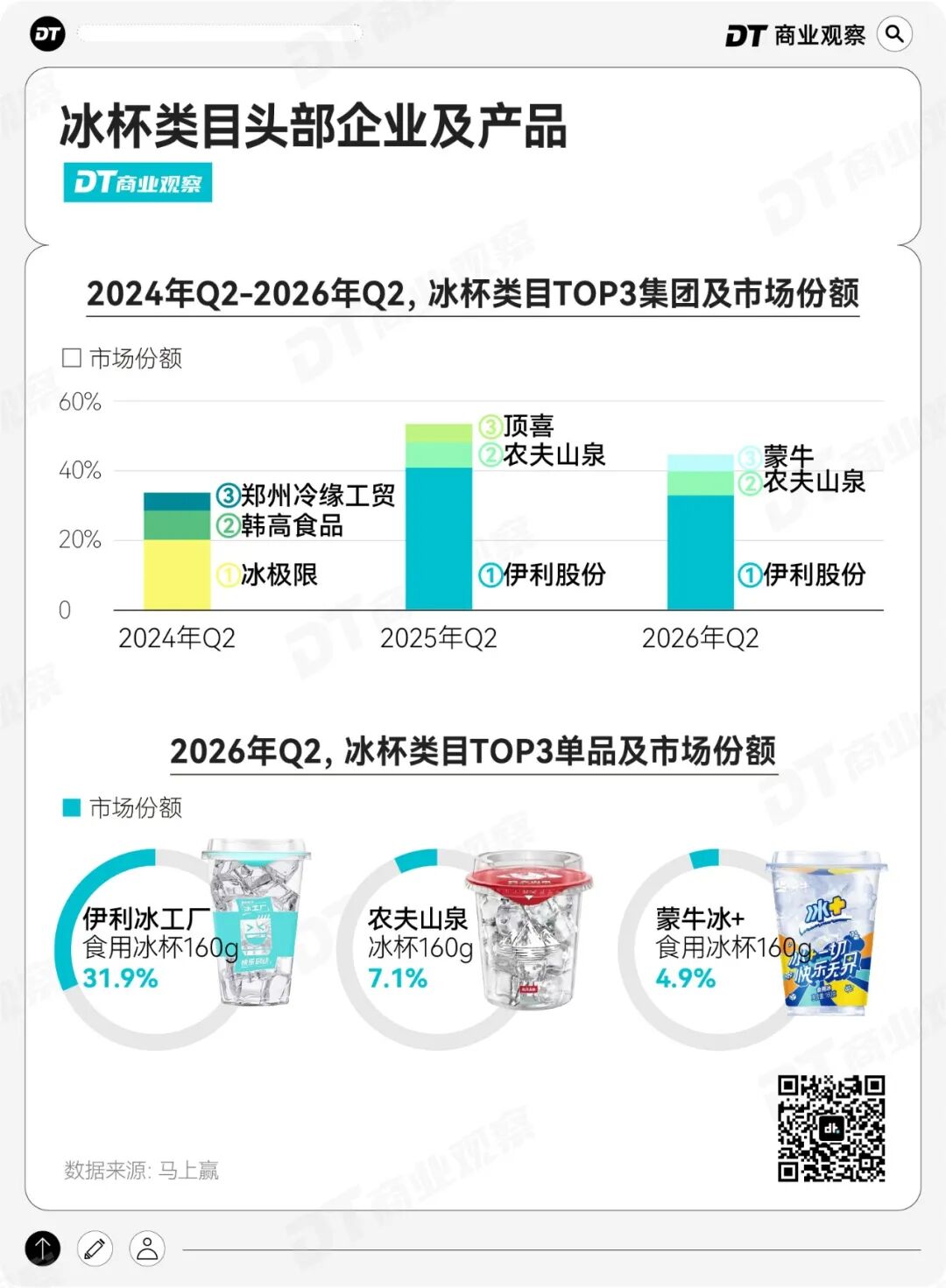
In just three years, the leading players in the iced cup market have been completely replaced. This means that iced cups are evolving from a small business for professional ice enterprises to a new market that food and beverage giants are also scrambling for.
With intensified competition, iced cups are no longer limited to the simple function of "freezing water into ice". In addition to basic iced cups, more and more new products have emerged in the market.
The first is the technical upgrade: iced cups have become more melt-resistant and better-looking.
For example, "slow-melting ice", through industrial degassing and high-density crystallization technology, is more transparent and melts slower than ordinary ice cubes, and will not dilute the taste of drinks; there are also shaped ice such as moon-shaped ice and football-shaped ice, which directly bring the sense of ritual and atmosphere that could only be experienced in bars to ordinary homes.
Secondly, with the rapid development of instant retail, iced cups have realized "minute-level delivery". Consumers can get iced drinks immediately whenever they want to drink them.
When it is sweltering in summer, you can order an iced cup plus sugar-free oolong tea through takeout, and pour them together to get a cup of icy tea that is healthy and quenches your thirst; when watching a football game at night, you can temporarily order a portion of football-shaped ice with whiskey. In the past, you had to freeze the mold one day in advance, but now you can place an order casually and it will be delivered to your door within half an hour.
When the supply becomes richer and the purchase becomes more convenient, iced cups have ushered in another more direct change — they are getting cheaper and cheaper.
As early as two years ago when iced cups just became popular, some people on social media questioned its price: "A 500ml bottle of mineral water costs 2 yuan, but a 200g iced cup costs four or five yuan, which is comparable to the price of a bottle of drink."
Nowadays, as the market supply matures, the unit price of iced cups is also declining. Data from Ma Shangying shows that in Q2 2024, the average price per 100 grams of iced cups was about 2.04 yuan; by Q2 2026, it has dropped to about 1.84 yuan.
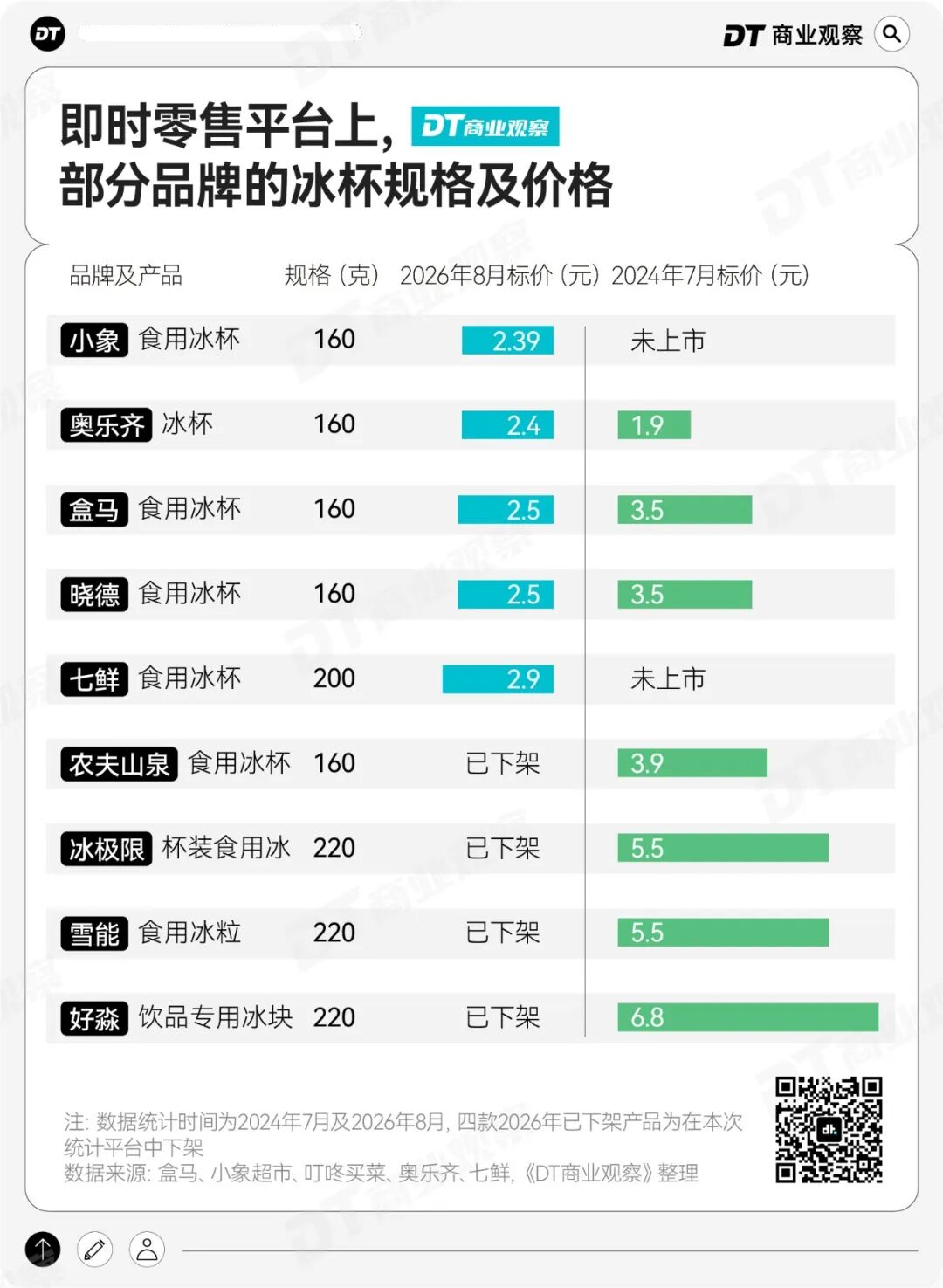
In July 2024, *DT Business Review* once counted the iced cup products on four major instant retail platforms: Freshippo, Xiaohongshu Supermarket, Dingdong Maicai, and Aldi. At that time, the price range of iced cups with 160g-220g specification was 1.9 yuan-6.8 yuan. By August this year, the high-priced iced cups priced above 5 yuan in the early stage have been gradually removed from shelves, and the price of mainstream basic iced cups is concentrated in 2.39 yuan-2.9 yuan.
An iced cup seems to be just a cup of "water", but every link from industrial production, low-temperature resistant packaging material sealing, to the whole-process cold chain transportation in convenience stores and instant retail platforms adds up the cost.
However, as the sales volume continues to expand, the scale effect is gradually released, and the price has fallen.
Dong Yuanyuan, iced cup procurement staff of Freshippo, said: "The price drop is mainly because the consumer awareness of iced cups is gradually established, the sales volume rises and the cost decreases." She emphasized that "the price drop is not achieved by sacrificing quality, but by optimizing packaging technology, improving the efficiency of automated production lines and spreading the cost of supply logistics."
According to Red Star News, Da Jin, the person in charge of Bingshimashi, also said, "Now the profit of a single cup is only about 0.1 yuan. Compared with 2025, the overall gross profit margin in 2026 has dropped by 20 to 30 percentage points."
Why iced cups, and why now?
"Iced cups" are not a new product.
In South Korea and Japan, convenience stores have long sold iced cups together with bagged coffee. A netizen said, "Ten years ago I saw 7-Eleven convenience stores in Japan selling this product, and I wondered why we didn't have it here, and it only became popular now."
Why did iced cups, which have been sold in Japanese and Korean convenience stores for many years, suddenly become popular in China in the past two years? The answer may not only lie in the iced cup itself, but in the fact that Chinese consumers' habit of "drinking ice" has finally reached this stage.
First of all, from the perspective of consumption habits, the rapid development of freshly made drinks has completed the national "drinking ice education".
In the past few years, freshly made coffee and new tea drinks have expanded rapidly, "iced American coffee" and "iced milk tea" have become more and more daily, and young people have developed the habit of drinking iced drinks.
An interesting comparison is that while iced cups are growing, traditional ice cream and frozen desserts are cooling down. Data from Ma Shangying shows that in Q2 2026, the domestic sales of ice cream declined by 13.1% year on year, and the number of new products also decreased from 790 in 2025 to 408. More and more consumers are abandoning high-sugar and sweet ice cream, and turning to lighter iced drinks.
In addition, the prevalence of the DIY trend has also found more consumption scenarios for iced cups.
Around 2021, the trend of "convenience store drink mixing" rose, and iced cups became an important prop in it. A cup of ice, plus sparkling water, juice, coffee liquid or alcoholic drinks from convenience stores, can be combined into a cup of drink that belongs to you. For young people, there is not only the fun of DIY by hands, but also a sense of participation of "making it by yourself".
Third, for channels, iced cups are also the "golden partner" that leverages beverage consumption.
When more consumers begin to buy iced cups, convenience stores, supermarkets and instant retail platforms soon find that the value of iced cups is far more than the cup of ice itself. It can be sold in combination with products such as coffee liquid, soda, juice, and alcoholic drinks. Platforms such as Freshippo even directly package and sell the matching scheme of "a cup of drink" to consumers.
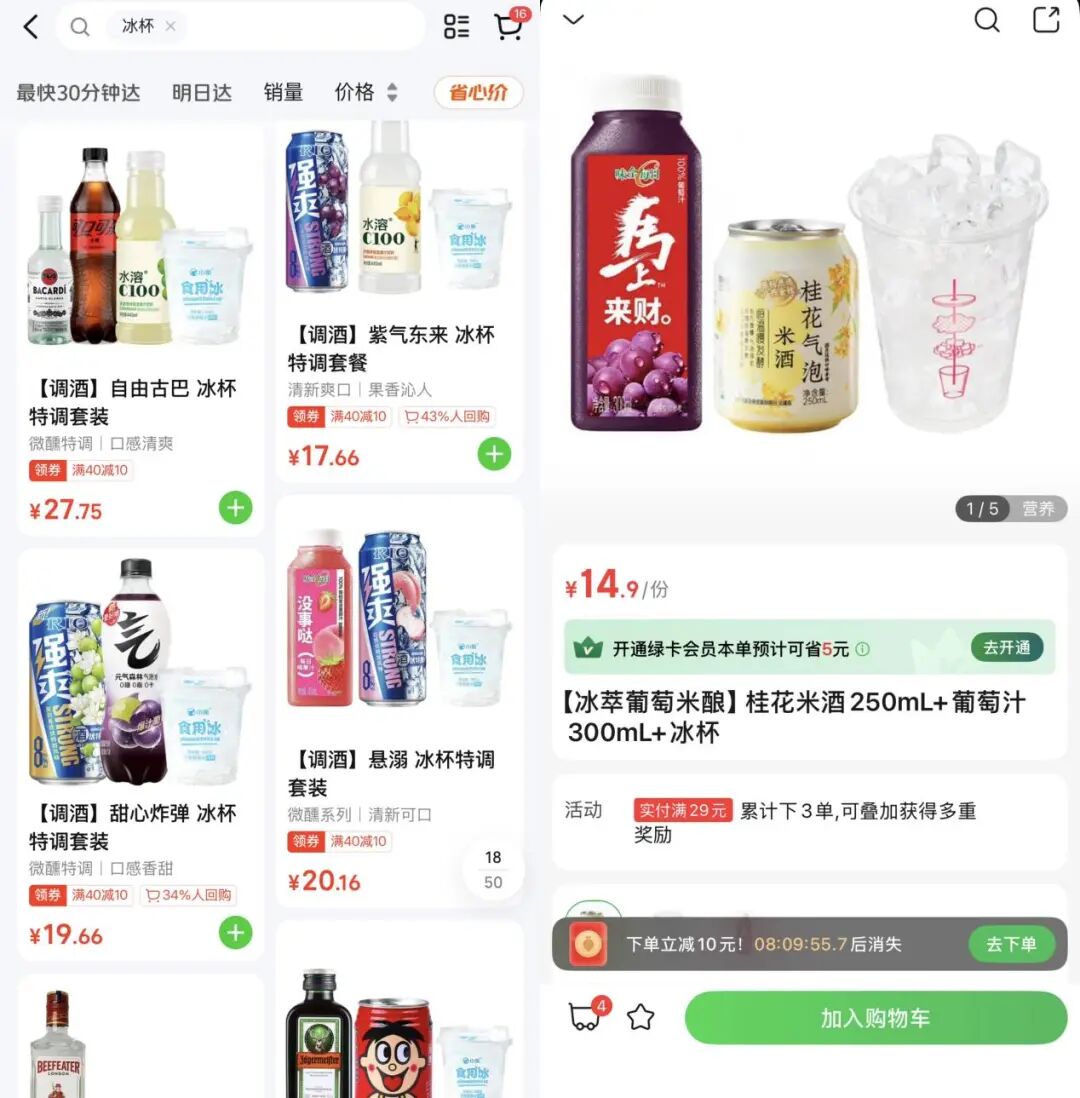
In the past, if consumers wanted to mix a cup of drink, they had to search for recipes and check the proportions by themselves. Now the store has directly matched everything for you — a cup of ice plus several bottles of drinks is a ready-made DIY solution.
This not only promotes associated sales, but also enables a basic iced cup worth only a few yuan to enter a consumption scenario with higher unit price, and finds new commercial value for iced cups with originally low gross profit.
Iced cups did not become popular out of thin air in China. They caught up with the