The Enzyme War: A "Subcutaneous Revolution" That May Reshape the Global Competitive Landscape of Innovative Drugs
In the infusion room of the oncology department, time flows at a different pace.
A lung cancer patient huddles on the infusion chair, with the liquid medicine above his head dripping drop by drop through the catheter. Thirty minutes, sixty minutes, sometimes even longer. What he counts is not only the passing time, but also the parking space, queuing time, puncture procedure, post-observation period, and the half-day salary his accompanying family member has to lose for taking leave. Scenes like this repeat tens of millions of times across the globe every year.
What drives this scenario is not the disease itself, but a negligible physical constraint: subcutaneous tissue is rich in hyaluronic acid, a highly viscoelastic extracellular matrix that forms a dense tissue barrier, making it difficult for drugs with large size and high molecular weight to spread subcutaneously and enter the circulation. As a result, antibody drugs can only be administered intravenously, forcing patients to receive "drip infusions".
It is an enzyme that breaks this constraint.
On September 2, 2026, South Korean biotechnology firm Alteogen announced that it has signed an option and license agreement with Novartis: the latter obtains the exclusive right to develop subcutaneous formulations for multiple of its products using ALT-B4 (berahyaluronidase alfa, recombinant human hyaluronidase). If all options are exercised and all milestones are met, Alteogen will receive up to 3.223 billion US dollars (approximately 4.4165 trillion won), covering option exercise fees, development and commercialization milestone payments, and sales royalties.
This is already the fourth major licensing deal Alteogen has signed in 2026: in January, it reached a deal with GSK's subsidiary Tesaro worth up to 285 million US dollars; in March, a deal with Biogen worth up to 579 million US dollars; in August, a deal with an undisclosed global pharmaceutical company worth up to 365 million US dollars. As early as 2025, AstraZeneca had already joined the cooperation. Including Novartis, 10 global pharmaceutical giants have signed licensing agreements for ALT-B4.
What is noteworthy is that none of these transactions involves a new drug. The molecules remain the same, the targets remain the same, and the only change is the administration method, which is shortened from more than 30 minutes of intravenous infusion to less than 5 minutes of subcutaneous injection.
The drugs are still the same, but the competition dimension has changed. A global race centered on "how to administer injections" is redistributing a market worth hundreds of billions of dollars.
01 "Overtaking on curves" under the patent wall
To understand whether ALT-B4 is worth 3.2 billion US dollars, we must first recognize the real pioneer in this field, the US company Halozyme founded in 1998.
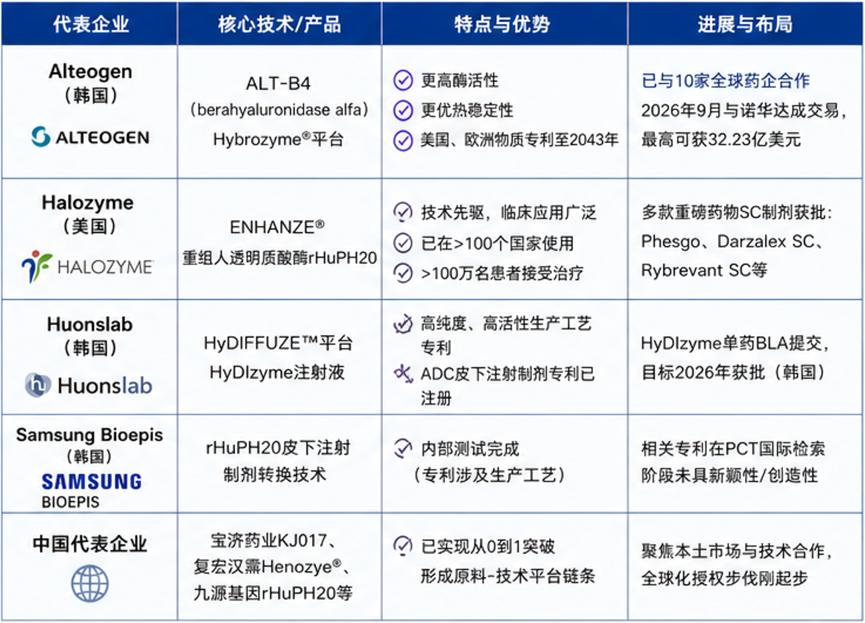
Halozyme's ENHANZE® platform is based on recombinant human hyaluronidase rHuPH20, which has successfully moved a number of blockbuster drugs from intravenous administration to subcutaneous administration, including Roche's Phesgo, Johnson & Johnson's Darzalex SC and Rybrevant SC. This technology has been deployed in more than 100 countries, and more than 1 million patients have received treatment with products using this technology. For a long time, it was the only "tax collector" in this track.
But the tax collector has a fatal weakness: the composition of matter patent for rHuPH20 will expire in the United States in 2027. Halozyme is of course unwilling to accept this, and has successively built peripheral defenses including composition patents, MDASE engineered enzyme patents, Hypercon, Surf Bio, and auto-injector patents, trying to deepen its moat.
However, the composition of matter patent is the foundation. No matter how luxurious the decoration above the foundation is, it cannot stop others from building a brand new building elsewhere.
Alteogen is building that new building.
Its Hybrozyme® platform uses domain swapping technology to cross-combine the human hyaluronidase PH20 with domains from other types of hyaluronidases, and develops ALT-B4.
In layman's terms: the core function of the enzyme remains unchanged - it temporarily degrades subcutaneous hyaluronic acid, increases the permeability of local tissues, and helps the co-injected biologic to diffuse and absorb faster; hyaluronic acid will recover within 24-48 hours, and the effect is reversible. But ALT-B4 surpasses rHuPH20 in enzyme activity and thermal stability, and has completed the registration of new composition of matter patents in the United States and Europe, with exclusive rights lasting until 2043.
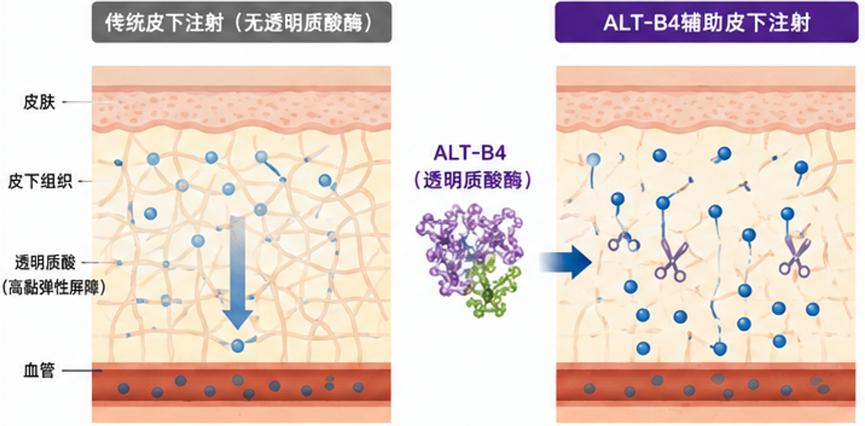
On the one hand, the gate that expires in 2027 is slowly opening, and on the other hand, the new lock for 2043 has just been locked. Alteogen's "overtaking on curves" transcends the patent life cycle - it uses a new set of molecules to turn itself into the "tax collector" for the next 16 years.
This is why Novartis is willing to pay 3.2 billion US dollars: to buy the freedom to move its own blockbuster drugs from intravenous to subcutaneous administration in the next 16 years.
02 The best due diligence report is Merck's financial statement
No matter how excellent the technology is, if the market does not pay for it, it is just a research paper.
In September 2025, Merck's Keytruda Qlex was approved by the FDA, becoming the first commercialized product using ALT-B4. The core drug is still pembrolizumab, the king of drugs with annual sales close to 30 billion US dollars. The only change is the administration method: shortened from about 30 minutes of intravenous infusion to 1-2 minutes of subcutaneous injection.
Then the market gave its ruling.
Keytruda Qlex achieved sales of 463 million US dollars in the second quarter of 2026, an increase of about 262% compared with 128 million US dollars in the first quarter. Merck stated that since April 2026, benefiting from the permanent J code (medical insurance reimbursement code) and the convenience of administration, the adoption and formulation conversion among medical institutions is accelerating. In other words, a "formulation improvement" product that has been on the market for less than a year has shown a growth curve close to that of a mature blockbuster drug in a single quarter.
If the king of drugs performs so well, what about other drugs? The significance of Keytruda Qlex goes far beyond its own sales. It is equivalent to issuing a public, auditable commercial verification report for the entire subcutaneous administration track. Previously, pharmaceutical companies calculated based on models when evaluating such licenses; now, they calculate based on Merck's quarterly reports.
Global pharmaceutical giants can no longer sit still. Novartis' 3.2 billion US dollar deal is essentially a follow-up order based on this financial report.
03 The "Hyaluronidase Corridor" on the outskirts of Seoul
The rise of Alteogen has ignited the entire South Korean biotechnology industry.
Huonslab has developed a human hyaluronidase platform called HyDIFFUZE™, holding production process patents for high-purity and high-activity products. The biologics license application for its recombinant hyaluronidase monotherapy product HyDIzyme Injection has been submitted, with the goal of obtaining approval from the Ministry of Food and Drug Safety of South Korea within 2026; in July 2026, the ADC subcutaneous formulation patent of HyDIFFUZE™ was registered.
Samsung Bioepis has taken a different path: it recently completed internal testing of subcutaneous formulation conversion technology based on recombinant human hyaluronidase PH20. But it is thought-provoking that neither of its two hyaluronidase-related patents was found to have novelty or inventive step during the PCT international search stage. Industry analysis believes that these patents cover production processes rather than new enzyme molecules.
Alteogen's CEO commented unreservedly: "Based on the currently published patents, it is difficult to confirm that Samsung Bioepis has obtained a new composition of matter that can replace ALT-B4."
Chong Kun Dang announced its entry into this field in August 2026, and applied for the patent of "Novel Hyaluronic Acid-Degrading Enzyme"; Celltrion, Inventage Lab, and G2GBIO have also built their own subcutaneous formulation conversion platforms respectively.
Putting this puzzle together: a leader that has closed the "patent + commercialization" loop, a group of followers that have taken positions in all links of platforms, processes, monotherapies, and formulations, backed by the order book of real money from the world's top 10 pharmaceutical companies. South Korea is forming a complete industrial ecosystem around hyaluronidase subcutaneous administration technology.
This is exactly what Chinese peers need to be most alert to: A single technological breakthrough can be caught up, but an industrial ecosystem is very difficult to replicate and catch up with.
04 Three cards in China's hand
In this race, Chinese companies are not absent, they have just sat at the table. At present, they hold three cards in hand.
The first card is the "domestic first" of Baoji Pharmaceutical.
On March 31, 2026, its independently developed recombinant human hyaluronidase for injection, Baoshuyi® (KJ017), was approved for marketing by the National Medical Products Administration, becoming the first recombinant human hyaluronidase in China, with a specification of 385U/vial, used to assist subcutaneous infusion (sodium chloride injection, compound sodium lactate injection, etc.). In May 2025, KJ017 has completed DMF filing in the United States.
Compared with traditional animal-derived hyaluronidase - which has allergy risks, requires skin tests before use, and has unstable quality between batches - KJ017 achieves high consistency between batches through genetic recombination technology, significantly reduces the risk of immunogenicity, and does not require skin tests.
What is more critical is its business model: Baoji adopts the "shovel seller" model, and its hyaluronidase technology has reached cooperation with more than 60 companies including WuXi Biologics, Shanghai RAAS, and Qilu Pharmaceutical.
The second card is the "molecule re-engineering" of Henlius.
Through AI-assisted simulation and computing platform, it redesigned rHuPH20 and launched the new generation of hyaluronidase Henozye® with independent intellectual property rights. Its product HLXTE-HAase02 was approved by NMPA to carry out phase I clinical trials in March 2026, and Henozye® has completed excipient filing with CDE in China and FDA in the United States.
The strategic intention of this card is the clearest: ALT-B4's exclusive right in the United States lasts until 2043. To compete on the global market with it, a completely different molecule must be developed, which is exactly why Henlius bets on AI to redesign the enzyme.
The third card is the "upstream business" of Jiu Yuan Gene.
Its recombinant human hyaluronidase (rHuPH20) has completed the pharmaceutical excipient registration with CDE in China, and has authorized Nearshore Protein to be the exclusive distributor in Greater China, earning the basic revenue of the entire industrial chain.
Three cards, three business models: finished drugs, technology platforms, and upstream raw materials. China has completed the breakthrough from 0 to 0 in the field of recombinant human hyaluronidase, forming a key chain from raw material supply to technology platforms.
But if you count the accounts clearly: Alteogen signed four deals in one year, with a single deal worth up to 3.2 billion US dollars; the current revenue structure of Chinese companies is still based on the local market and technical cooperation. At the same table, others are collecting taxes, while we have just learned to deal cards.
The end game: The war of ecosystems
How can China break through? The answer is actually written in Alteogen's history of development - its rise never relied on a single technological breakthrough, but a complete set of ecosystem construction: on the patent side, it built a composite patent portfolio covering composition of matter patents, composition patents, and usage patents around ALT-B4, making "circumventing it" a triple difficulty; on the commercial side, through in-depth cooperation with 10 global pharmaceutical companies, it embedded the technology into the life cycle of blockbuster drugs from Keytruda to Enhertu, becoming the "infrastructure" of the giants; on the verification side, it got the market's endorsement with real money through the commercial success of Keytruda Qlex.
Molecules are only the admission ticket, and the ecosystem is the real moat.
For Chinese companies, there are two sets of obvious contradictions on the table.
On the challenge side: ALT-B4's composition of matter exclusive patent right in the United States lasts until 2043, and the European patent registration has also been completed. If Chinese products want to go global and compete on the same stage, they must prove that they are new molecules with completely different structures, which is exactly the logic behind Henlius' bet on AI redesign.
On the opportunity side: The rHuPH20 composition of matter patent is about to expire; and in China and Europe, regulators classify hyaluronidase as a "modifiable excipient". When developing subcutaneous formulations, replacing different hyaluronidases will most likely not be regarded as a brand new drug, and only bridging tests for improved formulations are required. This is equivalent to leaving an institutional side door for domestic enzymes in the local market.
The more macro account is: Novartis' 3.2 billion, GSK's 285 million, Biogen's 579 million, behind these numbers is the market space of dozens of blockbuster drugs waiting to be converted from intravenous to subcutaneous administration. Demand is far from being met, and the table is not yet full.
From Halozyme's ENHANZE® to Alteogen's ALT-B4, from the industrial corridor in Seoul to China's three cards, this revolution from "drip infusion" to "injection" on the surface reduces the pain of patients by 30 minutes, but at the underlying level it is the redivision of a hundreds of billions of dollars market.
The historical law of the pharmaceutical industry has always been this: Those who make big money are often not the people who discover the drugs, but the people who change the way the drugs enter the body. 16 years ago it was Halozyme, today it is Alteogen. Who will belong to the next 16 years - the story of this drop of enzyme has only just begun.
This article is from the WeChat official account "Yi Yao", author: Yan Song, published with authorization from 36Kr.