360's Odyssey Moment: Yet Another Company Rushes Into the AI Office Track

From 360 Zhinao to Nano Work, Why Has 360 Repeatedly Placed Big Bets on AI?

Written by | Li Jiaxing
Edited by | Zhang Wei
Image Source | Pexels
On July 28, at the Beijing National Convention Center, 360 released Nano Work, positioning it as a new-generation enterprise intelligent agent work platform. Zhou Hongyi stated that AI should evolve from answering questions to completing practical tasks.
My first reaction was actually confusion. Tencent has WeCom, Alibaba has DingTalk, ByteDance has Feishu, all of which have already established a solid foothold in the office scenario. What 360 is most widely known for, however, remains its antivirus software, browsers and endpoint security services. As a security company that lacks a mature office ecosystem, why does it also want to develop Nano Work?
It is undeniable that AI office assistants have already become a booming trend. Tencent has tilted resources toward WorkBuddy, and launched its Android, iOS and Hongmeng versions at the end of July. In the same period, according to media reports, ByteDance integrated Feishu, TRAE and Coze into Doubao, and is set to launch "Doubao Work". On August 3, Alibaba consolidated QoderWork, MuleRun and Wukong into Tongyi Office and opened public beta; in mid-August, media reported that Baidu also merged the R&D and resources related to dodo into Baidu Buddy, and renamed the general intelligent agents of its library and cloud disk to Kuku AI.
Nano Work is not 360's first attempt at AI. More accurately, in almost every key iteration of AI product forms, the shadow of 360's products can be spotted. When large models became the new entry point, it launched 360 Zhinao; after AI search gained momentum, it rolled out Nano AI Search; when complex tasks began to require collaboration of multiple intelligent agents, 360 launched Nano AI and the intelligent agent swarm; after products like OpenClaw and "lobster" type tools became popular, 360 tried to embed Agent into computers to enable it to call tools directly. Now, Nano Work is designed to integrate all these previously scattered products and capabilities.
This time, 360 has further shifted its focus to the enterprise version. On August 17, the investment promotion kickoff meeting for partners of the Nano Work enterprise edition was held, with more than 200 channel partners participating online. Less than a month after the product was released, 360 has already started to explore paths to bring it into external enterprises.
From 360 Zhinao and AI Search to Nano Work, 360 has changed its product forms time and time again. What we want to explore is why a company that started its business in the security field keeps pushing itself back to the AI track?

Why Does a Security Brand Want to Develop AI?
The story starts with a "request for battle" written by Liang Zhihui for AI search.
Liang Zhihui is currently the overall head of 360's AI products.
In the spring of 2023, the domestic "Hundred Model Battle" had just kicked off, and almost every company wanted to prove that it had its own large model. 360 was no exception. The relevant team only had 20 to 30 people at that time, but it launched both 360 Zhinao and AI digital employees at the same time. The former belonged to the model line, while the latter was the product line, and the two lines were advanced almost simultaneously.
However, Liang Zhihui realized a problem: the first area that large models are most likely to transform is search and browsers.
That "request for battle" was written exactly at this time. He proposed to break through 360's existing organizational boundaries, transfer the search product team in, and build a dedicated search engine for AI usage.
AI first collided with 360's traditional business.
In the past, people had to learn how to use search. If you wanted to know the primary school enrollment policy in Beijing, you would first break the question into keywords, open several web pages, and judge which one was the latest regulation of the current year. After the emergence of AI, users are no longer willing to do these trivial tasks. They ask complete questions, hoping that the machine can directly find the official website of the education commission, exclude outdated content, and then give a definite answer.
A search engine designed for human users can just display a row of links. But a search engine for AI cannot stop at this. It needs to identify whether the source is credible, whether the information is expired, and break an ambiguous sentence into multiple retrieval operations. Liang Zhihui said that in the past, one question only needed one search, but for AI search, it may need three or four searches.
Therefore, that "request for battle" first changed the organizational structure. The original search database and ranking rules were readjusted, and the search product team was also transferred to the project.
But before the product was fully optimized, users' demands had already moved a step forward.
Liang Zhihui found that more and more software development problems began to appear in the search box. Users did not want to learn a piece of code, but required AI to directly generate web pages, dashboards or small tools. "People no longer use AI as a suggestion provider," he said, "They probably want to generate a tool or build a web page directly."
At this point, search alone is no longer sufficient. The content input by users has evolved from keywords to complete questions, and finally to tasks. Search can find materials and organize information, but it cannot open software for users, modify files, and continue working along the results.
360 had made some preparations before. 360 Zhinao solved the problem of where the model came from, and AI digital employees tried simple applications of the model. Nano AI and the intelligent agent swarm enabled different models and different intelligent agents to start division of labor. They did not directly become today's Nano Work, and some of them were even put on hold, but all of them pushed AI from an all-purpose chat box to specific work scenarios.
The continuous popularity of general Agent and "lobster" type products completed the last piece of the puzzle. The model no longer only answers questions, it is equipped with browsers, terminals and a complete computer environment, can find tools on its own, and continue to complete tasks.
But the "lobster" products at that time were more like geek tools. Users needed to install the environment, configure the software by themselves, and understand how the Agent calls the browser and terminal. For 360, the new problem is not just whether the Agent can run, but whether ordinary users can use it.
After joining 360 in 2010, Liang Zhihui was responsible for patch distribution and dual-core browsers. He believes that one of the things 360 was best at in the early stage was turning complex technologies into products that "even the shop owners in remote mountainous areas can use". "When we develop products, we always hope that first, it is easy to install; second, it is easy to run," Liang Zhihui said. Users do not need to understand how patches are distributed or how the browser switches kernels. The technology behind it can be very complex, and the only thing left for users is preferably a single button.
To turn the "lobster" from a geek tool into a product for ordinary users, 360 first had to answer a specific question: where exactly should the Agent run? This question later became one of the most important product choices for Nano Work.
Another key factor is that Zhou Hongyi, CEO of 360, has been personally promoting this matter. According to Liang Zhihui, 360 later established "All in Agent" as the company's core strategy, and Zhou Hongyi even personally participated in developing Agents.

Zhou Hongyi personally demonstrates the Security Lobster
When producing the Nano blockbuster, Zhou Hongyi spent two months studying a method called "spatial engine": the script only wrote about a palace, but the model also needed to deduce where the palace lanterns are placed, which direction the windows face, how the characters stand, which dynasty the scene belongs to, and how the light falls. The team later re-experienced and optimized the solution along his ideas. Liang Zhihui also mentioned that Zhou Hongyi once participated in Agent R&D for three consecutive days for business, "not only for discussion and design, sometimes he even writes codes himself".
Many executives inside 360 are technical background themselves, which forms a different decision-making habit: managers are more willing to personally test products, and more tolerant of immature technologies. At least according to Liang Zhihui's account, Agent is not just a new product managed by the business department in 360, it has gradually become a company-level project with direct intervention from the management.
Rather than saying that 360 suddenly entered the AI office track, it is AI that gradually pushed it beyond its original search boundary. Nano Work is the current result of this response: search is responsible for finding information, and Agent continues to use tools to complete the tasks.

AI Has Higher Permissions Than Employees
In 360, a tester cannot access the code, but his Agent can.
According to Liang Zhihui, testers did not have the permission to read the code repository in the past. To let AI help them complete unit testing and quality inspection, the team allowed their Agent to read and analyze the code on a controlled server, and even submit modifications.
Why can tasks that a person cannot do be handed over to the AI that works on his behalf?
The answer lies in the tasks. If you copy a piece of error report into the chat box, AI can only make guesses based on limited information. To actually complete the test, it needs to enter the code repository. The more complete the work AI does, the more company information it needs to access.
This set of practices cannot be tested on external customers first. 360 decided to test it on itself first.
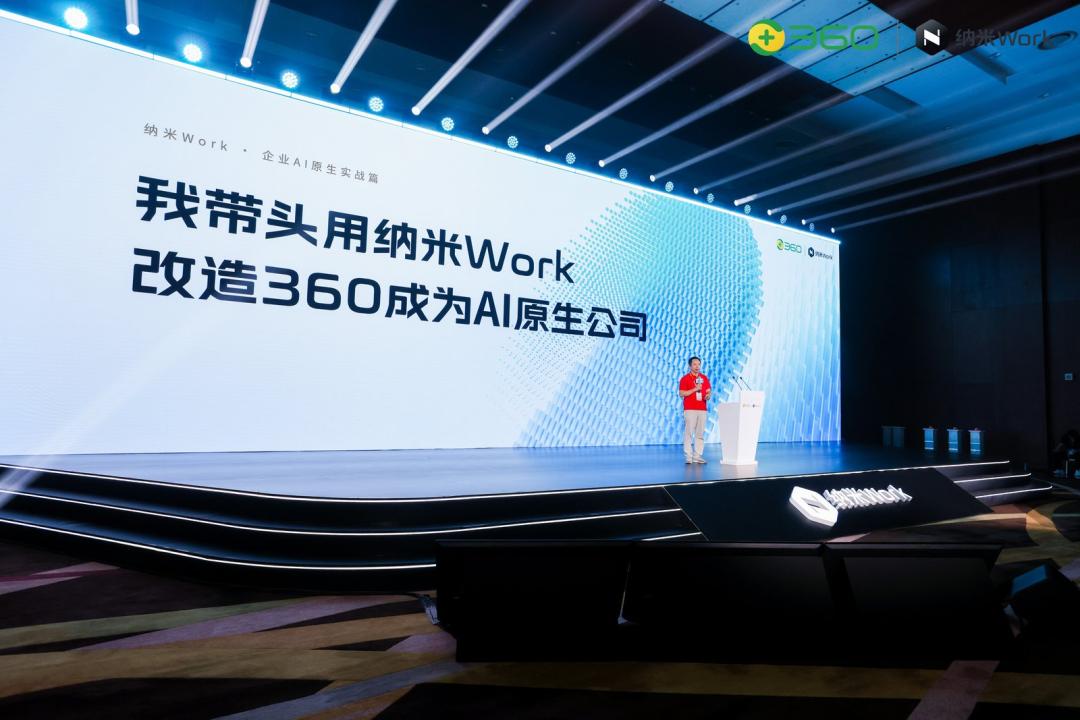
Zhou Hongyi takes the lead in testing Nano Work inside 360
According to Liang Zhihui, Nano Work was first rolled out inside the company. Employees got their own Agents, and the Agents began to get identities to enter the company's internal system. But it soon hit a wall.
The enterprise information security department is usually responsible for "building walls": the code repository, emails, OA and financial systems are isolated from each other, and each person can only access the areas related to their position. For Nano Work to work properly, the first problem the team needs to solve is how to "demolish the walls" in a controlled way. This matter is particularly sensitive in a security company.
Ordinary Agents do not even have an access card to enter the company. They are not connected to the enterprise ID, cannot prove who they represent, and cannot reuse the existing authorization of employees. 360 assigned an "ID card" to the Agent, and connected it with the domain account. When accessing the internal system, it needs to carry the login identity of the specific employee; unreviewed Skills in the intranet cannot be used directly.
With identity, the new problem is how much permission should be granted to it.
The QA case gives an internal answer at 360: human permissions are divided according to positions, while Agents can get additional permissions based on the tasks they receive. But these permissions are not granted all at once. Reading code, submitting modifications and official release are split into different permission nodes. The Agent can complete the previous work in a controlled environment, and the final confirmation is still done by human.
Nano Work had many problems in the early stage of launch, and this method was first used to repair itself.
The team set up an internal group, and an intern was initially responsible for handling feedback. There was also a "Nano Work Doctor" next to him. Since the Agent and the faulty environment both run in the virtual machine, the "Doctor" can directly check the environment and assist in handling problems.
Later, it began to inspect the environment, locate faults, and then assign the problems to corresponding developers. Some bugs will also be fixed and submitted by the robot, and released after human confirmation.
"We are trying to let real intelligent agents take up their jobs," Liang Zhihui said. After AI started working, the internal management method of 360 also began to change.
There is a daily Token ranking list inside 360, the system can analyze what the person with the highest consumption uses AI to do, and these work traces can be organized into weekly reports by AI. Managers can understand the work progress based on this, and ask specific questions around specific issues.
In the past, managers waited for employees to recount what they had done. Now, they begin to directly ask for the data left by the work.
More visibility also brings new boundaries. The enterprise version tries to make work conversations shared by default, but employees can choose to set them as private. Liang Zhihui emphasized that the analysis target is the interactions in the enterprise version of Nano Work, not all activities on the employee's personal computer. Even so, clear rules are still needed to clarify who can see the work process and who can call these records.
360 initially just