Six cities join forces! Has the first expanded national-level metropolitan area emerged?
The first national-level metropolitan area expected to expand has emerged.
Not long ago, Shaanxi Province released the *Implementation Opinions on Promoting High-Quality Urban Development*, rolling out the latest deployment for the functional positioning of all cities within the province.
In the section titled "Building a Modern Metropolitan Area and Urban Agglomeration", it clearly states: Optimize the development pattern of the Xi'an Metropolitan Area... Take Xixian New Area as the core hub to accelerate the Xi'an-Xianyang integration process, promote the integrated development of Xi'an-Tongchuan, Xi'an-Weinan, Xi'an-Shangluo and Xi'an-Yangling... and build high-level transportation, technology, industry, living and ecological circles.
Compared with the *Xi'an Metropolitan Area Development Plan* approved by the central government in 2022, the proposal of "Xi'an-Shangluo integrated development" may mean that Shangluo, which was not included in the previous plan, has now been incorporated into the development vision of the Xi'an Metropolitan Area.
Against the general backdrop that most metropolitan area plans have seen a "scope shrink" in recent years, does this signal that the Xi'an Metropolitan Area will take the lead in ushering in expansion? What kind of underlying message does it send out?
01
In fact, this implementation opinion covers very rich content, outlining a new pattern of urban development across Shaanxi Province.
For example, it explicitly puts forward the goal to enhance the driving force of the "dual poles" of Xi'an and Yulin, reaffirming the province's urban development framework led by the "dual poles".
Certainly, there are obvious differences in the specific positioning of the two cities. Xi'an will continue to improve its leading driving capacity for the development of the whole province and the entire northwest region. Yulin, on the other hand, will focus on high-quality efforts to build a provincial sub-central city and become a key growth pole for the high-quality economic development of the whole province.
Beyond the "dual poles", the document clarifies that further efforts will be made to promote cities including Baoji, Xianyang, Weinan and Hanzhong to improve urban functions, enhance urban quality and facilitate industrial upgrading; support small and medium-sized cities such as Tongchuan, Yan'an, Ankang and Shangluo to optimize infrastructure layout and public service supply, and drive relatively concentrated population aggregation and industrial clustering.
However, "building a modern metropolitan area and urban agglomeration" remains the top priority of the implementation plan.
On one hand, as the fifth national-level metropolitan area in China and the only one of its kind in the northwest region, the Xi'an Metropolitan Area undoubtedly ranks at the top tier in Shaanxi Province in terms of status and development level. On the other hand, in terms of economic aggregate and population size, the Xi'an Metropolitan Area is also the absolute "foundation" of Shaanxi's development.
By 2025, the economic aggregate of the Xi'an Metropolitan Area (excluding Shangluo) reached 1.75 trillion yuan, 1.3 times the figure at the time of plan approval, accounting for 47.8% of the province's total GDP.
In other words, this single metropolitan area contributes nearly half of Shaanxi's total economic output.
02
Then, does the inclusion of "Xi'an-Shangluo integrated development" into the consideration of optimizing the development pattern of the Xi'an Metropolitan Area mean that Shangluo has officially become a new member of the metropolitan area? Is the Xi'an Metropolitan Area really going to upgrade from a cluster of five cities to a cluster of six cities?
According to the official plan, the scope of the Xi'an Metropolitan Area mainly includes: the entire administrative region of Xi'an (including Xixian New Area), Qindu District, Weicheng District, Xingping City, Sanyuan County, Jingyang County, Liquan County, Qian County and Wugong County in Xianyang City, Yaozhou District in Tongchuan City, Linwei District, Huazhou District and Fuping County in Weinan City, and Yangling Agricultural Hi-tech Industries Demonstration Zone, covering an area of 20,600 square kilometers, with a permanent resident population of 18.02 million by the end of 2020 and a regional GDP of about 1.3 trillion yuan.
It is clear that Shangluo has not yet been officially "included in the metropolitan area".
But this time, the proposal of Xi'an-Shangluo integrated development is put forward side by side with Xi'an-Tongchuan, Xi'an-Weinan and Xi'an-Yangling integrated development. Does this equal the expansion of the Xi'an Metropolitan Area?
In fact, although Shangluo is located in the southern part of Shaanxi, it is only about 100 kilometers away from Xi'an. Therefore, in the early stage of the Xi'an Metropolitan Area planning, some districts and counties of Shangluo, such as Shangzhou District and Zhashui County, were indeed included in the discussion scope. However, Shangluo was not successfully included in the final officially approved plan.
Just one year after the Xi'an Metropolitan Area plan was approved, Xi'an and Shangluo signed the Strategic Cooperation Framework Agreement on Xi'an-Shangluo Integrated Development.
Meanwhile, the 15th Five-Year Plan of Shaanxi Province also lists "Xi'an-Shangluo integrated development" as a key project for the integrated development of cities in the Guanzhong area.
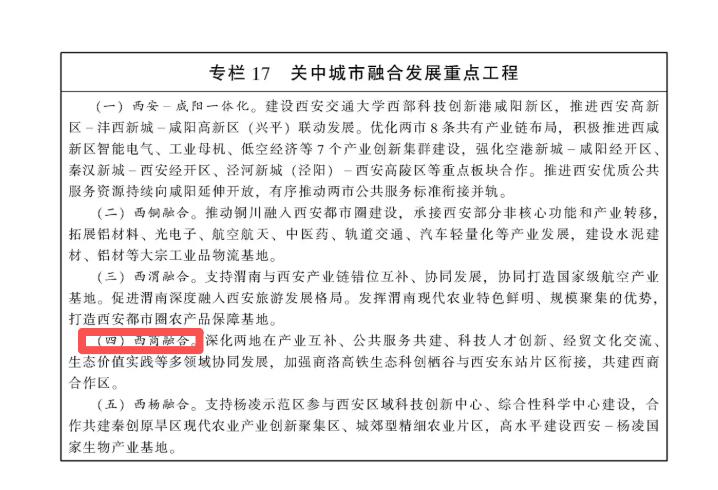
This further inclusion of Xi'an-Shangluo integrated development into the metropolitan area pattern indicates that Shangluo's "inclusion into the metropolitan area" has been recognized at the provincial level. At the same time, the external conditions for Shangluo to join the Xi'an Metropolitan Area are indeed becoming increasingly mature at present.
At the end of June this year, with the opening of the Xi'an-Shiyan High-speed Railway, Shangluo has been officially integrated into Xi'an's "half-hour economic circle".
In addition, from the perspective of development foundation, Shangluo's total economic output is less than 100 billion yuan, with a permanent resident population of about 2 million, both ranking at the lower end across the province. It is also known as the "back garden of Xi'an", so integrating into the Xi'an Metropolitan Area is a mutually beneficial win-win move for both Shangluo and Xi'an.
03
However, the adjustment of the scope and development pattern of a national-level metropolitan area cannot be completed independently by a single province or city, and must go through strict approval procedures.
As early as 2022, the National Development and Reform Commission clearly stated that the development of metropolitan areas in China is still in the initial stage. All regions should follow objective laws, not cross the development stage and promote metropolitan area construction without sufficient conditions... The spatial scope of the metropolitan area should be determined scientifically and reasonably based on population and economic ties, so as to prevent blind expansion.
Meanwhile, the metropolitan area itself has a strict definition. It generally refers to an urbanized spatial form within an urban agglomeration, centered on a megacity, super-large city or a large city with strong radiation driving capacity, with the 1-hour commuting circle as its basic scope.
For this reason, in recent years, compared with the "draft plans", the finally approved scope of many metropolitan areas has seen a "shrink":
The Hangzhou Metropolitan Area was reduced from 6 cities of "Hangzhou-Jiaxing-Huzhou-Shaoxing-Quzhou-Huangshan" to 4 cities of "Hangzhou-Jiaxing-Huzhou-Shaoxing"; the Wuhan Metropolitan Area was adjusted from the "1+8" city cluster (9 cities) to "Wuhan-Ezhou-Huanggang-Huangshi"; in the Guangzhou Metropolitan Area, Shaoguan and Yunfu were excluded; in the Shenzhen Metropolitan Area, Heyuan and Shanwei were excluded.
Against this backdrop, it is still too early for Shangluo to be officially included in the Xi'an Metropolitan Area plan. However, the proposal of "Xi'an-Shangluo integrated development" at least sends out a positive signal.
At the same time, it is certain that whether for Xi'an or the whole Shaanxi Province, under the general trend of "one province with one national metropolitan area", the importance of the Xi'an Metropolitan Area will become increasingly prominent.
And whether a city can be included in the metropolitan area will directly affect the development trend of surrounding cities.
According to the national deployment, China plans to lay out a total of 27 national-level metropolitan areas.
21 of them have been approved so far, covering all four major regions of eastern, central, western and northeastern China. The remaining 6 quotas will most likely be allocated to the following metropolitan areas: Harbin Metropolitan Area, Hohhot Metropolitan Area, Taiyuan Metropolitan Area, Shanghai Metropolitan Area, Nanchang Metropolitan Area, Nanning Metropolitan Area, Guiyang Metropolitan Area, Lanzhou-Baiyin Metropolitan Area, Xining-Haidong Metropolitan Area, and Suzhou-Wuxi-Changzhou Metropolitan Area.
There have been recent reports that the Taiyuan Metropolitan Area has received a reply of planning coordination from the relevant authorities, which means it is very likely to become the 22nd national-level metropolitan area in China.
In addition, five years have passed since the first batch of metropolitan areas was approved. It is not ruled out that in the new development stage, some mature metropolitan areas will usher in expansion opportunities.
This article is from the WeChat official account "West City Affairs", written by Xibu Jun, and published by 36Kr with authorization.