The biggest challenge for universities to extend their campuses to county-level locations is not the construction of buildings.
In early September, a large number of young people suddenly poured into Lingshui County, Hainan Province. They did not come for tourism, work or job hunting, but headed for the university campuses settled here.
This phenomenon is far from new. In recent years, a considerable number of higher education institutions, including "Double First-Class" universities, have extended their presence to county-level administrative regions, which has become a notable trend worthy of observation in the changing landscape of higher education.
The pace of university campus construction in county-level regions has accelerated significantly in the past two years. In 2025, the construction of the Future College (New Campus) of Anhui University fully broke ground in Feixi County, Hefei; the Jiangbei Campus of Northeast Forestry University was also approved by the Ministry of Education and located in Zhaodong, a county-level city; during the same period, the Jinjiang Campus of Fuzhou University continued to expand.
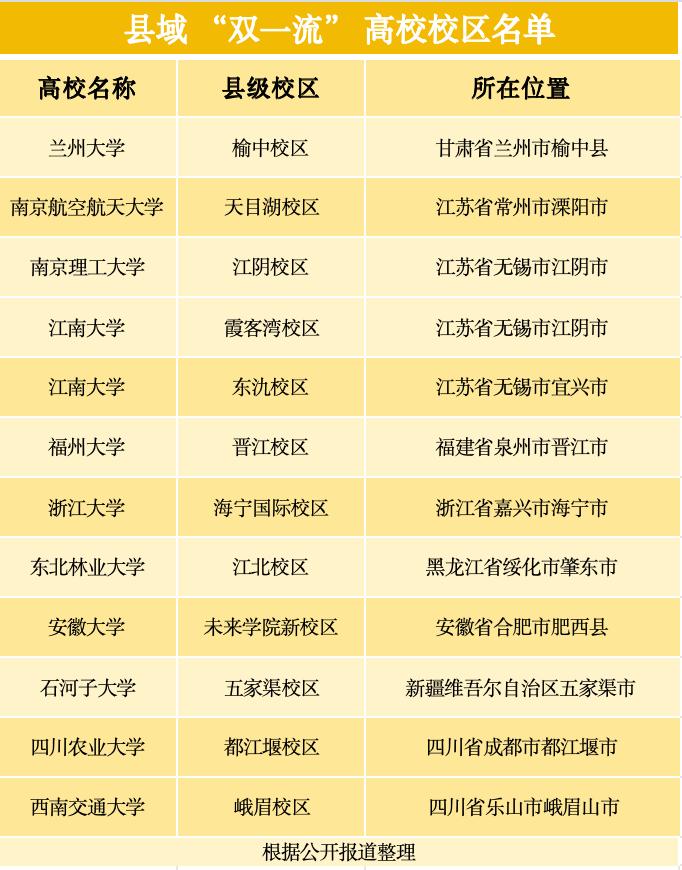
Chart production: Time Weekly, City Reading Studio
The most typical case is Lingshui, Hainan. Relying on the Li'an International Education Innovation Pilot Zone, Lingshui has gathered 11 Chinese universities and 19 overseas universities, including "Double First-Class" institutions such as Tianjin University and Xi'an Jiaotong University. In 2026, the pilot zone added new cooperative school-running projects including Northeast Forestry University, continuing its expansion.
If we broaden our horizon beyond several well-known prestigious universities, the more obvious change in the past two years is that the number of university campus constructions in county-level regions is increasing, and key universities classified as "985 Project" and "211 Project" have become a part that draws widespread attention.
The trend of universities expanding into county-level regions does not mean that all counties have equal opportunities. The real question is, in the new round of higher education institution layout, what kind of counties are capable of attracting universities to set up campuses there?
Why Are Universities Targeting County-Level Regions
The move of "985 Project" and "211 Project" universities to set up campuses in county-level regions did not happen overnight. If we trace back the timeline, we can find that prestigious universities have gradually extended their presence beyond central urban areas of big cities.
Over the past years, many universities have set up campuses in cities outside their main campus locations: Harbin Institute of Technology has campuses in Weihai and Shenzhen; Shandong University has formed a school-running pattern of "one university, three locations" covering Jinan, Weihai and Qingdao; Sun Yat-sen University has also established a campus in Zhuhai.
In recent years, a new change has emerged in the location selection of universities — county-level cities. Jiangyin, located in Jiangsu Province, is a typical sample of this trend.
In 2024, the Xiakewan Campus of Jiangnan University located in Jiangyin was put into use. Together with the Jiangyin Campus of Nanjing University of Science and Technology that has been in operation for years, this county-level city now has two campus sites of national "211 Project" and "Double First-Class" universities directly under the Ministry of Education.
For Jiangnan University, Jiangyin is a key wing of the university's "one body with two wings" school-running pattern. The university takes the Lihu Campus in Wuxi as the "one body", and the two campuses in Jiangyin and Yixing as the "two wings". One of the important considerations behind this layout is to make academic disciplines more closely aligned with local industries. With a solid industrial foundation in Jiangyin itself, Jiangnan University has therefore set up new schools such as the School of Integrated Circuits and the School of Intelligent Manufacturing focusing on local industries including integrated circuits, advanced manufacturing, new materials and low-altitude economy, to promote direct alignment between majors and industrial demands.
Jinjiang in Fujian Province has followed a similar path.
As a strong manufacturing county, after introducing Fuzhou University, the majors and scientific research directions of the campus have been continuously adjusted to fit local industries. In 2025, Fuzhou University successively carried out cooperation with enterprises including Anta and Septwolves to conduct R&D in fields such as high-performance materials, intelligent manufacturing and smart wearables. The university also jointly established an Industrial Innovation Research Institute with Septwolves, building the innovation platform directly inside the enterprise.
For Jinjiang, introducing a university is not just about adding educational resources, more importantly, it connects the scientific research capabilities of universities with the real demands of local enterprises.
Lingshui in Hainan represents another type of case.
The Li'an International Education Innovation Pilot Zone, unveiled in 2020, is an education opening platform co-built by the Ministry of Education and Hainan Provincial Government, whose core task is to expand the opening-up of education to the outside world and introduce high-quality domestic and international educational resources. The park is not built around a single university. Instead, following the idea of "large shared facilities + small independent colleges", it gathers different universities on the same platform to explore school-running modes such as shared courses and mutual recognition of credits. In 2026, the pilot zone has gathered 30 Chinese and foreign universities.
The 2023 government work report of Lingshui County mentioned that the construction of the pilot zone is an important part of the county's efforts to develop and expand the modern service industry and accurately develop high-tech industries. Later, Hainan issued the "Regulations on Li'an International Education Innovation Pilot Zone in Lingshui, Hainan Free Trade Port", which clearly supports universities, scientific research institutions and enterprises to carry out collaborative innovation around industries, promote the incubation, transformation and industrialization of scientific and technological achievements, and facilitate the integrated development of "education, research, industry and city".
In other words, Lingshui hopes to further cultivate industries by leveraging the educational, talent and scientific research resources brought by the agglomeration of universities.
In 2026, the pilot zone has built a university-enterprise collaborative talent training platform focusing on key industries such as digital economy, cultural tourism and modern service industry, constructed a digital economy talent development center and a digital laboratory, and cooperated with enterprises including Huawei, Softcom and BrainCo to build practical training bases. More than 20 student entrepreneurship projects have been incubated so far.
Who Can Benefit From the Expansion of Higher Education Institutions
The expansion of universities into county-level regions is backed by a bigger background: the higher education sector itself is scaling up.
In June 2026, the State Council issued the "15th Five-Year Plan for Education Development", which clearly put forward the promotion of quality improvement and expansion of higher education, supported the construction of a number of new campuses for "Double First-Class" universities, and proposed that by the end of the 15th Five-Year Plan period, the number of undergraduate students enrolled by "Double First-Class" universities will increase by more than 100,000.
For some universities whose main campuses are already facing tight space, building new campuses has become a path to expand the supply of high-quality higher education resources.
Judging from the cases that have been implemented in recent years, county-level cities with a large number of university layouts are often the top-performing regions in terms of county-level economy across the country. In the 2025 list of top 100 counties in terms of comprehensive competitiveness in China, Kunshan, Jiangyin, Zhangjiagang, Yiwu, Changshu, Jinjiang, Cixi, Zhuji, Yixing and Taicang occupy the top 10 positions; among them, high-level universities have already set up campuses in regions including Jiangyin, Jinjiang, Yixing and Taicang.
The economic volume, population size and urban functions of these economically strong counties are no longer the traditional small towns in the general sense.
Taking Jiangyin as an example, its GDP reached 527.218 billion yuan in 2025, the added value of industrial enterprises above designated size increased by 7.2%, and the general public budget revenue increased by 3.1%. Taicang has long ranked among the top 100 counties in China, its GDP reached 193.566 billion yuan in 2025, the annual output value of industrial enterprises above designated size reached 343.358 billion yuan, of which the output value of high-tech industries accounted for 56.8%.
Of course, economic volume is only one of the conditions. Judging from the actual locations of these universities, another obvious feature is that many of them are within the radiation scope of urban agglomerations or metropolitan areas.
The Huailai Campus of Beijing Institute of Technology is located in Huailai County, Zhangjiakou City, which is part of the Beijing-Tianjin-Hebei urban agglomeration; the Future College of Anhui University is located in Feixi, adjacent to the central urban area of Hefei, and Hefei Metro Line 3 has already extended to Feixi. Such county-level regions can not only undertake the spillover of higher education resources from central cities, but also reduce the space cost of study, life and internships for teachers and students by relying on the convenient transportation connections with central cities.
After all, for a university to settle in a county, what is needed is not just space for a campus, but also conditions that can sustain long-term school operation. Stable student sources, teaching staff and employment markets are all inseparable from the local population and industrial foundation.
For county-level cities with strong economic strength and high population agglomeration, these conditions are usually relatively sufficient. However, for some counties with limited industrial and population size, issues such as subsequent faculty recruitment, campus operation, student enrollment and graduate employment may become new challenges after the university campus is completed.
Practices in some regions in the past have illustrated this point.
In 2013, Dushan University Town, the first county-level university town in Guizhou Province, was settled in the southern part of Dushan County, 2 kilometers away from the county seat, covering an area of more than 15,000 mu. It was planned to accommodate 10 universities with 80,000 to 100,000 enrolled students, with a total estimated investment of about 135 billion yuan.
However, after many years, this university town has not reached the scale of the original plan. According to reports, there are not many schools actually settled in the park, only a few institutions including Qiannan Normal College for Nationalities and Dushan Secondary Vocational School have moved in, and universities such as the Central Conservatory of Music that were previously publicized have not settled here.
The experience of Dushan shows that the construction of a university town does not necessarily bring in universities, students and supporting industries. For county-level regions, the real difficulty is not building the campus, but whether they can continuously attract universities, retain students, and form a stable connection between educational resources and local economic development.
At the same time, some regions have adopted a prudent attitude towards laying out universities in county-level regions. Henan and Guizhou have clearly stated that in principle, they will not arrange the layout of new universities in county-level regions; Sichuan has also proposed that the establishment of new higher education institutions should be prioritized to regional central cities and important node cities.
During the 15th Five-Year Plan period, high-quality higher education resources will continue to expand, and new university campuses will continue to increase. For county-level regions, the settlement of a university is just a starting point. What is really worthy of observation is whether these new campuses can gradually transform from a construction project into an integral part of the local development of education, talent and industries.
This article is from the WeChat official account "City Reading Studio", author: Li Hang, published with authorization from 36Kr.