After a year-long fierce battle between Insta360 and DJI: from a 100-billion-yuan market capitalization to zero profit.
"I've decided I'll never step into the camera track again, the work intensity is far too high", a former Insta360 employee sighed to Tech Planet. As working hours keep getting longer and KPIs increasingly heavier, in the office buildings of Bao'an District, Shenzhen, the company he used to work for is now part of one of the most hyper-competitive sectors in China.
Over the past few years, action cameras have expanded from niche geek toys to mass consumer products. But behind the bustling prosperity, the offensive and defensive battle between industry giants has reached white-hot intensity. Insta360 launched its panoramic drone product line, while DJI started developing panoramic cameras, with both marching into each other's core business territory.
The 2026 semi-annual report recently disclosed by Insta360 also confirms the brutal reality of industry competition.
Financial reports show that Insta360 achieved an operating revenue of 5.517 billion yuan in the first half of the year, a substantial year-on-year increase of 50.29%, but the net profit attributable to shareholders of the listed company was only 30.4073 million yuan, plummeting 94.15% year-on-year; the net profit attributable to shareholders of the listed company after deducting non-recurring gains and losses even recorded a loss of 15.3392 million yuan, marking the first shift from profit to loss since the company went public.
The release of the financial report almost coincided with the first anniversary of Insta360's listing. At its peak, the company's market value once reached as high as 150 billion yuan, but as of now, its market value has dropped to only 43.6 billion yuan. What exactly happened in the year since Insta360 went public?
01
5.5 billion yuan in sales for half a year, but profitability is getting harder
Since its listing, Insta360's revenue growth rate has not been slow, but making profits has become increasingly difficult. In the first half of 2026, operating revenue reached 5.517 billion yuan, while the net profit attributable to parent company shareholders was only 30.4073 million yuan; in the second quarter, the company even fell directly into a net loss of 54.21 million yuan.
Specifically, Insta360's quarterly revenue maintains a year-on-year growth rate of over 50%, and the growth rate even exceeded 80% in Q3 2025 and Q1 2026. However, the dilemma of "revenue growth without profit growth" has become increasingly prominent. Net profit has declined year-on-year since Q3 2025, and turned into a single-quarter loss in Q2 2026.
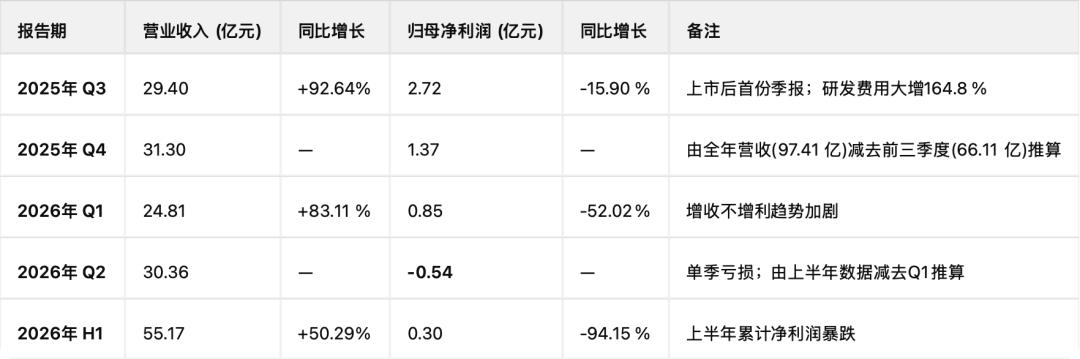
Figure note: Quarterly performance of Insta360 after listing, sorted out by Tech Planet based on financial reports.
Regarding the plunge in net profit, Insta360 stated in the financial report that first, the procurement cost of core raw materials continued to rise, and the price of storage chips such as DDR kept rising and remained at a high level during the reporting period; second, the phased investment in the expansion of panoramic drones as a new product category had a negative impact on the company's overall profit.
In addition, from the perspective of time node, DJI officially launched the panoramic camera Osmo 360 in July 2025. After the new product distribution period in Q3, the Double 11 shopping festival in Q4 and the Spring Festival promotion in Q1, Q2 2026 is the first quarter for both sides to enter normalised competition.
Financial reports show that Insta360's gross margin in Q2 2026 fell by about 12% year-on-year to 38.33%, and the sales expense ratio rose by about 2.6% year-on-year. The sharp drop in gross margin and the rise in sales expense ratio are interpreted by the market as dual signals of increased defensive investment and weakened pricing power. The panoramic camera track has moved from the blue ocean dividend period to the stage of close hand-to-hand combat.
In the past year, Insta360 has also been accelerating the deployment of offline stores. Taking the Beijing market as an example, in addition to the store at Hopson One, the Insta360 stores in many business districts are actually operated by the same agent. According to an Insta360 store manager who introduced the situation to Tech Planet, each agent operates at least a dozen stores, most of which are located in high-traffic premium malls, "We generally do not enter malls with low passenger flow". He admitted that the initial investment in decoration, stock procurement, utilities and other items is quite high, and it is difficult to get the cost back in the short term, "It will get better after operating for a long time".
A DJI store manager confirmed the intensity of channel competition from another perspective: his store has a monthly minimum sales target of hundreds of thousands of yuan. "In order to sell more products, almost every one of our staff is taking throat lozenges", he said. When not receiving customers, staff need to learn product materials, there are unified training and exams after new products are launched, and there are also weekly and monthly internal assessments. He said frankly that the Pocket series is the best-selling, and joked that "you can sell them even with your eyes closed".
At both DJI and Insta360 stores, staff said that the gimbal camera series sells better offline, with female users as the main buyers, and the usage scenarios are concentrated in daily photo taking, Vlog recording and concert shooting.
In the past year, competitive pressure has also been transmitted to the interior of Insta360. A former Insta360 employee revealed to Tech Planet, "The competition is getting more and more fierce, especially the fierce confrontation with DJI. The working hours vary greatly in different departments, and the marketing and R&D positions face more serious overtime. The business team even replied to my messages at two or three o'clock in the morning before".
According to the above-mentioned employee, the performance assessment of his department is carried out on a quarterly basis with a very high assessment frequency. After the quarterly meeting, the supervisor will communicate with the 10% of employees who rank at the bottom. In addition, many employees from mobile phone manufacturers have switched to Insta360 in the past two years.
02
Dragged into a war of attrition by DJI?
In June 2025, Insta360 Innovation was listed on the Sci-Tech Innovation Board. Only one month later, at the end of July, Insta360 announced the launch of its panoramic drone brand "Yingling", officially entering DJI's core business territory. DJI has long maintained a market share of more than 70% in the global consumer drone track, which is the first time Insta360 has taken the initiative to attack the industry giant after its listing.
DJI's counterattack came even faster. Only three days later, DJI released its first panoramic camera Osmo 360, entering Insta360's core market at a lower price.
First looking at the drone battlefield, Insta360 cannot shake DJI's market position in the short term. Financial reports show that the four subsidiaries under Insta360's drone business recorded a total loss of about 367 million yuan. Less than four months after its launch, the Yingling A1 was once significantly reduced in price, with the standard package dropping directly from 6799 yuan to 5499 yuan.
According to the disassembly report from Wellsenn XR, the comprehensive post-tax hardware cost of Yingling is about 5512 yuan. The price after the price reduction is close to or even lower than the cost line. If channel and after-sales expenses are included, the business is basically exchanging market share at a loss.
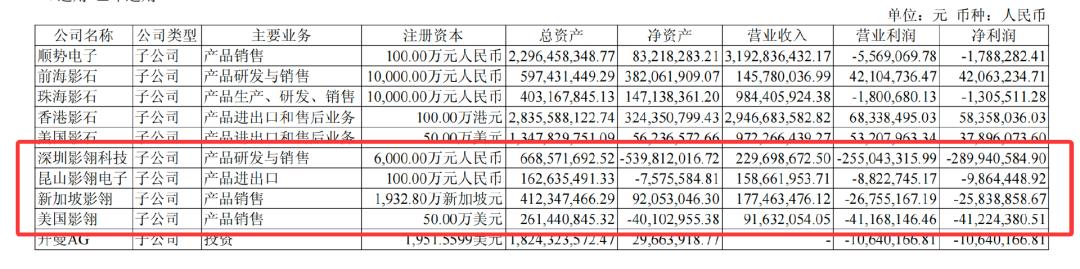
Figure note: Sourced from Insta360 financial report.
UBS pointed out in its research report in February 2026 that Insta360's panoramic drone business "seriously underperforms expectations", and the market education cycle is far longer than predicted. China Galaxy Securities stated in its research report that Insta360's panoramic drone products have novel positioning, but the supply chain does not have scale effect, leading to high costs.
As of now, the cumulative sales volume of Yingling A1 in the official flagship stores on Tmall, JD and Douyin has reached 700+, 1000+ and 100+ respectively.

Figure note: Comparison of Insta360 and DJI products, sorted out by Tech Planet based on public data.
Looking at Insta360's core business, in the panoramic camera market, data from Juku Consulting shows that Insta360 once held a leading share of 91% in the first half of 2025, but this figure fell back to 53% in the second half of the year. Almost all the lost market share was taken over by DJI. Although Insta360 founder Liu Jingkang said in a public speech in March this year that "7 out of every 10 panoramic cameras sold worldwide are from us", its dominant position has loosened under the impact of Osmo 360.
In addition, DJI has launched a price war. According to an Insta360 store manager, all DJI products that compete with Insta360's offerings are priced about 500 yuan lower than the latter, and the Osmo 360 series is as much as 700 yuan cheaper than the Insta360 X6 series.
The war has not been limited to the product level. Entering 2026, the rivalry between the two sides has spread to multiple dimensions such as patent litigation, supply chain and channel competition.
In the offline battlefield, DJI has more than 700 authorized retail stores and experience stores across the country, while Insta360 has been catching up aggressively in the past three years. The number of its exclusive stores has surged from only 5 in 2023 to nearly 300, and many stores are located close to DJI outlets, quickly achieving full coverage of first-tier and second-tier cities.
The 2026 semi-annual report shows that its offline sales revenue accounts for 44.02% of total revenue. In July this year, Insta360 successively secured two channel partners, Honor and Apple, and many of its products entered more than 500 Apple authorized stores across the country, trying to narrow the offline gap with DJI with the help of giant channel resources.
However, the flip side of aggressive expansion is operating pressure. According to an Insta360 store manager who revealed the situation to Tech Planet, the store located in Beijing SKP has recently closed due to lower-than-expected passenger flow.
03
New changes amid attacks from both sides
Action camera is one of the few tracks in the current consumer electronics industry that still maintains doubling growth. The market cake is getting larger, while the number of competitors is also surging. The dimensions of competition are expanding from traditional image quality and anti-shake to form innovation and scenario segmentation.
An industry insider introduced to Tech Planet that Insta360's biggest contribution is opening two doors: one is the drone track, which allows a large number of entrepreneurs to dare to enter the market; the other is the handheld shooting track, which opens up new space for latecomers. But the flip side of the coin is that Insta360 itself is passively caught in the middle.
In the view of the above industry insider, the technical threshold of action cameras is much lower than that of drones. The fierce fight between giants has instead created entry opportunities for other players. Hover camera, bouncing follow-shot robot, AI intelligent follow-shot device, these new players are mostly in the early market stage, but their products have been launched one after another. The track is being activated, and many related projects have successively received financing.
The supply chain side is also changing. In the past, the supply chain was unwilling to accept orders from small players, but now more and more supply chain manufacturers are taking the initiative to enter the market.
For Insta360, the current situation can be described as being attacked from both sides. But this pressure may not be a bad thing, and may instead force it to become stronger, the above-mentioned industry practitioner analyzed: "However, DJI has a larger volume and deeper technical accumulation. If the confrontation lasts for a long time, Insta360 may not be able to sustain the consumption".
In addition, the technical threshold of panoramic cameras is much lower than that of drones, which means that DJI and Insta360 will eventually meet head-on on the same track. The emergence of the panoramic drone product line only detonated this battle in advance. The high talent cost in the drone field has also created a unique scene in the venture capital circle: VCs have "waited by the tree for hares" at the gate of DJI, launching a talent snatch battle at the first time.
Looking at the demand side, shooting itself is a basic demand. Handheld cameras are just one of the many product forms that meet this demand. Flying follow-shot, portable lightweight devices, intelligent tracking shooting, every segmented direction is likely to grow into an independent track. For every new scenario that is developed, the irreplaceability of handheld shooting will be diluted a little.
More players are entering the market, including mobile phone manufacturers such as OPPO, vivo and Xiaomi, who have successively spread news of project approval, product proofing and even mass production of handheld cameras.
For Insta360, it is not easy to seize more market share if there is a lack of sufficient product innovation in the follow-up stage. What the outside world is most concerned about recently is its upcoming entry into the mirrorless camera track, a market that has been firmly controlled by Japanese manufacturers such as Canon, Sony and Nikon for decades. Insta360 is trying to carve out a place for itself through differentiated positioning.
While fighting with DJI, Insta360 is also constantly looking for new growth points. After all, the capital market's patience is limited.
This article is from WeChat official account "Tech Planet" (ID: tech618), author: Lin Jing, published with authorization from 36Kr.