DingTalk cannot accommodate Qianwen Office
Qianwen Office, the office agent under Alibaba, has recorded over 30 million registered users one month after its launch, more than half of whom are enterprise employees. This is not a product story starting from scratch — DingTalk's 26 million enterprise organizations and Alibaba Cloud's 5 million customers have provided a ready-made customer base for Qianwen Office.
Among the 30 million users is Guo Ziya, a front-line employee of Changan Automobile.
At Changan Automobile's production base in Hebei, there is a tedious yet error-intolerant process before a car leaves the factory.
There are more than 100 mandatory pre-delivery inspection parameters in the certificate of conformity and accompanying documents for each vehicle. Before vehicle delivery, dozens of parameters on documents such as the certificate of conformity and environmental protection list must be consistent with the national regulatory website. In the past, quality inspection engineers needed to compare each item one by one, and it took more than ten minutes to complete the verification of one vehicle. With the help of AI (Artificial Intelligence), the entire process and efficiency are completely different now.
Guo Ziya is a quality inspection engineer at Hebei Changan with 13 years of work experience and has never written a single line of code before. After getting in touch with AI this year, she assigned this work to Qianwen Office. After taking photos and uploading the certificate of conformity and accompanying documents, the AI will identify the parameters, automatically complete the verification and generate the comparison result. The verification time for one vehicle has been shortened from more than ten minutes in the past to one or two minutes.
The daily collaborative office software used by Changan Automobile is not Alibaba's DingTalk. For a large central state-owned enterprise, replacing the office software of the entire company involves issues such as organizational habits.
However, this has not become an obstacle for Changan Automobile's employees to use Qianwen Office, as Qianwen Office has been interconnected with mainstream office platforms including DingTalk, Feishu and WeCom.
Qianwen Office has been integrated into multiple links of Changan Automobile, including R&D, production, supply chain, sales and service. A group of employees at Changan Automobile are using AI for office work, and Qianwen Office is entering the real business processes of more and more enterprises.
Alibaba disclosed that enterprises including Changan Automobile, Huifu Tianxia, Transfar Group, Kelun Pharmaceutical, and Laoxiangji have accessed Qianwen Office, covering more than ten industries such as automotive, finance, logistics, pharmaceutical and catering.
Qianwen Office has targeted the enterprise market from the very beginning of its birth, and it is deeply integrated with DingTalk. We have learned that Alibaba hopes "Qianwen Office + DingTalk" can directly enter and expand the original office and business processes of enterprises. However, the open ecosystem means that Qianwen Office cannot be limited to DingTalk.
The agent itself is becoming an important entry point that affects users' choices.
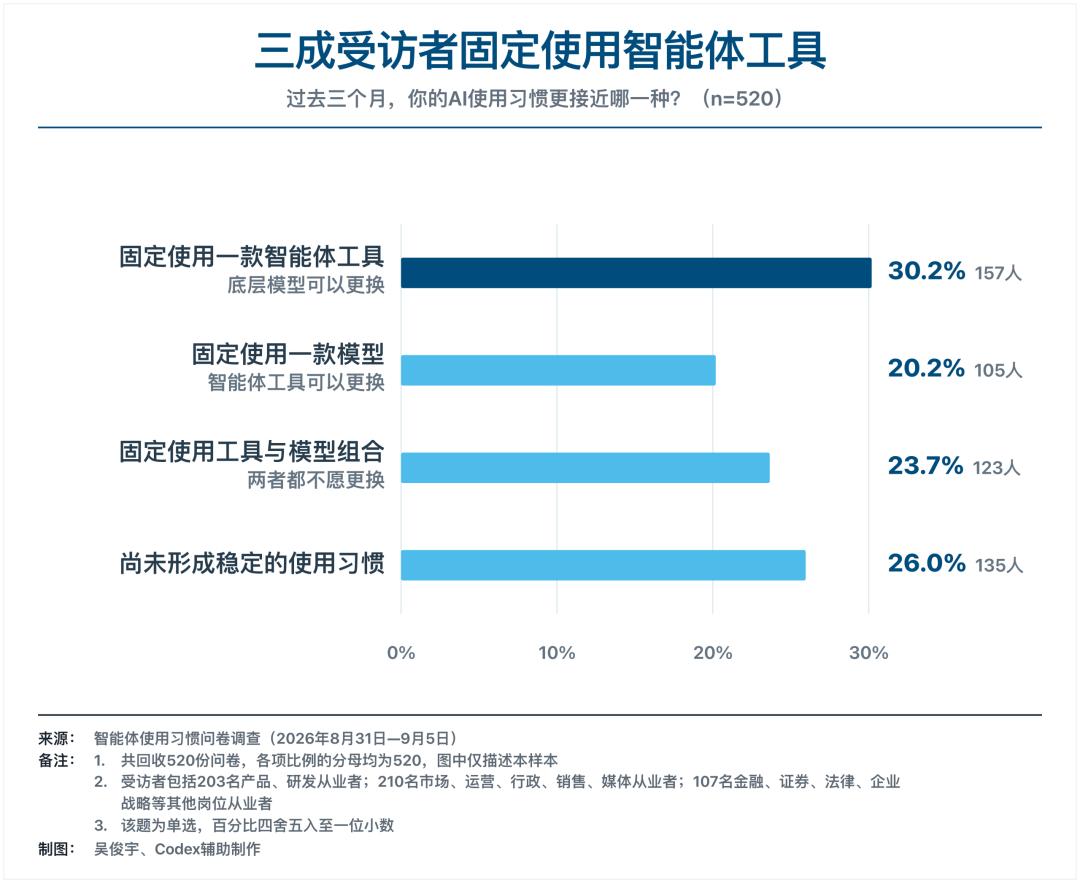
A targeted questionnaire survey we conducted on 520 employees in the Internet and pan-technology industries in early September this year shows that in the past three months, 30.2% of the respondents fixedly use one agent tool but can replace the underlying model; 20.2% of the respondents fixedly use one model but can replace the agent; 23.7% of the respondents have formed a fixed "agent + model" combination, and the remaining respondents have not formed a fixed usage habit.
This survey only reflects the current sample and does not constitute a random sampling of the overall market (Note: This questionnaire is an independent survey with no entrusting party. We will analyze and interpret the survey results in the near future).
For some knowledge workers, choosing which agent to use has become as important as choosing which model to use.
Whoever occupies the agent entry point will be closer to the first-layer interface where users call models, tools and enterprise software.
In the past six months, Alibaba, ByteDance and Tencent have all accelerated their layout of office agents. Alibaba's Qianwen Office, ByteDance's Doubao Work, and Tencent's WorkBuddy have been pushed to the forefront of the new round of competition for enterprise office entry points.
01
Integrated into Enterprise Workflow
"In the past, when we carried out digital transformation, we focused more on IT systems, and often hoped to solve many problems through one large-scale system. Now when developing AI, a major change is that we are more focused on people, and specific people use AI to solve specific problems."
In the view of Xiao Shiqiang, manager of the AI Application Development Department at Changan Automobile, the most obvious difference between this round of AI transformation and the previous round of digital transformation is that the way to solve problems has changed.
In the past, after the business department identified a demand, it usually needed to hand it over to the IT department to build a system. Now, front-line employees who are directly facing the problems can also use their business experience to directly solve problems with AI.
More and more front-line employees who did not understand IT and could not write code in the past are beginning to have the ability to develop tools. They can directly turn their own business knowledge into tools.
Guo Ziya's major is materials science, and she has no software development experience. In the past, if the quality management system needed to add new functions, it often had to be handed over to the IT team for development and then wait for scheduling. Now she can use AI to solve part of the problems by herself.
This year, employees at Changan's Hebei factory have also built a set of agents and embedded it into the original problem management process to assist in verifying the cause analysis and rectification measures submitted by employees. In the past, managers needed to check each of these contents one by one for rationality. Guo Ziya hoped to assign this repetitive work to AI, so she directly talked to AI, asking it to tell her step by step how to build the workflow and how to connect the parameters. After three or four rounds of debugging, this set of agents was finally built.
When the ability to develop tools begins to sink to the front line, many ideas that used to have high development costs, long cycles and were difficult to verify quickly can now be tried first.
At Changan Automobile's Product Development Center, when there was only a vague idea in the past, product engineers often needed to figure out the solution by themselves first, and then enter the product design and subsequent development process. This cycle is often very long. But now, product engineers can first hand an immature idea to AI to generate different solutions through divergent thinking, and then turn the vague demand into an executable product solution step by step through continuous selection and feedback.
The low-voltage wire harness selection tool is an example.
Wire harnesses spread all over the interior of a car, which can be understood as the "blood vessels and nerves" of the car, responsible for energy supply and signal transmission. Air conditioners, wipers and a large number of controllers all rely on the normal operation of the wire harness.
In the past, the low-voltage wire harness selection for a car model involved a large number of parameters such as wire diameter, pins, current load, voltage load and temperature. Engineers needed to open the spreadsheet to calculate and check each item one by one, and even a skilled engineer would spend about two days.
But this year, engineers first sorted out the calculation logic in their minds to form a product requirement document, and then handed it over to AI to develop it into a tool. After several rounds of debugging, now it only needs to import data, and the selection can be completed in about 5 minutes. The tool will also list the calculation process of each step, which is convenient for engineers to trace and verify.
For large enterprises like Changan, enabling front-line employees to have the ability to develop tools is only the first step. More importantly, whether the method explored by one person can be quickly replicated by other employees.
A project manager at Changan Automobile's Procurement Center has split his work into 58 AI scenarios and 58 Skills. Emails, meeting minutes and online documents will be continuously organized by AI into project progress, generating daily reports, to-do lists and meeting materials. In the past two weeks, he has interacted with AI more than 240 times, and he estimates that this has saved 45 hours of working time.
These Skills not only serve him personally, but can also be shared with other employees. This has changed the past working mode of "master leading apprentice" — in the past, a professional ability often took a very long time to pass on. But now, once a Skill is shared, other employees can directly obtain part of the precipitated methods and experience in it, and then make adjustments combined with their own positions and working environments.
Business experience that used to be attached to individuals now has the opportunity to be precipitated as the capability within the organization.
02
Support from Alibaba's To B System
The many explorations of front-line employees at Changan Automobile are just a microcosm. One month after its launch, Qianwen Office has more than 30 million registered users, more than half of whom are enterprise employees.
Behind this, the growth is not only achieved by new users downloading and registering a new product one by one.
The enterprise customers, office entry points and sales network accumulated by Alibaba over the years are becoming an important foundation for Qianwen Office to quickly acquire enterprise users.
A relevant person from Alibaba told us that the current user growth of Qianwen Office comes from both individual users and the original enterprise customers of Alibaba Cloud and DingTalk. Unlike consumer Internet products that acquire individual users one by one, once an enterprise product enters a company, it may face hundreds, thousands or even tens of thousands of employees.
Qianwen Office does not develop the enterprise market from scratch. According to the data disclosed by Alibaba, DingTalk has served more than 26 million enterprises and organizations, and Alibaba Cloud has more than 5 million customers. After its launch, Qianwen Office can enter enterprises along the existing customer relationships of DingTalk and Alibaba Cloud.
DingTalk is a natural channel for Qianwen Office to enter enterprises.
Both Qianwen Office and DingTalk are currently led by Chen Yusen, CEO of Qianwen Office.
The entry point for Qianwen Office has been provided in DingTalk. For enterprises that originally process messages, meetings, documents and approvals in DingTalk, using Qianwen Office does not require building a new working environment from scratch. Qianwen Office can also call information such as group chats, documents and meetings in DingTalk to obtain the context that employees need to complete their work.
A person from a media company told us that in the past, when using overseas agents such as Claude Code and Codex, they often needed to reorganize and upload materials such as meeting stenography, chat records and knowledge base to the new platform. But after using domestic office agents, the process of organizing materials can be omitted. After the meeting ends, the agent can directly call the meeting minutes, and he can directly complete the follow-up work.
What DingTalk brings to Qianwen Office is not only customers. The organizational relationships, collaboration records and office data that enterprises have precipitated in DingTalk in the past can also become part of the foundation for agents to understand the work of enterprises.
The sales system of Alibaba Cloud and DingTalk is also a key support for Qianwen Office to enter the large enterprise market.
Alibaba Cloud's sales team has also begun to promote Qianwen Office to existing enterprise customers. A front-line architect of Alibaba Cloud told us that an important task for him in the past few months is to help customers increase their Token usage. This can not only meet the needs of customers to improve efficiency, but also bring Token revenue to Alibaba Cloud. Qianwen Office is an important starting point for him to promote AI applications to enterprise customers.
There is a clear business logic behind this.
After enterprises purchase models and APIs (Application Programming Interfaces), they usually need to go through processes such as integration, configuration and development before they can truly enter the daily work of employees. For ordinary employees, these underlying capabilities are also difficult to use directly. However, office agents like Qianwen Office have lower usage thresholds, and it is easier for enterprises to see the value of AI in specific businesses.
Compared with simply selling models and APIs to enterprises, office agents are also easier to enter specific business scenarios. Once AI continues to participate in daily work such as meetings, documents, R&D and data analysis, the amount of model calls by enterprises will also increase accordingly.
In Alibaba's layout, DingTalk provides office entry points and enterprise context, Alibaba Cloud and DingTalk provide customer relationships and sales networks, and Qianwen Office turns model capabilities into applications that enterprise employees can use directly. With the superposition of the three, Qianwen Office was born on a mature To B system from the very beginning.
03
Competition is Escalating
The boom of this round of general office agents in early 2026 was initially driven by overseas Coding tools such as Anthropic's Claude Code and OpenAI's Codex.
As model capabilities such as Opus 4.6/GPT-5 break through the critical point, agents gradually have the capabilities of tool invocation and long-horizon task execution. Claude Code and Codex can not only write code, but also process files, retrieve information, make spreadsheets, and even continuously execute a series of complex knowledge work tasks.
The first group of people who used Coding tools for office work were geeks. They accidentally found that Coding agents originally used to write code can also be used for knowledge work. In the Chinese market, overseas products such as Claude Code and Codex have usage thresholds in terms of payment methods and network environment.
Even with these thresholds, in our questionnaire survey targeting employees in the Internet and pan-technology industries, if only one AI tool can be retained, more than 60% of the respondents still choose Codex or Claude Code. Overseas Coding agents still firmly occupy a group of professional users.
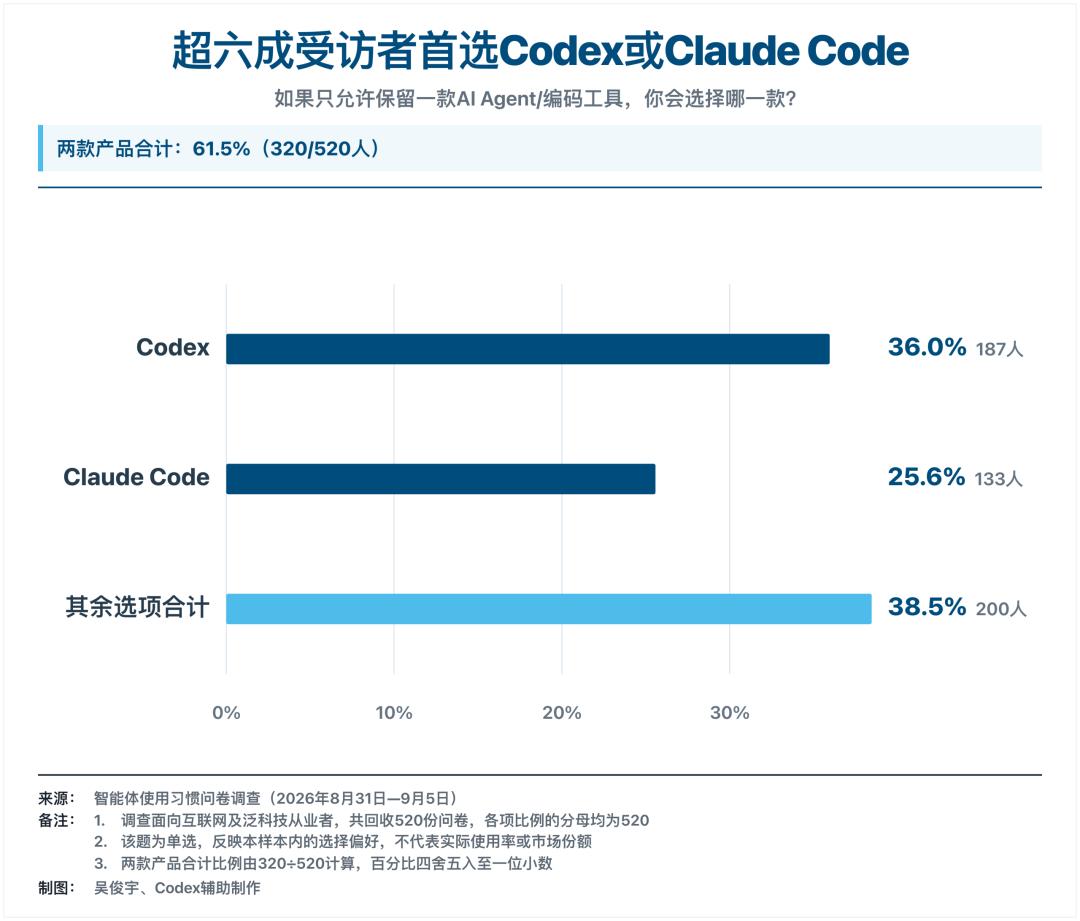
At least in the first half of this year, AI office work is more of a personal behavior used spontaneously by employees, rather than an organizational behavior promoted uniformly by enterprises.
However, improving individual efficiency does not equal improving organizational efficiency.
The CIO (Chief Information Officer) of the digital business of a large Chinese home appliance group told us that personal office accounts are often outside the enterprise management system, making it difficult to access internal business processes. It is also difficult for enterprises to uniformly manage data security and account permissions.
Cost is also a problem. The CEO of a Chinese computing power infrastructure manufacturer believes that it is unsustainable to let employees buy AI office tools at their own expense for the company's work for a long time. The subscription fee of AI tools and the cost of Token invocation are not cheap, and it is also difficult for enterprises to pass this part of the cost on to individual employees for a long time.
For many Chinese enterprises, AI is still more of an efficiency tool used spontaneously by employees. More and more enterprises are beginning to actively look for a set of AI tools that can be deployed and used within the organization.
A person from Alibaba told us that when they communicated with enterprise customers in the past month, they clearly felt that more and more enterprises hope to become "AI Native" companies in their industries. In particular, some leading enterprises have begun to worry that if they do not complete the AI transformation in time, they may fall behind in the next round of competition.
Enterprise demands are beginning to emerge intensively, and Chinese technology companies are undertaking this part of the market demand.
Alibaba combines Qianwen Office with DingTalk; ByteDance begins to promote the collaboration between Doubao Work and Feishu; Tencent hopes to cut into enterprise software and business processes through WorkBuddy. All three companies already have the infrastructure left by the previous generation of enterprise software: DingTalk, Feishu, WeCom and other collaborative office and enterprise service ecosystems.
This is different from the development path of overseas tools such as Claude and Codex. They first gained a large number of users from developers and individual knowledge workers, and then gradually penetrated into enterprises. Chinese large factories directly graft agents onto the enterprise software system that has been established in the past.
For Alibaba, ByteDance and Tencent, the value accumulated by the previous generation of enterprise software such as DingTalk, Feishu and WeCom is being revalued.
In the past, DingTalk, Feishu and WeCom were the platforms that many enterprise employees worked on every day. Now, Qianwen Office, Doubao Work and WorkBuddy are competing for the new entry points on these