Helping guys control gun recoil, drinking extra-strong cockroach milk, this year's Ig Nobel Prizes are so overwhelmingly wacky and absurdly hilarious.
All of you who are staying up late waiting for new updates from Chaping are in for a treat! Who wouldn't love to enjoy a hilarious Ig Nobel Prize recap written by Shi Chao in the middle of a weekend night?
Yep, the annual Ig Nobel Prize is back again. The ceremony still invites real Nobel laureates to present the awards, and the prize money is still a whopping 10 trillion — but it's from the long-discontinued Zimbabwean dollar, of course.

It's exactly the familiar formula and familiar vibe we all know.
But this year's Ig Nobel has new changes. For the past 35 years, the award ceremony had always been held in Massachusetts, USA, hosted in rotation by Harvard University, MIT and Boston University.
But this year, due to unforeseen political factors such as US border screenings, the ceremony was directly moved to the Parliament Building in Zurich, Switzerland.
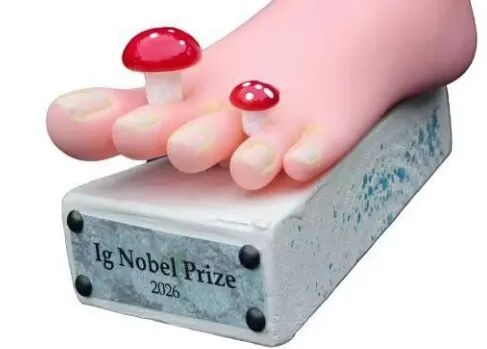
The theme of this year's event is "Fungi", so the winning research teams will receive a one-of-a-kind trophy: a 3D model that combines the features of mushrooms and human feet.
Shi Chao won't ramble any longer, let's cut straight to the awards and see what new tricks the scientists have come up with for us this time.
First up is the Soil Science Award that fits the fungi theme perfectly, which is awarded to teams from Switzerland and the Netherlands in recognition of their artistic scientific behavior of burying underwear.
The "Underwear Team" launched a citizen science campaign: they first purchased a batch of 100% cotton underwear of uniform specifications, then distributed them to more than 1,000 volunteers from 25 countries, asking them to bury the underwear in their home gardens, farmlands, public lawns and other places.

After 30 or 60 days, they dug up the tattered underwear together with soil samples and sent them back to the laboratory.
Although the behavior seems weird, the scientific logic behind it is quite rigorous: the component of 100% cotton underwear is cellulose, and the traditional methods to test soil health include metagenomic sequencing, enzyme activity measurement and so on.
Now with the underwear method, you only need to check the degree of decomposition of the underwear (cellulose). The faster it rots, the healthier the soil micro-ecosystem is.
To this end, they even named this standard the "Underwear Index".
The result is as expected by everyone: the private gardens that are not over-treated with chemical fertilizers and herbicides have a significantly better Underwear Index than the public lawns that get hit by multiple disturbances every day.
The winning team is also a group of playful people: they directly made the experimental subjects, the underwear, into a team flag, and brought it swaggeringly to the award stage.
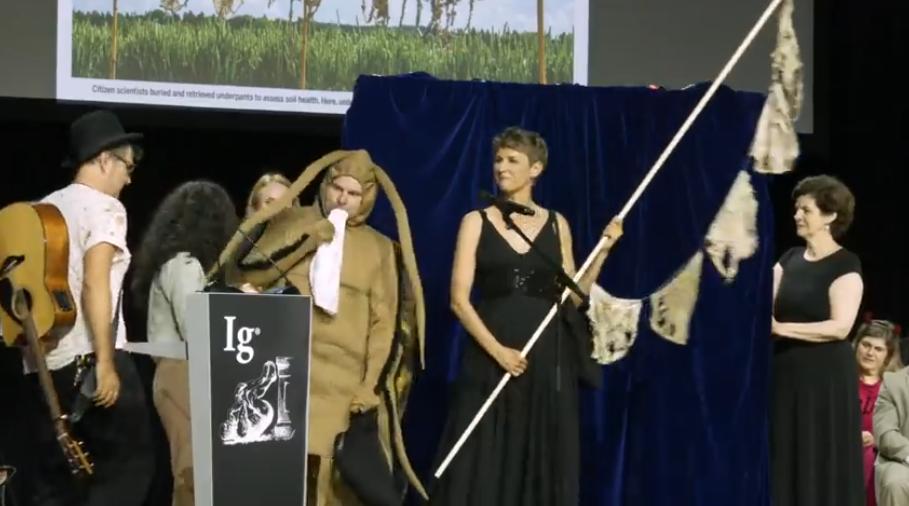
After receiving the award, the research team not only handed out underwear to everyone in the venue, but also gave a pair to each of the Nobel laureates present.

Tim Hunt, the 2001 Nobel laureate in Physiology or Medicine, didn't want to be a party pooper at all, and directly put on the awarded pair of underwear on the spot.

The physics community didn't want to be left out either. Research teams from China, the US, Canada and other countries successfully won this year's Ig Nobel Prize by designing a "urine-splash-proof men's urinal that never splashes".
The following part is for boys only, girls had better skip this section, and guys are suggested to read every word carefully.
Let's talk about something girls might not know: the men's restroom is somewhat like a magical world for all men, with several unsolved urban legends circulating:
For example, no matter how empty the men's restroom is, the row of urinals always follows the "no adjacent stall compatibility principle": if the first stall is occupied, the next guy coming to the restroom will automatically avoid the second stall.
There is also the "no eye contact allowed in men's restrooms" rule. As soon as you walk into a men's restroom, everyone seems to automatically follow the unwritten no-eye-contact rule, and your eyes can only land on three places: the tiles straight ahead, and the urinal right below you.
And that civilized slogan that only boys can understand: "One small step forward, one big step for civilization".

When I was younger, Shi Chao always found it confusing: one small step forward does bring a big step for civilization, but even if I tried my best to aim, I still ended up in the situation of "one small step forward, everything gets splashed wet".
To solve this problem, the urinal research team used the Navier-Stokes equations, plus high-frequency high-speed cameras to shoot non-stop, accurately calculated the Reynolds number and Weber number, and found a perfect critical phase transition phenomenon.
That is, as long as the angle at which the jet hits the urinal wall is less than 30 degrees, the kinetic energy inside the fluid cannot overcome the surface tension, the ejected liquid will flow as if covered by a film, smoothly and without any splashing at all.
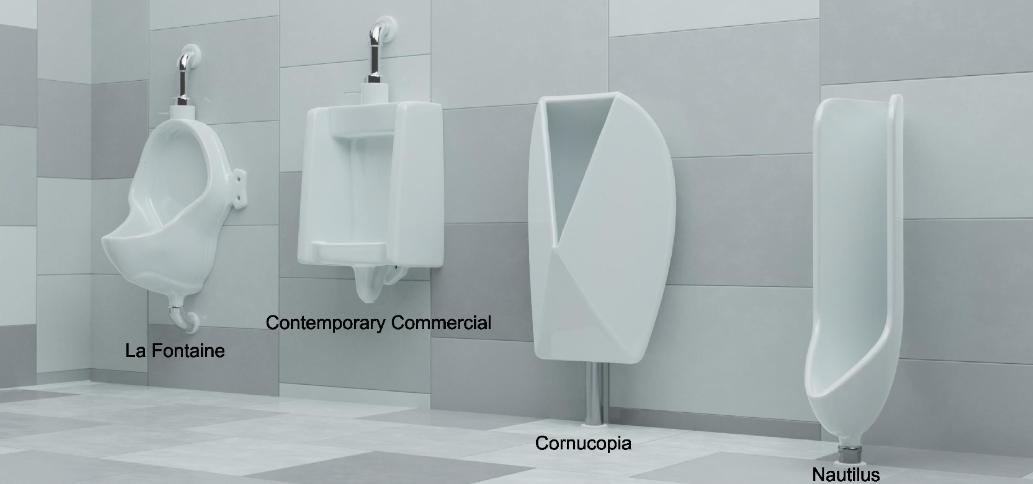
Based on this great research, they directly launched a urinal revolution, and redesigned a number of new-shaped urinals.
For example, referring to the logarithmic spiral surface of the nautilus in nature, they designed a new type of urinal called "Nautilus", which can reduce the splashing rate by 85% to 95%.
The Nautilus urinal is the first one on the right
To be honest, this is really great.
But is there really no team willing to improve the sitting toilets in China?
If the shape is changed from O-shape to U-shape, I guess every time I sit on the toilet, I won't have to worry about where to place my "tap".
Okay, now it's time for a fun part suitable for people of all ages. I believe the female friends have quickly scrolled past the previous award, because the next Chemistry Award is designed to "tease" everyone equally.
The fame of the double-tailed cockroaches in Guangdong goes without saying, and many of you have probably heard the popular science that cockroaches have extremely high protein content, so in some disaster movies, cockroaches often become the last food source for humans.

But now, scientists may want to let everyone taste the flavor of cockroach milk in advance...
A multinational joint team found that there is a rare Pacific beetle cockroach in nature that does things differently: it gives birth to live young.
When the female cockroach is nurturing her embryos, the mother will secrete a very nutrient-dense cockroach milk.
The researchers went through a series of operations, extracted the extremely difficult-to-cultivate natural protein crystal from the cockroach embryo, and used advanced X-ray diffraction technology to analyze the 3D structure of this cockroach milk protein crystal at an ultra-high atomic resolution of 1.2 angstroms.
The results show that this stuff is an extremely advanced energy bomb, and its unit energy density is more than three times that of the world's highest quality cow milk.
I kinda want to buy this cockroach hat

I knew it, humans will eventually create food with 10,000+ calories, right?
However, at present, scientists are mainly studying the structure of cockroach milk, but in the future, it is not impossible that they will make delicacies such as cockroach latte.
Of course, the lucky ones to taste it are again the real Nobel laureates present at the scene. The cockroach milk research team specially prepared several cups of the milk for them to try.
But the host only said it was milk, and did not specify whether it was real cow milk or real cockroach milk.

But if you see Tim Hunt's pained expression, Shi Chao can only say: the taste is so strong, no more words needed!

Apart from the winners mentioned above, the rest of the research projects are all equally wild.
For example, the Biology Award was given to a group of tough guys who put on protective boots and stepped on 75 venomous snakes 40,000 times in total.
The results show that venomous snakes are more likely to bite people during hot days, and compared to big snakes that look fierce, small snakes are more likely to attack and bite. Also, if you have a choice, just avoid stepping on the snake's head and try to step on the snake's tail, the risk of being bitten will be much lower.
Oh c'mon, why didn't you tell me that earlier?
Tonight I'm definitely going to find a big cobra and test stepping on its tail to see if that works.

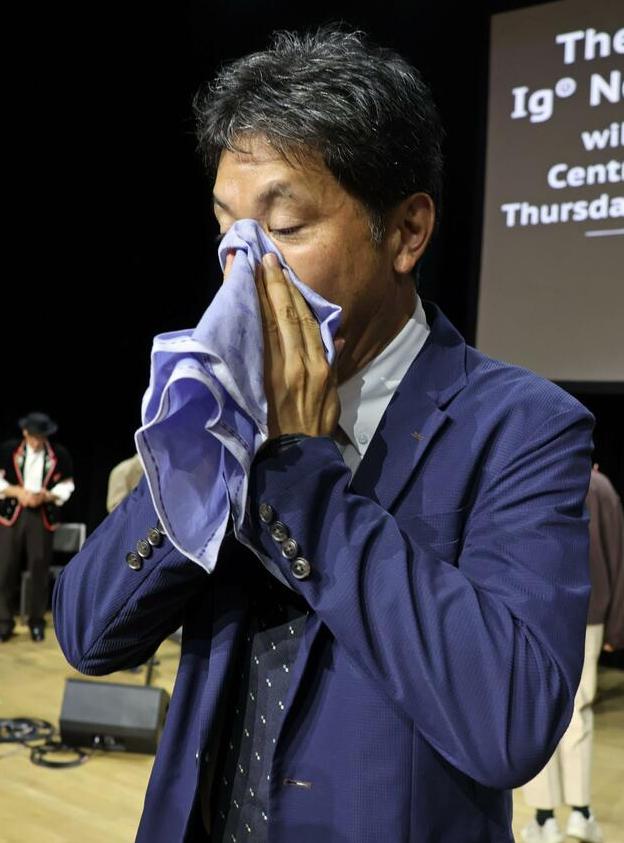
The Medicine Award goes to a long-forgotten research project, in which a late Japanese scholar won the award for studying nose-blowing from an aerodynamic perspective back in 1977.
Scientific research proves that to avoid otitis media caused by nose-blowing and blow your nose more efficiently, you should first take a deep breath and hold your breath, then press one nostril and blow hard through the other.
By the way, it's worth noting that Japanese scholars have won this award for 20 consecutive years, so we might as well call him the Ig Nobel Prize immortal.
The Economics Award is a bit counter-intuitive. A research team from the US, Canada and Mexico (friendly reminder: these three countries are co-hosting the World Cup this year) found through research that the saying "the poor resort to trickery while the rich have a conscience" is wrong.
In their study, people from higher social classes are more likely to rationalize selfishness and greed as ambition, and they will even take more candies that are meant for children.
The Peace Prize is even more playful. They found that although people like nice guys when making friends, they prefer their friends to