OpenAI's Head of Product: The 50-page document you pulled an all-nighter to write is no longer valuable.
Whether you like it or not, the 50-page document you stayed up late to finish is rapidly losing its value.
This is not your fault. It's just that AI today is far more capable than expected — it can generate a substitute of comparable length, equally neat format and almost no flaws in just a few minutes.
Every knowledge worker is now facing this harsh reality:
In the current era, being able to write long documents no longer proves that you have done in-depth thinking.
The person who said this is Tara Seshan, Product Lead of OpenAI Codex and ChatGPT Work.
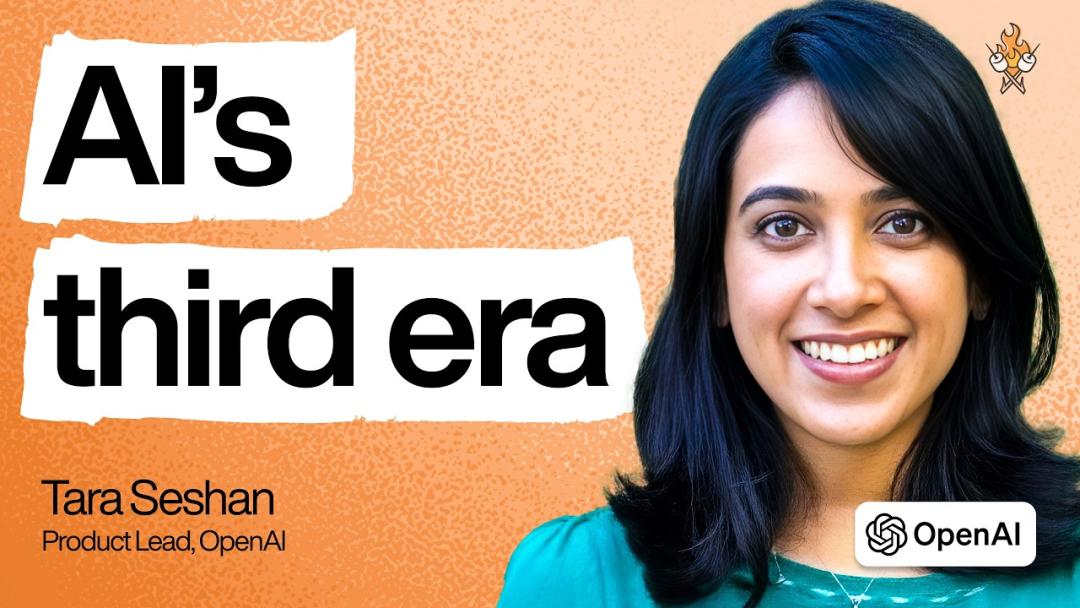
Tara Seshan
In the 81-minute interview on Lenny's Podcast, she also put forward a more blunt assertion:
Building products for the current models will end in failure. Building products for the models you expect to see a year later will also end in failure.
When everyone has access to top-tier tools, and when AI is evolving into a "permanently online Agent colleague", what on earth is the moat for knowledge workers?
The logic that Tara shared, which has been proven effective inside OpenAI, is worth careful reading for every knowledge worker who does not want to be eliminated.
Leave the rowing work to AI
Humans only take charge of "steering the helm"
Tara divides the evolution of AI products into three stages:
- Stage 1: Chat, you ask and it answers.
- Stage 2: Co-pilot, helping you complete tasks in specific scenarios such as coding.
- Stage 3: Permanent AI Agent, which stays online for a long time, retains context, and completes complex tasks independently.
The division of labor boundary between humans and AI is shifting upward at a speed visible to the naked eye.
From the past "completing the next line of code" to now directly setting a clear goal and letting the automated workflow run through the whole process in the background.
Whether it is the "Agent Command Center" on the Codex desktop, or ChatGPT Work that fully covers spreadsheets, reports and business analysis, they all point to the same trend: the execution layer is being fully taken over by AI.
In Tara's words: Agents are responsible for rowing, and humans are responsible for steering the helm.
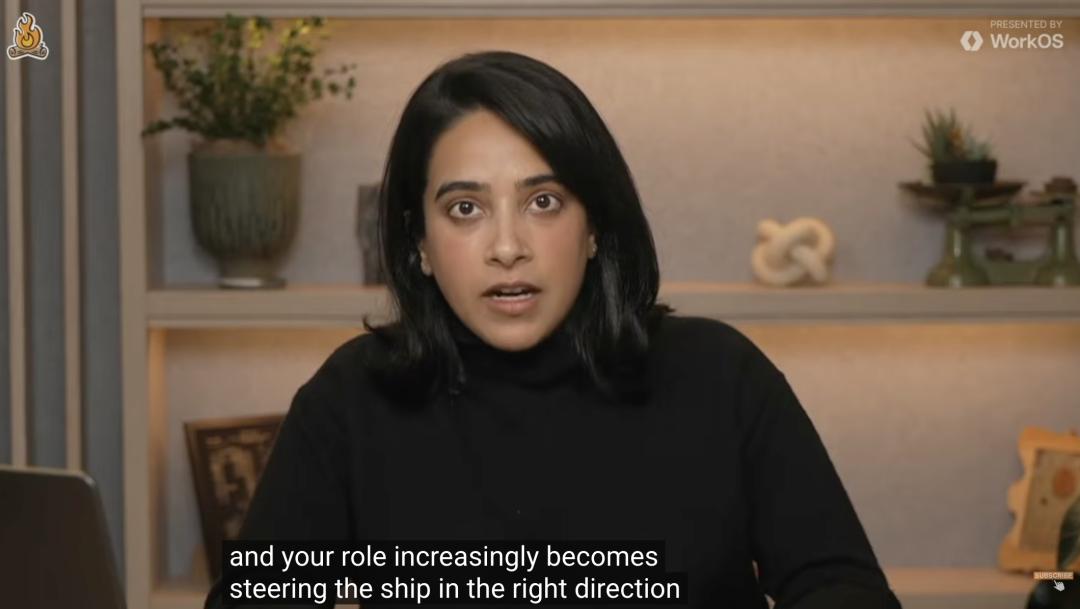
Tara said in the interview that Agents are in charge of rowing, and the role of humans is to steer the ship in the right direction.
When the rowing work is taken over by AI, the remaining core value of humans boils down to 5 things:
- Setting the direction (deciding where to go)
- Being accountable for results (taking responsibility)
- Judging quality (controlling the pass)
- Injecting stance and expression (giving the work soul)
- Collaborating with, caring for and motivating the team (uniting people's hearts)
OpenAI has abandoned its one-year product roadmap
Why is it a dead end to "base on the present" or "bet on the models a year later"?
If you build products completely around the current models: the models are evolving at an extremely fast speed.
You racked your brains to design a complex product mechanism to avoid the shortcomings of today's models, but the next generation of models will be released tomorrow, making all these mechanisms completely worthless "appendages".
If you bet on the models a year later: it is equivalent to making a blind guess.
Putting the entire lifeline of the product on a bunch of assumptions that are most likely to fail is doomed to total failure.
This leads to the famous insider saying in the tech circle: "The model you are using today is the dumbest version it will ever be in its entire life."
Tara pointed out sharply that the most absurd part of this sentence is that everyone agrees with it verbally, but when they actually start working, they will unconsciously arrange the schedule according to the "dumbest" current model.
To break this fatal inertial thinking, OpenAI internally cut off the rigid "one-year roadmap" and forcibly shortened the planning cycle to two to three months.
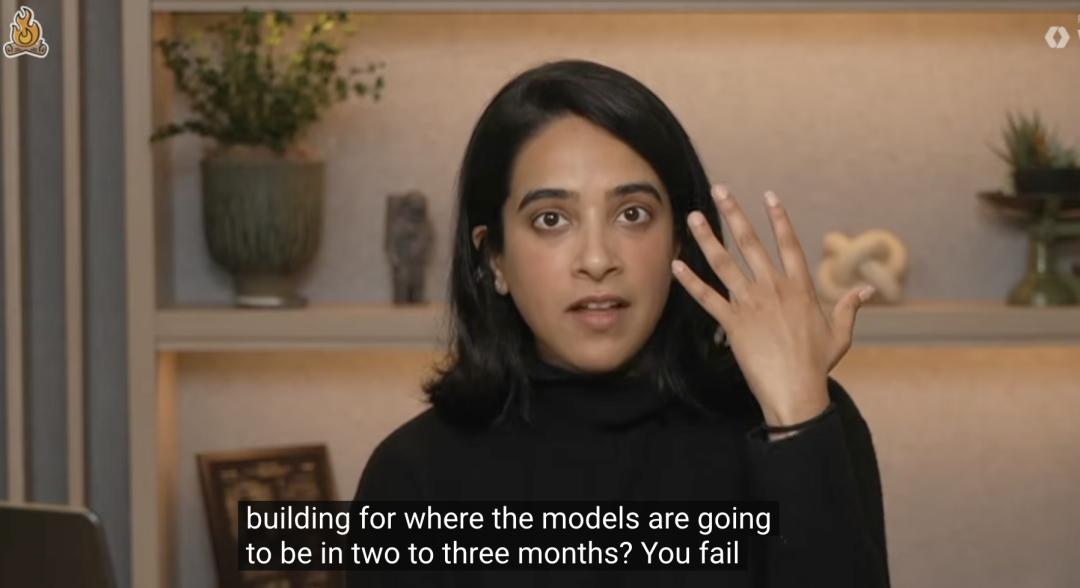
Tara said in the interview that products must be built for the models that will be available in two or three months, and betting on the current models or the models a year later will both fail.
However, this short two-to-three-month cycle is by no means blind trial and error based on intuition, and no "black box" is allowed inside the team.
Tara's real core logic is: no long-term nominal planning, but products must be closely aligned with the real progress of the research team.
The product team and the research team are required to maintain extremely high-frequency communication, to fully align on one core information: which capabilities of the model will be enhanced next, and at what specific time node these enhancements will be available?
After clarifying this information, the product team can iterate agilely following the pace of technological breakthroughs.
This is not abandoning the roadmap, but turning the rigid schedule on the wall into a "real-time navigator" that can be adjusted at any time according to the actual progress on the front line.
Say goodbye to perfect documents
The "rough edge" philosophy of writing documents only for yourself
Tara used to work at Stripe, which attaches great importance to writing culture, and she used to polish every brief to be completely flawless before sending it out.
But at OpenAI, she completely changed this habit: long documents are only written for her own reference.
Because "complete materials" no longer represent "in-depth thinking", and the value of long documents as proof of intellectual work has dropped to zero.
Now, directly runnable prototypes, A/B test data and user feedback have completely replaced those lengthy documents with inflated value.
But she retains a very smart working rule: when a solution is 70% complete, go to the person who needs to approve it, and let them help you finish the remaining 30%.
The reason is very realistic: if a completely flawless solution is placed in front of others, their ideas will not be accepted at all; only by leaving "rough edges" can the other party be willing to participate and polish the solution together with you.
Two types of writing
What can be outsourced, and what must never be given to AI?
Tara divides writing into two categories:
- Report-style writing (weekly reports, summaries, abstracts, format conversion): all handed over to AI, and automated whenever possible;
- Thinking-style writing (project establishment logic, route selection, controversial judgment): never outsourced to AI.
Why can't thinking-style writing be handed over to AI?
Because the whole process of drafting, revising and polishing the text is exactly the process of sorting out your own thoughts.
If you hand it over to AI to write, you get the text, but the step of "thinking clearly" never happens in your mind.
To prevent her thinking ability from degrading, she set two strict rules for herself:
1. For any document you are going to send to n people to read, you have to read it n times first.
2. For any meeting that will take up X hours of everyone's time, the preparation work for the meeting has to take up X hours in total.
Your ambition
Become the ultimate bottleneck
When the barriers to design, analysis, coding and prototyping are drastically lowered by AI, tasks that used to require a whole team to complete can now be roughly done by one person.
Then what determines the gap between different people?
"Ambition".
True high-performers never just use AI to automate repetitive work, but use it to expand their own ability boundaries infinitely.
This has also completely subverted the responsibilities of product managers (and all knowledge workers):
In the past: most of the effort was spent on peripheral rituals such as schedule arrangement, document writing and review.
Now: identify the key issues that determine success or failure, put forward the sharpest hypotheses, and verify them at the fastest speed.
Most importantly, raise the ambition of the whole team.
When others propose a solution, your value lies in asking: "Can the ceiling be higher? Can the speed be 10 times faster?"
Three insider mottos inside OpenAI
These three sentences correspond to three self-check items respectively.
The first is whether this matter can be done faster.
The second is to ask whether your ambition is big enough, and whether the goal can be set higher.
The third one is the most strict: do you use this product every day as soon as you wake up, can you not live without it, and have you put all your taste into judging whether it is user-friendly enough?
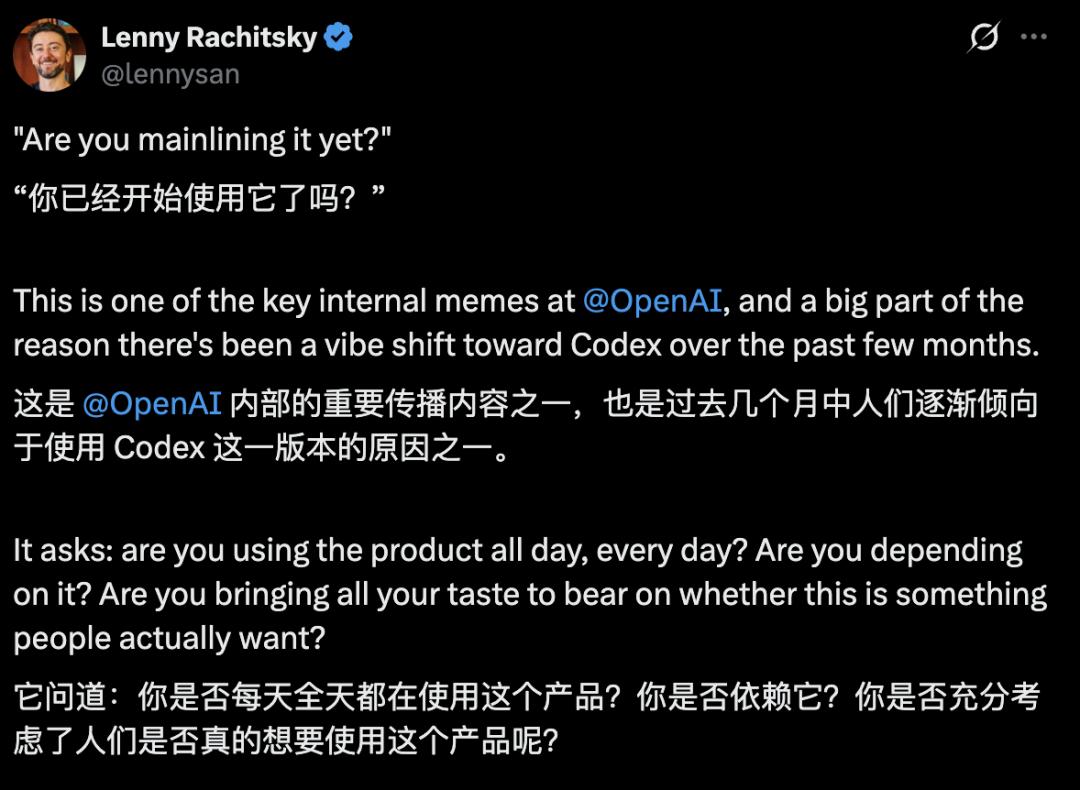
Lenny asked her that in the past three to six months, the trend on Twitter has obviously shifted from Claude Code to Codex, what changes have been made inside the team.
Tara's answer is: nothing has changed. The team has been using the product intensively all the time, collecting feedback and iterating rapidly, and the working method has never changed from beginning to end.
The only change is that people outside the team have started to notice it.
There is no "compile and test" for knowledge work
The whole process must be made transparent
Coding is result-oriented: after the Agent finishes modifying the code, run the test, pass means pass, fail means fail.
But knowledge work is completely different.
If the final PPT says "the success rate is 90%", you can't just look at the number and choose to believe it.
You have to check what its original input is, and how the intermediate reasoning is derived step by step.
This is also why the core design of ChatGPT Work is not to directly deliver a "perfect finished product", but to fully display all references, inputs and half-finished work, so that you can control the whole process.
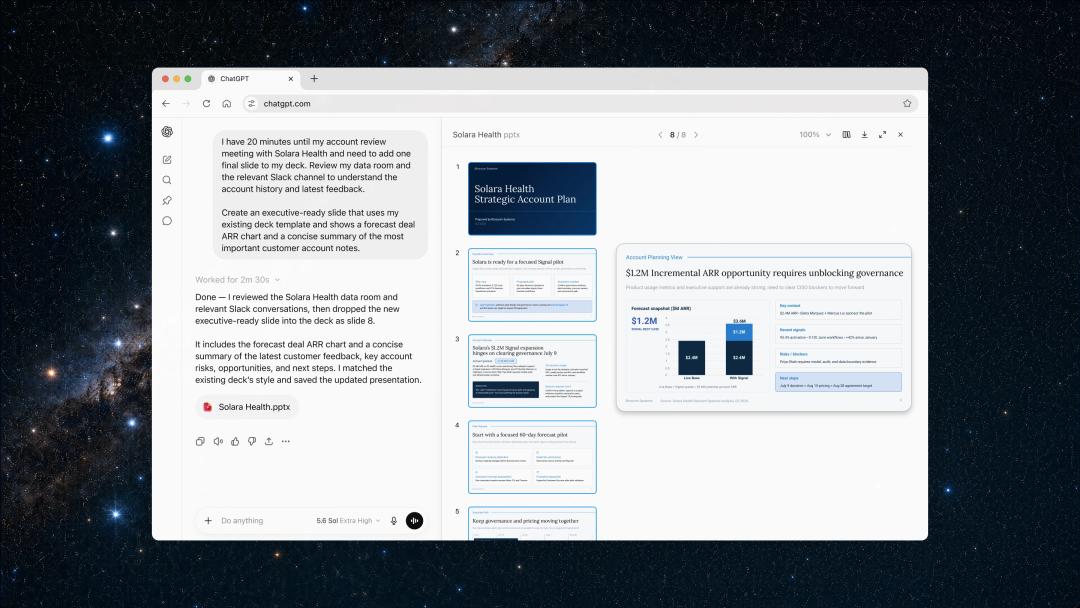
With only 20 minutes left before the client meeting, ChatGPT Work generates the 8th slide in 2 minutes and 30 seconds, and all the materials it referred to are fully visible.
Everyone has access to the same tools, and the underlying capabilities are being rapidly equalized.
In the era when AI takes over "rowing", the only thing that determines your value is — do you really have the ability to steer the helm?
Where do you want to steer this ship to?
References:
https://x.com/lennysan/status/2094444052204998908
https://youtu.be/zMvBMfj4cSQ
This article is from the WeChat public account "AI Era Insights", Author: ASI Revelation, Editor: YUAN Yu, published with authorization from 36Kr.