Uncovering the truth behind the semi-annual reports of domestic chip manufacturers: why only 2 out of the seven companies are truly profitable?
When technological prospects are fully priced in, how far are domestic computing power chip companies from generating real profits?
Over the past year, domestic computing power chips have become one of the most highly valued tracks in the capital market. Cambricon once claimed the title of "top stock" in the A-share market, with its market value exceeding 1 trillion yuan; Moore Threads rose by 425.46% on its first trading day after listing, and Muxi Co., Ltd. increased by 692.95% on its debut, both becoming the top-performing new shares of 2025. The capital market has paid a huge premium in advance for computing power demand, domestic substitution and future earnings.
As Muxi Co., Ltd. released its first semi-annual report after listing, the performance disclosure of domestic listed computing power chip enterprises for the first half of 2026 has been basically completed. Combined with the latest prospectus materials from pre-IPO firm Enflame Technology, *Future Tech Review* has sorted out the operating data of seven core enterprises.
High valuations ultimately need to be delivered by actual performance. The seven sets of operating results show that the domestic computing power chip industry as a whole has entered the large-scale delivery stage, but the ability of each player to convert technology and orders into profits and cash flows varies greatly.
Seven companies saw revenue double, but only two are truly profitable
In the first half of 2026, the seven major chip companies recorded a total revenue of about 214.56 billion yuan, almost doubling compared with the same period of the previous year. Based on overall revenue scale and core business profitability, the seven companies have formed three distinct tiers.
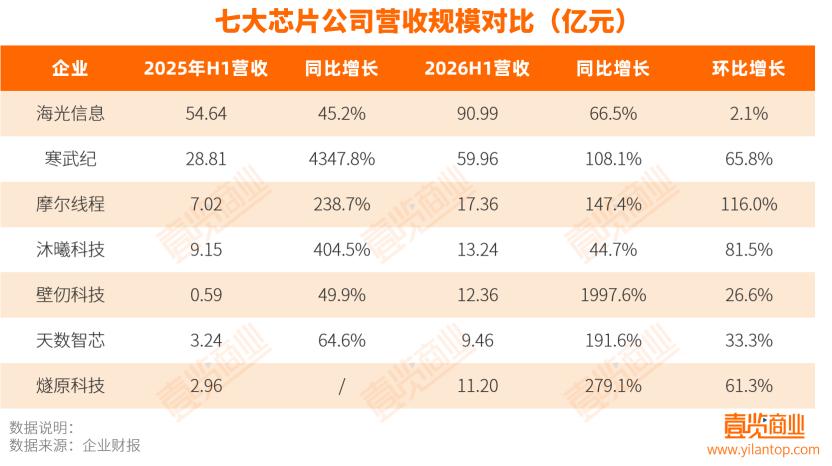
The first tier includes Hygon Information and Cambricon. The two companies generated a combined revenue of 150.95 billion yuan, accounting for 70.4% of the total revenue of the seven companies, and both posted positive profits from their core businesses.
Among them, Hygon Information ranked first with a revenue of 90.99 billion yuan, a year-on-year increase of 66.5%, and its attributable net profit reached 17.98 billion yuan, up 49.7% year on year. Its advantages come from the dual product lines of CPU and DCU: the CPU business lays the foundation for its presence in the general server market, while the DCU business caters to AI training, inference and high-performance computing demands. The relatively broad ecosystem of customers and complete machines improves the stability of its revenue.
However, Hygon's revenue in the first half of the year only increased by 2.1% compared with the second half of 2025, and its profit growth rate was also lower than its revenue growth rate, indicating that its growth slope has slowed down, and profit release has not accelerated simultaneously.
Cambricon recorded a revenue of 59.96 billion yuan, a year-on-year increase of 108.1%, and its attributable net profit reached 23.11 billion yuan, up 122.6% year on year, with its profit scale exceeding that of Hygon. Its revenue is highly concentrated in cloud AI chips, acceleration cards and related systems. The product focus has brought more obvious scale effects: although R&D expenses increased by 29.6%, the R&D expense ratio dropped from 18.8% to 11.7%.
Next are the four GPU players (Moore Threads, Muxi Technology, Biren Technology and Enflame Technology). The four have comparable revenue scales, all ranging from 1 billion yuan to 2 billion yuan, but their core business profitability varies greatly.
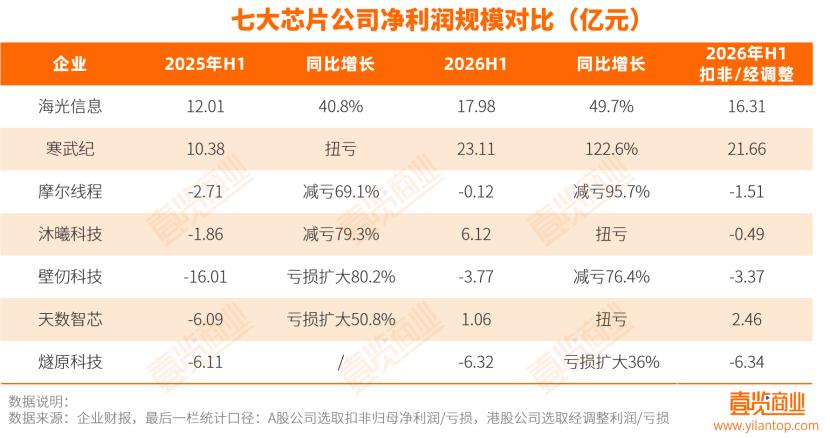
Among them, Moore Threads recorded a revenue of 1.736 billion yuan, up 147.4% year on year and 116.0% compared with the second half of 2025, which was mainly driven by the mass production of MTT S5000 and the delivery of the Kuae intelligent computing cluster; its attributable net loss narrowed from 271 million yuan to 12 million yuan, but the non-recurring net loss still stood at 151 million yuan.
Muxi Technology posted a revenue of 1.324 billion yuan, a year-on-year increase of 44.7% and an 81.5% rise compared with the second half of 2025, which was mainly driven by the growing shipment volume of GPU products. The company achieved an attributable net profit of 612 million yuan, but this included about 887 million yuan of fair value change gains, and it still posted a loss of 49 million yuan after deducting non-recurring items.
Biren Technology recorded a revenue of 1.236 billion yuan, a year-on-year increase of nearly 20 times, which mainly came from the delivery of the Birl series products and large-scale intelligent computing clusters; as its revenue in the same period of the previous year was only 59 million yuan, the high growth rate had an obvious low-base effect. Its loss narrowed from 1.601 billion yuan to 377 million yuan.
Enflame Technology recorded a revenue of 1.120 billion yuan, up 279.1% year on year, and its half-year revenue has exceeded the full-year revenue of 2025, but its attributable net loss expanded to 632 million yuan. The main reason is that Tencent is both a shareholder and its absolute major customer, leading to Enflame's gross margin far lower than its peers.
The last player is Iluvatar Corex, which recorded a revenue of 946 million yuan, up 191.6% year on year. Its inference series revenue reached 654 million yuan, a year-on-year increase of 651.8%, becoming the main driving force for growth. The company achieved a profit of 106 million yuan in the period, of which about 760 million yuan came from unrealized fair value gains generated by participating in the strategic placement of JCET's IPO, and another about 65 million yuan came from government subsidies and 41 million yuan from interest income. If only the fair value gains are excluded, the profit for the period will turn from positive to negative, with a loss of about 654 million yuan.
*Future Tech Review* notes that after stripping out a large number of extra gains, the real profitability foundation of the industry is weaker than the book results. Although four of the seven companies reported positive profits, only Hygon Information and Cambricon are profitable relying on their core businesses; the book return to profitability of Muxi Co., Ltd. and Iluvatar Corex is supported by large fair value gains from financial assets. Moore Threads is only one step away from book break-even, but it still posted a loss of 151 million yuan after deducting non-recurring items; Biren and Enflame have not got rid of operating losses of hundreds of millions of yuan.
Why has revenue nearly doubled, but core business profitability is still limited to only two companies? This is because at the stage of parallel R&D of multiple generations of chips and continuous improvement of the software ecosystem, new revenue is still largely consumed by high R&D and commercialization investment.
R&D investment continues to expand, and revenue growth still cannot cover costs
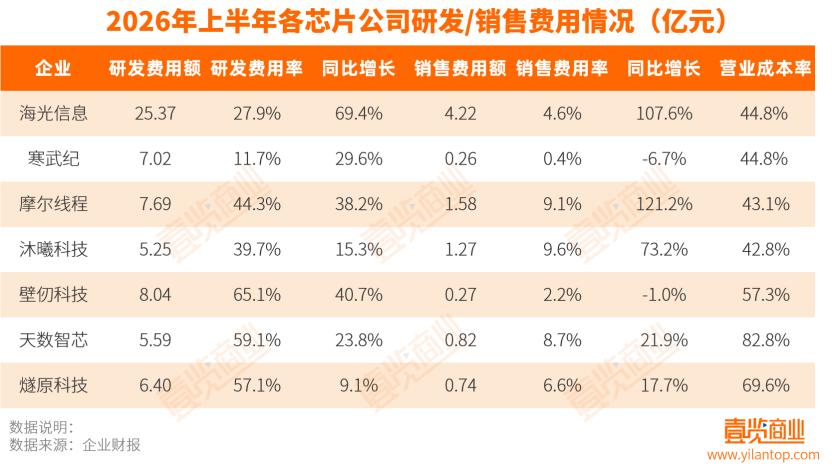
The most direct cost pressure behind the five companies that have not got rid of core business losses comes from R&D. In the first half of 2026, the total R&D expenses of the seven companies reached 6.536 billion yuan, equivalent to 30.5% of their total revenue. If we exclude Hygon and Cambricon, which have achieved large-scale profitability, the remaining five companies recorded a combined revenue of 6.361 billion yuan, and their R&D expenses reached 3.297 billion yuan, which means that for every 2 yuan of revenue generated, more than 1 yuan is invested in R&D.
R&D pressure does not only come from single chip design. Computing power chip enterprises usually need to promote multiple generations of products at the same time, and their expenditures cover multiple links such as chip architecture, tape-out verification, drivers, compilers, operator libraries, model adaptation and cluster software. When one generation of products just starts to generate revenue, the next generation of products often has entered the peak investment period, so R&D expenses are difficult to drop immediately with the mass production of a single product.
By enterprise: Hygon Information has the highest R&D expense, with an investment of 2.537 billion yuan in the first half of the year, a year-on-year increase of 69.4%. However, its revenue of 9.099 billion yuan keeps the R&D expense ratio at 27.9%. Cambricon's R&D expenses increased by 29.6% year on year to 703 million yuan, but its R&D expense ratio dropped from 18.8% in the same period of last year to 11.7% due to scale effect, which is the lowest among the seven companies.
The R&D expense ratio of the remaining five enterprises is significantly higher. Biren Technology's R&D expenditure reached 804 million yuan, with an R&D expense ratio of 65.1%; Iluvatar Corex invested 559 million yuan, with an R&D expense ratio of 59.1%; Enflame invested 640 million yuan, with an R&D expense ratio of 57.1%.
The R&D expense ratios of Moore Threads and Muxi are 44.3% and 39.7% respectively, which are relatively low. Moore Threads' R&D expenses in the first half of the year reached 769 million yuan, of which the Huashan and Lushan chip projects invested 276 million yuan and 197 million yuan respectively. The full-featured GPU route also requires it to maintain capabilities in AI computing, graphics rendering, scientific computing and video processing at the same time, and it needs to continuously improve the MUSA software ecosystem in addition to hardware development.
Muxi invested 525 million yuan in the first half of the year, of which high-performance general GPU optimization and C600 and C700 R&D accounted for about 92.7% of the total R&D investment. While the C600 has entered the mass production stage, the C700 has taken on the task of next-generation product iteration. For enterprises still in the product ramp-up period, it is particularly critical whether R&D investment can be reused across generations: if the new generation of chips continues to use the existing software stack, development tools and customer adaptation results, the marginal cost of subsequent delivery is expected to decline; if each generation of products needs to re-complete model and customer adaptation, R&D expenses will be difficult to be quickly diluted by scale growth.
In addition to R&D, sales investment is also increasing. The total sales expenses of the seven companies in the first half of the year reached about 917 million yuan, of which Hygon, Moore Threads and Muxi increased by 107.6%, 121.2% and 73.2% year on year respectively. The sales expense ratios of Moore Threads, Muxi and Iluvatar Corex reached 9.1%, 9.6% and 8.7% respectively, significantly higher than 4.6% of Hygon and 0.4% of Cambricon. This difference reflects that manufacturers that have just entered the large-scale delivery period still need to invest more resources to acquire customers, complete product adaptation and promote project acceptance, while a mature customer system can reduce the sales cost corresponding to new revenue.
It is worth noting that the high operating cost ratio of Iluvatar Corex and Enflame Technology does not entirely stem from the low gross profit of core chips, but is also affected by special businesses, product structure and major customer delivery modes.
For example, in the first half of the year, Iluvatar Corex generated about 171 million yuan of gross loss from reselling semiconductor components, and made a provision of 72.21 million yuan for inventory impairment, pulling the overall gross margin down to 17.2%, but the gross margin of its general GPU products still reached 43.9%; Enflame Technology has long taken Tencent, one of its important shareholders, as its core customer. The price concessions brought by bulk procurement from major customers, coupled with the high proportion of inference products with relatively low gross margin, make its operating cost ratio reach 69.6%, and the sum of operating cost, R&D and sales expenses is equivalent to 133.3% of its revenue.
Cash flow test behind 23.9 billion yuan of inventory
While the income statement still shows growth momentum, the balance sheet has begun to expose pressure.
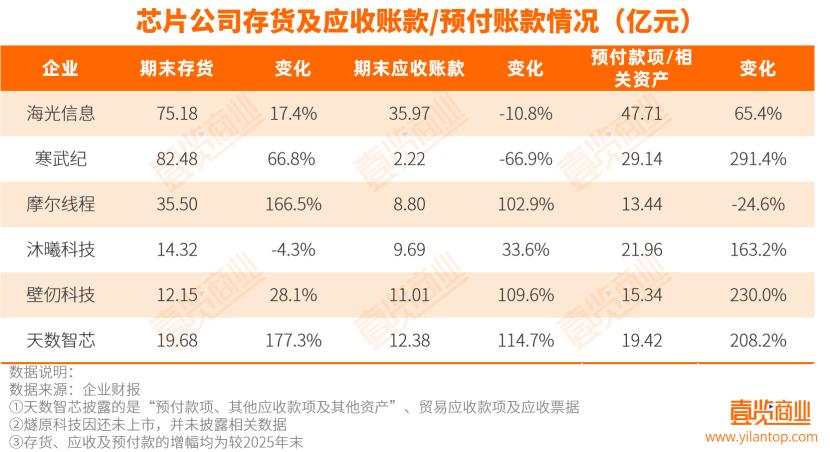
As of the end of June 2026, the total inventory of the six companies that disclosed detailed data reached 23.93 billion yuan, an increase of 51.1% compared with the end of 2025, which has exceeded the total revenue of the seven companies in the first half of the year. For domestic computing power chip enterprises, before products are sold, funds need to go through multiple links such as wafer manufacturing, packaging and testing, board card production and server integration. The more orders there are, the more production capacity and materials need to be locked in advance.
Therefore, the first sum of money on the company's books is occupied by the upstream supply chain. For example, Cambricon's inventory and advance payments increased by 66.8% and 291.4% respectively, and Hygon's increased by 17.4% and 65.4% respectively; although Muxi's inventory decreased slightly, its advance payments increased by 163.2% to 2.196 billion yuan.
Against the background of strong AI computing power demand and the need to lock in advanced manufacturing processes and key materials in advance, the high level of both inventory and advance payments is first a relatively positive signal. This means that enterprises are actively reserving production capacity and materials to prepare for subsequent order delivery; if contract liabilities and customer advance payments increase simultaneously, it further indicates that there is clear demand behind the stockpiling. For example, Cambricon's and Moore Threads' contract liabilities increased to 188 million yuan and 71 million yuan respectively, indicating that part of the inventory has been supported by orders from certain customers.
However, this positive signal comes with a premise: the stockpiled goods must be converted into delivery in time. After all, the higher the advance payment, the more cash flows to suppliers in advance; the more inventory there is, the greater the capital occupation and product iteration risks the enterprise will bear.
The second sum of money is occupied by downstream customers. Large-scale intelligent computing projects usually go through equipment delivery, cluster debugging and customer acceptance, and there is a clear time lag between revenue recognition and actual payment collection. While Moore Threads' inventory increased by 166.5%, its accounts receivable increased by 102.9%; Iluvatar Corex's inventory and receivables also increased by 177.3% and 114.7% respectively. Biren's ending trade receivables increased by 109.8%, and only 23.3% of them had been recovered as of the performance announcement date.
The upstream requires advance payment, while the downstream cannot collect payments in time, and the final result is pressure on cash flow. According to the financial report data, the five companies including Enfl