Lei Jun has cast the anchor of his high-end market foray to the 10,000-yuan price segment.
Lei Jun said, "This is the most premium Xiaomi phone to date."
On September 2, he unveiled the Xiaomi 18 Fold in person and made this positioning statement. On September 7, this flagship device defined by Xiaomi as a new form factor of "mid-fold" will go head-to-head with Huawei; three days later, Apple's first foldable phone, the iPhone Ultra, will also be launched.
The three foldable phones debuting in the same week have been dubbed the "Foldable Three Kingdoms Showdown" by media outlets eager for hype, which has inadvertently boosted the visibility of Xiaomi's new foldable product.
Three Major Highlights of the Xiaomi 18 Fold
Up to now, Xiaomi has built up massive momentum for this phone. Based on current updates, there are three major highlights:
The "naming battle" in the foldable phone sector. The design of the Xiaomi 18 Fold, with both inner and outer screens adopting the approximate √2:1 standard paper aspect ratio, ultra-narrow equal bezels on all four sides and ultra-elliptical large rounded corners, and the signature colorway "West Field Red" among other details, makes it hard for people not to associate it with Huawei's wide-fold devices. For example, Yu Chengdong once specifically shared the story behind the √2:1 screen aspect ratio.
Many netizens shared a post from Xu Jieyun to express their attitude: "I have a peer friend who has very strong learning ability, please don't laugh at him."
Lu Weibing also wrote a long post to lay the groundwork, stating that the original intention of foldable phones is to resolve the oldest contradiction in the mobile phone industry: the trade-off between a large screen and portability. Neither large-fold nor small-fold devices have properly addressed this initial demand.
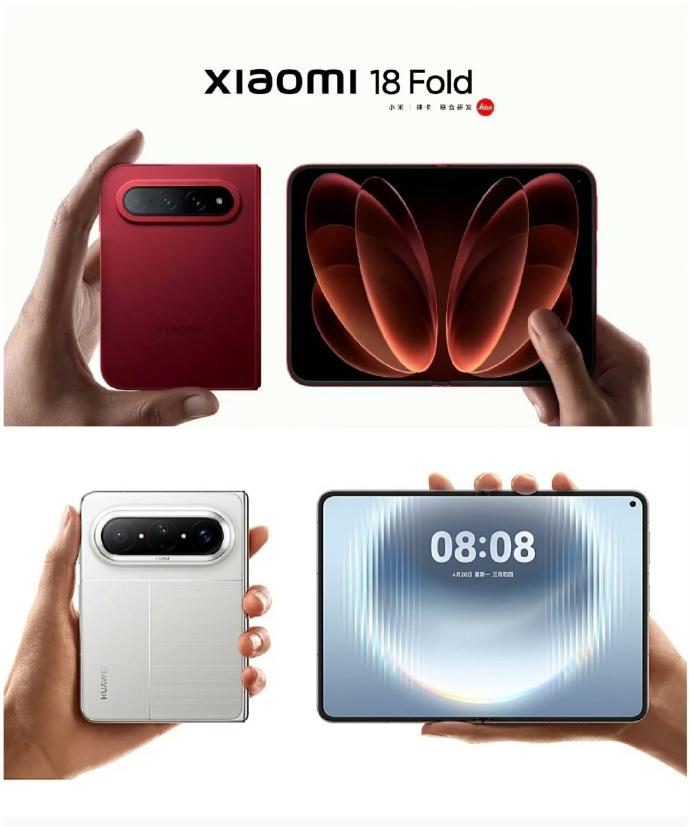
Xiaomi mid-fold VS Huawei wide-fold Source: netizen collage
Xiaomi's "mid-fold" can be held in one hand when closed, just like a passport, and unfolds into a large screen, perfectly solving the long-standing conflict between large displays and portability in the industry. He also said that this will be the most important form factor leap in Xiaomi's foldable history.
Xiaomi seems to have incorporated the "wide-fold" concept into its size system of large, medium and small. As pointed out by some reviews, the biggest innovation of the Xiaomi 18 Fold in all the pre-launch promotions so far can be summed up in one word: mid-fold. Large-fold and small-fold products have been debated for years, with all players competing for the technical high ground. Xiaomi is directly opening a new track with the mid-fold.
Simply put, Huawei defined the "wide-fold" category, and Xiaomi followed Huawei's footsteps to define the "mid-fold" separately, refusing to follow others' scripts in naming. The party that names the category gets to define the market first. The right to define the market is often the right to set pricing.
Powerful hardware and software configuration. This time, Xiaomi has included the mid-fold device in its flagship digital series, integrating all the chips, materials, structural technologies and core know-how it has accumulated over the years. For example, it is the first device to be equipped with the brand new Xiaomi Xuanjie O3 AI flagship SoC, the next-generation HyperOS 4, and the Xiaomi MiMo on-device large model, marking the first time that three cutting-edge self-developed technologies are assembled on a single device.
At the same time, Lei Jun also announced the world's first launch of domestic memory ChangXin LPDDR6, though it is exclusive to the top-tier configuration. It is worth noting that the LPDDR6 standard was only finalized in July 2025. The first-mover advantage in this field has long been dominated by the fixed lineup of Samsung, SK Hynix and Micron.
When the self-developed SoC and domestic memory are integrated in the same device for the first time, Xiaomi's high-spec configuration, which is extended to the 10,000-yuan price bracket, takes on a special meaning. Lei Jun set a very high tone, saying, "In the future, more outstanding Chinese tech enterprises will join hands, build on each other's strengths and strive for new heights!"
The biggest highlight is still the price. Lu Weibing admitted during a live stream at IFA in Germany that the Xiaomi 18 Fold does have a relatively high price, it is a foregone conclusion that the starting price will exceed 10,000 yuan, and "the price will definitely be more than 10,000 yuan by a noticeable margin". But compared with Apple's products, the Xiaomi 18 Fold is still excellent value for money.
Other channel sources show that the starting price of the Xiaomi 18 Fold is around 12,000 yuan, which basically confirms that it will be the first Xiaomi phone in history with a starting price above 10,000 yuan, possibly even more expensive than Huawei's wide-fold Pura X Max which starts at 10,999 yuan.
In fact, Xiaomi's foldable phones have never performed very well in sales. The MIX Fold product line has been running for five years and has never entered the mainstream market; in 2025, Xiaomi dropped out of the top five players in China's foldable phone market.
By launching a foldable phone starting at 10,000 yuan and "redefining" the category at this point, with Lei Jun and Lu Weibing giving this "wide-fold" product enough exposure, the considerations behind this move go far beyond simply releasing a new form factor phone.
Lei Jun's Three Levels of Consideration
In my opinion, Lei Jun and Xiaomi have at least three layers of considerations.
The first layer is reflected in the financial report. In the second quarter of 2026, Xiaomi's smartphone shipments reached 31.2 million units, down 26.5% year on year; its mobile phone revenue was 42.1 billion yuan, down only 7.5%. This means that the decline in Xiaomi's mobile phone sales revenue and profit is within a controllable range.
The sharp drop in Xiaomi's mobile phone sales is partly due to passive pressure. Storage component prices have been rising for more than a year, and AI computing power has occupied production capacity, which has hit Xiaomi's low-end phones that form its basic market the hardest; at the same time, Xiaomi has taken the initiative to reduce the supply of low-end products, consciously controlling the shipment proportion of entry-level phones.
As a result, the ASP (Average Selling Price) of Xiaomi's mobile phones surged 25.9% to a record high of 1,351 yuan. Among them, the sales proportion of models priced above 3,000 yuan in mainland China rose to 32.1%.
However, in the same quarter, the gross profit margin of Xiaomi's mobile phones dropped from 11.5% to 8.5%. This means that Xiaomi only earns a gross profit of more than 100 yuan for each 1,351-yuan phone it sells. The financial pressure on Xiaomi's mobile phone business leaves it with only two options: if it retreats from the low-end market, it must advance further into the high-end segment.
The next issue is the price anchor point. After years of efforts to move upmarket, Xiaomi has long lacked a clear and competitive price anchor. In consumers' minds, the "Xiaomi price range" is still anchored at 3,000 to 4,000 yuan by Redmi and Xiaomi's digital flagship series. It has always been unable to break through to higher price segments.
For example, the Xiaomi 17 series released last year was fully positioned to compete with the iPhone, with matching naming and release schedules, but the standard edition was still the best-selling variant. This gave many people the illusion that Xiaomi's competition against the iPhone mostly stays in the naming scheme.
There is an obvious gap in Xiaomi's mobile phone price range: the digital series aims to move upmarket but cannot break its price ceiling; Redmi tries to move up to higher price segments, but its pricing is outpaced by the brand's public perception. This ambiguous zone is exactly the headache for Xiaomi.
The unexpected rise in storage component prices has disrupted Xiaomi's original pricing rhythm. Instead of being criticized for passively raising prices, it is better to proactively push up the price ceiling with a new form factor, which accidentally becomes a structural adjustment.
Xiaomi's "mid-fold" is undoubtedly the best choice. It does not need to bear the sales KPI pressure, and can also integrate the Xuanjie O3 chip, ChangXin memory and other highlights into its high-end brand narrative.
This strategy is not new. Apple uses the iPhone Pro Max to anchor the high-end segment, and Huawei uses the Mate series and tri-fold devices to anchor the ultra-high-end segment. Price anchoring has always been a standard feature of premium brands, and Xiaomi has long been missing this key part.
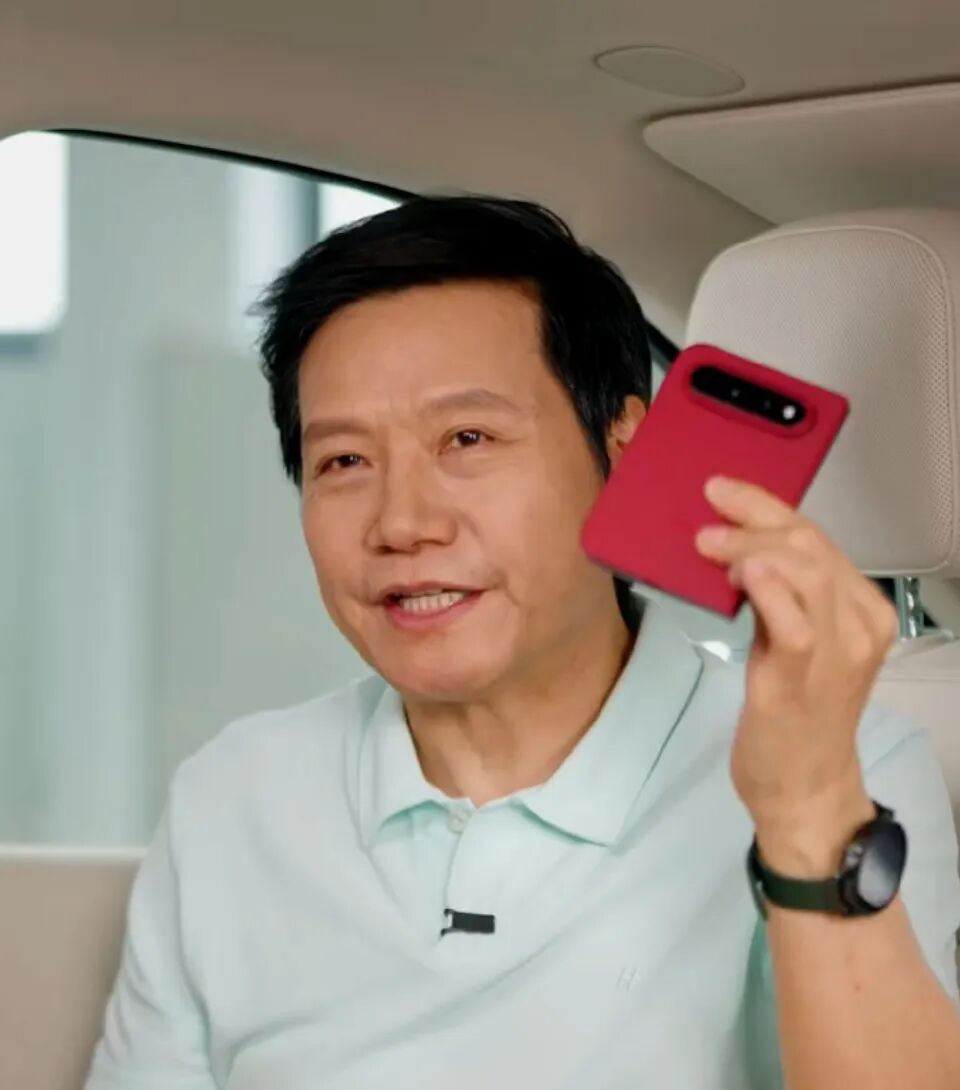
Lei Jun showing the Xiaomi Fold Source: screenshot from Lei Jun's live stream
Price anchoring is first and foremost psychological anchoring. When consumers accept that Xiaomi can sell phones at 10,000 yuan, Xiaomi will regain full initiative over its entire pricing system. Once a 10,000-yuan phone gains a firm foothold, the 7,000 to 8,000-yuan models will not seem expensive, and the 4,000 to 5,000-yuan standard editions will also become logically justifiable.
A mobile phone vendor with an ASP of 1,000 yuan stepping onto the 10,000-yuan price table for the first time has extraordinary significance. This is a key strategic move made by Lei Jun.
The third layer is the high-end brand narrative, which incorporates its self-developed chips and other self-developed technologies. Xiaomi claims that the shipment of its first self-developed chip, the Xuanjie O1, has exceeded 1 million units. But in reality, it is only equipped on the Xiaomi 15S Pro, Pad 7 Ultra and Pad 7S Pro.
Over the past year, Lei Jun has spent a lot of time promoting the Xuanjie chip, but its implementation has always stayed outside the core product line, which does not make sense. The O3 is positioned as a high-end chip, but Xiaomi does not yet have the courage to directly install it on mass-market phones, even if it launches dual-track variants with Qualcomm chips and Xuanjie chips.
The Xiaomi 18 Fold is the perfect fit: from the Xuanjie O3 to ChangXin memory, all the most competitive elements in the self-development narrative have found their carrier.
For Xiaomi, this is a new form factor mobile phone product; for the Xuanjie chip, this is its second launch event, and the story of self-developed chips can continue.
There is also an excellent external condition: the market entry timing is mature.
First, Huawei has completed the market education in the domestic market. In 2025, the shipment of foldable phones in China exceeded 10 million units, with Huawei accounting for more than 70% of the total; the total activated volume of the two generations of the Pura X series exceeded 2 million units, and products starting at 10,999 yuan still have strong demand, proving that the demand for 10,000-yuan foldable phones is real for the entire industry. Consumers are no longer unfamiliar with foldable phones, and supply chain components such as hinges and flexible glass have gradually matured, greatly reducing the trial-and-error cost for late entrants.
Second, Apple's iPhone foldable phone is coming, which is also a wide-fold form factor, and this is an extremely important variable. Apple's entry into the sector sends a signal that the category has matured, and will thoroughly establish the public's recognition of 10,000-yuan foldable phones.
Xiaomi's follow-up move has a clever timing: it is neither too aggressive nor too late, and it is also ahead of OPPO, VIVO and Honor. Huawei planted the trees, Apple watered them, and Xiaomi enters the orchard right before harvest.
Therefore, Xiaomi has every reason to push the 18 Fold aggressively. As for sales volume, it is not that important.
Huawei's foldable phones have sold millions of units, and in absolute terms, this is still a niche market; but in terms of strategic significance, it has absolute benchmark value. The 10,000-yuan price bracket has an anchoring effect for Huawei, Xiaomi and even Apple.
What Xiaomi is striving for is exactly this anchor point. Moreover, this anchor point brings even greater room for imagination for Xiaomi.
Restricted by objective conditions, Huawei cannot quickly expand its foldable phone business overseas in the short term. Xiaomi does not have such constraints, and it can go global with its foldable phones to compete head-to-head with Apple and Samsung: for foldable phones of the same form factor, the constraints that limit Huawei are the cards that Xiaomi can play globally.
This may be another version of the saying "If you think you're good, get your product out and sell it".
Lei Jun's final card may still be the "full ecosystem of people, vehicles and homes". According to the data from the second quarter, Xiaomi's smartphone shipments rank top three in 53 countries and regions, and top five in 67 countries and regions. The number of connected AIoT devices reached 1.16 billion, and the monthly active users of Xiao AI and the Mi Home App increased to 175 million and 124 million respectively.
At this year's IFA exhibition in Germany, Xiaomi's "full ecosystem of people, vehicles and homes" made its debut for the first time, and the Mijia brand also entered the European market on a large scale accordingly.
Even if the 10,000-yuan price range anchored by the Xiaomi 18 Fold has not been verified by the market, it is a card that Xiaomi has to play, and it is also a card that is bound to pay off.
For Lei Jun, having this anchor point is more important than all hypothetical scenarios. Only by nailing down this anchor point can the story move on to the next chapter.
This article is from the WeChat official account "Tang Chen Classmate", author: Tang Chen, published with authorization from 36Kr.