A "little octopus" pries open a new trillion-dollar market for Alibaba.
This year, AI players have flocked to the AI office track. What they aim to revolutionize is far more than your Office software, as they are targeting a trillion-dollar market. Alibaba's "Little Octopus" is rapidly extending its tentacles in this competition.
A month ago, Alibaba integrated products including QoderWork, Wukong and MuleRun into Qwen Office, and later adopted "Little Octopus" as its logo. Connecting DingTalk and WeCom on one hand, grasping CRM and ERP on the other, and scheduling models, querying data and running processes at the same time... Qwen Office aims to embed AI into every capillary of enterprise work step by step.
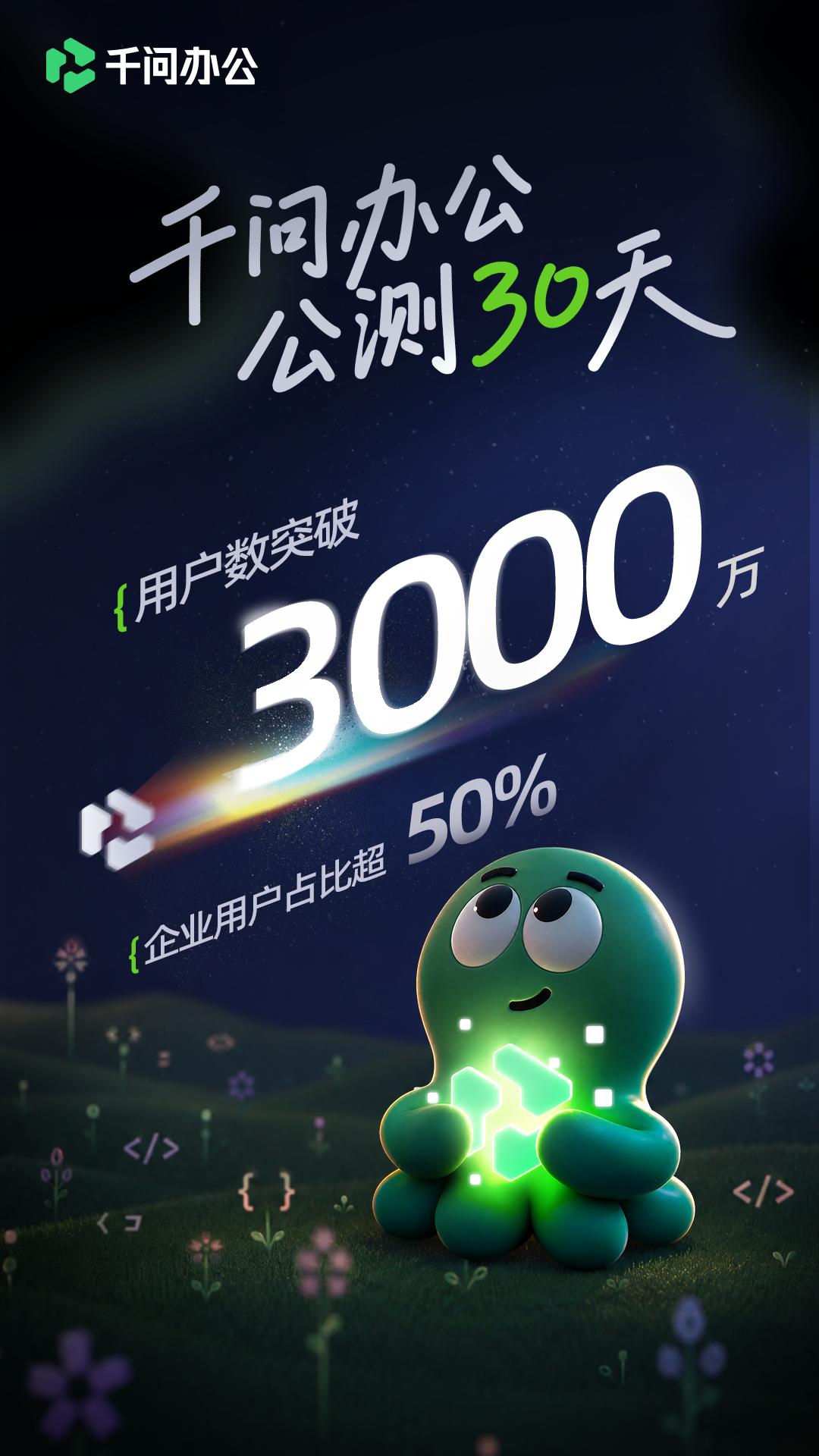
On September 4, this month-old "Little Octopus" has been installed on the computers of more than 30 million people, half of whom are enterprise users. Leading enterprises in the automotive, finance, pharmaceutical, supply chain and catering industries are using the "Little Octopus" to connect Alibaba's AI infrastructure Qwen to real business processes such as R&D, finance, supply chain and store operations.
This is happening at the most anxious moment for the AI industry. Competition among large models is so fierce that each can only "lead the trend for a few months", with new models, Benchmarks and product capabilities iterated every few weeks. In order not to fall behind, large AI manufacturers keep raising financing, purchasing chips and expanding data centers, making the Capex arms race increasingly costly. Investors are wondering when these investments can generate real returns.
Alibaba's nearly 30-year toB genes have allowed it to see the direction of this story early on.
As Qwen crossed the capability critical point of "autonomous Agent" this year, Qwen Office plunged into this most lucrative B-end market — global software and IT services correspond to expenditures of more than 3 trillion US dollars, while there is a value pool of about 30 trillion US dollars behind knowledge work. Sullivan predicts that China's AI Agent market will grow from 2.6 trillion yuan in 2025 to 20.1 trillion yuan in 2030, with the enterprise end contributing about 90% of the revenue in the long run.
In other words, as long as Agents like Qwen Office replace a certain proportion of such work, enterprises can speed up operations, improve efficiency and enjoy the dividends of AI Native; "Little Octopus" can unlock hundreds of billions or trillions of dollars in new markets along various real work scenarios.
01. The Trillion-Dollar "Temptation"
Over the past two years, the large model industry has easily fallen into a kind of "single-point leading anxiety": who tops the Benchmark today, who doubles the context window tomorrow, and who hits a new high in Coding scores the day after tomorrow. Model capabilities continue to rise, but the leading window is getting shorter and shorter, and the landscape is always reshuffling.
If you shift your perspective from the model ranking list to commercialization, the sense of anxiety will be much less.
Chatbot subscriptions first proved that people are willing to pay directly for intelligence; Coding tools went a step further, with AI starting to deliver code that can actually run, and customers are willing to pay for the engineer time it saves. Agents and Coworkers continue to push commercialization toward work outcomes, where models can plan steps, call tools, handle errors, and complete a whole task from start to finish.
With every level of capability improvement, what customers buy gets closer to the final economic outcome. This change will rewrite the revenue ceiling of AI players.
How much an enterprise is willing to spend on Office, CRM and ERP is roughly predictable; but in order to complete knowledge work such as R&D, finance, legal affairs, procurement, sales and customer service, a company's annual investment may be an order of magnitude higher.
A straightforward example is the financial scenario. HSG pointed out in a research report that a company may only spend 10,000 US dollars a year on financial software, but is willing to spend 120,000 US dollars to hire accountants to complete the closing work. The tool budget is only a very small part, and the truly lucrative market has always been hidden in the work itself.
In other words, what AI can most easily penetrate is not the low-skilled labor in everyone's impression, but those white-collar jobs with complex but clear rules. In the future, when AI delivers results, it will have the opportunity to enter the professional service budget. It should be noted that the global wage expenditure for knowledge workers is about 30 trillion US dollars, and ARK Invest predicts that this figure will exceed 45 trillion US dollars by 2030.
The commercialization space of Agents is opened along this gap.
Theoretically, as long as the value created by AI is higher than the Token cost consumed to complete the task, enterprises will have the motivation to continue to increase calls. This shows the initial sign of the "Jevons Paradox": the cheaper the Token, the more motivated enterprises are to let AI improve organizational efficiency; the decline in unit intelligence cost will eventually lead to a larger total call volume.
Qwen Office's bet on the B-end is exactly following this curve.
02. "Little Octopus" Gets the Admission Ticket
Among the month-old data of Qwen Office, the 30 million users figure is very eye-catching, and the fact that enterprise users account for more than half is even more important. The latter determines whether it has the opportunity to touch that tens of trillions of dollars market.
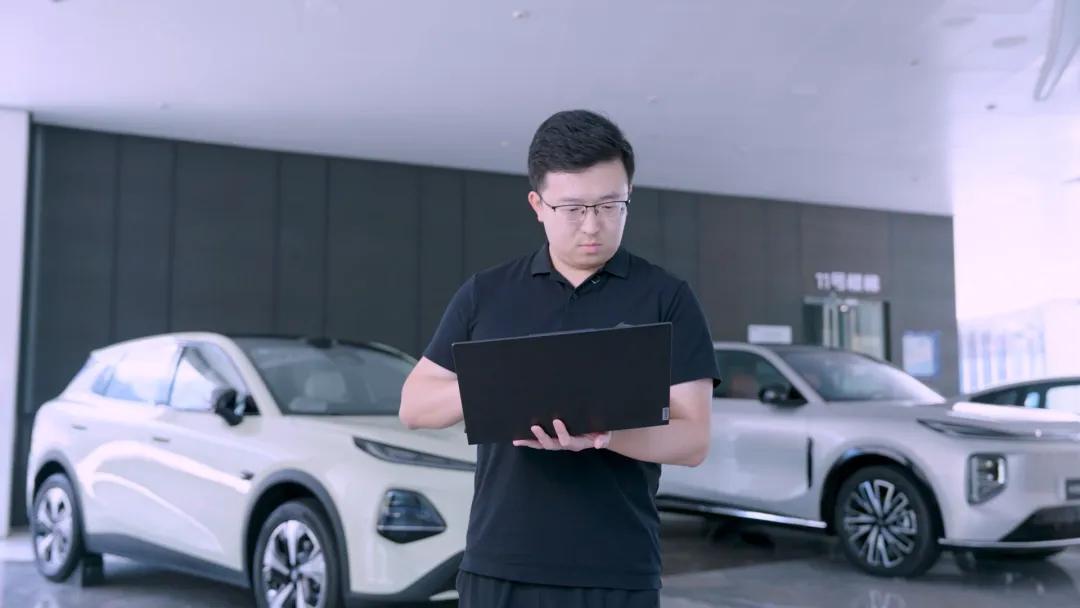
At present, Changan Automobile has integrated Qwen Office into the whole chain of "research, production, supply, sales and service". On the R&D side, the wiring harness selection calculation that senior engineers used to take two days to complete has been shortened to 5 minutes; on the production side, the verification of in-vehicle documents has been reduced from more than ten minutes per vehicle to one or two minutes; after the automation of supply chain packaging review, the workload has been reduced by more than 90%; the analysis cycle of 20,000 to 30,000 user surveys has also been compressed from several days to half a day.
These sets of figures are very close to the ROI that enterprises care about.
Shortening two days to 5 minutes can be converted into the working hours of senior engineers; reducing the workload by 90% can calculate organizational costs; turning tens of thousands of surveys from several days into half a day corresponds to the decision-making cycle. Enterprises are beginning to help Alibaba answer a question that was difficult to answer in the past: how much money can AI really save?
More industries are also calculating similar accounts.
Transfar Group has embedded Qwen Office into supply chain scheduling, real-time inventory monitoring and auxiliary decision-making; Kelun Pharma allows AI to participate in financial statement generation, account verification and data analysis; Huifu World builds co-innovation around knowledge bases, data governance and payment scenarios, and precipitates internal knowledge and sales processes into reusable AI capabilities; Laoxiangji has brought Agents into store operation and supply chain collaboration.
The common point of these industries from manufacturing to finance, pharmaceuticals and catering is very clear: first find a section of work with relatively clear rules, verifiable results, and that used to require a lot of manual work, and let Agents take over part of it.
The enterprise Agent market grows out of the processes little by little in this way.
The revenue of traditional SaaS often grows with the number of employees. An enterprise with 1000 people usually only needs about 1000 sets of office accounts; Agents correspond to Tasks, an employee can generate dozens of tasks per day, and a company may generate tens of thousands or even hundreds of thousands of tasks a day.
The more work AI undertakes, the greater the Token consumption, and the closer the market size will be to the actual labor cost paid by enterprises. This is why Sullivan predicts that about 90% of the revenue of China's Agent market in the future will come from the B-end.
One month after its launch, Qwen Office has stood on the most lucrative side of Agent commercialization first. What it needs to continue to verify is whether these enterprise users can use Qwen Office from "access" to "deep integration", and finally let more processes run continuously on Agents.
03. Deeply Embedded in Enterprise Workflows
The difficulties of enterprise Agents also start from here.
It is easy to let an employee write AI reports faster, but it is much more complicated to improve the overall efficiency of an enterprise. Sales personnel need to access customer records, inventory and quotation permissions at the same time; R&D personnel need to understand historical projects, product documents and supply chain information; financial work involves rules, approval and data permissions. A task often spans multiple people, multiple systems and a large amount of historical context.
The product iteration of Qwen Office in the past month is clearly continuing to deepen inside enterprises.
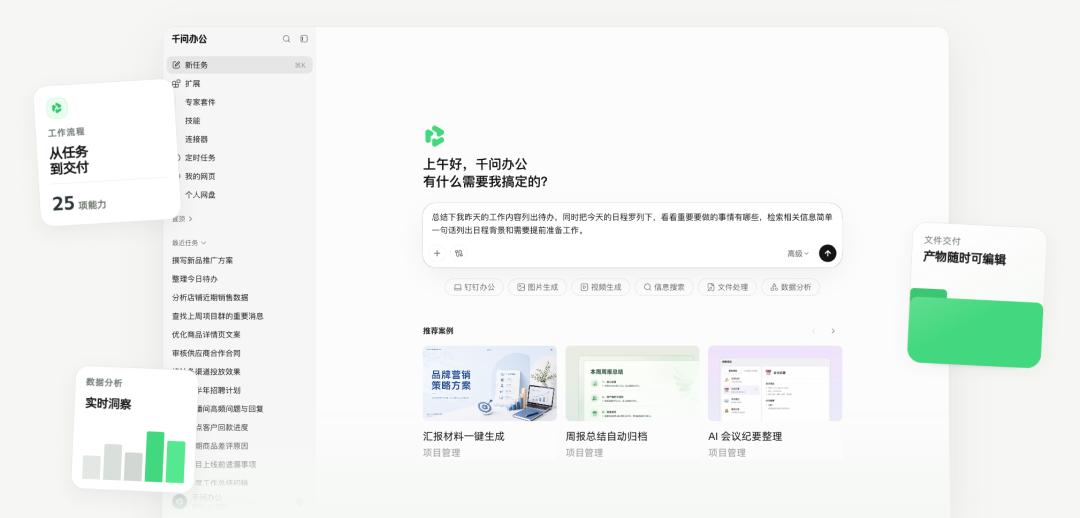
The first step is connection. Qwen Office has connected DingTalk, Feishu and WeCom, which can directly process messages, meetings, documents and schedules, and also take over desktop operation files and programs. Thus, "Little Octopus" truly has the "hands and feet" to enter the user's working environment.
After enterprises actually start using it, these "hands and feet" will continue to extend to CRM, ERP and internal systems.
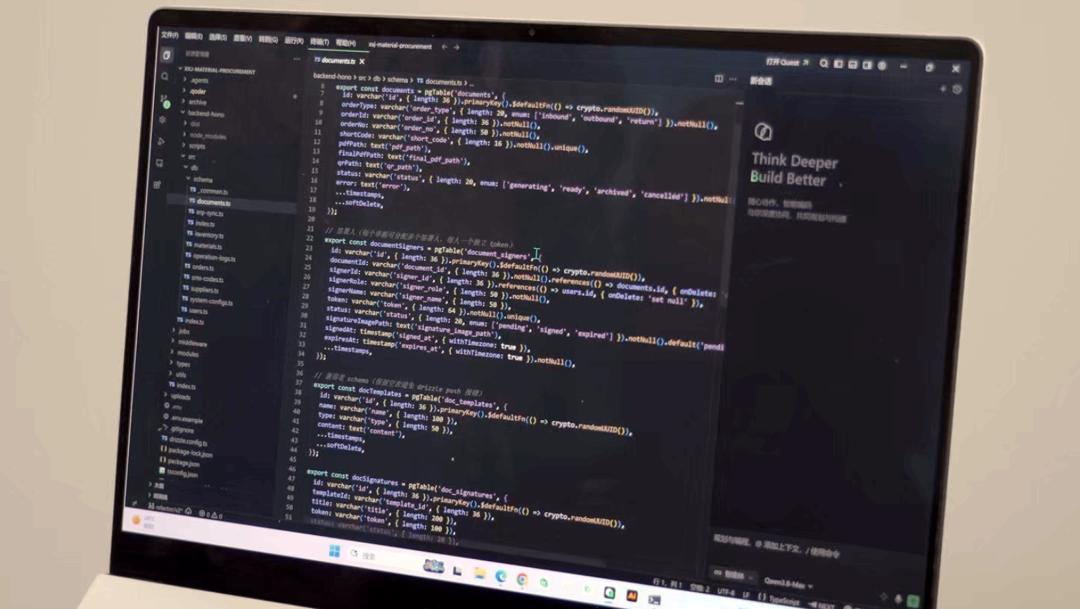
Sales personnel can initiate demands in DingTalk, and Qwen Office can query customers, inventory and orders across systems, and then organize them into business suggestions. AI does not need to let employees replace the familiar working interface, but directly integrates into the original workflow of the enterprise.
The second step is context. Qwen Office has open-sourced MyContext, which precipitates enterprise data, processes and employee experience into context that Agents can continuously understand, so that it knows "who is doing what, and what stage the task is at". This is the key capability for Agents to evolve from tools to Coworkers.
The third step is Skill. Qwen Office is further precipitating personal experience into organizational capabilities. Individuals can encapsulate work processes and professional know-how into Skills, and enterprises can form a reusable skill library to realize "created by one person, called by the whole company". For example, Beijing Deheng Hangzhou Law Firm has turned more than ten years of practical experience in wills and marriage and family affairs into Skills.
It can be said that the experience that was difficult to enter the software system in the past has become enterprise digital assets that can be called repeatedly by Agents through Context and Skill.
The product is continuing to move towards multi-person collaboration.
In the past month, Qwen Office has carried out high-frequency iterations of 120 versions, and launched many functions designed for enterprise scenarios, such as "multi-person workspace", where users can generate and publish a multi-person collaboration web page with one sentence, supporting up to 100 people online at the same time, and providing capabilities such as role permissions, cloud databases, management backends and online publishing.
This also means that Qwen Office has begun to extend from serving one person to serving a team, or even a complete business process. This is the second stage of enterprise AI transformation.
04. Enterprises and "Little Octopus" Support Each Other
Whether the trillion-dollar market can be truly implemented ultimately depends on one thing: whether models and Agents can continuously take on longer, more complete and more professional work. Increasing investment in the B-end is Qwen Office's "open conspiracy".
After entering enterprises, Qwen Office connects enterprise data, tools and business systems on one end, and accesses real processes such as procurement, finance, customer service, R&D and IT operation and maintenance; on the other end, these processes will continuously put forward new capability requirements. The model needs to understand demands, disassemble tasks, call tools, handle failures, and finally deliver a verifiable result. Thus, enterprise workflows provide a large number of real task environments, evaluation signals and optimization directions.
This capability traction mechanism has already run on the Coding track first. Code naturally has high-density and verifiable feedback: whether it can run, whether the test passes, and whether the Bug is fixed, all have clear answers. What the model practices in these environments is not just writing code, but more general Agent capabilities such as long-term planning, tool call, error recovery and continuous execution.
The latest research from METR also shows that the task duration that cutting-edge AI Agents can reliably complete is still growing rapidly. Since 2024, the task duration corresponding to a 50% success rate has roughly doubled every 89 days; its task set is mainly used to measure the capabilities required for research and software engineering.
When this set of capabilities matures, it can continue to migrate to more complex and higher-value professional work. Today, models can understand code bases, call tools, find errors and re-plan for several hours continuously. Next, similar capabilities will have the opportunity to be generalized to scenarios such as security, financial analysis, IT operation and maintenance, and supply chain. The more complete work each generation of Qwen can undertake, the deeper Qwen Office can go into enterprise processes.
Enterprise scenarios will continue to pull this capability curve forward.
From organizing information to calling business systems, from single-point tasks to cross-system processes, from a few minutes of work to execution of several hours or even longer cycles, real tasks will continuously expose the shortcomings of models in planning, reliability, context understanding and error recovery, and then drive the continuous optimization of models, Harness and tool systems.
Finally, a long-term mechanism is formed: first practice Agent capabilities in verifiable tasks, and then migrate the capabilities to new professional scenarios; new scenarios put forward more complex tasks, which will continue to promote the next generation of capability upgrading.
For enterprises, every level of improvement in model capability and Harness collaboration means that more complete work can be handed over to Qwen Office, and ROI will continue to increase accordingly; for Qwen Office, the more real scenarios it enters, the clearer it is where the next generation of capabilities should be developed. It is not difficult for a model to lead temporarily, but the difficulty is to continuously migrate capabilities to new high-value tasks.
The speed of this capability migration and unlocking new scenarios is the longer-term moat of Qwen Office.
05. Alibaba Builds a Deep Moat in the AI Era
Qwen Office has another more important role: to string together Alibaba's previously scattered AI investments into a complete commercial link.
Qwen is responsible for generating intelligence, Qwen Office enters enterprises to turn model capabilities into specific tasks such as R&D, finance and supply chain; DingTalk has more than 26 million enterprise organizations, providing organization and collaboration entrances, and Alibaba Cloud undertakes the Token call and computing power demands behind it.
These links are beginning to form a complete business closed loop.
The stronger the capability of Qwen's Max version, the higher the value of tasks that Qwen Office can undertake; the cheaper Qwen's Flash version, the more tasks that can be automated; the more tasks Qwen Office runs in enterprises, the greater the Token demand and Alibaba Cloud's revenue; these revenues and computing power demands will support the next round of R&D investment.
The "returning revenue" of AI is beginning to flow back along this flywheel. More importantly, this closed loop will also precipitate another layer of system moat.
The Benchmark champion can change every few weeks, and a new Agent function can also be quickly copied; but after Qwen Office enters enterprises, customers will gradually accumulate Context, Skill, permission system, workflow, evaluation standards and system interfaces around it. These system precipitations will form migration costs, and it is difficult for competitors to catch up through a single model release.