Brands including ICICLE and PANE are breaking through the market encirclement, moving one step closer to the "Chinese luxury" positioning.
In many well-known business districts in Shanghai, an increasing number of new brands have emerged. Pioneering labels including ICICLE, PANE, QIZHEN, SHANXIA YOUSONG have successively occupied prime locations along Huaihai Middle Road, West Nanjing Road and other golden business zones.
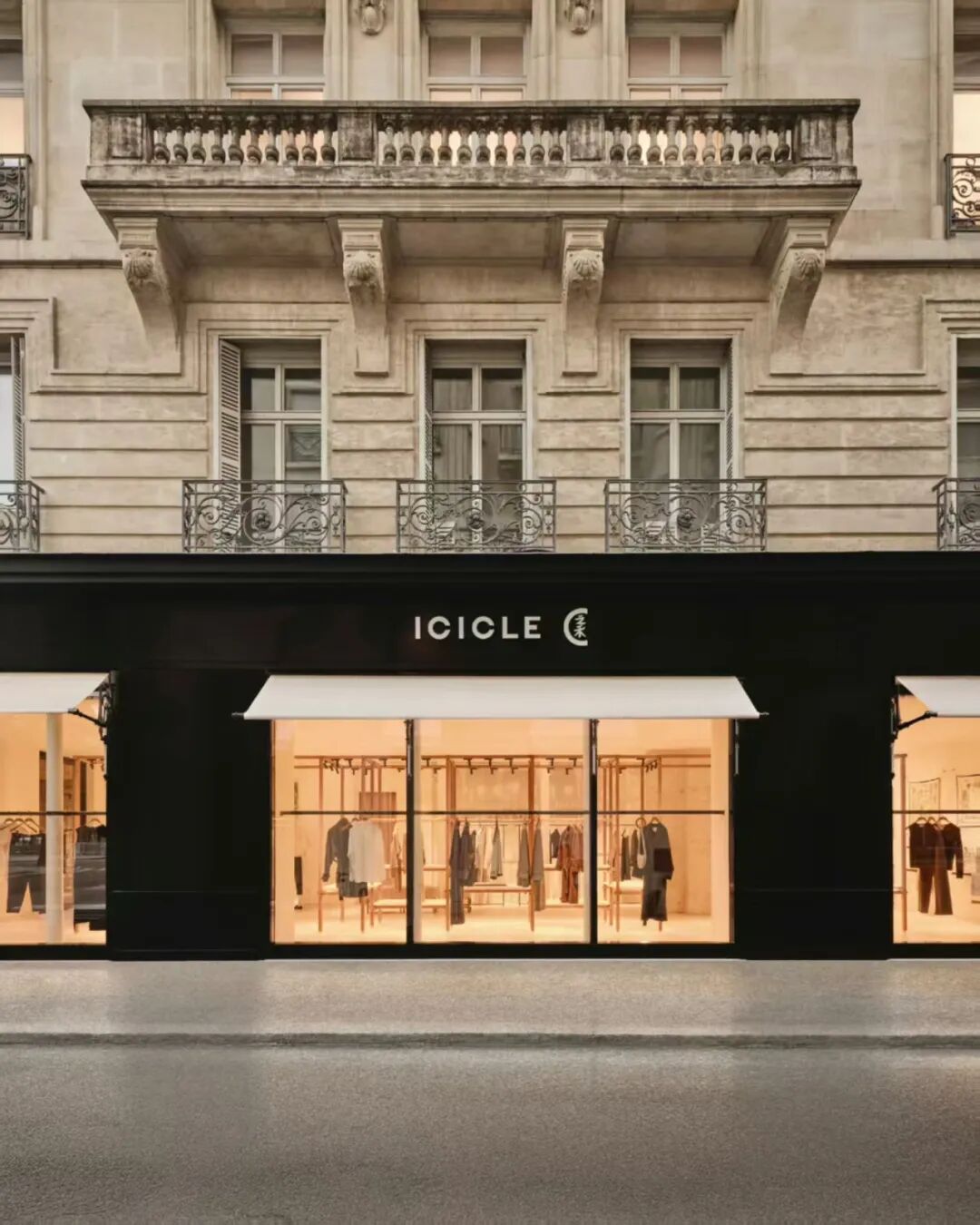
The positions once occupied by European and American luxury brands are now being replaced by Chinese brands in batches. ICICLE has even opened a store on Place Charles de Gaulle on the Champs-Élysées in Paris, with Hermès as its neighbor, becoming a new trendsetter in the fashion industry. All these brands share common features: strong design capabilities, unique brand culture and great growth potential, which make their names remembered by consumers.
This is undoubtedly a great encouragement for China's apparel industry. Frankly speaking, there haven't been many new stories in the apparel industry over the years, which is intuitively reflected in the retail sales data of consumer goods. Since 2026, the total retail sales of footwear and apparel have maintained positive growth, but the growth rate has shown a trend of being high in the early stage and low in the later stage, slowing down month by month. In the first six months of this year, the total retail sales of clothing, footwear, hats and knitted textile products across the country reached 770.9 billion yuan, a year-on-year increase of 6.7%; among which the retail sales in June alone was 128.5 billion yuan, up 3.9% year on year.
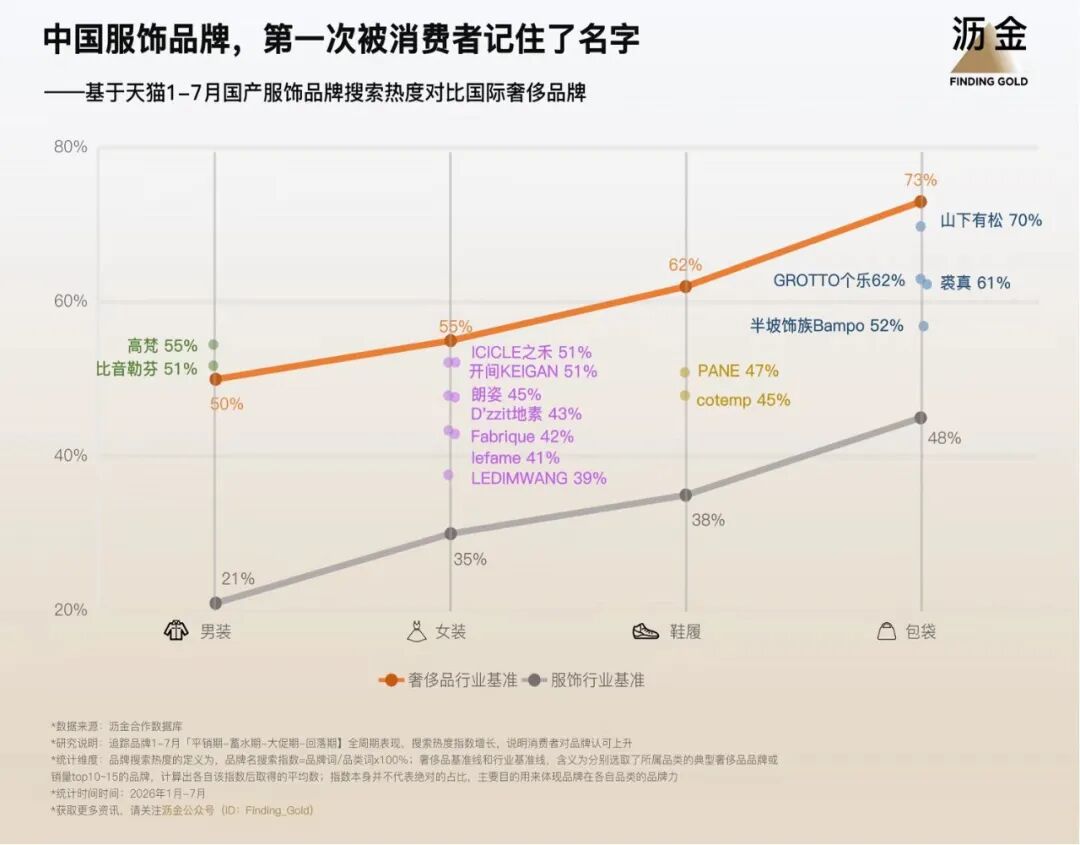
Against such a general environment, people inside and outside the industry are almost scrambling to recognize high-quality brands like ICICLE, PANE and SHANXIA YOUSONG. Behind this recognition is the support of impressive data. Li Jin released a tracking report in August, investigating the "brand search popularity data" (brand keyword search volume / category keyword search volume × 100%) of 15 domestic mid-to-high-end apparel brands from January to July this year. It found that all 15 brands outperformed the industry average and were close to the luxury benchmark line.
Source: Li Jin
The long-held consensus that "there are no high-end domestic brands" is being broken. In the past, the industry generally believed that domestic apparel brands could not do well in the price range above 1000 yuan, and the high-end market was the territory of international brands. Previous data from the 618 shopping festival showed that the average unit price of a number of domestic brands has steadily exceeded the 1000-yuan mark on a large scale. Consumers are willing to pay for them, and are willing to make repeat purchases (with a repurchase rate of over 40%). Consumers do not "only recognize international brands" — when the quality and design of domestic brands are truly up to standard, they will recognize and pay for them.
This forms a huge contrast with the overall development of the apparel industry market.
Zhong Xian, General Manager of E-commerce at ICICLE, shared her insights in a recent interview with 36Kr to explain this contrast: "The current consumption environment is not a simple downgrade, but a rational stratification of K-shaped consumption. Middle and high-income consumer groups have not stopped purchasing, but have disenchanted with the 'logo tax' of traditional luxury goods, and begun to re-explore the criteria for 'worth buying'. They are still willing to pay for good design, high-quality fabrics, well-tailored cuts and emotional value. ICICLE's breakthrough is precisely because we have accurately caught this shift in consumption structure."
To seize this rare golden development period, ICICLE decisively increased the proportion of high-end fabrics imported from Italy, and used the ultimate "cost-performance ratio" and stable aesthetic system to meet the rational consumer demand that refuses to compromise. In her view: "When consumers recognize our value, growth will come naturally."
In the story of ICICLE, good products and good experience are of great significance. Good products are the foundation for brands to retain consumers, and the supply chain is responsible for stabilizing product quality; good experience requires providing emotional value to consumers, which means "cultural power". If there is only a sound supply chain, the products will have good quality but insufficient brand bargaining power. The two together constitute "brand power".
There is no need to compete for traffic and low prices anymore, the good era of the apparel industry has truly arrived.
Build brand first, then expand scale
In the past, the common path to build a brand was to expand scale first and then build brand influence, while domestic high-end brands represented by ICICLE choose to build consumer mindshare first before scaling up.
This has to mention ICICLE's product methodology.
ICICLE was born against the background of sharply rising life pressure in modern society, and "comfortable and environmentally friendly commuter wear" has become a new demand of urban white-collar workers. Natural fabrics have become ICICLE's first choice. Natural fabrics are skin-friendly, comfortable and environmentally friendly, but the production of such fabrics is very difficult and requires a lot of extra costs. In the early stage of brand development, ICICLE attracted attention by using unique ramie materials, making consumers automatically associate the brand with the concept of "natural" when they think of ICICLE.
Over the past few years, ICICLE has extended the concept of "natural" and "comfortable" from fabric selection to the entire supply chain. Behind this is a set of strict supply chain selection standards. In the past, most manufacturers that met the standards were overseas enterprises. For example, the first batch of fabrics that met both requirements came from Sojitz Corporation of Japan.
More than 20 years ago, ICICLE began to purchase cotton and linen fabrics from Sojitz, and later, Sojitz's fabrics once accounted for 40% of ICICLE's total fabric usage. Later, ICICLE set up a Paris center, and established in-depth cooperation with more than a dozen top Italian fabric suppliers such as LORO PIANA, REDA and PIACENZA. Until last year, 40% of ICICLE's fabrics still came from Italy, and 10% came from Japan. In addition, ICICLE acquired the OEM supplier of MaxMara, which is very good at making double-face wool coats by hand and silk craftsmanship.
The HUG down jacket is also a signature product of ICICLE, which uses natural fabrics such as cashmere, wool or silk camel hair as the outer layer and is filled with Hungarian goose down. The workshop formal dresses are created by the Paris Design Center, using heavyweight silk with good drapability, suitable for important occasions, with precise tailoring and exquisite details emphasized in the craft.
In the eyes of Ye Shouzeng, the founder, Chinese manufacturing is the most mature resource in the world and should be seen by more people. Therefore, ICICLE has established a complete self-owned supply chain in the field of natural materials since 2005, such as building a factory in Shanghai. For example, the Nature Capsule Series uses environmentally grown cotton, linen, silk, Xiangyun gauze and other materials, and also combines plant dyeing, food dyeing and other techniques, many of which are localized sustainable processes.
Years of deep cultivation in the supply chain have ensured that ICICLE's raw materials such as cashmere, wool, organic cotton and linen all come from a controllable origin cooperation network. It adheres to environmentally friendly dyeing and low-carbon processing in the production process, and the fabrics are practical, wear-resistant and easy to take care of in daily life, which meets the needs of urban life.
It is precisely because ICICLE is backed by high-quality supply chain and excellent design level that it can sell a double-face wool coat at 40,000 yuan, a price that domestic brands could not reach before.
In the newly launched outdoor capsule series, ICICLE still adheres to the concept of being natural and comfortable on the basis of ensuring outdoor functionality, which is highly consistent with the outdoor enthusiasts' pursuit of high wearability, comfort and environmental protection.
With high-quality products, a good brand also needs a unique brand concept that can resonate with consumers, and find a good way to "tell stories". Different from many traditional brands, ICICLE has adopted many unconventional communication strategies in brand building.
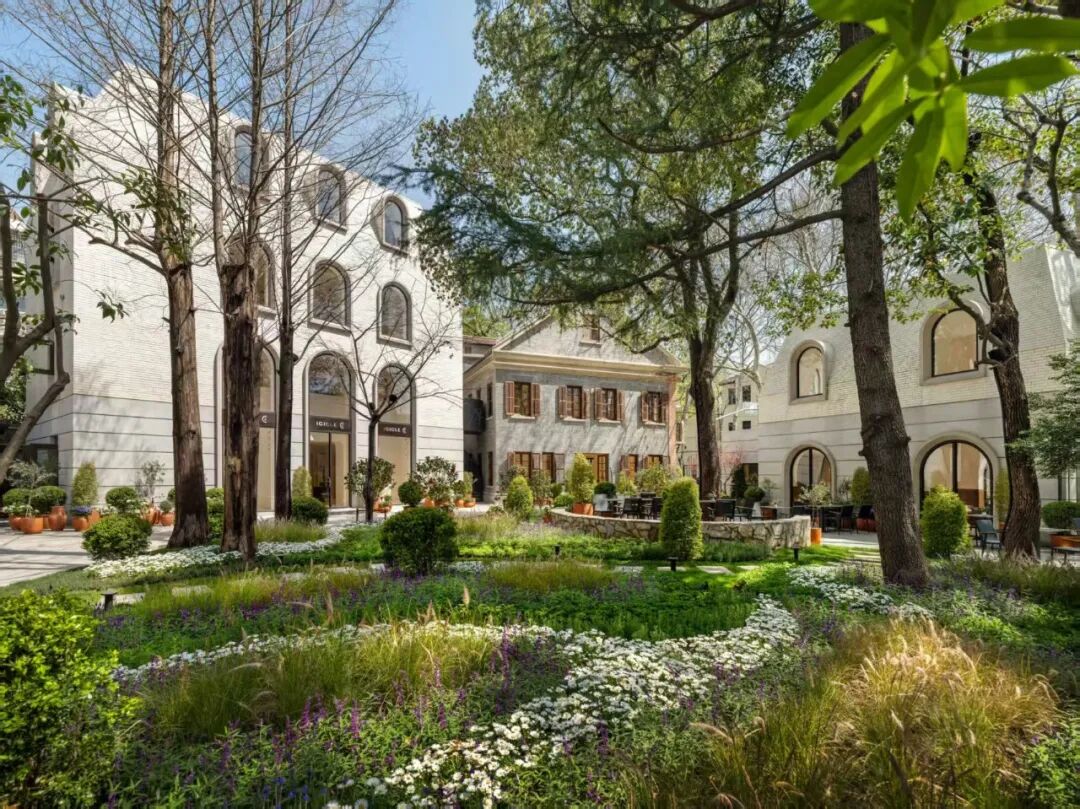
While major European and American brands are reducing the number of stores and opening more small stores, ICICLE has taken the opposite path. It opened an offline garden store in Shanghai in 2024. Offline scenarios are still indispensable for brands to build mindshare, especially for high-end brands.
ICICLE's garden store is built in the core of Hengfu Historical and Cultural Area in Shanghai. It is the first multi-brand flagship complex, building a symbiotic space for human-made creations, humanities and nature. Customers can experience a richer range of products and scenarios. They can not only buy clothes, but also drink coffee, hold parties, read books and appreciate ceramics. This is a complete one-stop experience.
ICICLE hopes that consumers can have a complete cognition and understanding of the brand, and also hopes to gain more comprehensive insights into consumers through this store: "For middle and high-income consumers, what do they interact with every day, what experiences do they need, and they can have a more comprehensive understanding of the concept of this brand and this group. The concept is not only reflected in clothing, but also in coffee, catering, books and ceramics, which can all show a person's taste."
In recent years, ICICLE has completely cut off its marketing budget for airport, high-speed railway and outdoor advertisements, and invested the budget in its annual brand books. The annual brand book is a high-quality art photo album, with the founder as the editor-in-chief, which uses images and essays to present ICICLE's fabric traceability and sustainable concept. Many major luxury brands also have the practice of publishing brand magazines and regular publications.
ICICLE has a unique definition of marketing: "Doing marketing is not only about increasing exposure and creating hit products, but also about telling the story of products well, because marketing is top-down, and how consumers perceive ICICLE is very important."
In addition, the reason why brands like ICICLE can become mid-to-high-end brands may also lie in their unique understanding of e-commerce channels.
As we all know, luxury brands that have long been used to operating offline stores have always been relatively cautious about e-commerce channels. It was not until the Tmall luxury platform Luxury Pavilion was launched in 2017 that Burberry settled in as one of the first batch of brands. GUCCI did not settle in until 2020, and LV has not settled in any e-commerce platform so far.
ICICLE actively embraced e-commerce very early, but it never regards e-commerce as a channel to boost sales and clear inventory. Zhong Xian, General Manager of E-commerce at ICICLE, said: "Seven years ago, we decided to operate the Tmall flagship store as an offline boutique, and insisted on outputting content to cultivate consumers' brand mindshare."
Even in the online scenario, ICICLE is very clear that the brand aims to build a high-quality product shelf, which is due to the great change in the path of brand building: to do long-term business on a mature platform. Promotion events and high-exposure nodes should not only be outlets for selling goods, but also windows to amplify brand tonality.
For example, ICICLE regards e-commerce as a "new show window for brand series launch", and integrates intangible cultural heritage culture and high-quality lifestyle into the live broadcast narrative through IPs such as "Tmall Super Fashion Release". This kind of show-style in-store live broadcast and consultant-style hosts not only maintain the brand expression, but also directly convert aesthetic recognition into transaction results, realizing the integration of brand effect and sales performance.
Coincidentally, ICICLE was also the first brand selected for the Tmall Chinese Fashion Award — this award is not ranked only by GMV, but by design, product strength and brand potential.
Behind this is a change in the industry's incentive structure. In the past, most of the traffic and resources of many e-commerce platforms were allocated according to GMV. A medium-sized brand would find that investing in brand building requires large capital input, long cycle and uncertain return, so it is better to concentrate resources to create hit products. Therefore, it is not that brands do not want to build brands, but the incentive structure does not support it.
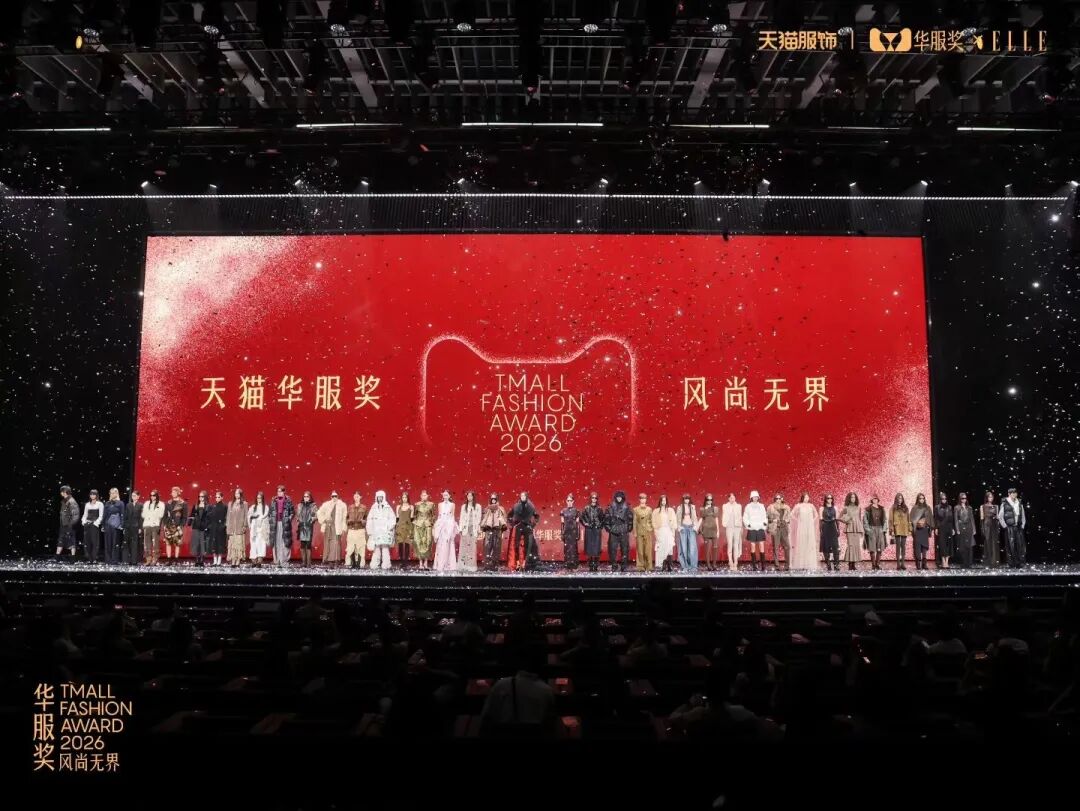
The evaluation criteria of the Chinese Fashion Award show that Tmall has shifted part of its traffic and support from "the brands with the largest sales volume" to "the brands with excellent product quality". Once this signal is verified, the business decisions of brands will change accordingly — investing in product development will also bring returns.
During this year's 618 shopping festival, ICICLE's average unit price rose from 2700 yuan to 3200 yuan, and the repurchase rate reached 68%. It climbed from outside the top 400 of Tmall women's wear category to the top 9. These figures show that the apparel industry has a new development path: starting from design, relying on high-quality products to gain a foothold, being continuously purchased by consumers, and achieving business growth.
Do not compete for low prices and sales volume, a unique e-commerce operation methodology
These newly rising Chinese high-end brands accumulate mindshare faster than the expectations of traditional models. A set of data shows that some domestic high-end brands have approached the level of luxury brands in a shorter period of time. For example, on e-commerce channels, SHANXIA YOUSONG took 13 years to achieve a 70% search popularity in the bag category, while the figure for luxury brands is 73%; ICICLE also reached 51% in the women's wear category, compared with 55% for luxury brands.
Traditional international luxury brands rely on the path of telling long-standing historical stories, opening thousands of stores, and continuously putting in performance-based advertisements, while the rising local high-end Chinese apparel brands have taken a different path.
On the one hand, the new generation of middle and high-income consumer groups have disenchanted with international brands. They no longer need to prove their own value through the logos of overseas big brands, which provides a broad mindshare soil for "Cool China". National confidence has promoted their trust in local mid-to-high-end brands, which is moving from superficial impulse to deep recognition.
On the other hand, China's mature e-commerce ecosystem provides systematic infrastructure support and payment trust for these brands. These e-commerce platforms can often help brands efficiently complete the closed loop of "finding the right people, retaining them, and expanding to more people". In particular, the membership system represented by Tmall 88VIP helps brands accurately target the domestic group with strong purchasing power, so that the compound interest effect of brand power can be quickly manifested. In addition, the combination of recommendation algorithm and search improves the efficiency of reach and conversion.
Clearly, a new path for brands to build brand power is taking shape: brand official online store operation + content platform seeding + Tmall search conversion + private domain repurchase precipitation. PANE achieved a 47% search popularity on Tmall in 3 years, and ICICLE's average unit price rose from 2700 yuan to 3200 yuan with a repurchase rate of 68%, far higher than the industry level, which all proves that this new path is feasible