AI investors have set their sights on Bilibili UP creators
On September 5, in Shanghai, Bilibili's "Build in Bilibili · AI Creation Open Tournament" announced the winners of its first season.
This AI competition with no participation threshold has a total prize pool of 1.43 million RMB. UP creator @Dr.W and AI Neko Maid won the first prize with *Neko Project Project N.E.K.O.*; *Soul Knight 3D Version* by UP creator @Zack Chicken and *Gate of the World* by UP creator @Grilled King Halibut won the second and third prizes respectively.
In terms of competition scale, this is a very lively event for AI developers. From June 5 to August 20, 13,400 people participated in submissions, with more than 30,000 works, the total cumulative viewing duration exceeded 350 million minutes, and more than 1 million users participated in voting. Among the contestants, more than 88% are UP creators with fewer than 10,000 followers, 64% have no professional development background, and more than 80% are one-person teams.
What is more noteworthy is that what these people created are not only AI images and AI short films, but also AI cooking robots, AI vision-assistance glasses, AI world games, as well as highly "Bilibili-style" AI neko maid, AI Zhou Dynasty ritual translator, AI big dog barking simulator...
In terms of the creation quality of AI applications, user activity, and participant scale, this AI competition is undoubtedly top-tier in China, and it is no less impressive than the Demo Day of major VC roadshows.
Before the competition, HSG, ZhenFund, NVIDIA, Zhipu AI and Vivo joined forces to provide models, computing power and Tokens. Many participating AI projects had already obtained financing before the award ceremony. For example, the Shell-breaking Robot by UP creator @Xu Huazhe Harry received tens of millions of US dollars in angel round financing from Yunqi Capital, Baidu, Shunwei Capital and other funds; the Space-time Telephone Bureau project by UP creator @Wonderful Lab - Du Qian'a received tens of millions of RMB in angel round financing led by Jinqiu Fund and co-invested by Shoucheng Holdings.
Unconsciously, more and more people are learning AI, using AI, showing AI achievements and discussing AI ecology on Bilibili...
Bilibili's identity has changed, and perhaps even Bilibili itself has not realized it.
01
AI Belongs to the Young, and the Young Belong to Bilibili
In the past few years, there has been only one main theme in the AI industry, which is "youth".
According to data from international venture capital firm Antler, the average age of founders of global AI unicorns was only 29 in 2024. The iteration of cutting-edge AI technology is so fast that the value structure of experience accumulation is changing drastically, and post-95s and post-00s startup stars are emerging in endlessly, both at home and abroad.
The same is true on the AI user side. At present, high-frequency AI users at home and abroad show an extremely young age structure. According to Accenture data, 85% of Generation Z (born between 1995 and 2009) frequently use AI tools, 8 percentage points higher than the full-age sample. According to CNNIC data, among generative AI users in China, the number of users aged 19 and below is about 186 million, ranking first among all age groups.
The people who make AI are young, the people who use AI are young, and the people who play with AI are young.
This makes Bilibili's user structure particularly interesting.
According to the 2026 mid-year financial report data, the average age of Bilibili users is only 26.5 years old, the daily active users are 117 million, and the daily usage duration reaches 113 minutes, which is equivalent to a nearly 2-hour movie.
Looking at the participant list of Bilibili's AI Creation Open Tournament, this sense of "youth" will become even more obvious.
Take the UP creator @Dr.W and AI Neko Maid of the award-winning work *Neko Project* as an example. Dr.W was born in 1998, studied at Peking University for his bachelor's degree, and then went to Michigan State University in the United States to pursue his doctorate, with research directions covering many cutting-edge AI fields such as graph neural network and Transformer. Long before that, he was already an old user of Bilibili, and he had already become a Bilibili UP creator when he was still in middle school in 2013.
At the beginning of returning to China, Dr.W was already the key target favored by major AI headhunters and investors, and he received countless offers and investment invitations. But in the end, he chose to start his own business independently to create an "AI neko maid" with strong two-dimensional style. The reason is simple - because he likes it.
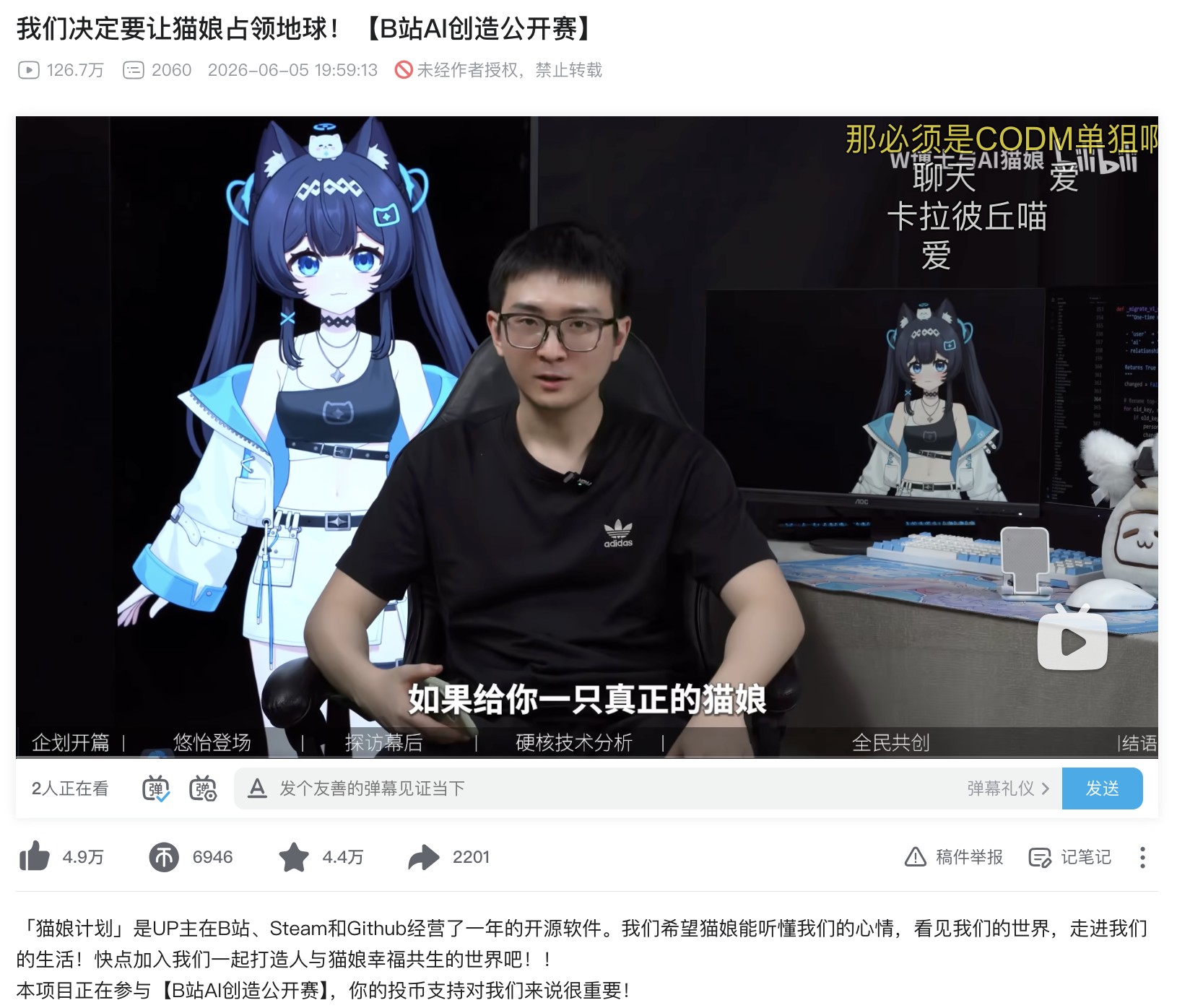
It is difficult to explain to people who do not understand "otaku culture" what AI neko maid and digital life are, but to some extent, the meme from *The Wandering Earth* that keeps popping up in the comment area "I want to give her a complete life" is an excellent description.
In a sense, this also explains why the overlap between AI and Bilibili's crowd is so obvious. A large number of today's cutting-edge young AI talents are the generation that grew up in the Internet content community. The identity boundaries between AI researchers, AI users and AI creators have long been increasingly blurred.
A 22-year-old student may be writing his first product with Claude Code, while being a level 1 "Captain" of other AI UP creators; a doctoral student may read the latest papers in the morning and upload a Demo to the community in the evening; a CEO may have just finished updating the code and then start recording a "cyber unboxing" video.
The community ultimately depends on user attributes, and Bilibili happens to have the young user base in the Chinese Internet that highly overlaps with AI users.
At the 2026 H1 earnings call of Bilibili, Li Ni, COO of Bilibili, said that the consumption duration of AI knowledge content on Bilibili increased by 72% year-on-year this quarter, and Bilibili has become a well-known AI learning video community across the network, "AI users and Bilibili users are highly overlapping".
02
The "Demo Field" for Chinese AI Products
Based on such a user structure, many interesting things will "grow out" of it.
For example, unconsciously, Bilibili has actually become the first Demo field for many AI projects.
In the past, the functions of traditional Internet products were usually clear enough. An accounting software, a browser, and a set of enterprise SaaS can roughly tell what problems they solve through function descriptions and a few screenshots.
However, after the emergence of large AI models, the situation of AI Agent, AI games, AI generative interactive products and so on is much more complicated. Products labeled as "AI assistant" may have completely different memory mechanisms, interaction methods and Agent capabilities behind them. Whether a generative game is playable and what a robot has learned, the information provided by text introduction is very limited. Users need to see it run and play first, and then consider whether to use it.
This makes Demo undertake part of the functions of product manuals, press conferences and even advertisements in the AI era.
And Bilibili just meets this demand.
First of all, the high overlap between community user portraits and AI users saves enterprises a lot of invalid traffic investment. Secondly, Bilibili users are patient and interested in listening to complex demonstrations of several or even dozens of minutes, users are willing to listen, and creators are also used to explaining the technical process.
The most critical point is that the story does not end after the video is released. UP creators can continue to update the second and third episodes, turning a one-time product release into a continuous development log. In this "Build in Bilibili · AI Creation Open Tournament", a large number of participating projects have gone through multiple versions of iterations. Even "amateur projects" that have never had AI development experience or UP creator experience can find their target users.
For example, the participating UP creator @Grilled King Halibut had no followers at all before, and the first video he posted on Bilibili was the competition submission. However, the Demo of his AI generative world game *Gate of the World* got an amazing 2.75 million views, and the work was selected into the top 10 award-winning works of the competition.
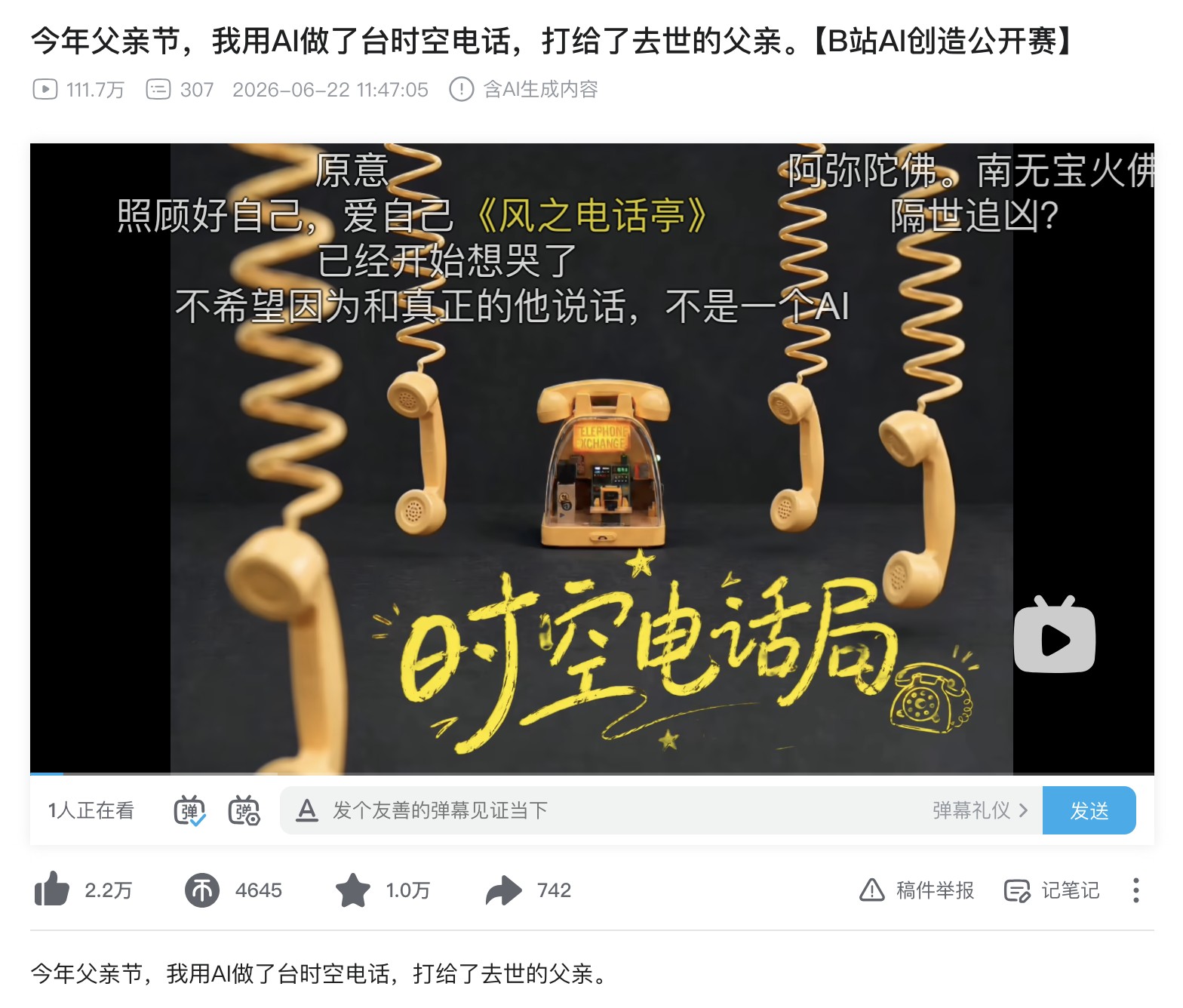
There are also many "cross-border players" who have no previous AI development experience. The UP creator @Wonderful Lab - Du Qian'a who obtained Jinqiu Investment used to be a film director, and his participating project is "AI Space-time Telephone", the introduction of which is: On Father's Day, I used AI to make a space-time telephone and called my deceased father.
The path of another UP creator @Xu Huazhe Harry is closer to the star AI entrepreneurs familiar to the primary market today. He is an assistant professor and doctoral supervisor at the Institute for Interdisciplinary Information Sciences of Tsinghua University, and the head of the Tsinghua University Embodied Intelligence Laboratory. Shortly after its establishment, Shell-breaking Robot completed tens of millions of US dollars in angel round financing led by Yunqi Capital, with participation from Shunwei Capital, Xiaomi Strategic Investment, and Baidu Venture Capital. Only a few months later, the company announced a Pre-A round of financing of hundreds of millions of US dollars, co-led by Shunwei Capital and Matrix Partners China.
Putting these people in the same competition will show a very interesting spectrum.
First of all, without exception, they all take Bilibili as the Demo field for product debut and inspiration verification. Many of them are long-time old users of Bilibili, and they may come from all walks of life with different academic and professional backgrounds.
But they share the same discourse system, they will smile knowingly at every YPM meme picture and *Axis Powers Hetalia* sticker in the comment area. Bilibili's community culture and bullet screen culture have permeated their daily life, and they in turn feed back the community through product output.
"All our live streams, videos and posts from the beginning to the end of the project are only posted on Bilibili," Dr.W told *Intelligent Emergence*.
As for why he didn't consider other platforms, Dr.W's answer is also very simple, "Because I don't use those platforms."
03
The Fake "AI Community", the Real "AI Community"
In the communication with the participating UP creators this time, a common feeling appeared repeatedly in the chat.
"The product roadmap 'grows out of the comment area'", "This demand has appeared too many times in the bullet screen/comment area, and it is impossible to ignore it", "Some users spontaneously answer questions for us in the comment area, and even 'relay development'".
Yes, Bilibili's comment area is a gathering place for "AI application enthusiasts" that is no less inferior than any professional developer community.
A large number of developers represented by *Neko Project* first publish their immature Demos publicly. Users in Bilibili put forward demands, suggestions and product roadmaps, developers continue to iterate, and the new Demo brings the next batch of users, even the next batch of "wild developers" who voluntarily participate in open source projects, and they take the initiative to participate out of interest and love.
Dr.W told *Intelligent Emergence* that during the competition, the entire collection of *Neko Project* received more than 17,000 comments in total, and the truly valuable demands often appeared dozens or even hundreds of times, "Even if you want to ignore these voices, you can't do it."
A typical case is the game companion plug-in for the game *Calabiyau* in the Neko Project. Before the competition, Dr.W had never even heard of this game. However, after the first video was released, some users asked "Can the neko maid play *Calabiyau* with me?" After that, similar demands kept appearing in the comment areas of different videos, and the team finally decided to develop this plug-in.
After the first version was launched, many players took the initiative to help other users troubleshoot problems in the comment area. Later, some people even spontaneously joined the open source project of Neko Project to optimize and develop functions, which eventually became a "co-development" between creators and users.
Dr.W described to *Intelligent Emergence* that for the first time, he felt very specifically that "the product roadmap can really grow out of Bilibili's comment area."
In fact, they accidentally stepped on the latest rhythm of project development in the AI era — BIP (Build in Public).
With the emergence of large models, Vibe Coding and various programming development Agents, the threshold for AI programming has become lower and lower, but correspondingly, the threshold for "finding users" has become higher and higher.
Whether an AI product can find the first batch of people willing to use it, whether developers can know in time why users stay and why they leave, what users really want, what is the creator's "self-indulgence", and what is the real user demand.
The information that traditional developers need to piece together gradually through Focus Group, user research and Demo Day is gradually satisfied in the public development process.
This is exactly the BIP idea that is very popular in Silicon Valley at present. Developers attract attention, build communities, obtain user feedback by sharing publicly, and use the real feedback from the community to polish products.
Overseas, many such communities have achieved good results. Product Hunt can serve as the cold start entrance for new products, Hacker News has long been an important place for Silicon Valley entrepreneurs and engineers to observe new technologies, and GitHub allows investment institutions to see excellent developers earlier.
On these bases, Bilibili has an additional variable: products are more deeply bound to the creators themselves.
When investors see a Demo, they can judge the creator's technical accumulation through his past videos, and also see the version changes of a project over several months. The comment area retains the real problems of users, and the views and interactions form the earliest demand signals. More and more investors are paying attention to Bilibili: who made it, how it was made, how fast it iterates, what users want, and whether the market will accept it.
This is probably why HSG also came to the scene of this "Build in Bilibili · AI Creation Open Tournament".
If more and more AI projects have completed product verification on Bilibili before registering the company, Bilibili's role will continue to move upstream of the industry, gradually evolving from a Demo field to a platform for startup incubation, discovery, and even investment and financing.
That's why the article said at the beginning that Bilibili's identity has changed. And this point, perhaps even Bilibili itself has not realized it.
Conclusion
The Capital Market May Still Understand Bilibili with the Logic of the Previous Generation
In the past, when people talked about Bilibili's AI, their focus was easily on "AI content growth" and "AI advertising growth", but unconsciously, the logic of understanding Bilibili has changed.
The new era of AI developers, AI users and AI players are generally young and have personalities. Most of them are "hardcore" users of Bilibili. After growing into AI creators and users, Bilibili has naturally become a platform for them to carry and release their works.
This naturally grown AI community culture makes more AI products choose Bilibili for their first public appearance; Bilibili users who share the same discourse system with them will not hesitate to give very positive comments, feedback and constructive suggestions, which in turn affects the next generation of product development by developers.
Later, some more mature projects move towards financing and the market, and the keen capital in turn actively searches on Bilibili, taking Bilibili as a project radar.
According to the data of Bilibili's AI Creation Open Tournament, among the 13,400 contestants, 26% of them said that they began to seriously consider starting a business or continuing