WorkBuddy Open Ecosystem, Tencent does not want to be trapped in the desktop segment.
As the capability gap between large models narrows, AI Agent in the office sector has become a fiercely contested battleground for major tech companies.
If previous-generation office products such as DingTalk, Feishu, and WeCom solved collaboration pain points, the hard nut to crack for this generation of AI office products is handling actual work: users can feed a batch of files or a simple instruction to the AI Agent, which will break down tasks, call relevant tools, and deliver final results.
This is a huge market verified by empirical data. Data from iiMedia Research shows that the market size of China's AI agent sector reached 80.4 billion yuan in 2025, representing a year-on-year increase of 123.2%, and is expected to hit 696.8 billion yuan by 2030; the enterprise-level AI Agent market will grow from 21.2 billion yuan in 2025 to 332 billion yuan in 2029. Tencent's WorkBuddy is currently the leading player in this track. According to Citi's research report, its cross-platform monthly active users have exceeded 20 million and daily active users have surpassed 13 million, making it the most widely used productivity agent in China by daily active user count.
Users have proven that the Agent has passed the threshold of being able to perform practical tasks. The real challenge now is to ensure uninterrupted service across all devices, operating systems and scenarios.
On the afternoon of September 2, Tencent held the first launch event for WorkBuddy since its release nearly half a year ago, and announced the official launch of its open platform (open.WorkBuddy.cn), with over 100 ecological partners introduced in the first batch, opening underlying Agent capabilities to smart hardware vendors, industry application developers and other stakeholders.
This is the first open platform in China's AI Agent track that connects the three layers of ecology: hardware, applications and developers, and it is also the first time for WorkBuddy to disclose its complete open ecology strategy since its launch in March this year.
"Genuine productivity never depends on how powerful a single tool is, but on how many capabilities it can connect and how many scenarios it can penetrate," said Liu Yi, Vice President of Tencent Cloud and Head of Tencent CodeBuddy & WorkBuddy, "We aim to build WorkBuddy into an operating system for the Agent era — not to create a more powerful standalone tool, but to build a platform that can carry all kinds of tools."
In other words, Tencent does not want WorkBuddy to be restricted to desktop scenarios.
Open the Underlying Architecture: Over 100 Partners, 9 Hardware Products, Three-layer Ecology
The WorkBuddy event site in Shenzhen on September 2 was packed with attendees. Before the conference kicked off, the exhibition area was already crowded, and representatives from software and hardware vendors including Plaud, Rokid, Insta360, iFlytek, Beisen and Fanruan were demonstrating the performance of their products after integrating with WorkBuddy.
At this conference, Tencent WorkBuddy announced the official launch of its open platform (open.WorkBuddy.cn), with more than 100 ecological partners introduced in the first batch, 9 co-branded smart hardware products debuted, and over 30 industry applications connected simultaneously, covering more than 20 fields including finance, law, healthcare, education and public welfare.
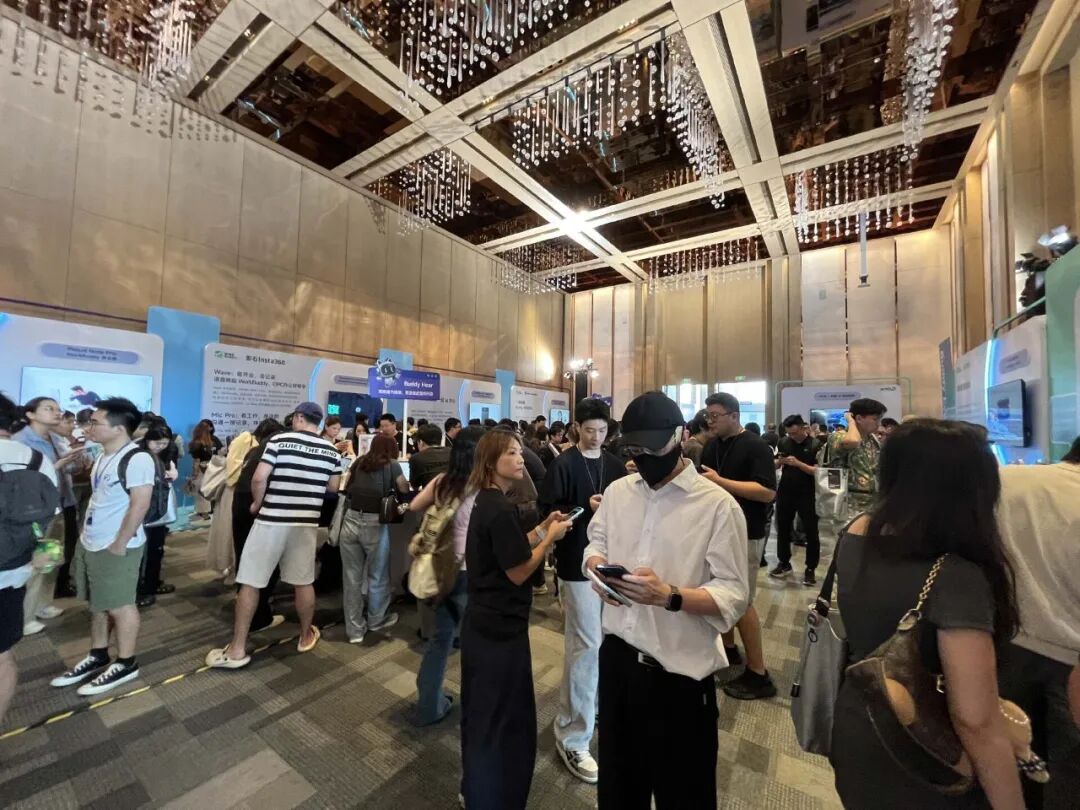
Caption: WorkBuddy launch event site
At the hardware level, focusing on the five core scenarios of "listening, viewing, recording, communicating and collaborating", WorkBuddy has integrated with more than 30 hardware brands across over 10 categories including smart glasses, recording devices, earphones, smart wearables and PCs.
Take smart glasses as an example: its microphone and camera are responsible for data collection, while WorkBuddy handles understanding, planning and execution. Accounts, tasks, memories and output results are synchronized across the glasses, mobile phones, PCs and web terminals. When users enter a meeting room wearing the glasses, speech transcription, meeting minutes, to-do lists and follow-up emails can be completed in one coherent workflow; during field interviews, the content seen and heard will be automatically archived into retrievable memory, so that users can later directly ask about the specific demands raised by the client last week and call WorkBuddy to complete relevant tasks.
The collaboration between smart hardware and WorkBuddy enables office demands to be addressed outside the workstation. "AI is not meant to replace humans, but to free up more time for people to do the things they enjoy. For example, when your boss contacts you while you are walking your dog, you can respond to the demand with one simple voice instruction via the smart glasses, and you can continue walking the dog," said Cai Guoxiang from Rokid. In other words, WorkBuddy can improve work efficiency for users at their workstations, while AI glasses help users stay productive even when they leave their desks. This is exactly the real scenario that WorkBuddy aims to cover.
For software partners, Tencent has launched the "Buddy App" entry, through which more than 30 partners including Tongdaxin, GF Securities, PKU Law, Weimob, Beisen and Fanruan can build their own branded AI workbenches based on the underlying architecture, without the need for independent AI R&D. For developers, WorkBuddy opens three core capabilities: Skill, Expert and Connector, supporting dual access of MCP and CLI. Developers can easily connect to WorkBuddy through standard protocols, and provide users with professional systems, tools and industry know-how.
Software partners have already achieved positive results. Shen Tao, Strategic Vice President of Fanruan, compared the current track to the era when WeCom was launched in 2015. He noted that the overall traffic and market opportunities now are 10 times or even 100 times larger than that period. Fanruan has launched 9 expert modules on WorkBuddy, which have been called for over 10,000 times, and the top three most popular products on the platform are all data analysis tools, a scenario that has long troubled office workers the most.
Lin Zuolu, Head of WorkBuddy Open Ecology, said that the Agent has passed the threshold of being able to perform practical tasks, and the real challenge now is to ensure uninterrupted service across all devices, operating systems and scenarios.
Office Agents are not all-powerful. When receiving a task, they need to read enterprise data and operate in business systems; however, general-purpose models do not understand the permission rules of a specific company, nor do they master the industry workflows of finance, taxation and law. Tencent is well aware that it cannot independently develop all these capabilities, and forced independent development will only extend the development cycle and increase delivery costs. External partners, on the other hand, already have ready-made business systems, years of accumulated industry know-how and stable customer relationships.
By opening up capabilities through three paths: hardware, industry applications and developers, so that every industry and every partner can integrate Buddy into their own scenarios, WorkBuddy will become much more practical and user-friendly.
AI Office Enters a New Competitive Stage
WorkBuddy is not the only player that wants to "welcome partners openly", but it is seizing the ongoing battle for ecological position in the sector.
Data from Analysys shows that the total monthly visits of 17 mainstream desktop AI office agents in China in June this year exceeded 60 million, three times the figure in March, among which WorkBuddy ranked first with about 20.97 million visits, exceeding the sum of the second and third place players.
In August this year, Alibaba launched Qwen Office, a product that deeply integrates three of Alibaba's self-developed Agents: QoderWork, Wukong and MuleRun. Qwen Office covers APP, PC and AI glasses terminals, and is fully open to third-party Agents and Skills. Brands including KFC, Luckin Coffee, SF Express, Ziroom and China Eastern Airlines have already settled in the platform.
Doubao Work was released on August 25, integrating Feishu, Coze and TRAE, directly providing a skill store, connectors and "work partners", and is deeply connected with Feishu, enabling chat, documents, meeting minutes and schedules to be called seamlessly.
Although Qwen Office and Doubao Work have not yet officially announced their full ecology layout, the inherent limitations of office Agents determine that if they want to expand their scale, they must cover more scenarios and have more experts, connectors and Skills. In other words, in the second half of the AI office competition, the competition is no longer about "how capable my Agent is", but about "who has more partners and who covers more scenarios".
It is worth noting that Lin Zuolu, Head of WorkBuddy Open Ecology, has repeatedly emphasized that Tencent does not measure the quality of the ecology by the number of partners. "The 100 partners are only the initial group of collaborators with high willingness to cooperate, which does not equal the final ecological outcome. We value more the high-frequency use of scenario applications, and the partners can obtain corresponding development benefits at the same time."
However, to build the most prosperous ecology, there are still huge challenges to overcome, the core of which is the challenge of business models.
For hardware vendors, they only provide a new service, and they still make profits only from hardware sales. The subscription revenue of WorkBuddy belongs to WorkBuddy, and the two parties do not participate in each other's revenue sharing for the time being.
But the software sector is much more complex. The first risk they face is being marginalized as a pipeline. Traditional software is interacted with by humans, while AI office software is interacted with by Agents, which means that the data of the software becomes the context of the AI.
Huang Shan, General Manager of Shenzhen Fortune Trend Technology Co., Ltd., said that traditional software has very profound functional accumulation, and not all content needs to be called by AI. AI is an entry point, but for scenarios that require heavy computing and high efficiency, the algorithms of AI or large language models are not sufficient. These scenarios require accurate, fast and real-time computing, rather than probabilistic computing.
The second issue is the charging model. Traditional software is billed by seat, while the billing logic of office Agents is different. Wang Shengjie, Product Expert of Tencent WorkBuddy, also said that the Token fees generated by software use are still paid by users to WorkBuddy on a pay-as-you-go basis.
Shen Tao, Strategic Vice President of Fanruan, believes that current AI office products like WorkBuddy are still in the user education stage. "We once discussed whether to set the pricing strategy, but finally decided to make all functions free for users to experience. Losing tens of thousands of yuan per month is our happy trouble, and formal paid service will be the matter of the second stage. I think we will follow the revenue policy of WorkBuddy," he added.
This may be the consensus in the first half of the ecology battle: first cover as many scenarios as possible and gather all partners, then start the paid operation phase.
Tencent does not want WorkBuddy to be restricted to desktop scenarios. What it aims to carry is the industry capabilities that other players have spent decades accumulating. The underlying architecture has been opened, but whether it can truly grow into a prosperous and functional ecology still needs to be tested by time.
This article is from the WeChat official account "Tech Planet" (ID: tech618), written by Wang Lin, authorized for release by 36Kr.