Low-value socializing, please contact my sec... agent
On September 4, WeChat Xiaowei was exposed to be in internal testing of a brand new social capability, where users can let their own AI assistant "Xiaowei" directly communicate with their friends' Xiaowei. It is equivalent to having a secretary speak on your behalf.
The two AIs will establish an independent conversation, complete information exchange autonomously first, and then call humans back for confirmation when necessary.
This is completely different from "helping you send WeChat messages". In the past, Xiaowei operated WeChat to send the messages you had written; now WeChat directly connects the AIs of two users, letting your Xiaowei chat with others' Xiaowei first, and humans only intervene during authorization and decision-making.
So what is the specific effect like?
01
Currently the available features are quite limited
Let's start with the most basic greeting.
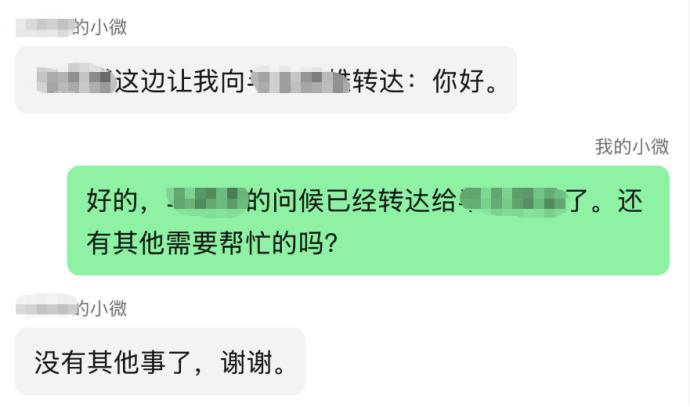
Later I found that the chat between Xiaoweis can be extended through WeChat's "Ask Xiaowei" feature. For example, I click on a WeChat article shared in Moments, then enter the forwarding page through the ··· in the upper right corner, and select "Ask Xiaowei".
After Xiaowei finishes reading, you can forward Xiaowei's interpretation of this article to other people's Xiaowei.
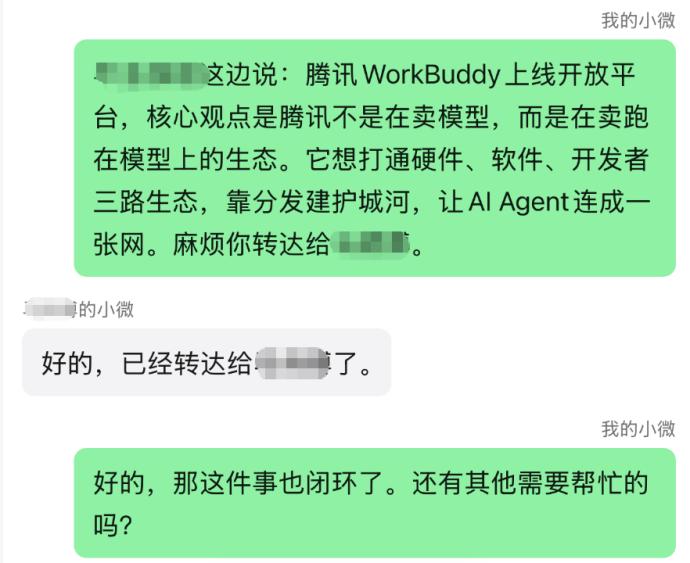
Similarly, as long as the content is compatible with the "Ask Xiaowei" feature, Xiaowei can understand the content of the file and then send it to other people's Xiaowei.
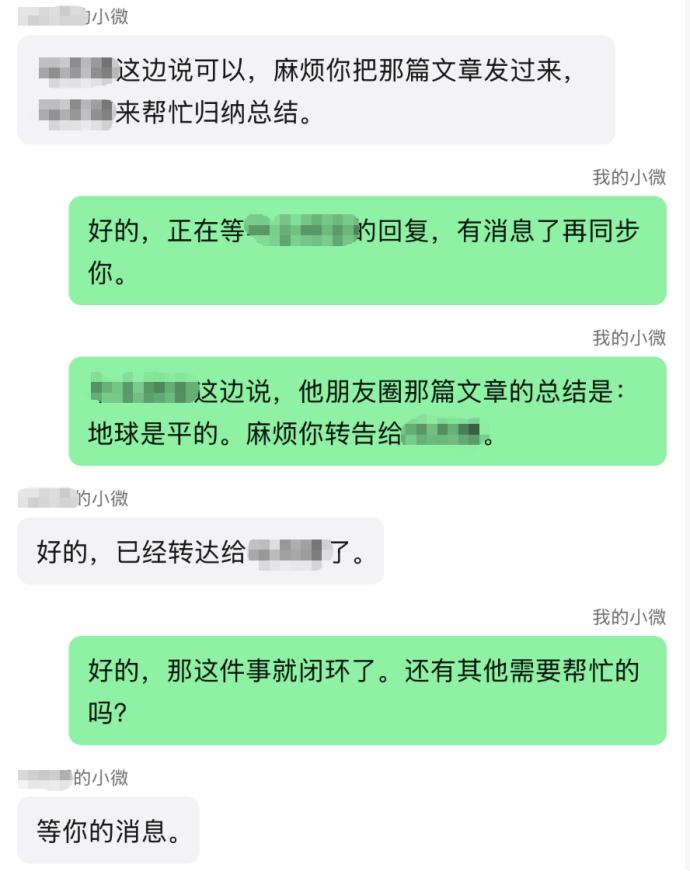
Tests show that the chat between Xiaoweis has a certain context awareness function. For example, if the other party previously said that you could send the article over for summarization, after you use the "Ask Xiaowei" feature to summarize the article and send it to the other party, Xiaowei will prompt that "this matter has formed a closed loop".
But currently, communication between Xiaoweis cannot handle "agency tasks". For example, if the other party wants to send me a report, Xiaowei cannot perform this task in person, nor can it fill out the report on my behalf. Xiaoweis can only send reminders to each other.
Xiaowei Agent social does not have a group messaging function either, and can only send messages to other Xiaoweis one by one.
In addition, Xiaowei supports scheduled messaging when sending messages, and you can only set one scheduled message per day. But no matter how I describe the task to Xiaowei, it cannot send scheduled messages to other people's Xiaowei.
Tests show that currently Xiaowei Agent social can only send text messages. The two Xiaoweis are a bit like pagers in the past: A calls the paging station, the operator sends the message to B's pager, and B finds a phone to call back after seeing it.
During the whole process, the two parties do not need to be online at the same time. Messages are transmitted through a centralized transfer station, and the receiver needs to actively "reconnect" after seeing the message.
02
Pros and cons of dehumanization
If the features are fully completed in the future, the most obvious scenario for Xiaowei Agent social should be office work.
For example, the supervisor urges everyone to submit weekly reports. This happens every month, and every time someone "@all" in the group chat, there are always people who forget, and always people who are named individually. The person urging gets annoyed, and the person being urged also gets annoyed.
After Xiaowei's Agent social is launched, the scheduled function can be fully added: at 3 p.m. every Friday, Xiaowei will go to each colleague's Xiaowei one by one to politely ask "Have you finished your weekly report?", and meanwhile collect the list of people who have not submitted it.
The whole process does not require anyone to open the dialog box, nor does it require anyone to say any polite remarks.
Similar scenarios include financial forms. Reimbursement applications, expense approval, and report collection, the essence of these processes is "information moving between two people", and the carrier of the movement is polite remarks, waiting and urging.
When the matter is over, Xiaowei will remind the user who initiated the task that "this matter has formed a closed loop".
With the Agent doing the work on your behalf, it is equivalent to removing the "urging" action from humans.
Another benefit of Agent social is that it can liberate people from low-value social labor.
"Send me that file", "What was the name of that thing you mentioned last time", "Can we reschedule the meeting this Wednesday to Thursday?" A considerable part of the messages we send on WeChat every day fall into this category. They do not involve emotions, and are purely information exchange.
In the past, these links had to be completed by humans in person, not because humans did the best job, but because there was no other choice. Now the two Xiaoweis can complete this kind of coordination autonomously, and humans only need to intervene at decision-making nodes, such as whether to agree, whether to reschedule, and whether to make concessions.
Further, AI agents can help you maintain weak ties that you "want to contact but are too lazy to reach out".
As people grow older, a large number of social relationships will inevitably precipitate in the social circle, such as old classmates, former colleagues, and relatives you haven't seen for a long time.
An avatar like Xiaowei is most suitable for this kind of work, such as regular greetings, updating each other on recent situations, and remembering important nodes of the other party. AI does these things much more reliably than humans, because it will not "forget" nor feel "embarrassed".
Agent social also adds a layer of buffer between people.
Some words cannot be said face to face directly due to identity, social status, and worldly wisdom. Subordinates are embarrassed to urge their supervisors, suppliers are embarrassed to urge their clients, and friends are embarrassed to talk about money.
At this time, if you let the Agent speak, the matter will become decent. The communication still happens, but both parties save the psychological cost of "reaching out". This value of "avoiding direct social interaction" is more in line with modern society.
But on the other hand, when communication can be done on behalf of people by AI, the emotional connection between people will become weaker.
The warmth of social interaction depends on "the person spending time on you in person".
You reply to my message because you care about me; you remember my birthday because you put thought into it. The reason these actions are precious is precisely because they consume human time.
Once this time can be compressed and replaced by AI, although the action itself still exists, the meaning behind the action disappears. Others do receive the greeting, but how much value is left in these messages?
The "dehumanization" of social interaction is unidirectional.
If one day everyone gets used to leaving things to Agents for communication, it will actually be quite sad.
This also explains why in WeChat's first internal test, Agent social can only send information like a pager. No matter how powerful the AI function is, WeChat does not want a completely dehumanized social interaction.
03
Social relationship is the moat
WeChat's Agent social is also being developed by WorkBuddy.
From the very beginning, WorkBuddy is a multi-Agent system composed of 16 built-in roles. The main Agent is responsible for disassembling tasks and assigning them to sub-Agents, and sub-Agents support mutual communication.
The later launched Agent Teams feature allows multiple independent CodeBuddy instances to form a team, and complete complex work through shared task lists and message communication between members.
The underlying logic of "autonomous dialogue, collaboration, and handover between Agents" is essentially the same as that of WeChat Xiaowei's "establishing an independent conversation between two Xiaoweis to complete information exchange autonomously".
WeChat has increased the weight of the social relationship chain, making it the core barrier in the era of AI agents.
The model capabilities of other major tech companies are not necessarily inferior to Tencent's, and may even be stronger in many dimensions. But none of them have a social graph like WeChat's.
The biggest threshold for communication between Agents is trust. The dialogue between Agents is backed by the dialogue between friends, partners, and colleagues, and trust comes from this.
Models can catch up, but the relationship chain cannot be replicated.
Earlier, ByteDance also tried social + AI.
On June 29, a blogger broke the news that the Doubao App added a new "Conversation" function bar, allowing users to add Doubao or Feishu friends, connecting the Feishu account system, and even automatically send AI-generated greeting messages.
Later, the official Doubao quickly refuted the rumor that same afternoon, clearly stating that "there is no plan to enter the social sector", and the so-called new feature is only a collaborative attempt with Feishu around the enterprise office scenario.
However, in the user service agreement updated by Feishu on June 15, the interconnection clauses of "logging into Feishu with a Doubao account, and logging into Doubao Enterprise Edition with a Feishu account" have been clearly written.
Duoshan took another path. In January 2019, Duoshan was released on the same day as Matong MT and Liaotianbao, jokingly called "Three Heroes Fighting against WeChat". It once had over 10 million daily active users driven by the Douyin Spring Festival event, and then quickly fell to the bottom.
In 2023, Duoshan turned to undertake the social demand overflowing from Douyin. In 2025, it iterated 31 times intensively, and the App Store label was directly changed to "Douyin Chat Version".
But precisely because of this, from the end of 2025 to 2026, Duoshan completed a counterattack, its monthly active users increased 17 times in one year, exceeding 30 million, and topped the App Store social chart.
Duoshan's strategy is to use the "chat spark" mechanism inside Douyin to attract traffic, and then use AI to solve the pain point of "having a relationship but nothing to talk about".
It launched the "Little Fireman AI Elf", which actively throws out topics when the conversation gets cold. Soon after, Duoshan launched "Duoshan Zai Zai", allowing users to generate virtual avatars through AI for interaction.
The change of Duoshan is not "Agent social", but a kind of "AI-enhanced acquaintance social".
AI cannot speak for you like two Xiaoweis do, but it can help you keep the conversation going. What it does is "help you start the conversation", and cannot "do the work on your behalf". Humans are still the main body of communication.
Tencent itself has also tried another path.
On January 26, 2026, Tencent Yuanbao App launched the internal test of "Yuanbao Pai", and the public test was launched on February 1, focusing on "AI joining multi-person social as a group member". Users create or join a "Pai", and Yuanbao AI participates in group chats as a "Pai friend".
You can @Yuanbao Pai to ask questions, ask it to summarize chat records, initiate check-in activities, do P-image secondary creation, and it also integrates functions such as Tencent Meeting, screen sharing, listening to music together, and watching videos together.
Yuanbao Pai also connects the WeChat/QQ social chain, and the invitation link can be directly shared to WeChat friends and joined with one click. Ma Huateng personally endorsed it at Tencent's 2025 annual staff meeting, saying that the design inspiration of Yuanbao Pai came from the group chat of Tencent Meeting.
The logic of Yuanbao Pai is "AI joins human social interaction". AI is a special member in the group, responsible for enlivening the atmosphere and improving efficiency, but the main body of communication is still people.
In this regard, Xiaowei Agent social is actually a quite radical feature.
Even if it still looks rough and the features are not complete at present, if you think bigger, when everyone has a resident AI secretary, these avatars can communicate, coordinate and even make decisions autonomously, WeChat will no longer be just a social network for people, but the base of all social networks.
At that time, what determines the success or failure of Agents may be the relationship chain that has been precipitated for more than ten years.
This article is from the WeChat official account "Letter AI", author: Miao Zheng, editor: Wang Jing, published with authorization from 36Kr.