ByteDance has secured $29.6 billion in "ammunition": Major tech enterprises are collectively raising funds for AI development. How long can this cash-burning spree last, and who will be the first to be unable to hold out?
On September 3, a syndicated loan of 29.6 billion U.S. dollars (approximately 200 billion yuan) was settled on ByteDance's account.
Banks are rushing to offer capital. What is notable is not the amount, but the intensity of the "scramble": ByteDance initially only planned to raise 20 billion U.S. dollars, but the subscription orders from banks accumulated to more than 30 billion U.S. dollars, and the scale was finally expanded to 29.6 billion. Citi and JPMorgan Chase served as coordinating arrangers, with the interest rate set at SOFR plus 68 basis points — this marks the historical low record of the overseas loan spread for Chinese enterprises, 17 basis points lower than ByteDance's 10.8 billion U.S. dollar loan in 2024.
Three-year term, extendable to five years. Once signed, it will be the second-largest U.S. dollar-denominated syndicated loan in Asia in 2026, second only to the 40 billion U.S. dollar bridge financing that SoftBank prepared for OpenAI in March.
This is not an ordinary loan, but a "military expenditure" bill in the computing power era — ByteDance, Alibaba, and Tencent are using debt to pre-pay for their future AI tickets in advance.
A simple conclusion is that international banks are betting real money that they believe in ByteDance's AI story. But what is more worth asking is another thing: why does a top-tier company that has made huge profits suddenly take on such a large amount of debt?
Where the money goes: A high-stakes bet on "heavy asset expansion"
The answer is two words: computing power.
According to reports from multiple media outlets, ByteDance is evaluating pushing its 2026 capital expenditure to a maximum of 70 billion U.S. dollars (approximately 470 billion yuan), more than doubling from 2025; even with a more conservative caliber, its 2026 AI capital expenditure has also been revised up to more than 200 billion yuan, at least 25% higher than the previous plan. The newly added investment is concentrated on data center expansion and AI infrastructure.
Where exactly is this money spent? The procurement structure disclosed by TechTimes is very informative:
AI chips: About half of the capital expenditure is used to purchase chips. Among them, the NVIDIA H200 is restricted by the case-by-case approval of the National Development and Reform Commission, and only 13% of the authorized quota has arrived by the end of August; ByteDance has therefore accelerated its shift to domestic products — its procurement amount for Huawei Ascend 910B in 2026 has exceeded 40 billion yuan.
Data centers: Deployments are underway in multiple locations including Inner Mongolia, Zhongwei in Ningxia, and Datong in Shanxi (Volcano Cloud Taihang Computing Power Center). Just the two new companies in Ningxia that are 100% owned by ByteDance with a total registered capital of 4.6 billion yuan, whose business scope includes "non-residential real estate leasing", are directly targeted at computing power infrastructure.
Model ambition: ByteDance's Seed team (about 2,000 people) is reportedly pre-training a large model with 10 trillion parameters — which is itself a huge money burner.
The cost has already emerged. According to sources informed by Red Star Capital Bureau, ByteDance's net profit in 2025 fell by more than 70% year-on-year, with a sharp contraction in profit margin, which is exactly due to the massive increase in investment in the AI business since the third and fourth quarters of last year.
In other words, ByteDance is exchanging profits for computing power and debt for time.
A "Replenishment Map": Top Tech Companies Collectively Raise Funds for AI
ByteDance's 29.6 billion U.S. dollar loan is only the latest part of this "fundraising campaign". If you lay out the moves of leading players since the beginning of this year, you will see a clear hidden line — equity placement, bond issuance, and syndicated loans are advancing in multiple ways, with only one goal: to provide blood supply for AI.
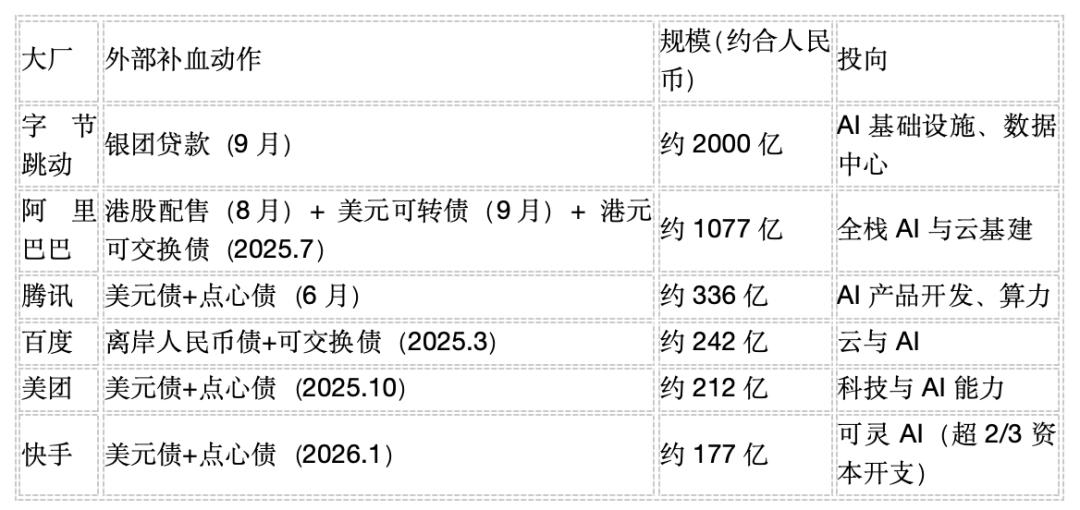
Alibaba is another benchmark. The 80 billion Hong Kong dollar new share placement completed on August 26 is Alibaba's first placement since it returned to Hong Kong in 2019. It received nearly 3 times oversubscription in less than one hour after launch, and 100% of the net proceeds are invested in global computing power and AI data centers. Combined with the previously announced "380 billion yuan in three years" plan (about 190 billion yuan has been invested as of June 2026), Alibaba's AI investment has entered a "self-escalation" cycle — CEO Wu Yongming even overturned his own estimate from last year at the earnings meeting, saying that the original 380 billion yuan plan was "too conservative".
Tencent took the bond issuance path. The nearly 4.7 billion U.S. dollar bond in June this year is its largest scale since 2020, and the raised funds are used for purposes including AI product development. The financial report is more straightforward: the capital expenditure in the second quarter was 527.84 billion yuan, a year-on-year increase of 176%, and the cumulative 84.7 billion yuan in the first half of the year has exceeded the total of 2025. The cost is that the free cash flow in the second quarter dropped to -138 billion yuan — this is the first time Tencent has turned negative since it disclosed single-quarter data in 2014.
Meituan, Kuaishou, and Baidu are also queuing up in the bond market. More than two-thirds of Kuaishou's capital expenditure is invested in Kuaishou AI, and in the latest capital increase of Kuaishou AI, the three giants Tencent, Alibaba, and Baidu rarely appear together, with a post-investment valuation of about 18 billion U.S. dollars, almost equal to the market value of parent company Kuaishou.
How long can they keep burning: Who will be the first to be unable to hold on?
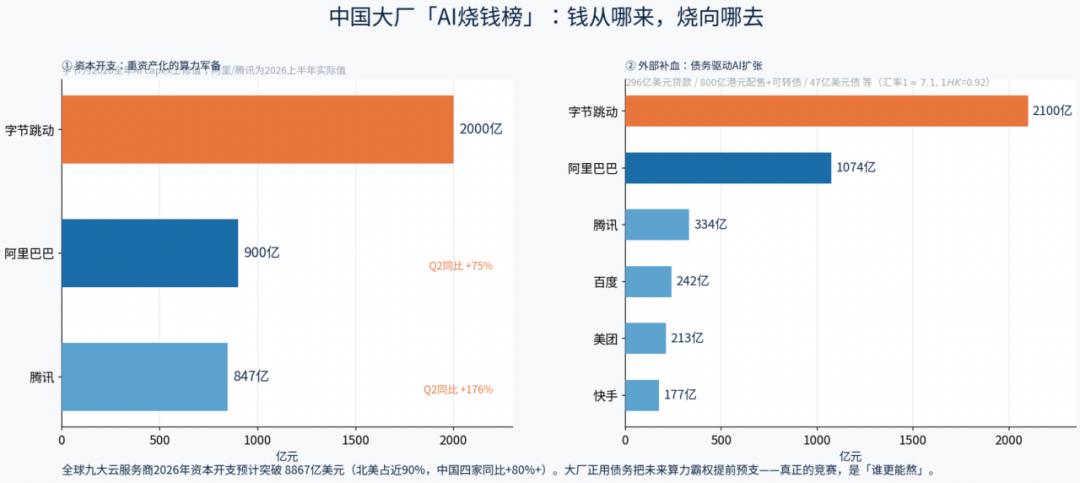
Looking at the global picture, the scale of this "money burning" is staggering. TrendForce predicts that the capital expenditure of the world's nine major cloud service providers (Google, Amazon, Meta, Microsoft, Oracle, plus ByteDance, Tencent, Alibaba, Baidu) will exceed 886.7 billion U.S. dollars in 2026, of which the five North American players account for nearly 90%, and the total of the four Chinese players has surged by more than 80% year-on-year.
But the other side of the bill is the suspense of returns.
Alibaba CEO Wu Yongming gave the public answer that "the payback will be realized within three years, and the payback period is even expected to be shortened to 2.5 years". But the market voted with its feet: Michael Burry, the prototype of *The Big Short*, explicitly turned bearish after Alibaba's placement plan, saying that "unless the stock price is halved, it will no longer be attractive"; after Tencent's financial report was released, Hong Kong stocks opened lower and moved lower on the first post-earnings day.
Globally, OpenAI's revenue in 2025 was 13.07 billion U.S. dollars, but its operating loss was as high as 20.92 billion U.S. dollars — even the top players are suffering huge blood loss.
Meitu provides a counterexample: its capital expenditure in the first half of the year was only 16.26 million yuan, and R&D investment was less than 500 million yuan, but it achieved 18.44 million paying users through AI subscriptions. Not all players have to play the "hundred-billion arms race" game.
This means that the real watershed of the AI competition is not "who starts first", but who can sustain the debt until the revenue is realized.
ByteDance's 29.6 billion U.S. dollar loan has a three-year term and can be extended to five years. For an intelligent computing center of such a magnitude, three years is not long — it bets that the Douyin advertising engine and AI products such as Doubao can grow fast enough to make this loan look "conservative" in hindsight. Tencent's negative free cash flow and Alibaba's profits being eaten up by capital expenditure are essentially different forms of the same bet.
Back to the loan at the beginning. 29.6 billion U.S. dollars, banks are scrambling to offer it, and the spread is suppressed to a historical low — the signal from the market is clear: on the track of AI infrastructure, capital is still willing to pay for the imagination of "future AI tickets".
But the other side of the signal is equally clear: when a top company needs to take on debt to maintain the acceleration of computing power expansion, and when the free cash flow of leading players is under collective pressure, this competition has changed from "who is smarter" to "who can hold on longer".
ByteDance has got the ammunition. Alibaba and Tencent are also replenishing their ammunition. The real problem is never whether the money can be borrowed, but whether the revenue can keep up before the bullets run out.
(Data sources: Yicai, Bloomberg, 21st Century Business Herald, IT Home, TechTimes, TrendForce, financial reports and public disclosures of various companies.)
This article is from the WeChat official account "Xinyan Finance" (ID: tech621), author: Jia Ningyu, published with authorization from 36Kr.