IFA 2026 Frontline | The Involution Reality in the Blue Ocean Track: How Ecovacs Answers the Exam Questions of Globalization and Embodied Intelligence
Author | Huang Nan
Editor | Yuan Silai
At the IFA 2026 exhibition venue in Berlin in 2026, household robots have become a major highlight of Chinese hardware exhibitors. Multiple categories of robots for sweeping and mopping, window cleaning, courtyard lawn mowing, pool maintenance and other scenarios are on centralized display, with covered scenarios extending from indoors to outdoors, from the ground to vertical facades and water surfaces.
The changes in its layout also reflect the evolution trend of the entire household robot industry in recent years, shifting from in-depth breakthroughs in a single category to platform-based competition across full scenarios and multiple product lines.
On September 3 local time, one day before the opening of IFA, Forbes released its industry assessment report, officially naming Ecovacs the world's No.1 household robot brand with a comprehensive score of 8.56 points. This assessment does not only look at market share, it examines a more complete dimension: the depth of global operation, the landing capability of multi-category commercialization, and the technological and channel barriers from the upstream supply chain to the downstream brand end.
Looking at the global overall market, the growth logic of household service robots still holds. Data from IDC reports predicts that China's cleaning robot market will reach nearly 3.4 billion US dollars in 2026, a year-on-year increase of 18%. Among them, Chinese manufacturers account for more than 85% of global shipments, and Chinese hardware companies are deeply dominating this track from supply chain to product definition.
The actual domestic market performance presents a contrast. In the first half of 2026, the domestic sales revenue of sweeping robots fell by 4.0% year-on-year, and sales volume decreased by 4.6% year-on-year.
On one side is the broad long-term incremental space, on the other side is the realistic pressure of short-term market slowdown and rising costs in the domestic market. The penetration rate of sweeping robots in Chinese households is only 5-7%, and the fully educated stock users have become the core of competition.
Against this backdrop, Ecovacs achieved double-digit growth in both revenue and profit in the first half of 2026, with total revenue reaching 10.341 billion yuan, up 19.18% year-on-year; net profit hit 1.248 billion yuan, up 27.40% year-on-year.
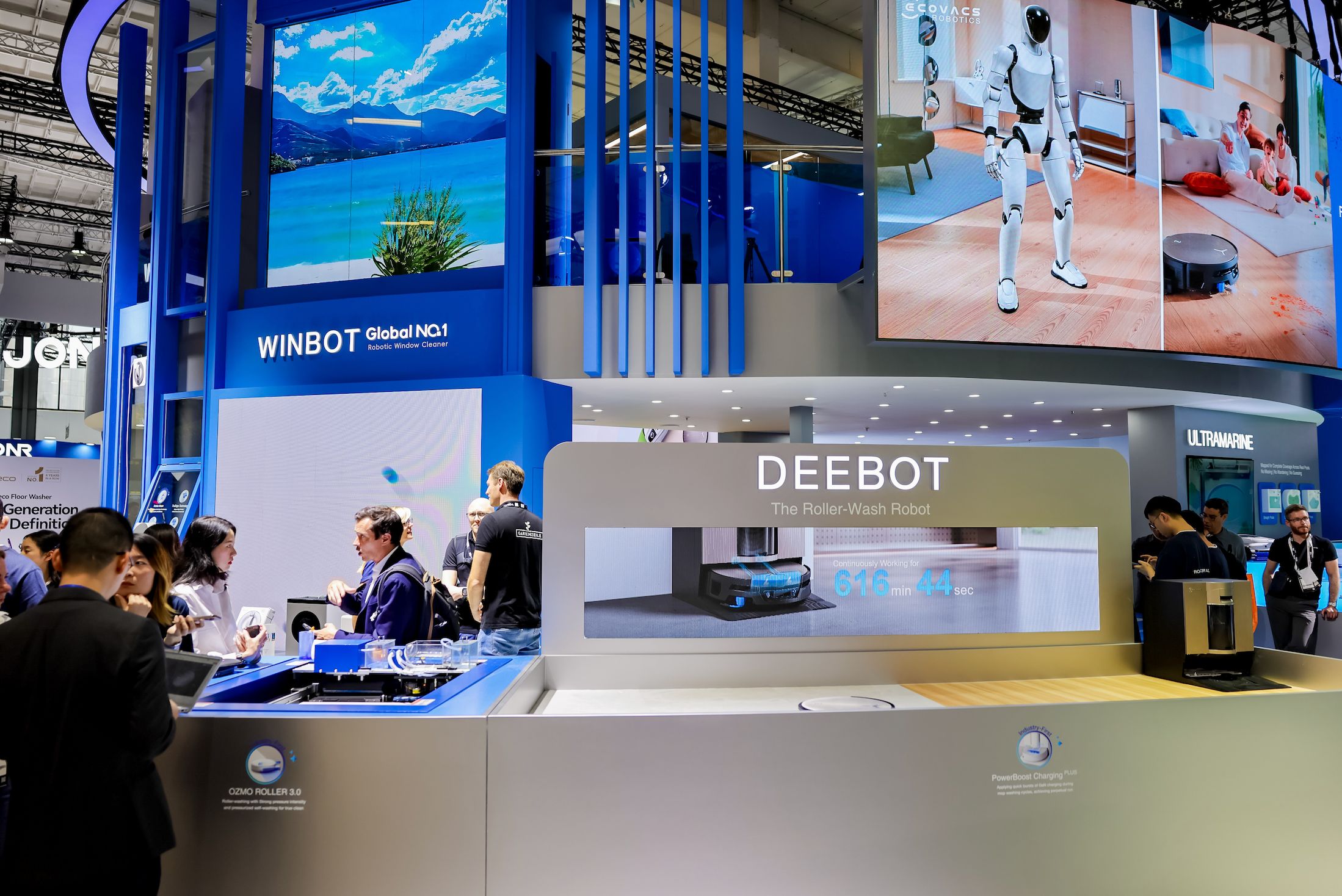
Ecovacs sweeping robot on display at IFA 2026 (Source / Enterprise)
Behind the financial figures, Ecovacs' solutions fall into three interrelated directions: accelerating the layout of business focus in overseas markets, reusing mature technology stacks to expand multi-scenario hardware for households, and building a complete technology base to embrace the era of physical AI.
Overseas business is the core variable supporting Ecovacs' current round of growth. Data shows that Ecovacs' overseas revenue in the first half of the year accounted for 49.0% of the brand's total revenue, and exceeded 51.0% for the first time in the second quarter, marking the first time that overseas revenue surpassed domestic revenue in the nearly 30 years since the brand was founded.
In terms of specific business segments, Ecovacs' main brand overseas revenue rose 46.5% year-on-year, and Tineco's overseas revenue increased 40.6% year-on-year; the overseas growth rate of emerging categories such as window cleaning, lawn mowing and pool robots is particularly prominent, with a year-on-year revenue increase of 75.1%.
The explosion of overseas markets is not a short-term traffic dividend. Real globalization is not just "selling goods out", but the entire system of products, supply chains and services adapting to the global market.
Around 2015, Ecovacs established the idea of product localization, carried out customized adaptation for the residential environment and usage habits of different regions, and formed a set of "3S" technical framework, namely Space (spatial perception), Setting (scene understanding) and Service (service delivery).
Qian Cheng, Vice Chairman of Ecovacs Group and CEO of Ecovacs Robotics, pointed out in his speech at IFA 2026 that the first layer is spatial perception; robots need to have basic perception capabilities, with the help of radar and sensor technology, to measure and map indoor and outdoor environments with centimeter-level and millimeter-level accuracy, which is the premise of all subsequent decisions.
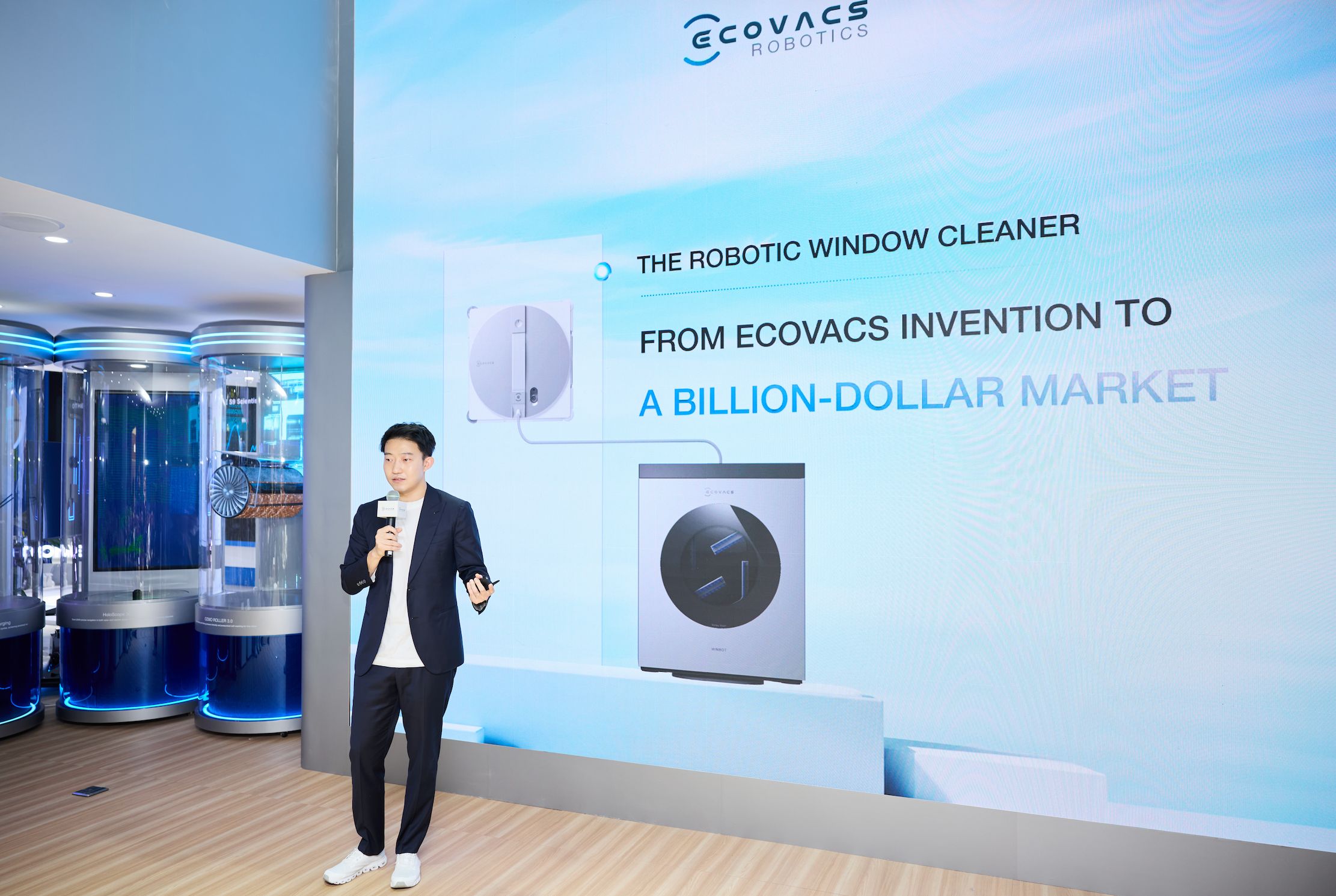
Qian Cheng, Vice Chairman of Ecovacs Group and CEO of Ecovacs Robotics (Source / Enterprise)
The second layer is scene understanding. Indoor and outdoor, kitchen and bedroom, families with or without pets, different spaces have completely different task requirements for robots. When AI identifies stains on the floor or pets in the home, the sweeping robot will automatically adjust the cleaning strategy, increase suction or switch the cleaning mode. Scene perception capability enables robots to evolve from "executing instructions" to "understanding the environment", and independently adjust behaviors according to environmental changes.
The third layer is service delivery. The cognition of space and scenarios is not limited to indoors. Outdoor lawns vary greatly in different regions, for example, grass species in southern Europe are different from those in northern Europe, and lawn maintenance habits in the United States and Australia also have their own characteristics; the shape, material and layout of swimming pools are also very different. Only by deeply understanding the specific differences of these segmented scenarios can we provide truly adapted products and services for different markets.
Globalization opens up external growth space, while the multi-category layout driven by homologous technology taps the incremental value inside the home.
Ecovacs' category expansion is not illogical cross-border. The perception, navigation, obstacle avoidance and motion control capabilities accumulated over ten years of iteration of sweeping robots are being systematically reused in more household tasks.
Winbot is the first category that has achieved success under this reuse logic. The obstacle avoidance algorithm of the sweeping robot that identifies obstacles on the ground is migrated to the vertical scene to identify window frames, handles and glass edges; the obstacle-surmounting power for carpets and thresholds is reused as the control basis for Winbot to climb slopes and cross window frames. This migration supports Winbot to rank first in the global market for three consecutive years, capturing 65% of the market share, with sales volume exceeding 1 million units in 2025, and it has become a million-level independent category in the first half of 2026.
Similarly, the lawn mowing robot GOAT migrates the navigation and obstacle avoidance capabilities in complex indoor home environments to open courtyards, extending from identifying ground data cables and pet feces to identifying trees, flower beds and outdoor furniture; the SLAM algorithm is upgraded from indoor 2D maps to 3D courtyard modeling. The pool robot ULTRAMARINE migrates the path planning algorithm from the pool water surface to the underwater environment, and the obstacle avoidance logic is reused from Winbot's recognition experience of special-shaped structures on vertical surfaces.
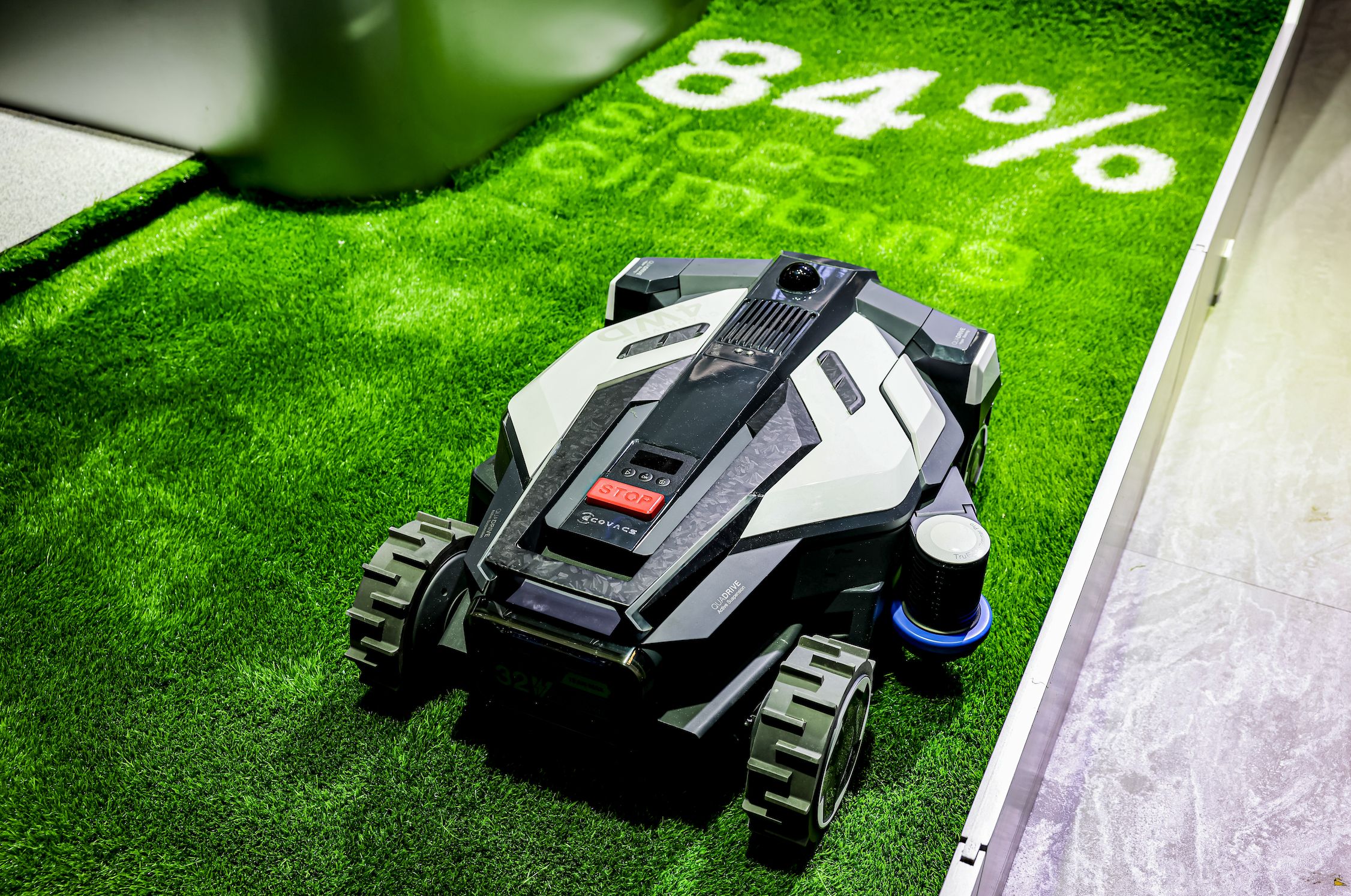
Ecovacs lawn mowing robot GOAT (Source / Enterprise)
Three new categories share the same technology base. From the ground to vertical facades, courtyards and swimming pools, what Ecovacs has completed is the horizontal migration of technical capabilities, not blind category stacking.
But the imagination space of household robots is far more than tools, and the implementation of embodied intelligence is rewriting the boundary of people's imagination.
Ecovacs is testing its self-developed "world model" based on service robots. The large model acts as the communication interface for human-computer interaction, with the help of human prior knowledge and language guidance, assists robots to complete actions in the physical world, and prioritizes the realization of implementable product forms.
On this basis, the company has also launched the bionic companion robot "Furry" and the open-source embodied robot platform "Eight Realms", accelerating the extension from deterministic household chores tools to the cutting-edge exploration of human-computer interaction and embodied intelligence.
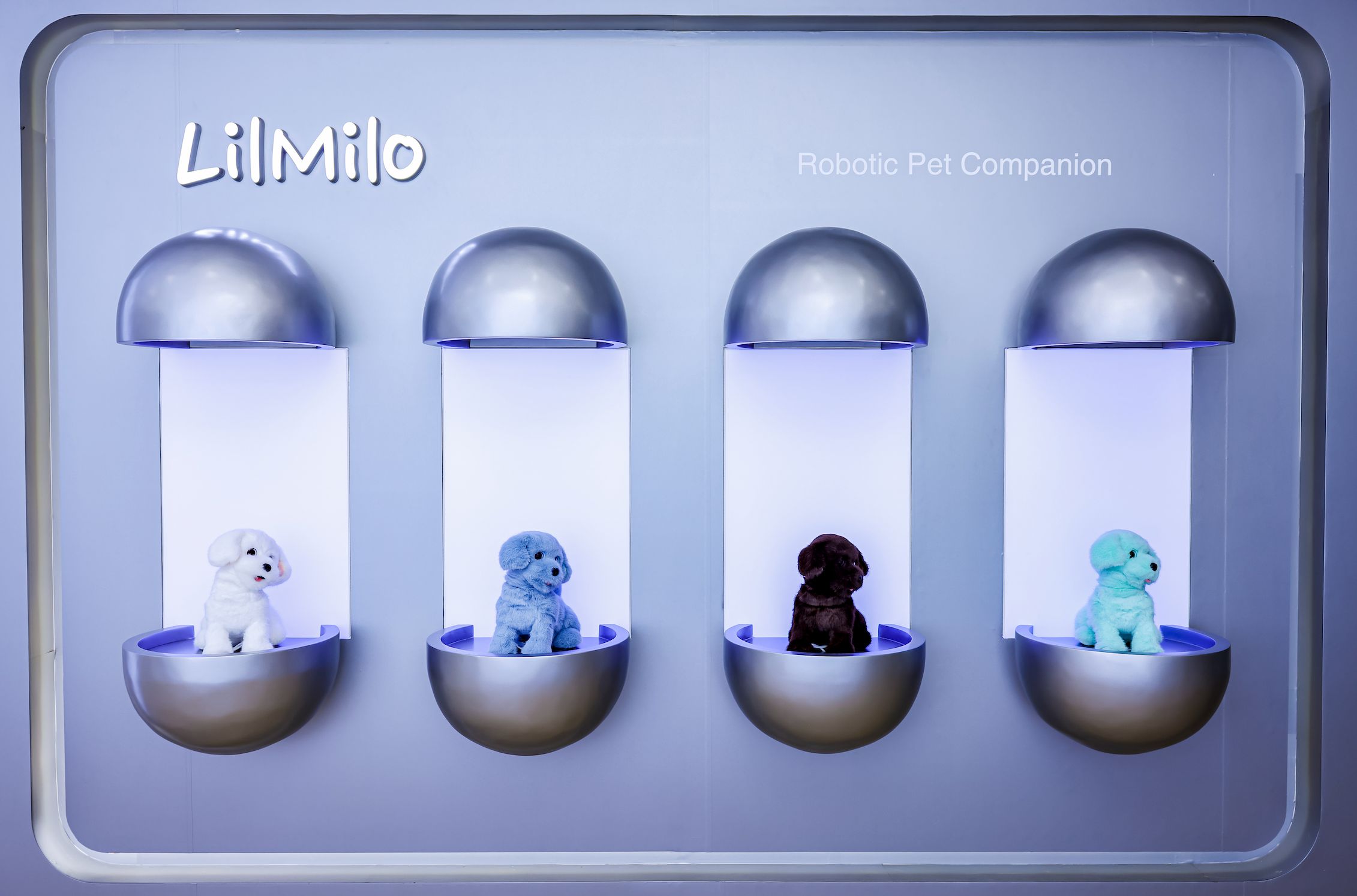
Ecovacs bionic companion robot "Furry" (Source / Enterprise)
Today, Forbes' industry rating and Chinese manufacturers occupying the top ranks of global sweeping robot sales mark that the domestic household robot industry has completed the identity transition from a follower to an industry definer. But defining the track does not mean solving all problems.
Industry competition is shifting from the parameter comparison of single hardware to the all-round competition of multi-scenario robot experience, and further extending to the deep competition of AI physical execution capability. The implementation cycle of this track is far longer than the market imagines.
Back to the IFA 2026 site. The window cleaning robot climbs quietly along the glass facade, the lawn mowing robot automatically plans the path in the simulated courtyard, and the pool robot dives into the water to clean the wall. These robots of different forms are displayed side by side, outlining Ecovacs' understanding of "home": not only the ground, vertical facades, courtyards, swimming pools and even future companion spaces should be covered by robots.
Through continuous understanding of space and scenarios, the vision of "letting robots serve everyone" is broken down into specific categories and then delivered to the daily life of different families around the world. This is not a sprint, but a long-distance race with no end point.
For companies that have been marching in the industry for more than 20 years, maintaining patience in uncertainty and continuous investment in the long cycle is the norm of this business itself.