The world's most successful AI hardware company has gone public, selling 3.6 million AI rings in one year, with 32% of its gross profit derived from subscriptions.
In the early hours of this morning, AI ring company Oura released its prospectus.
This is likely the most successful AI hardware company to date. Over the 12 months ending June 30, 2026, the company sold a total of 3.6 million Oura Rings, which averages out to nearly 10,000 units sold per day.
Revenue growth is also extremely rapid. In fiscal 2024, the company's revenue was only 407 million US dollars. In the nine months ending June 2026, the company's revenue further reached 1.215 billion US dollars, a year-on-year increase of 74%.
What deserves more attention than revenue growth is that Oura is validating a new AI hardware business model: Hardware + Subscription.
At present, most of Oura's revenue still comes from ring sales, but the fastest-growing segment is already membership subscriptions.
In the first nine months of fiscal 2026, membership revenue reached 240.5 million US dollars, up 121% year-on-year, and its revenue share rose from 16% to 20%.
More importantly, as the gross margin of the membership business is as high as 89%, although it only accounts for 20% of total revenue, it contributes about 32% of the company's total gross profit.
This means that AI hardware may no longer be a business that can only make money by selling devices.
This makes Oura look less and less like a traditional hardware company. In the first nine months of fiscal 2026, the company's overall gross margin rose to 55% from 51% in the same period last year, and net profit increased from 1.6 million US dollars to 60.8 million US dollars.
Today, we are going to talk about Oura, and the AI hardware business behind it.
A ring worn 23 hours a day that turns into a "body monitor"
What Oura does is actually very simple: health monitoring.
Different from most wrist-worn wearable devices, Oura places its sensors on the finger.
According to the prospectus, fingers have richer blood vessels, which can capture PPG, namely photoplethysmography signals, that are 100 times stronger than those obtained from the wrist.
With stronger signals, data such as heart rate, heart rate variability, and respiration can be measured more accurately.
Oura disclosed that its accuracy rates for heart rate, heart rate variability, ovulation tracking and sleep monitoring are approximately 99%, 98%, 96% and 96% respectively.
87% of members stated that accuracy is an important reason for them to buy Oura. It is worth noting that monitoring accuracy is particularly important for athletes or fitness enthusiasts who focus on the precision of health data.
Apart from measurement accuracy, Oura also has to solve another very practical problem: how to get users to wear the device for as long as possible.
In terms of product design, Oura has always emphasized one thing: try to let users forget that they are wearing a smart device.
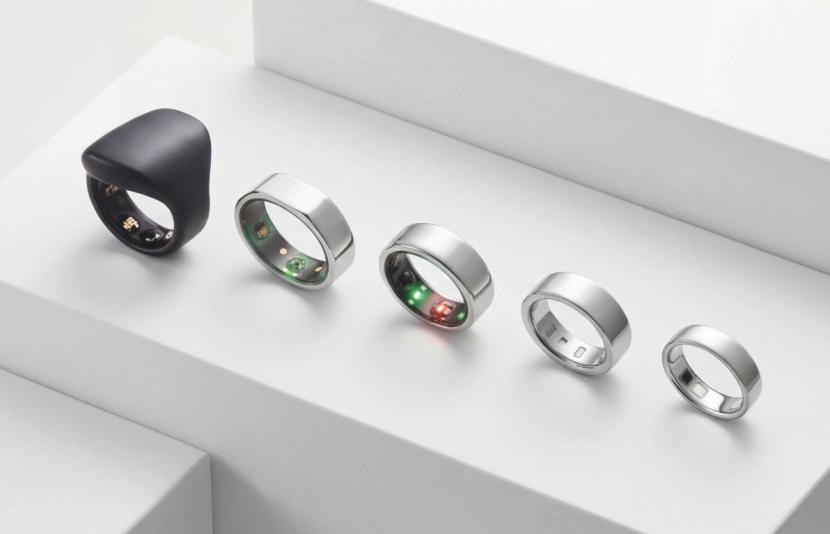
The core value lies in lightweight design. The latest Oura Ring 5 still adopts a screen-free design and a full titanium metal body. Its volume is 40% smaller than the previous generation, with a minimum weight of only 2 grams, and a single charge usually supports 6-9 days of use.
Compared with the usage habit of Apple Watch which needs charging almost once a day, the ring is obviously more suitable for long-time wearing, especially during sleep.
This design is finally directly reflected in the wearing duration. In the third quarter of fiscal 2026, Oura's paying members wore the ring for about 23 hours per day on average.
That means, except for the time when the ring is charging or taken off occasionally, Oura is almost always recording the user's physical state.
Since its establishment in 2013, Oura has accumulated nearly 42 billion hours of longitudinal biometric data, including heart rate, heart rate variability, respiratory rate, body temperature, sleep stages, menstrual cycle and activity status.
With this layer of data, AI can truly start to exert its value.
At present, Oura's intelligent system is roughly divided into three layers.
The first layer, is the foundational health model trained with more than ten years of real biometric data.
Different from general large models that are mainly trained on internet text, the training goal of Oura's foundational model is to learn how human physiological signals change, how different signals interact with each other, and when users start to deviate from their normal state.
The second layer, is the domain model for specific health scenarios.
At present, Oura has covered directions such as sleep, heart health, stress, metabolism and women's health.
Among them, women's health is likely to be Oura's most important vertical field. As of June 2026, 72% of Oura's members are women. Focusing on female users, the company has developed features for menstrual cycle tracking, ovulation prediction, pregnancy preparation and pregnancy analysis, as well as exclusive AI Advisor for issues related to menstruation, fertility, pregnancy and menopause.
For example, "Fertility Window" can predict ovulation and conception time, and "Symptom Radar" can detect signs of physiological stress in advance according to changes in physical signals.
To a certain extent, Oura has expanded from a sleep ring to an all-life-cycle health entry point for women.
The third layer, is the Oura Advisor that users can truly perceive.
Oura Advisor can be understood as a professional AI health assistant. Users do not need to study indicators such as heart rate, body temperature and sleep by themselves. They can directly ask why they slept poorly recently or how their recovery is going, and the Advisor will give explanations combined with the data of the past period of time.
While conducting health monitoring, the next step is to further expand into the medical field.
Oura has cooperated with medical and health companies such as Essence Healthcare, Maven Clinic, LillyDirect, Dexcom and ResMed.
For example, the company has connected blood glucose data with Dexcom; cooperated with ResMed to provide further sleep assessment paths for users with nighttime breathing problems; through Counsel Health, users can even get AI health navigation in the Oura App, and connect with licensed doctors when needed.
If this path can be realized, Oura will not only sell a smart ring. What it really holds that is valuable will be long-term health data, AI analysis capabilities, and the entry point connecting medical services.
3.6 million rings sold in a year, with 1.2 billion US dollars in revenue in nine months
From the perspective of financial data, Oura's growth rate in the past two years is very staggering.
In fiscal 2024, the company's revenue was only 407 million US dollars. In fiscal 2025, the revenue directly increased to 908 million US dollars, a year-on-year increase of 123%. In the nine months ending June 2026, the company's revenue further reached 1.215 billion US dollars, a year-on-year increase of 74%.
Behind the revenue explosion, the most direct reason is that the rings have achieved explosive sales.
Over the 12 months ending June 30, 2026, Oura sold a total of 3.6 million smart rings, which averages out to nearly 10,000 units sold per day.
And this is far from a particularly high market penetration. According to Oura's own estimation, the company's current sales volume only accounts for about 2% of the global wearable device market.
At present, the company's business is mainly divided into two parts: ring sales and membership sales.
In the first nine months of fiscal 2026, the average revenue per Oura Ring was about 311 US dollars. The membership subscription price in the US is 5.99 US dollars per month, or 69.99 US dollars per year, and about 63% of new members choose the annual payment plan.
From the perspective of revenue structure, hardware is still the main source of revenue for the company.
In the first nine months of fiscal 2026, the company's hardware revenue reached 974 million US dollars, up 65% year-on-year, accounting for 80% of total revenue; in the same period, membership revenue reached 240.5 million US dollars, up 121% year-on-year, and its share has increased to 20% from 16% in the same period of the previous year.
That means, Oura is still a company that takes hardware as its main source of revenue, but the fastest-growing business has become membership subscription.
The logic of this model is easy to understand: users first buy a ring worth hundreds of US dollars to get continuous health data monitoring; then the company allows users to continue subscribing to the service through functions such as sleep analysis, health insights and AI assistant in the App.
As users wear the ring for a long time, the hardware will continuously generate new health data, which in turn will enhance the value of membership services. This is why Oura's membership scale is also growing rapidly while expanding ring sales.
As of December 31, 2024, Oura only had 1.5 million paying members; by June 30, 2026, this number has grown to 5 million, an increase of 3.5 million in a year and a half.
What is even more staggering is that Oura's paying members have maintained a year-on-year growth rate of over 100% for 7 consecutive quarters.
Moreover, the quality of this part of revenue is very high.
The prospectus reveals that the gross margin of Oura's membership business is as high as 89%.
Calculated based on the data in the prospectus, in the first nine months of fiscal 2026, the company's overall gross margin was 55%, corresponding to a gross profit of about 668 million US dollars, of which membership revenue contributed about 214 million US dollars in gross profit, accounting for as high as 32%.
This hardware + subscription model has made Oura have considerable profitability. In the first nine months of fiscal 2026, the company's gross margin rose to 55% from 51% in the same period last year; net profit increased from 1.6 million US dollars to 60.8 million US dollars.
What supports the continuous operation of this model is user stickiness.
As of June 2026, the weighted average retention rate of Oura's paying members in the past 12 months is about 85%; DAU/MAU is about 65%, and users open the Oura App more than 3.5 times per day on average.
Therefore, Oura's business can be understood very simply: first sell 3.6 million rings a year, and then overlay a layer of subscription revenue with 89% gross margin on the basis of these rings.
Summary
Oura's prospectus also reveals an important change that is taking place in the AI hardware sector.
Compared with the past when companies only made money by selling hardware, the revenue share of software services in the new generation of AI hardware has increased significantly. Some AI hardware companies even achieve gross margins comparable to software companies relying on subscription services.
(For details, please refer to the article "The Profit Logic of AI Hardware Has Changed! Making Money from Subscriptions Instead of Hardware, with Gross Margin Comparable to Software Companies" written by Silicon-based Jun before.)
In addition to the Oura smart ring, we can also see similar trends in the AI voice recorder Plaud Note and the smart pet tracker Tractive.
So why can subscription services be successfully implemented in the AI hardware field? In the view of Silicon-based Jun, a very important change is that the high-quality data provided by sensors, combined with the powerful information processing capability of AI, makes customized software services possible.
The sensors of AI hardware can be understood as extensions of human organs. Sensors such as microphones, speakers and cameras can capture data from human mouths, ears and eyes, and then collect data related to human beings. Theoretically, as long as the user's data accumulates enough, AI hardware can even become a personal data center.
At the same time, AI itself has powerful information processing capabilities. With the increase of input data volume, AI hardware can improve products accordingly, realize more in-depth and complex functions, and thus make it easier to implement the subscription-based business model. Meanwhile, this feature of relying on continuous data iteration also greatly improves the user stickiness of AI hardware.
From this perspective, the value of AI hardware is not only the migration of computing centers, but also brings the integration of software and hardware to a new height, thus creating opportunities for the emergence of new business forms.
This article is from the WeChat official account "Silicon-based Observation Pro", author: Silicon-based Jun, published with authorization from 36Kr.