It turns out that people who make money just by sleeping can earn such a huge sum of income.
I used to think that sleep was the lowest-threshold consumption activity in the world.
But it turns out that's not the case at all.
Some people buy pillows worth thousands of yuan, some sleep wearing smart rings, some study blackout curtains, white noise, aromatherapy and sleep headphones, and others spend tens of thousands of yuan on a bed that adjusts its temperature automatically.
This is a rather peculiar thing for this generation: we are getting worse at sleeping, and more willing to spend money to "sleep a little better".
This trend is fostering a huge industry. According to the 2025 China Sleep Health Survey Report released by the Chinese Sleep Research Society, the rate of sleep distress among people aged 18 and above in China has reached 48.5%.
Nearly one in two people does not sleep well. Meanwhile, data from iiMedia Research shows that the market size of China's sleep economy has reached 573.72 billion yuan in 2025, and is expected to hit 790.43 billion yuan by 2030.
In 2016, this figure was only 261.63 billion yuan.
It has more than doubled in less than a decade.
So sometimes we have to admire those who are good at tapping business opportunities:
When one person cannot fall asleep, it is a personal suffering.
When hundreds of millions of people cannot fall asleep, it becomes an industry.
But if the sleep economy only means selling more pillows, eye masks and mattresses, this industry is not worth our special discussion today. The really interesting part comes next: AI is stepping into the sleep-related industry.
Previously you were sold a pillow, now the industry wants to take charge of your whole night
The sleep economy in the past is very easy to understand.
If you are afraid of light, there are eye masks.
If you are afraid of noise, there are earplugs.
If your neck hurts, you change a pillow.
If your waist hurts, you change a mattress.
If you cannot fall asleep, there are white noise and sleep-aid apps for you.
The essence of this business model is:
You find the problem first, and the product helps you solve one problem afterwards.
But after the emergence of sensors, wearable devices and AI, the logic has begun to change.
Current products are no longer satisfied with: "Making you lie comfortably."
They are trying to figure out:
What time do you actually fall asleep?
What time do you enter deep sleep?
How many times do you wake up in the middle of the night?
How many times do you turn over?
What is your heart rate?
Has your HRV changed?
Is there any abnormality in your breathing?
Why do you sleep worse today than yesterday?
This is also why the sleep economy is gradually transforming from a traditional consumer industry to smart hardware + sensors + AI + health data.
There is even a job position that sounds a little cyberpunk in the past: "Multimodal Sleep Large Model Engineer".
The Artificial Intelligence and Robotics Innovation Center of the Hong Kong Institute of Innovation, Chinese Academy of Sciences is currently recruiting for this position.
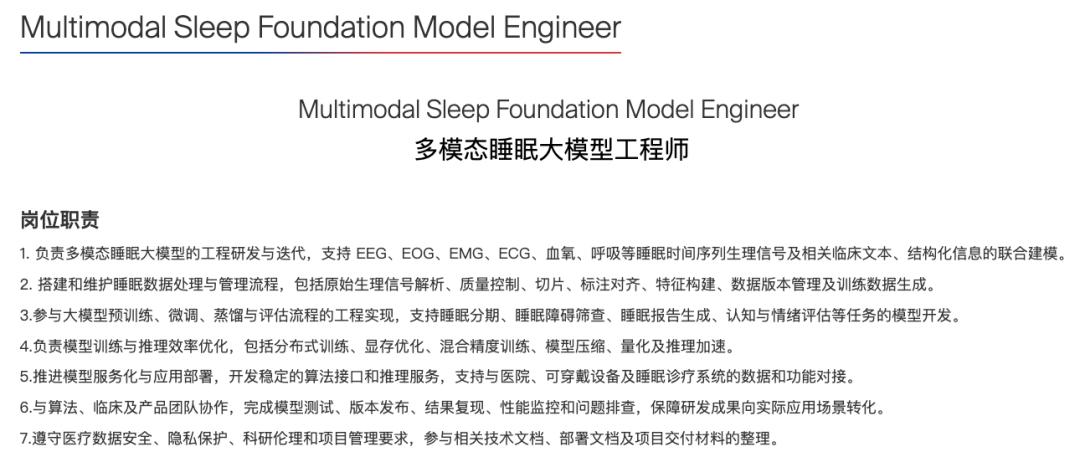
What exactly does this position do?
It is not to let AI tell you bedtime stories. Instead, the model is required to simultaneously interpret human body signals such as EEG, EOG, EMG, ECG, blood oxygen and respiration, combined with clinical texts, to make AI complete sleep staging, sleep disorder screening and sleep report generation.
Eventually, the model will even be connected to hospitals, wearable devices and sleep diagnosis and treatment systems.
The sleep business is becoming more and more "technology-driven"
The most authentic changes of an industry are all written in recruitment information, such as the Senior Health Algorithm Engineer position recruited by OPPO this year.
The job responsibilities clearly include sleep detection, heart rate, electrocardiogram and blood oxygen, requiring the candidate to process human body signals collected by sensors such as IMU, PPG and ECG, and master machine learning and deep learning.
Another Health Algorithm Engineer position is more straightforward: in addition to sleep detection and snoring detection, the position also requires participation in product exploration such as AI health assistants and health care robots.
Even positions like Biomedical Engineer have begun to require competencies related to sleep health, digital healthcare, clinical research and AI health at the same time.
Looking at foreign markets, the machine learning engineer position currently recruited by sleep technology company Eight Sleep has its direction clearly marked as: Foundation Models & Personalization.
The position requires work on personalized prediction, behavior understanding, LLM, RAG, multimodal modeling, and a very interesting concept:
Sleep Intelligence.
What it wants to achieve is no longer simply telling you:
You had 56 minutes of deep sleep last night.
Instead, based on long-term data of sleep, environment and living habits, it continues to answer: "What should we do for you next?"
Putting all these positions together, you will find a very interesting thing: The sleep economy is not simply "recruiting a few more AI engineers".
Around the goal of "making people sleep better", the talent portfolio required is being reshuffled.
Algorithm professionals are involved.
Sensor professionals are involved.
AI professionals are involved.
Medical professionals are involved.
Even clinical research professionals are involved.
People who used to work in completely different industries are now collaborating on the same product. This is the change that job seekers should really notice.
So don't just search for "sleep industry"
Because if you really search for "sleep economy" on recruitment platforms, you will most likely not find many exciting opportunities.
The real new opportunities are scattered in completely different fields instead.
For example: smart wearables, digital health, AI healthcare, smart hardware, biosensors, wearable medical devices, health large models.
Therefore, if you really want to enter this track, job seekers can focus on four types of positions.
Category 1: Positions related to sensors and smart hardware
This is the most fundamental part of sleep technology. No matter how powerful the subsequent AI is, the first step is to collect the physical state of the human body.
For example, these data may come from watches, rings, headphones, mattresses, and even other sensing devices at home in the future.
So this direction needs: sensor engineers, embedded engineers, smart hardware engineers, biomedical engineers.
If you are already working in industries such as consumer electronics, wearable devices, medical devices, and IoT, your existing competencies can be easily transferred to the sleep technology field.
Category 2: Sleep algorithm, health algorithm and AI positions
After the data is collected, the next question is: What do these data actually mean?
For example, when a watch monitors changes in your heart rate, turning over times and blood oxygen fluctuations, how to determine when you fall asleep? How to distinguish deep sleep from light sleep? How to identify abnormal breathing? How to judge that a person's sleep state is changing based on long-term data?
This is the problem to be solved by sleep algorithms, health algorithms and physiological signal algorithms.
Going one step further, we now already have: multimodal sleep large model, health large model, time series model.
Therefore, positions worth paying attention to in this direction include: Sleep Algorithm Engineer, Health Algorithm Engineer, Physiological Signal Algorithm Engineer, Machine Learning Engineer, Multimodal Large Model Engineer.
There is also an obvious AI trend behind it: In the past, large models mainly understood text, images and videos.
Now, it begins to learn to understand data from the real human body such as heart rate, EEG, respiration and blood oxygen.
Category 3: Clinical research, algorithm validation and health data positions
This type of position is very easy to be ignored, but it may become more and more important in the future.
Because there is a big difference between sleep technology and ordinary consumer Internet: it provides health judgments.
If an app tells you: "You may like this pair of shoes", it doesn't matter if it guesses wrong.
But if a device tells you: "There is an abnormality in your sleep", the situation is completely different.
It must answer:
Is the data accurate?
Is the algorithm judgment accurate?
What is the error compared with the hospital's standard?
After long-term use, does it really improve sleep?
Therefore, this industry will increasingly need professionals in clinical research, health data analysis, algorithm validation, real-world research, and medical device registration and compliance.
This is also an inevitable new type of talent as the sleep economy gradually evolves from ordinary consumer goods to digital health and even medical technology.
Category 4: AI health product and digital health product positions
I think this type of position is especially worthy of attention for people with non-technical backgrounds. Because technology must eventually be turned into something that users can really use.
Algorithms may calculate dozens of indicators: heart rate, HRV, sleep efficiency, deep sleep ratio, respiratory rate, recovery level...
But what users really care about every morning is only a few questions:
Did I sleep well last night?
Why am I so tired today?
How should I adjust my sleep tonight?
Therefore, a good sleep product in the future will not give users more data. Instead, it will turn complex medical, algorithm and health data into a piece of advice that people can understand and are willing to follow.
This is also why this industry will increasingly need positions such as AI Health Product Manager, Digital Health Product Manager, Smart Hardware Product Manager, and Health User Research Specialist.
After all, the talent structure of the sleep economy is becoming more and more cross-disciplinary.
In the past, the industry mainly needed professionals in:
materials, manufacturing, supply chain and channels.
Now a whole new set of capabilities is added:
Smart hardware + algorithm + AI + health data + clinical research + product.
For job seekers, what is really worth paying attention to is not "should I switch to the sleep industry". Instead, you need to think: Can my current competencies be transferred to this track that is being reshaped by AI?
This article is from the WeChat official account "Liepin" (ID: liepinwang), written by JJ, authorized to release by 36Kr.