From 6 million creators to the AI desk: Moma teams up with WorkBuddy to kick off the positioning battle for the "AI voice portal".
Now Vibe Coding has turned "speaking to write code" from a geek toy into a real workflow.
This shift has brought to light a previously overlooked problem: after AI accelerates the production link, a bottleneck emerges at the input end — the keyboard can no longer keep up with the speed of human thinking.
On September 2, Tencent's WorkBuddy Ecosystem Launch Conference announced "in-depth ecological cooperation" with HOLLYLAND, a professional audio and video hardware brand, and officially launched the WorkBuddy co-branded version of the Hollyland LARK A2 wireless microphone. As defined by both parties, this is "the first AI voice entry hardware natively linked to the WorkBuddy intelligent agent".
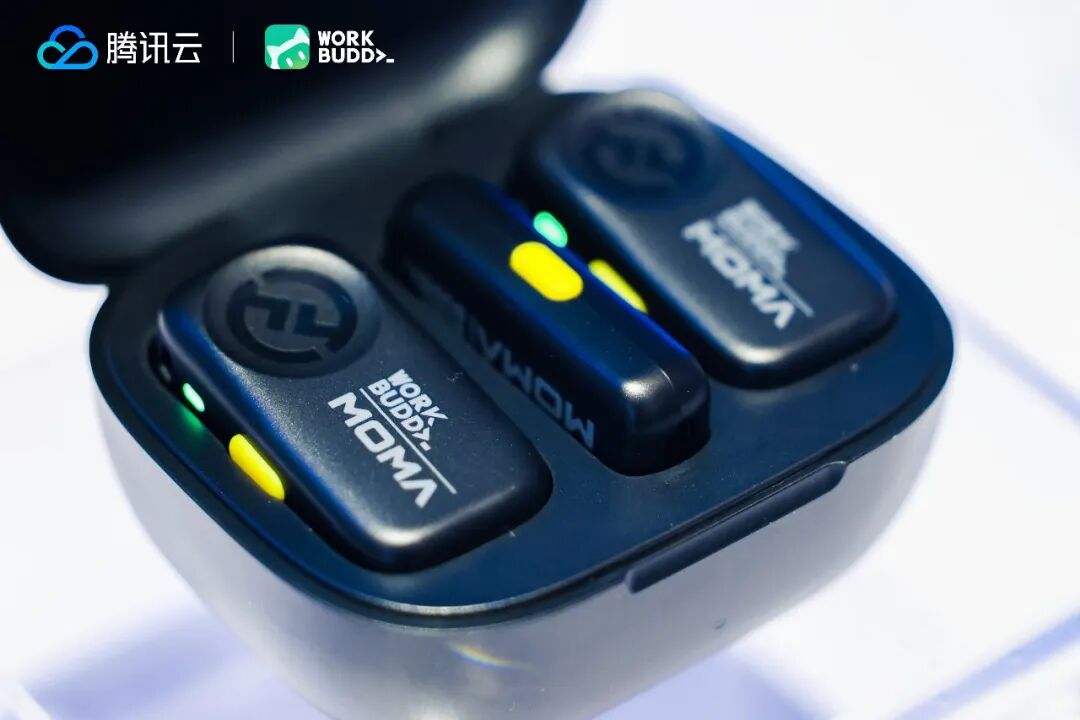
Caption: WorkBuddy co-branded version of Hollyland LARK A2 wireless microphone
Its interactions are simplified into three actions: single tap to wake up voice input, long press to delete content, double tap to send commands. No mouse or keyboard is needed throughout the whole process.
A professional microphone originally designed for Vlog, live streaming and film sound recording has thus crossed the category boundary of creative equipment and become part of the public AI workflow. Behind this is the breakthrough of a hardware manufacturer seeking incremental opportunities in the AI wave, as well as a real sample of an Agent platform looking for hardware entrances for implementation.
01. A microphone breaks out from the film set to the office desk
For a long time in the past, the microphone category was defined in the cognition of "creative equipment", serving Vlog shooting, live streaming, interviews, and film sound recording, all targeting creators.
But this co-branding has torn down this boundary; the people who pushed the wall are not the manufacturer, but the users themselves.
From the end of last year to the beginning of this year, Hollyland noticed a group of "unconventional" users on Xiaohongshu: they assembled Hollyland's microphones, a bracket and a small Bluetooth keyboard as an input kit for Vibe Coding. Searching for "Hollyland Vibe Coding", you can see many self-shared modification posts.
"After users do Vibe Coding for a long time, there will be a pain point that when they need to type long texts, or their thinking is very fast, typing down the content will interrupt their thinking." recalled Cao Xuefeng, Deputy General Manager of Hollyland and head of the audio product line, "Voice is a very good method, which has extremely high efficiency, will not interrupt the user's thinking, and does not have the burden of typing for a long time and thinking for a long time."
This DIY solution works, but it is rough and more expensive: users need to assemble and fix the equipment by themselves, and configure the trigger mode in the software. Essentially, it uses a bunch of external parts to achieve a closed loop that should have been completed by the product.
A group that was not in Hollyland's user portrait before has also surfaced: not short-video creators, but knowledge workers who write code, documents and plans. Their demand points to "speaking clearly".
Cao Xuefeng said that after seeing the clear needs of users, the decision to add AI functions to the next generation of microphones has been made within the company.
The product that landed is LARK A2. This product was launched at the end of July this year, which is a cost-effective model in Hollyland's product line, and its sales performance in the first week of listing is good. "As a professional microphone, it has good sound recording quality, and can also meet the price demand of office workers." Cao Xuefeng said.
On the AI side, Hollyland needed a co-branding partner. They approached WorkBuddy at the end of July. Hollyland's sales volume, cost performance, functions and cooperation degree perfectly matched WorkBuddy, and the cooperation between the two parties was finalized.
The whole August followed. The development cycle was originally expected to be two or three months, but after Hollyland listed it as the top priority and allocated all resources, it was compressed to one month: the two teams checked the user journey item by item to judge which problems could be solved and which could not.
Cao Xuefeng told 36Kr that it is a common shortcoming of traditional lavalier microphones that they can only be recharged when placed back in the charging case. After the company implemented the Vibe Coding working mode, most of the team truly felt that such products can hardly support a full day of Vibe Coding.
To this end, the co-branded version retains and strengthens several capabilities required for AI interaction: 7 hours of voice collaboration with full power, Type-C direct charging and fast charging that supports "5 minutes of charging for 1 hour of battery life". It supports 200-meter transmission in an open unobstructed environment, so that users can continue to dictate when they get up and walk around; it is equipped with MOMA Smart-Sound intelligent dual noise reduction technology, which can effectively suppress keyboard sounds in the office, and environmental noises in cafes and airports.
In addition, it adopts a clip structure instead of a magnetic suction structure, for a simple reason: under high-frequency use, clipping it and going is more convenient than repeatedly removing and pasting the magnetic pad.
On September 2, this microphone appeared on the stage of WorkBuddy's launch conference.
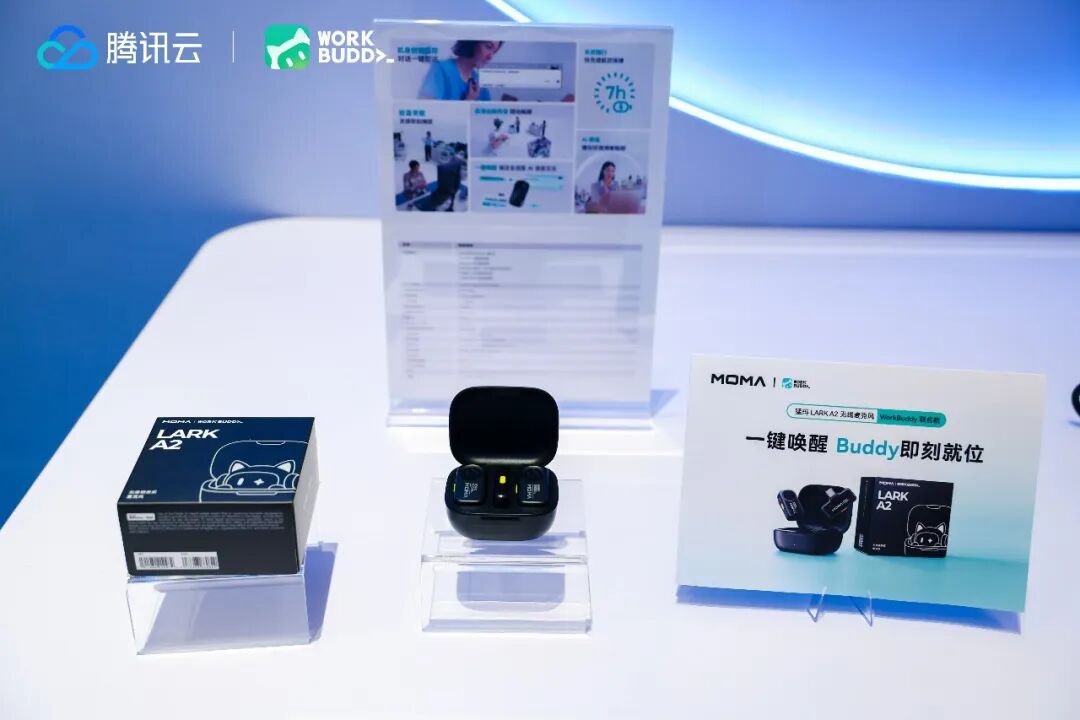
Caption: WorkBuddy co-branded version of Hollyland LARK A2 wireless microphone
02. Between "label sticking" and "deep integration": How does an in-depth ecological cooperation rewrite the rules of hardware co-branding?
To understand the weight of this cooperation, we must first see its definition: in the statements of both parties, this is "in-depth ecological cooperation", not "brand co-branding" or "cross-border marketing".
The insistence on wording points to a tacit situation in the industry: in the past few years, most of the co-branding between hardware and AI has stayed at the level of sticking labels and changing shells, the software is still called, the interaction still relies on keyboard and mouse, and the experience users get has no essential change.
The difference of the LARK A2 co-branded version is that it writes the interaction actions into the hardware layer.
Users take out the microphone, the cover opens and it pairs automatically, and the receiver is directly inserted into the computer; the device remembers the state, automatically switches back to the sound recording mode when connected to the mobile phone, and automatically enters the AI interaction mode when connected to the computer. After that, single tap, long press and double tap correspond to wake up, delete and send respectively. The complex process of "recording, transcribing, copying, opening software, inputting commands" in traditional voice office is simplified to "speaking, understanding, executing".
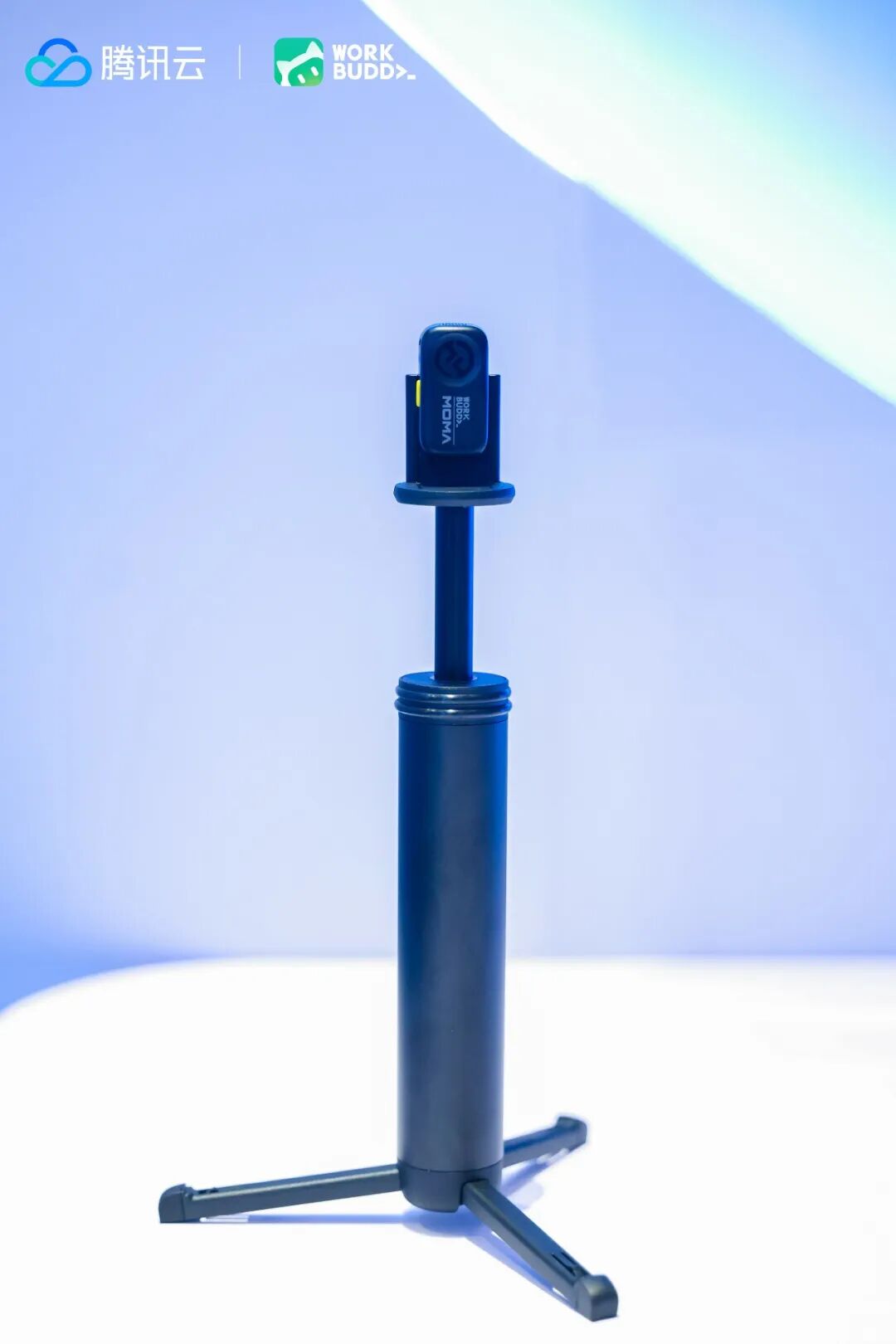
Caption: WorkBuddy co-branded version of Hollyland LARK A2 wireless microphone
At a time when headphones and smart glasses are competing for the "AI entrance", what makes the microphone stand out?
Cao Xuefeng's answer focuses on the sound pickup position. "From the dimension of human speech to final recording, the position under the human chin is the best, and we have done various different comparisons from the technical dimension."
He explained that the speech-to-text capability of all large models depends on the quality of the voice sent from the front end. "If you send a voice with noise or poor transmission quality, the recognition rate may only be 75% or 80%; if the voice I send now can reach 95% or 98% clarity, the final text conversion accuracy will be very high."
The microphone is responsible for the input end, and the sorting and structuring of text is handed over to the large model. The former determines the upper limit of the latter. This is also the basis for Hollyland to insist that microphones are irreplaceable.
This link is hard-won.
According to Cao Xuefeng's recollection, during the cooperation, the two parties found that the initial plan defined the product as two modes: "microphone mode" and "AI interaction mode". Users needed to plug in the computer, open the web page, manually switch modes and then make configurations.
The problem is that the URL of that web page cannot pop up automatically. "This function has high understanding cost and high operation cost." The two parties spent a period of time running in for this.
The essence of the divergence is product positioning. Hollyland's position is that "first it is a microphone, and second it is an AI software"; WorkBuddy believes that since the co-branded function is promoted, it should prioritize AI adaptation.
The final solution is "maximizing user value": the microphone is pre-set with WorkBuddy shortcut keys at the factory, it is automatically recognized for use when plugged into a computer, and users only need to enter the web page to adjust when they have DIY needs. "It is equivalent to that we have worked out a user interaction logic." Cao Xuefeng said.
The underlying logic is complementary capabilities. Hollyland has deep roots in wireless audio and video to solve the problem of "recording sound more accurately"; WorkBuddy undertakes semantic understanding and task processing to solve the problem of "understanding and responding to sound". With the division of labor of "hardware collection + AI processing", both parties get the missing puzzle piece.
In response to the question of overlapping customer groups, Hollyland responded that this is not a stock competition. "This market is basically an incremental market for our original microphone market." Cao Xuefeng said that the group of people using AI office is expanding, and creators, self-media practitioners and knowledge workers are not only the core target users of LARK A2, but also one of the main groups of WorkBuddy.
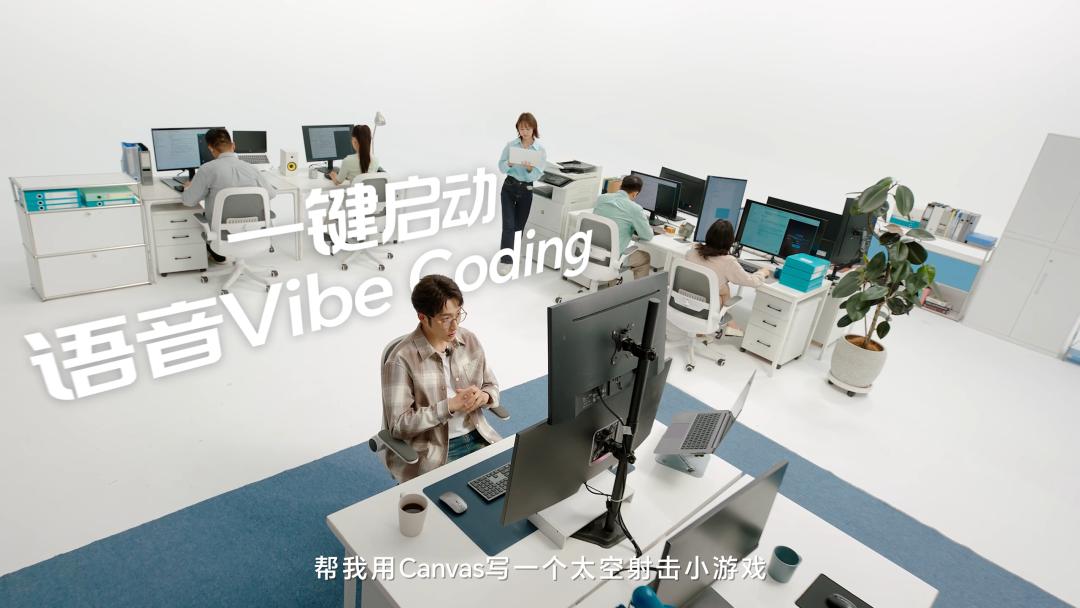
It is worth noting that this entrance is not exclusive. "We have talked with several parties, but at this stage we think WorkBuddy's development speed and its business plan are the most suitable for us." Cao Xuefeng admitted, "As a hardware entrance, theoretically it has no exclusivity."
03. Co-branding is just the prologue: Hollyland's AI strategy and the ambition carried by a microphone
For Hollyland, this microphone is not the end of a marketing co-branding, but the beginning of its AI strategy.
It is clearly positioned as an "initial layout", and the subsequent AI upgrading of product lines and iterative development of multi-category AI ecology will all take this as a starting point.
"It is not a project concept, but the strategic direction of the whole company." Cao Xuefeng said. His judgment standard is the workflow itself.
"Essentially, we still need to see what kind of workflows in users' actual work can be solved by AI. Based on this logic, we will integrate AI capabilities with existing hardware in different products or different scenarios."
The confidence comes from Hollyland's own accumulation: it has been deeply engaged in wireless audio and video for years, its products cover wireless microphones, image transmission, two-way communication, and live streaming cameras, which are exported to more than 160 countries and regions, serving more than 6 million creators, with more than 2000 channel partners and over 17 global service centers.
From the popular form innovation of the integrated storage charging case of LARK 150, to LARK MAX 2 that achieves 25ms no-sense latency end-to-end wireless monitoring, this company has always expanded the market by micro-innovation of product form and experience.
From a larger perspective, this move is also not isolated.
On June 7, Tencent Cloud launched the "Buddy AI Ecological Co-creation Plan". Among the first batch of partners, the hardware category covers scene entrances such as smart glasses, headphones, and microphones. Hollyland's entry is one of the moves in this big chess game of hardware entrances.
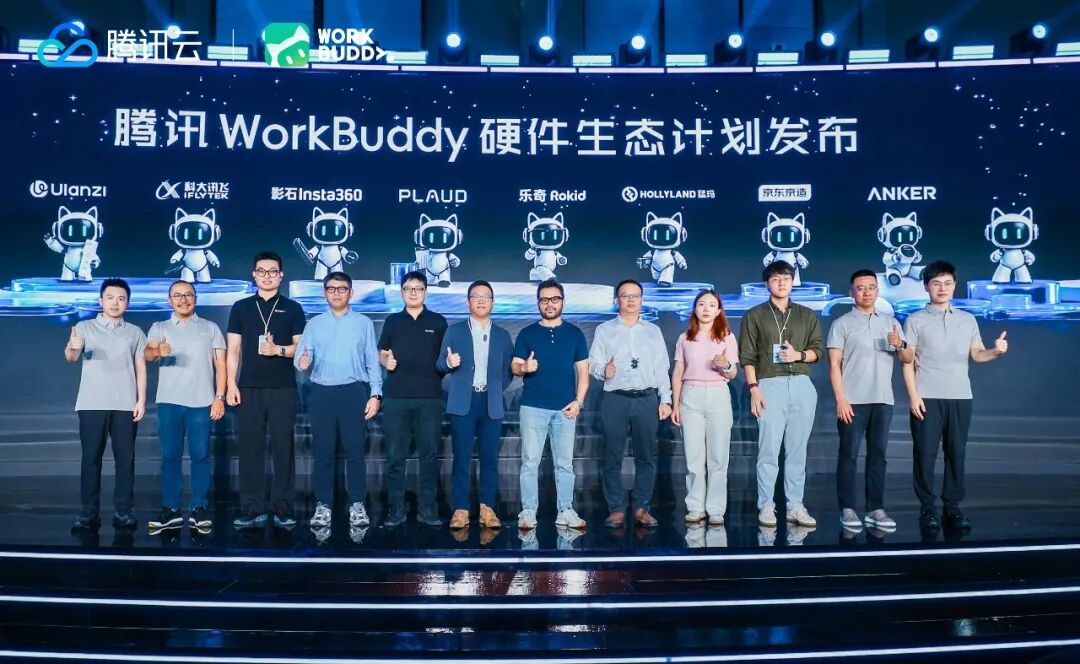
Caption: Hollyland has reached in-depth ecological cooperation with Tencent WorkBuddy
Hollyland's product line also includes wireless image transmission, wireless intercom and live streaming cameras. The combination path of these categories and AI has not been disclosed to the public, but the direction has been written in the strategy: it is not to add an AI function to a certain product, but to break through scenario by scenario.
The expansion of the strategy does not mean rapid volume growth and covering all categories. For this co-branded product with WorkBuddy, Hollyland has chosen a steady implementation rhythm.
A visible prospect is that AI Agents need hardware entrances closer to users to "land and work"; hardware manufacturers need large model capabilities to find AI incremental opportunities. The demands of both sides are connected on this microphone.
At this point, a small hardware has completed its identity leap: when Hollyland integrates professional audio capabilities into WorkBuddy, microphones in the price range of 200 to 300 yuan have the possibility of natively linking AI for the first time.
It is no longer just a tool for passively collecting sound, but becomes the starting point for the Agent to perceive user intentions and receive task instructions.
How far this starting point can go, the answer will be hidden in the new working habit of more and more people "speaking first, then typing on the keyboard".