2026 Semi-Annual Reports of 8 Power Battery Enterprises: Their profits outperform those of complete vehicle manufacturers by a large margin, but their gross profit margins have declined collectively.
Beneath the glossy aggregate data, hidden worries facing power battery enterprises have also clearly emerged.
Recently, domestic listed power battery enterprises have successively released their financial reports for the first half of 2026. Against the backdrop of overall declining sales in the automotive industry and generally lower profits of vehicle manufacturers, power battery enterprises have delivered a completely different report card. According to statistics from *The Economic Observer*, among 8 listed enterprises including CATL, EVE, Sunwoda, Gotion High-Tech, CALB, REPT, POWIN, and Farasis Energy, 7 have achieved revenue growth and 6 have achieved profit growth.
A more intuitive comparison shows that the total accumulated profit of the above 8 power battery enterprises reached 50.846 billion yuan, while the total accumulated profit of 23 mainstream listed vehicle manufacturers in the first half of the year was only 25.1 billion yuan. This means the 8 battery enterprises earned twice the total profit of the 23 vehicle manufacturers, and the average profitability of a single power battery enterprise is more than 6 times that of a vehicle manufacturer. In terms of gross profit margin, the average profit margin of the domestic vehicle manufacturing sector in the first half of 2026 has dropped to 1.5%, hitting a new low in nearly a decade, while the average gross profit margin of the 8 power battery enterprises reached 13.6%, 9 times that of vehicle manufacturers.
Beneath the glossy aggregate data, hidden worries facing power battery enterprises have also clearly emerged, which are mainly manifested in the general decline of gross profit margin, differentiation in the energy storage sector, and intensifying overseas risks.
The gross profit margin trend of power battery enterprises is not optimistic. Among the 8 enterprises, 7 have seen a collective decline in gross profit margin. Among them, POWIN posted the largest decline of 5.4 percentage points; EVE's gross profit margin dropped by more than 3 percentage points; CATL, Gotion High-Tech, Sunwoda and other enterprises also saw declines of varying degrees. Under the pressure of intensifying competition coupled with rising costs, the profit margin of the battery sector has also been squeezed.
The driving effect of energy storage business on performance has further emerged in the first half of 2026, but the differentiation among enterprises is obvious. Among the 8 enterprises, 6 have achieved revenue growth in the energy storage sector with generally high growth rates. The lowest growth rate of EVE is close to 70%, while the highest growth rate of POWIN reaches 799%. However, Gotion High-Tech's energy storage business unexpectedly shrank, with revenue decreasing by 19%, and Farasis Energy has basically not deployed energy storage business. In terms of revenue proportion, REPT has the highest proportion of energy storage business at 62%, making it the only battery enterprise dominated by energy storage business. Sunwoda has the lowest proportion at only 4.6%.
Against the backdrop of the ongoing domestic "price war", going global has also become a path for power battery enterprises to expand their market and improve profitability, just like vehicle manufacturers. In the first half of the year, Farasis Energy has the highest proportion of overseas revenue among power battery enterprises, reaching 63.5%, and it is also the only enterprise dominated by overseas markets; CALB has the lowest proportion at only 4.4%; the rest of the enterprises are basically between 25% and 35%. The overseas gross profit margin of power battery enterprises is generally higher than that in the domestic market. CATL's overseas gross profit margin reaches 29.97%, and the overseas gross profit margins of EVE and Gotion High-Tech are both higher than their overall gross profit margins. However, Farasis Energy, which is highly dependent on overseas markets, has exposed its performance vulnerability affected by export tax rebates and tariff adjustments.
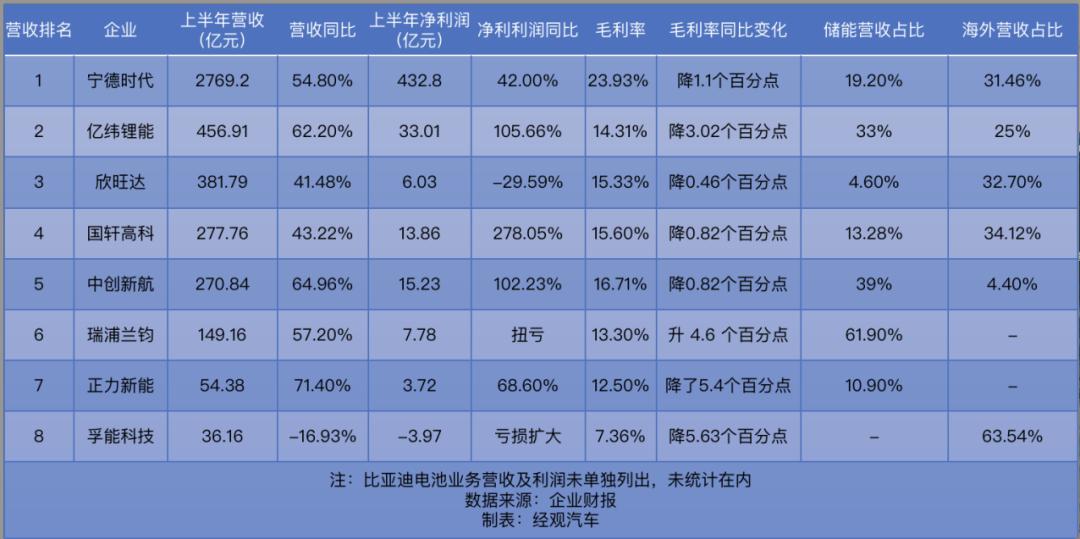
General Growth in Revenue and Profit
CATL undoubtedly ranks first in power battery performance. Its revenue in the first half of the year was 276.92 billion yuan, a year-on-year increase of 54.8%; its net profit attributable to shareholders was 43.28 billion yuan, a year-on-year increase of 42.0%. The profit of a single enterprise accounts for more than 85% of the total profit of the 8 enterprises, with a daily net profit of 119 million yuan. CATL's power battery system revenue was 192.125 billion yuan, a year-on-year increase of 46.02%, accounting for 69.4% of total revenue. Data shows that its installation share in domestic passenger vehicles reached 46.7% in the first half of the year, and the share of ternary power batteries reached 75.2%. The revenue of energy storage battery systems was 53.26 billion yuan, a year-on-year increase of 87.54%, accounting for 19.2% of total revenue, becoming the second growth pole.
However, CATL's gross profit margin declined. Its overall gross profit margin in the first half of the year was 23.93%, down 1.09 percentage points year-on-year. Among them, the gross profit margin of power batteries was 20.63%, down 1.78 percentage points year-on-year; the gross profit margin of energy storage was 23.96%, down 1.56 percentage points year-on-year. It is worth noting that CATL's overseas business performed strongly. Its overseas revenue in the first half of the year was 87.129 billion yuan, a year-on-year increase of 42.35%, with a gross profit margin as high as 29.97%, up 0.95 percentage points year-on-year. In contrast, the gross profit margin of its domestic business was only 21.16%, down 1.78 percentage points year-on-year.
EVE ranks second in the industry in both revenue and profit, but its scale is far from that of CATL. Its total operating revenue in the first half of the year was 45.691 billion yuan, a year-on-year increase of 62.2%, only 16.4% of that of CATL; its net profit attributable to shareholders was 3.301 billion yuan, a year-on-year surge of 105.66%, and the profit was only 7.6% of that of CATL.
In terms of the market, EVE's power battery shipment volume was 35.76GWh, a year-on-year increase of 66.47%, accounting for 37.8% of total revenue. The main reason is the explosion of commercial vehicle battery business, with commercial vehicle installation volume reaching 11.34GWh, ranking second in China, but its domestic passenger vehicle installation volume was only 5.46GWh, not in the top ten. EVE's energy storage battery shipment volume was 44.46GWh, a year-on-year increase of 54.88%, accounting for 25% of total revenue. However, in terms of gross profit margin, EVE's overall gross profit margin dropped by 3.02 percentage points to 14.31%, ranking last among leading power battery enterprises. Among them, the gross profit margin of power batteries dropped to 16.19%, and the gross profit margin of energy storage batteries was as low as 12.51%, down 1.36 percentage points year-on-year.
Gotion High-Tech is the enterprise with the fastest profit growth in the first half of this year. Its revenue in the first half of the year was 27.776 billion yuan, a year-on-year increase of 43.22%; its net profit was 1.386 billion yuan, a year-on-year surge of 278.05%. Power batteries are still the largest source of revenue for Gotion High-Tech, with revenue reaching 22.597 billion yuan, a year-on-year increase of 61.01%, and the proportion increased from 72.37% to 81.36%. In the first half of the year, Gotion High-Tech's domestic power battery installation volume reached 20.75GWh, with a market share of 6.2%, entering the top three in China for the first time. However, the gross profit margin of this business is only 14.02%, down 0.22 percentage points year-on-year, which is the lowest gross profit margin among all business segments.
It is worth noting that, unlike a large number of power battery manufacturers whose energy storage business is advancing by leaps and bounds, Gotion High-Tech's energy storage business has shrunk. In the first half of the year, its energy storage revenue was 3.689 billion yuan, a year-on-year decrease of 19.14%, and the proportion dropped from 23.52% to 13.28%, while the industry's energy storage shipment volume increased by 97.5% year-on-year in the same period. Gotion High-Tech did not give a clear explanation in the financial report. In the first half of the year, Gotion High-Tech's overall gross profit margin was 15.6%, down 0.82 percentage points year-on-year, among which the gross profit margin of energy storage was 19.5%, a slight increase of 0.15 percentage points year-on-year.
CALB's profit growth rate is also eye-catching. Its revenue in the first half of the year was 27.084 billion yuan, a year-on-year increase of 65.0%; its net profit was 1.523 billion yuan, a year-on-year increase of 102.2%. CALB said that the substantial increase in profit benefited from the expansion of new customers and new scenarios and the continuous increase in sales of new products. In terms of revenue structure, power battery sales revenue was 16.506 billion yuan, accounting for 60.9% of total revenue, a year-on-year increase of 54.8%; energy storage system products and other revenue was 10.579 billion yuan, accounting for 39.1%, a year-on-year increase of 83.8%. The growth rate of energy storage batteries is significantly faster than that of power batteries. However, CALB was exposed to battery quality problems in July this year, which may affect its subsequent performance.
Second and Third Tier Battery Manufacturers Seek Breakthrough
If CATL and BYD (whose battery business revenue and profit are not listed separately and not counted in this paper) are the first-tier enterprises in the power battery sector, EVE, Gotion High-Tech and CALB are in the second tier. The remaining several enterprises (Sunwoda, REPT, POWIN, Farasis Energy) belong to the third camp of power batteries, and the net profit of these enterprises in the first half of the year is all below 1 billion yuan. For enterprises in the second and third camps, the most important challenge is how to survive in the increasingly stable "duopoly" pattern.
Among them, Sunwoda's operating revenue in the first half of the year was 38.179 billion yuan, a year-on-year increase of 41.48%; its net profit was about 603 million yuan, a year-on-year decrease of 29.59%. Its gross profit margin was 15.33%, down 0.46 percentage points, which is a typical "revenue growth without profit growth".
From the perspective of business segments, Sunwoda's power battery sector achieved revenue of 14.134 billion yuan in the first half of the year, with a year-on-year increase of 85.87%, accounting for 37% of total revenue. The gross profit margin of power batteries increased by 8.59 percentage points year-on-year to 18.36%, becoming the only core business with positive gross profit margin improvement in the current period. In terms of energy storage business, Sunwoda's revenue was 1.77 billion yuan, a year-on-year increase of 76.21%. However, the gross profit margin of energy storage system business dropped by 2.08 percentage points year-on-year to 18.18%. The traditional consumer battery business with the highest revenue proportion is relatively under pressure, with revenue of 14.452 billion yuan, a year-on-year increase of only 4.04%, and a gross profit margin of 14.68%, down 4.95 percentage points year-on-year. Sunwoda attributes the decline of consumer battery business to the price rise of materials such as memory and the adjustment of terminal demand. At present, Sunwoda is pushing for an IPO on the Hong Kong Stock Exchange. Its prospectus has expired twice, and there is still no latest progress after resubmission.
REPT achieved a historic turnaround from loss to profit in the first half of the year. Data shows that REPT suffered a net loss for five consecutive years from 2020 to 2024, and recorded its first annual profit of 681 million yuan in 2025. It continued the profit trend in the first half of this year, with revenue of 14.916 billion yuan, a year-on-year increase of 57.2%; its net profit was 778 million yuan, compared with a net loss of 63 million yuan in the same period last year. From the perspective of business segments, energy storage batteries have become its first growth curve: revenue reached 9.225 billion yuan, a year-on-year increase of 81.5%, accounting for 61.9% of total revenue, with shipment volume of 27.2GWh, a year-on-year increase of 43.9%. REPT's energy storage business accounts for the highest proportion of revenue among all power battery enterprises. In addition, power battery revenue was 5.225 billion yuan, a year-on-year increase of 29.8%, accounting for 35.0% of total revenue. In the first half of the year, its total battery shipment volume was 15.5GWh, a year-on-year increase of 14.8%, ranking sixth in domestic power battery installation volume.
POWIN's revenue in the first half of the year was 5.438 billion yuan, a year-on-year increase of 71.4%; its net profit was 372 million yuan, a year-on-year increase of 68.6%. Among them, power battery sales revenue was 4.577 billion yuan, accounting for 84.2% of total revenue. The shipment volume was 11.13GWh, a substantial year-on-year increase, and its domestic new energy passenger vehicle installation ranking jumped from 7th in 2025 to 5th. Energy storage systems and other revenue was 862 million yuan, accounting for 15.8% of total revenue, of which energy storage battery revenue was 590 million yuan, accounting for more than 10% of total revenue, a year-on-year surge of nearly 8 times.
However, POWIN's sales cost increased from 2.603 billion yuan to 4.758 billion yuan, with an increase of 82.8%, which is higher than the revenue growth rate, leading to a drop in gross profit margin from 17.9% to 12.5%. The main reasons are the rising cost of upstream raw materials and intensifying industry competition.
Farasis Energy is the only enterprise with declining revenue and continuous losses, and there is still no sign of turning losses into profits at present. Its revenue in the first half of the year was 3.616 billion yuan, a year-on-year decrease of 16.93%; its net profit was -397 million yuan, and the loss expanded compared with the same period of last year. Farasis Energy explained the loss as the impact of business structure adjustment, changes in customer delivery rhythm and product upgrading and iteration.
Data shows that Farasis Energy's main business revenue is 3.355 billion yuan, almost all from power battery systems (accounting for 92.78% of total revenue). Its product structure is single, and it is the only enterprise that has not focused on deploying energy storage business. It is worth noting that, unlike other power battery enterprises that mainly focus on the domestic market, Farasis Energy's overseas sales revenue is 2.298 billion yuan, accounting for 63.54%, while the domestic proportion is only 29.24%. This means that one third of its revenue depends on overseas markets. However, it is precisely this high dependence that makes it extremely vulnerable to policies such as the reduction of export tax rebate rate and additional tariffs imposed by the United States, while facing the pressure of rising raw material prices. The financial report shows that affected by exchange rate fluctuations, Farasis Energy's exchange gains and losses in the first half of the year turned from exchange gains in the same period of last year to exchange losses, and financial expenses increased year-on-year.
Overall, in the first half of 2026, the power battery industry proved its strong discourse power in the new energy industrial chain with a report card that its total profit outstripped that of vehicle manufacturers. However, the general decline in gross profit margin, the differentiation of energy storage business, the fluctuation risk of overseas markets, and the profit vulnerability of tail enterprises all show that the dividend brought by scale expansion is being eroded by