Even two airports are not enough, and Chengdu is poised for a new round of expansion.
01
Tianfu International Airport is set to expand
On August 31, Chengdu High-tech Zone held the development conference for Chengdu Eastern New Area to optimize and strengthen its gateway hub function, and officially released the Three-Year Action Plan for Chengdu Eastern New Area to Enhance Gateway Hub Function and Build a National Gateway for Opening-up to the West and South (2026-2028).
The document clearly states:
First, we will fully promote the planning and construction of the Tianfu International Airport Phase II Project, strive to start construction in 2028, expand the business scope of "one-time check-in and interline baggage through" for transfer passengers, accelerate the construction of supporting projects including the Second Expressway of Tianfu Airport, the South Airport Expressway, the Outer Ring Railway and the Municipal Rail Line S13, and build a denser air-rail-road multimodal transport ground collection and distribution network.
Second, we will focus on five key tasks: "improving hub facilities, optimizing air route network structure, strengthening port functions, cultivating airport-oriented industrial clusters, and creating characteristic scenarios", and put forward 22 specific measures. By 2028, Tianfu International Airport will strive to open more than 85 international (regional) routes, with an annual passenger throughput of over 58 million and an annual cargo and mail throughput of over 480,000 tons.

In other words, in the next three years, Chengdu will focus on two major tasks: launching the construction of the Tianfu International Airport Phase II Project, and expanding the number of international routes of Tianfu International Airport.
The only goal behind these two tasks is to enhance Chengdu's function as a regional gateway of the international aviation hub, and consolidate Chengdu's strength as the third largest aviation city in China.
Certainly, this is not a unilateral wish of Chengdu, but is supported by national strategies.
The 15th Five-Year Plan released by the State Council earlier this year clearly points out:
We will improve the capacity of world-class airport clusters in the Beijing-Tianjin-Hebei region, the Yangtze River Delta, the Guangdong-Hong Kong-Macao Greater Bay Area, and the Chengdu-Chongqing region, complete the construction of new airports in Dalian and Xiamen, build new airports in Guangzhou and Nantong, advance the preliminary work for new airports in Chongqing and Sanya, and implement the renovation and expansion projects of hub airports including Shenyang, Changchun, Nanjing, Hangzhou, Wenzhou, Zhengzhou and Chengdu Tianfu. We will also promote regional airport projects such as the relocation of Yanji Airport and Yining Airport.
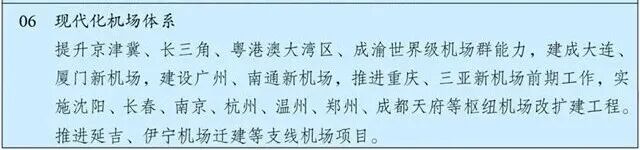
Source: Official website of the State Council of China
Four world-class airport clusters are specified in the document, and the Chengdu-Chongqing cluster is one of them.
In addition, the construction of two new airports under construction in Dalian and Xiamen will continue. The construction of the new Guangzhou Airport (the Pearl River Delta Hub Airport located in Foshan) and the new Nantong Airport will be promoted. The new Guangzhou Airport has already started construction, and the new Nantong Airport is scheduled to start construction next year.
The preliminary work for the new airports in Chongqing and Sanya will be advanced.
Besides, the airports of 7 cities will be expanded, and Tianfu International Airport in Chengdu is one of them.
02
Chengdu's passenger flow hits a record high
In addition to strategic support, objective demand is also the main driving force for the expansion of Tianfu Airport.
Since Tianfu International Airport was put into operation in 2021, Chengdu has become the third city in mainland China that owns two large civil transport airports (the other two are Shanghai and Beijing), and the second city in China that owns two 4F-class airports (the other one is Beijing).
At present, Tianfu International Airport has two terminal buildings and three runways, with a designed annual passenger throughput of 60 million.
In the year of its opening, the passenger throughput of Tianfu International Airport was 4.35 million, and the figure reached 56.68 million in 2025, ranking 5th among all airports in mainland China.
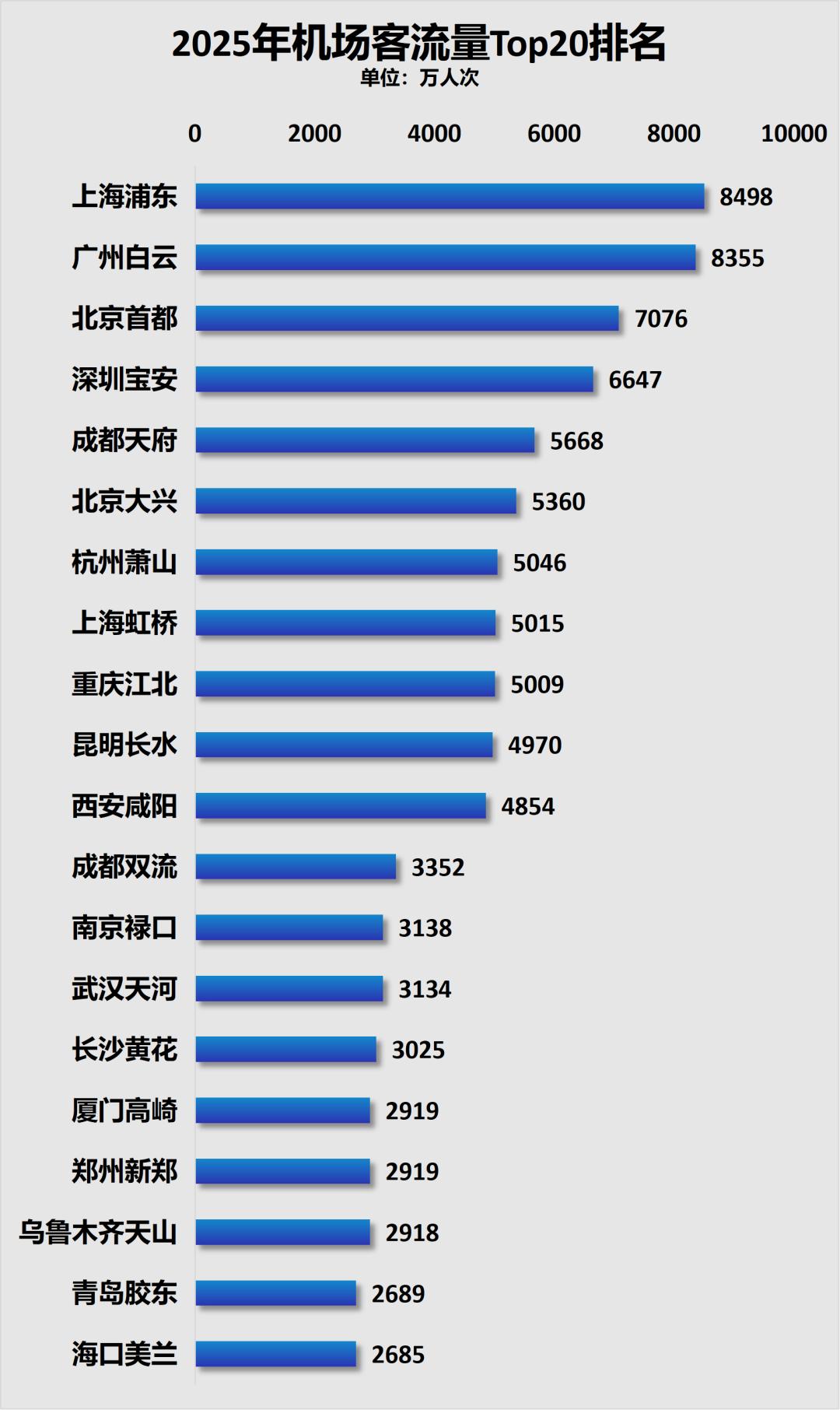
Illustration: City Finance; Data: Civil Aviation Data Analysis System
Most notably, the passenger flow of 56.68 million has approached the phase I designed capacity of 60 million, and the flight takeoff and landing volume is also close to the carrying limit of supporting facilities.
Therefore, it is the right time to propose the construction of the phase II project at this moment.
Sichuan Province has launched the preliminary preparation work for the Tianfu International Airport Phase II Project since last year, and all pre-procedures including project planning, design, environmental impact assessment, survey and mapping, and pre-feasibility study report compilation are being carried out in an orderly manner.
The project was included in the national 15th Five-Year Plan earlier this year, and is expected to start construction in 2028. According to official disclosure, the long-term designed passenger capacity of the phase II project can reach 120 million passengers per year, which is twice the current designed capacity of Tianfu International Airport.
That is equivalent to rebuilding another Tianfu Airport.
Two key questions arise:
First, Chengdu already has two airports. Even if the passenger flow of Tianfu International Airport is approaching the designed capacity, Shuangliu Airport can still be used. Why is it necessary to build the phase II project of Tianfu Airport?
The reason lies in the clear division of functions between the two airports.
After its opening, Tianfu Airport serves as the main hub, undertaking international trunk routes, transfer services and cargo transport; Shuangliu Airport is positioned as a regional hub, focusing on high-quality domestic business express routes.
Therefore, after the opening of Tianfu Airport, many original international trunk routes of Shuangliu Airport have been transferred to Tianfu Airport, while a large number of new domestic, international and regional routes have been launched.
That is why the passenger flow of Tianfu Airport has achieved explosive growth in the five years after its opening, with the annual passenger throughput increasing by more than 10 times in five years.
Another key factor is that Shuangliu Airport is not suitable for large-scale expansion, which is the core reason for promoting the phase II project of Tianfu Airport.
The designed capacity of Shuangliu Airport is 50 million passengers per year, and its actual annual passenger throughput reached 33.52 million last year.
Due to the diversion and functional strengthening of Tianfu Airport, the figure is much lower than that before the opening of Tianfu Airport. In 2019, the annual passenger throughput of Shuangliu Airport reached as high as 55.86 million.
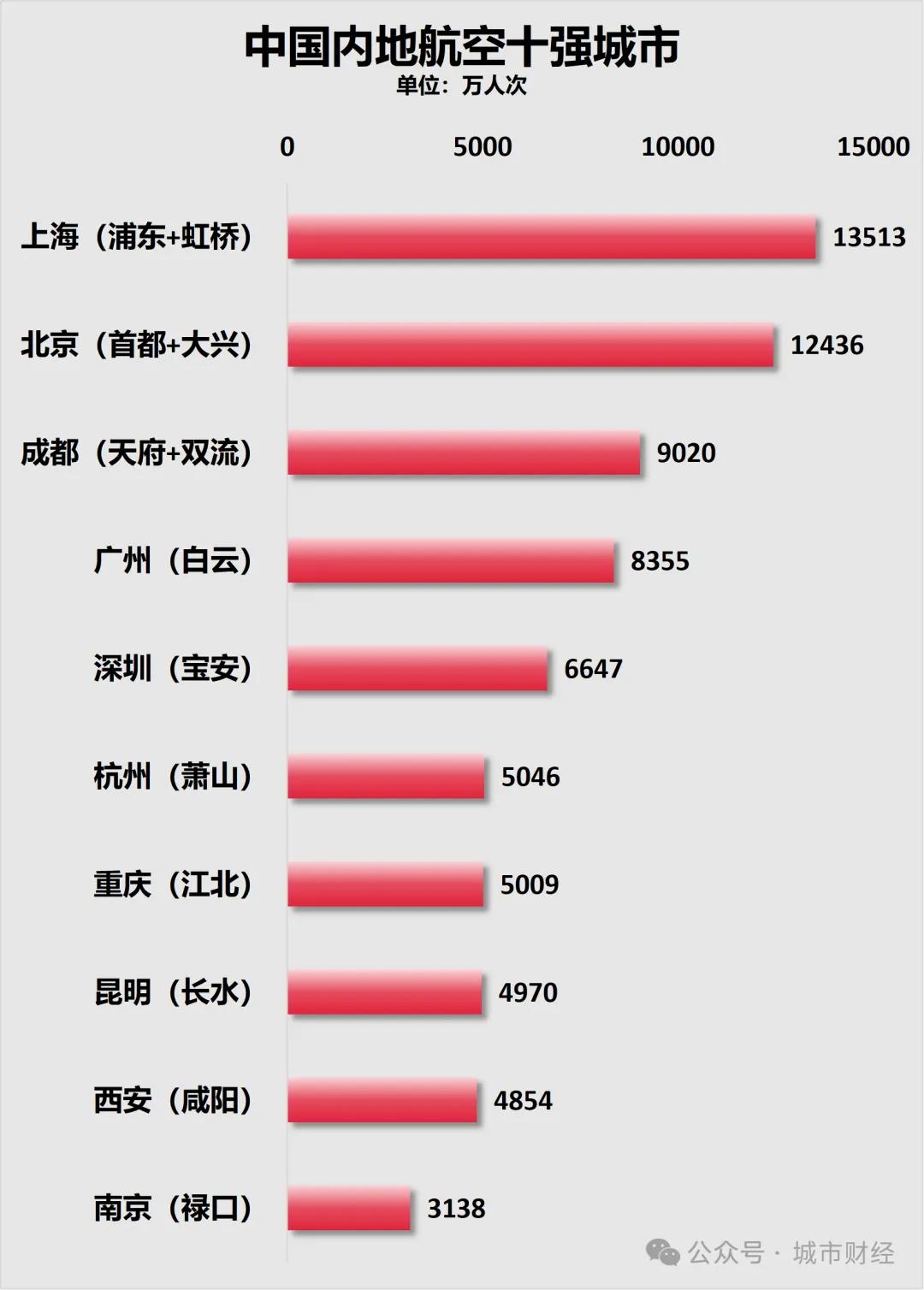
Illustration: City Finance; Data: Civil Aviation Data Analysis System
Although Shuangliu Airport has not yet reached saturation, there is hardly any remaining space for expansion.
Located in the built-up urban area, Shuangliu Airport is surrounded by dense buildings and restricted airspace, leaving no space for new runways or large-scale expansion. It can only improve the service quality based on existing facilities, and cannot support the medium and long-term incremental passenger flow of 100 million level for Chengdu's aviation hub.
Second, the phase II project of Tianfu Airport has been put on the agenda, with a long-term designed passenger flow of 120 million passengers per year. Together with the 50 million designed capacity of Shuangliu Airport, the total capacity reaches 170 million. Does Sichuan have such a large demand?
The answer is definitely yes.
We can see this from two perspectives.
On the one hand, Sichuan itself is a super-large population market.
Sichuan has a permanent resident population of 83.18 million, ranking 5th across China.
The city of Chengdu alone has a permanent resident population of 21.535 million, accounting for about a quarter of the total population of the province, and the primacy ratio of Chengdu's population is as high as 25.9%.
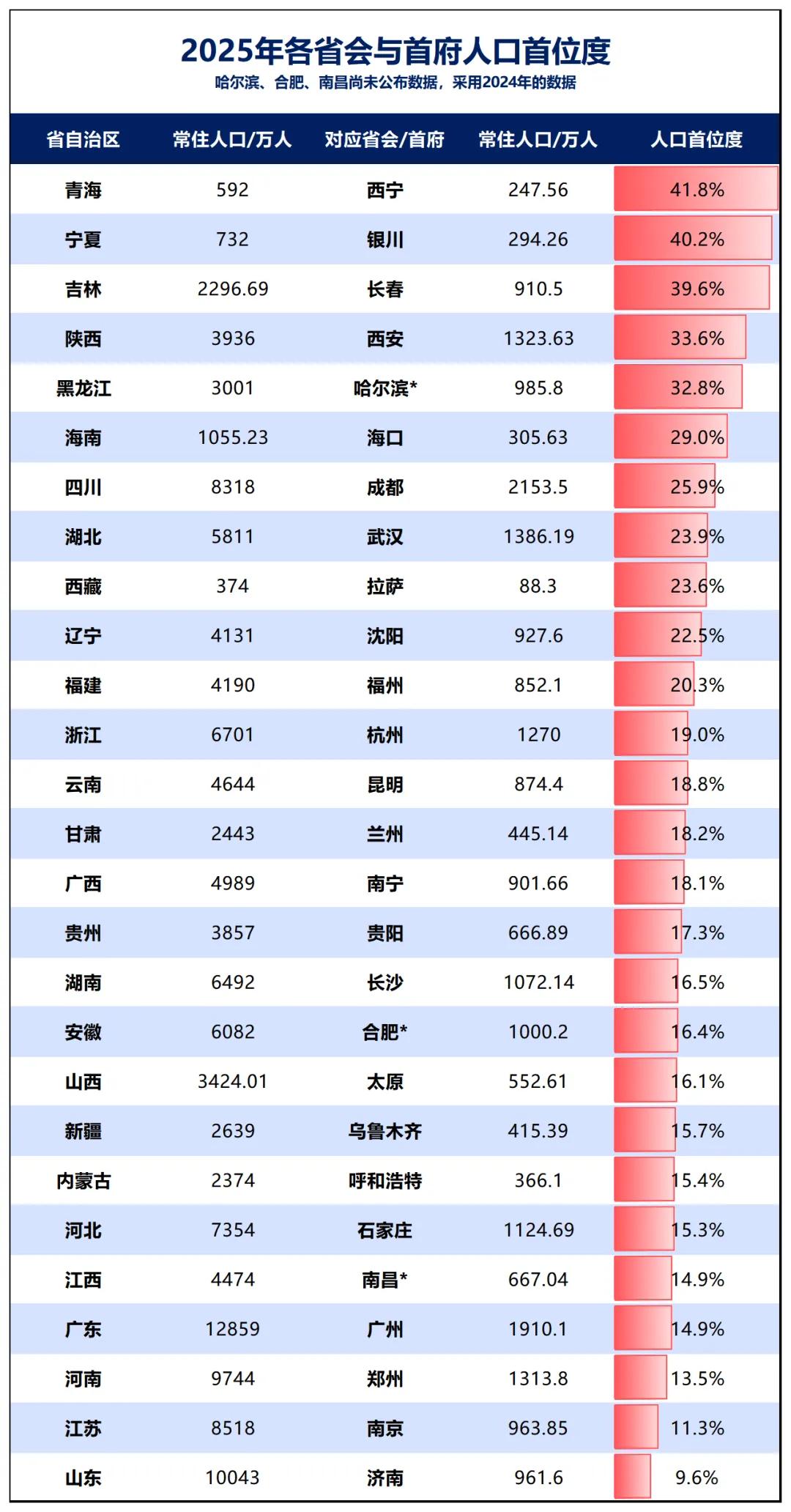
Illustration: City Finance; Data: Statistics Bureau of each city
This means that Chengdu's aviation market naturally has a very large local passenger source pool.
Moreover, air travel is not simply calculated as "one person takes one flight a year". Business travel, tourism, visiting relatives, studying abroad, as well as the large number of cross-regional personnel flows brought by Chengdu's status as the central city in western China, will continuously expand the aviation demand.
On the other hand, and more crucially, Chengdu's airports serve far more than Chengdu itself.
Chengdu's aviation positioning is set as a national international aviation hub and the southwestern aviation gateway.
Chengdu's biggest advantage is not only the large population of Sichuan, but also its geographical location across the entire southwestern region of China.
To the west of Sichuan is Tibet, to the south it connects Yunnan and Guizhou, to the east it connects Chongqing, and to the north it connects Shaanxi, Gansu, Qinghai and other regions. Chengdu is also one of the largest comprehensive cities in southwestern China, so a large number of personnel, business and international travel demands in the central and western regions will be concentrated in Chengdu.
In other words, the passenger flow hinterland of Chengdu's airports cannot be limited to Chengdu, let alone only Sichuan Province.
This is also why Chengdu can form the aviation hub pattern of "two airports integrated operation".
In fact, the total annual passenger throughput of all airports in Sichuan Province reached about 103 million in 2025, and the two airports in Chengdu contributed 90.206 million passengers, accounting for nearly 90% of the provincial total.
Therefore, the logic for Chengdu's airport expansion is very clear:
It is not that Sichuan needs 170 million passenger capacity so Chengdu builds 170 million capacity; it is that Chengdu needs to build an international aviation hub facing the entire southwestern region, so sufficient airport capacity is required.
Certainly, it is necessary to emphasize that 170 million is the long-term designed capacity, which does not mean that the passenger flow will reach 170 million immediately after the completion of the project.
The long-term planning capacity of Tianfu Airport is 120 million passengers per year, and the current support capacity of Shuangliu Airport has been increased to 50 million passengers per year, adding up to 170 million in total.
This capacity corresponds to the development space for the next few decades, rather than the passenger flow forecast for the next three to five years.
In the long run, what Chengdu really needs to consider is not "whether there is a passenger flow of 170 million", but whether Chengdu can truly expand the function of the southwestern aviation hub, especially further attract international transfer passengers, intercontinental route passengers and passengers from the central and western regions to Chengdu.
If this goal is achieved, 170 million passenger capacity is not an exaggeration; if Chengdu only serves the local passenger flow of Sichuan, it will indeed be difficult to give full play to the 170 million capacity.
03
Why has there been no progress for a long time on Chongqing's second airport?
While the construction of Chengdu's airport is in full swing, why is there no news about Chongqing's second airport?
As early as in the 14th Five-Year Plan released by Chongqing, the Chongqing government clearly proposed to start the construction of the new Chongqing airport.
During the entire 14th Five-Year Plan period, there were continuous favorable news about Chongqing's second airport.
In 2021, the Civil Aviation Administration of China officially conducted a survey on the site selection at Zhengxing Town, Bishan District.
Later in 2021, two documents released at the national level, namely the Comprehensive Transportation Development Plan for Chengdu-Chongqing Twin City Economic Circle and the Construction Plan Outline for Chengdu-Chongqing Twin City Economic Circle, both mentioned that the planning and research of the new Chongqing airport should be accelerated.
On March 23, 2023, the Civil Aviation Administration of China officially approved the site selection of the new Chongqing airport. The approval points out:
The new Chongqing airport meets the requirements of the 14th Five-Year Plan for Civil Aviation Development. Among the three alternative sites of Zhengxing in Bishan, Dashi in Hechuan and Guangpu in Bishan, the Zhengxing site in Bishan has relatively better conditions, and it is agreed to take the Zhengxing site in Bishan as the recommended site for the new Chongqing airport. It is suggested that in the next stage, combined with the implementation of the Construction Plan Outline for Chengdu-Chongqing Twin City Economic Circle, the preliminary work of the project should be steadily promoted according to the functional positioning of the airport.
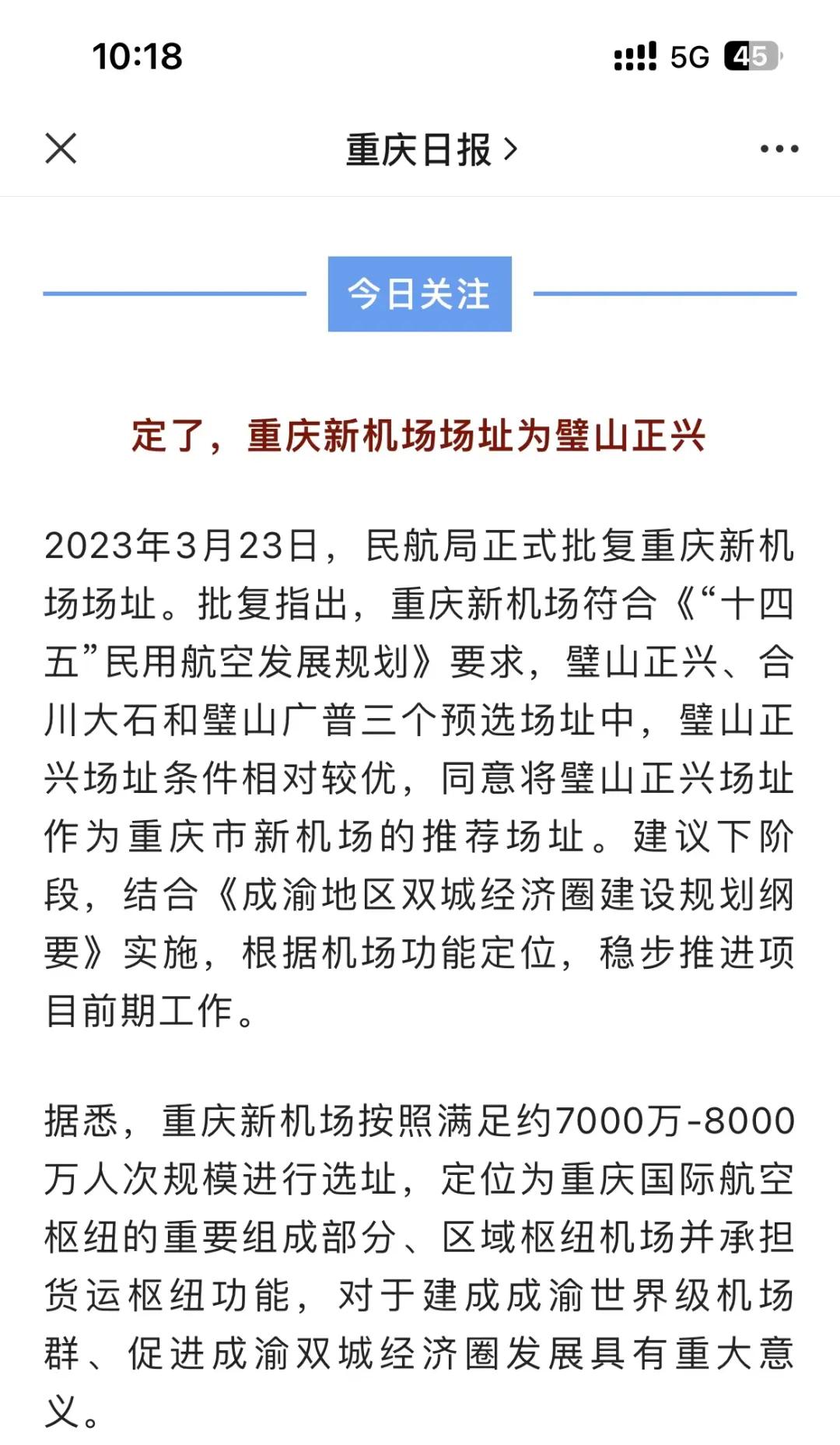
In other words, the new Chongqing airport has been officially sited at Zhengxing in Bishan.
After completing this step, there is basically no suspense about the start of construction of Chongqing's second airport, but two more procedures are required before the actual start of construction.
The project proposal needs to be approved by the Central Military Commission; after the approval of the Military Commission, the National Development and Reform Commission will give its approval, and