Exclusive Survey of 16 Commercial Management Enterprises: The "Challenges" and "Solutions" in the Lower-tier Market
The market takes root "downwards", while consumption grows "upwards".
The vast county-level market is rising at an accelerated pace, becoming a critical pillar for boosting domestic demand and stabilizing growth. McKinsey predicts that by 2030, around 66% of China's incremental personal consumption will come from sinking markets including tier-3 and below cities, as well as county and township markets. Based on this definite trend, stimulating consumption vitality in the sinking market has become a key policy priority for expanding domestic demand and stabilizing growth in the opening year of the 15th Five-Year Plan.
Recently, the Ministry of Commerce held the National Working Conference on Stimulating Consumption Vitality in the Sinking Market in Beijing. Responsible officials from the Ministry of Commerce, relevant departments and bureaus of the Ministry, relevant departments and bureaus of other relevant ministries and commissions, competent commercial departments of all provinces, autonomous regions, municipalities directly under the Central Government, and the Xinjiang Production and Construction Corps, as well as representatives of relevant industry organizations and enterprises attended the meeting.
Wu Chuankun, Chairman of Winshang Group and Vice President of China General Chamber of Commerce, was invited to attend the meeting and shared the report Insights into the Retail and Commercial Development of the Sinking Market at the conference. Based on in-depth monitoring of the sinking market by Winshang Big Data and special surveys of 16 representative commercial management enterprises, the report thoroughly analyzes the commercial fundamentals, consumption characteristics, and enterprise development strategies of the sinking market, providing first-line data support and decision-making references.
Data Description:
1. Enterprise Survey Samples: Covering 16 representative enterprises, spanning national leading commercial management groups, regionally focused enterprises, department store operators and county-level complex operators.
2. Definition of "Sinking Market": Winshang divides tier-3 and below cities according to the urban commercial tier: Commercial tier-3 refers to cities with relatively developed retail commerce that can drive the commercial development of surrounding regions and counties; Commercial tier-4 refers to cities whose retail commerce is in the process of growth and improvement, relying on the commercial radiation of key regional cities; Commercial tier-5 refers to cities with low-level retail commerce development that mainly meet the basic living needs of residents.
3. Definition of "Centralized Commerce": Refers to opened commercial projects under unified operation and management (including shopping malls, independent department stores, and outlet malls, with no restriction on volume).
4. Enterprise Operation Level: Comprehensively evaluates the operation capability of shopping mall operating enterprises based on the scale, operation quality, operation stability, expansion capability and development potential of commercial projects; and divides the operation capability levels according to the score distribution of the comprehensive evaluation, ranging from A to F from high to low.
01.
Sinking Market Commerce:
The Basic Market & Core Growth Engine of China's Consumption
At present, the sinking market accommodates more than 70% of the national population, contributes about 60% of the GDP and total retail sales of consumer goods, and nearly 80% of the incremental growth of the FMCG market. It is the veritable "basic market" and core growth engine of China's consumption.
In terms of passenger flow trend, in the first half of 2026, the passenger flow growth rate of commercial tier-3 and below cities rebounded from -1.4% in the same period of the previous year to 4.9%, becoming the only region with rising growth rate among all city tiers, while the passenger flow growth rate of tier-1 and tier-2 cities in the same period has declined for three consecutive years.
In terms of commercial volume, the sinking market accounts for nearly half of the national stock and one third of the national increment, forming the most important basic market of commercial real estate.
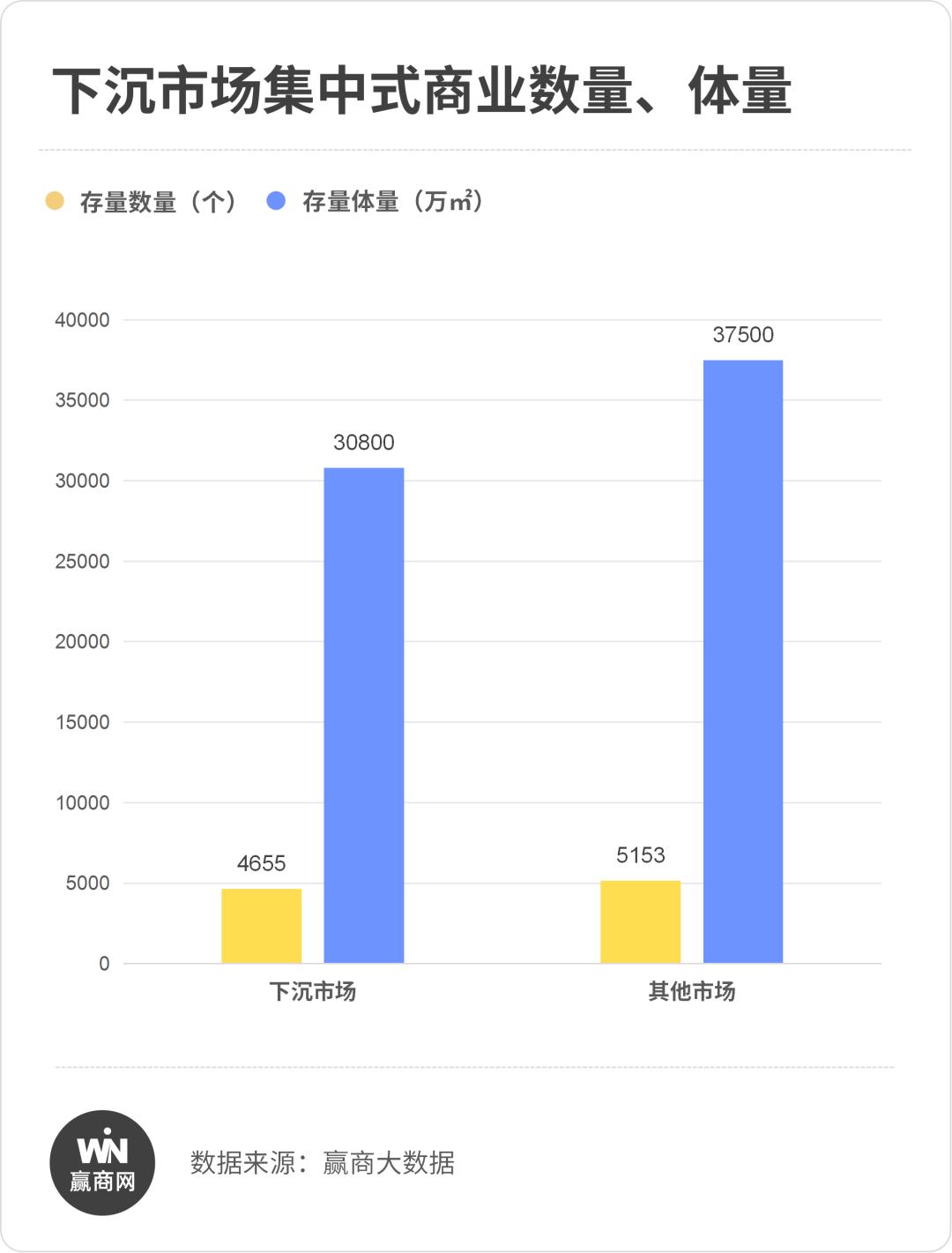
Total stock reaches 308 million ㎡, accounting for nearly half of the national total
According to Winshang Big Data statistics, as of July 31, 2026, there are 9808 centralized commercial projects in stock across the country, with a total volume of 683 million square meters.
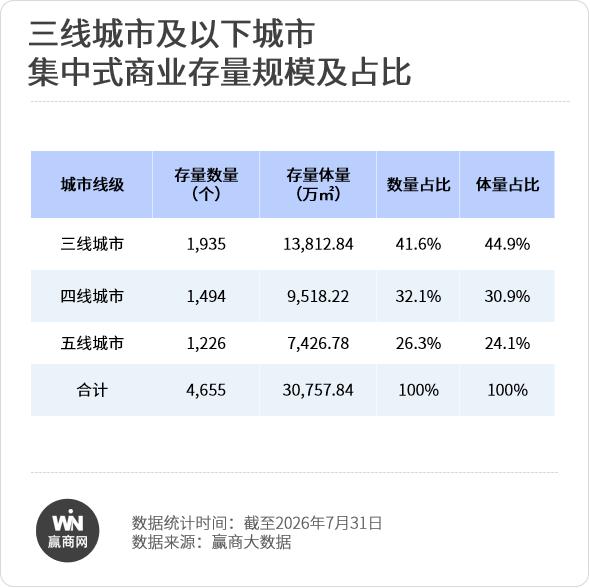
Among them, there are 4655 centralized commercial projects in stock in the sinking market, accounting for 47.5% of the national total; the stock volume reaches 308 million square meters, accounting for 45.1% of the national total.
By city tier, tier-3 cities are the core position for commercial layout in the current sinking market, with the stock scale accounting for 45.0% of the total, and the scale decreases gradiently in tier-4 and tier-5 cities.
The increment in the next two years accounts for one third of the national total
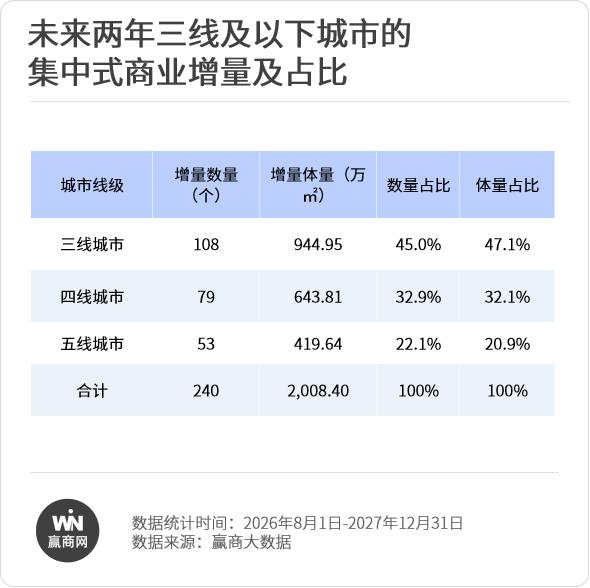
According to Winshang Big Data statistics, by December 31, 2027, there will be 701 centralized commercial projects planned to be opened across the country, with a total increment of 60.7323 million square meters.
Among them, there are 240 projects planned to be opened in the sinking market, with an incremental volume of 20.084 million square meters, accounting for about 33% of the national increment. The new supply is shrinking, and the core of market competition has shifted from "grabbing locations and expanding scale" to "improving operation and enhancing efficiency".
Commercial management enterprises present a "pyramid" structure,
with huge room for improvement
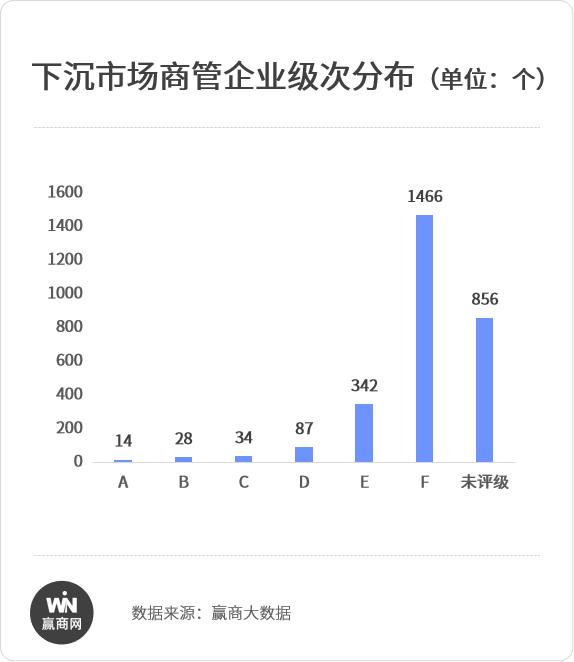
The distribution of commercial management enterprises in the sinking market presents a typical "pyramid" structure, the overall operation level of enterprises is relatively low, and there is large space for quality improvement and integration.
Specifically, there are 2827 commercial management enterprises with operating projects in the sinking market, of which only 42 are high-level enterprises (Class A + Class B), accounting for 1.5%. A large number of projects are managed by small and medium-sized local enterprises with low operation level, with limited professional and chain operation capabilities.
The stock scale is highly concentrated in leading enterprises. The top 30 enterprises in terms of centralized commercial stock scale in the sinking market have a total volume of 107 million square meters, accounting for 34.9% of the total sinking market volume, of which 17 are high-level enterprises (Class A + Class B), accounting for 56.7%. The settled enterprises include both national leading commercial management companies and regional leading department store enterprises.
In terms of increment, leading enterprises continue to be optimistic about the sinking market, and leading commercial management companies have settled in one after another. The top 30 commercial management enterprises in terms of increment will add 11.7223 million square meters of new volume in the sinking market in the next two years, accounting for 58.4% of the total increment. High-level enterprises (Class A + Class B) account for 50% of the total.
At the same time, many current leaders in the stock of the sinking market are also the main players of incremental layout in the future. There are 11 commercial management enterprises that are on both the top 30 stock list and top 30 increment list, all of which are Class A and Class B high-level enterprises, with a total stock of 75.4945 million square meters, accounting for 24.5% of the total stock of the sinking market; the total increment reaches 8.1565 million square meters, accounting for 40.6% of the total increment.
As industry competition shifts from scale expansion to in-depth operation of stock assets, the key to the sinking market in the future is not to promote more commercial projects to "be built", but to support high-quality supply to "sink down" and make existing stock projects "vibrant".
02.
Sinking Market vs High-tier Cities,
What are the Differences in Consumption Characteristics?
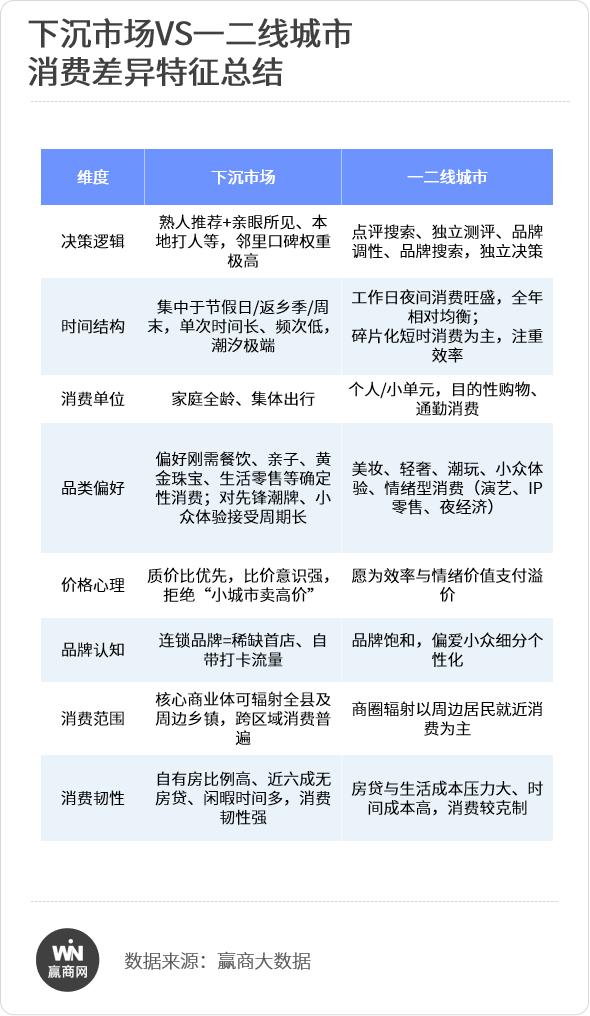
According to Winshang insights and enterprise surveys, the consumption gap between the sinking market and high-tier cities is superficially the income gap, but essentially the mismatch between supply and demand. On the demand side, consumers use the aesthetic, quality and experience standards of tier-1 cities to find matching commercial supply locally, while on the supply side, the operation rhythm still stays at the county-level pace. Under the mismatch between supply and demand, both consumption outflow and local commercial vacancy occur at the same time.
Consumption concepts are aligned with high-tier cities,
"Cost-effectiveness priority" becomes the mainstream
Consumption in the sinking market has entered a new stage of "quality improvement and upgrading" from the previous "low-price expansion" stage. Consumers' aesthetic standards are rapidly converging with those of tier-1 and tier-2 cities, their requirements for brand quality, scenario experience and supporting services are continuously upgrading, and their demand for better and more cost-effective goods and experiences is being released intensively.
However, compared with consumers in tier-1 and tier-2 cities who are willing to pay a premium for brand tonality and emotional value, pragmatic and cost-sensitive consumers in the sinking market are more willing to "pay reasonably" for quality and services, pursuing "reasonable price under the same quality".
Dominated by family customer groups, with obvious passenger flow tidal phenomenon
Consumers in tier-1 and tier-2 cities are dominated by "fragmented short-time consumption and personal pleasure-oriented consumption", while the customer groups in the sinking market present the structural feature of "the elderly and children as the main groups, and young people returning to their hometowns".
Therefore, "traveling and consuming as a family unit" is the mainstream, with prominent all-age consumption characteristics, which drives the core role of shopping malls to transform from a pure shopping place to "family leisure living room + social gathering destination".
In tier-1 and tier-2 cities, consumption is relatively balanced throughout the whole year and daily, with stronger consumption stability. While in the sinking market, commerce presents obvious passenger flow explosion on weekends, holidays, the Spring Festival return season of migrant workers, and winter and summer vacations, with prominent characteristics of return-home consumption, social-interaction consumption and gift consumption; the operation is deserted on working days, with a huge gap between peak and off seasons.
"Save on necessary expenses, spend on enjoyable experiences", and consumers pursue scarce first stores
Social and experience-oriented consumption such as new-style catering, leisure and entertainment, and parent-child experience has become the mainstream of county-level consumption, presenting the structural feature of "save on necessary expenses, spend on enjoyable experiences": people save on pure material consumption, and spend on spiritual value consumption, education, health and family experience consumption.
At the same time, different from the "efficiency-oriented consumption" in tier-1 and tier-2 cities, sinking cities have short commuting time and sufficient free time, with distinct "leisure-abundant" consumption characteristics. Offline "social/leisure consumption" scenarios continuously drive passenger flow to physical businesses such as catering and cinemas. In some county-level shopping malls, passenger flow after 18:00 can account for more than 60% of the whole day.
"First store economy" has become a core starting point to activate young customer groups in the sinking market and create urban topics. Mass chain brands such as Starbucks and new-style tea drinks, which are highly saturated in tier-1 and tier-2 cities, have the attribute of scarce first stores in counties, bringing natural check-in traffic.
Serious consumption outflow,
coexistence of excess supply and insufficient effective supply
From the demand side, consumption cognition in the sinking market is iterating rapidly, consumption aesthetics and demands are synchronized with tier-1 and tier-2 cities, and quality consumption needs to be met urgently. The time difference for trendy brands to sink has been shortened from 3-5 years to 1-2 years.
From the supply side, the consumption demand of the sinking market has been aligned with that of tier-1 and tier-2 cities, but the iteration of local commercial supply lags behind relatively.
On the one hand, the phenomenon of cross-city consumption by high purchasing power customer groups in the sinking market is prominent, forming a negative cycle of "weak local supply - continuous consumption outflow - pressure on commercial operation".
On the other hand, regional commercial development falls into the development dilemma of "fierce homogeneous competition of stock and high vacancy coexisting". The vacancy rate of some projects is as high as 50%, and the core contradiction behind it is "synchronized demand, unsynchronized supply".
03.
Practical Deconstruction of Typical Commercial Management Enterprises:
Systematic Operation Methods for Sinking Market Commerce
The sinking market commerce has generally entered the stage of "meticulous cultivation" from the previous "blind expansion" stage. To take root firmly in the county-level market, enterprises must complete systematic adaptation in four dimensions: site selection logic, cooperation mode, investment promotion and operation, and project innovation.
Site selection and layout: City entry focuses on population and industrial foundation, choose high-quality targets and enter prudently
Surveys show that enterprises entering the sinking market have formed a highly unified underlying logic for site selection. They generally take cities with large population base, obvious population return trend, industrial support, and gaps in commercial supply as core screening criteria, and avoid regions with continuous population outflow, hollow industries and excess commercial stock. In addition, all enterprises have formed certain quantitative standards for specific thresholds.
As the industry's sinking process enters the stage of differentiation and iteration, expansion and contraction coexist. Enterprises have shifted from "blind sinking" to "selective entry", and the characteristics of refined and professional market competition are becoming increasingly distinct.
Based on their own product capabilities, development strategies, sinking layout strategies, scale attitudes, as well as regional levels and market endowments, all enterprises adopt differentiated investment and expansion rhythms, and generally form a two-pattern camp of "selective deep cultivation and expansion, prudent selection and speed control".
The first pattern is actively deep cultivation, precise positioning, seizing