29.6 billion U.S. dollars, another major industry giant is placing a massive bet on AI.
It is reported that ByteDance, the developer of TikTok, has finalized a $29.6 billion loan, which is the second largest US dollar-denominated syndicated loan in Asia this year. The transaction has not been formally signed yet, and banks are still returning signed confirmations to verify their respective loan allocation quotas.
A piece of news claiming that ByteDance has obtained a huge $29.6 billion bank loan has sparked widespread heated discussions in the market.
According to media reports, ByteDance, the developer of TikTok, has finalized a $29.6 billion loan, which is the second largest US dollar-denominated syndicated loan in Asia this year. It originally planned to apply for a $20 billion credit line, and after receiving enthusiastic loan commitment intentions from major banks, ByteDance raised the loan size. The funds will be mainly used for general corporate operating purposes. The transaction has not been formally signed yet, and banks are still returning signed confirmations to verify their respective loan allocation quotas.
However, this news did not just come out in the past two days. In the middle of last month, some media released related reports stating that "ByteDance's overseas financing is highly sought after, with $20 billion syndicated loan receiving commitments exceeding $30 billion". In the reports at that time, "ByteDance had not yet made a decision on whether to expand the scale of the loan".
The new incremental information in this report is: "Citi and JPMorgan Chase are the coordinating banks for this loan, and the deadline for making loan commitments is August 19. ByteDance's this loan has three different commitment tiers. Each lead arranger and bookrunner has a minimum commitment amount of $1 billion, the minimum commitment for lead arrangers is $500 million; the commitment amount for other arrangers can be less than $500 million.
This will become ByteDance's largest overseas borrowing, with a term of three years and a maximum extension of five years."
Against the backdrop of increasingly fierce AI competition, with the superposition of factors including large tech companies, capital expenditure and AI, the market attention and discussion heat are extremely high. As a technology enterprise with great influence in the global AI layout, ByteDance's large-scale overseas financing trend has naturally triggered speculations from all parties about its business expansion.
How much does ByteDance plan to invest in AI?
ByteDance's official side has always been very cautious about the amount and details of capital expenditure. After the reporter of *Science and Technology Innovation Board Daily* made an inquiry, as of press time, ByteDance has not given a positive response to the "$29.6 billion bank loan" news. Moreover, "the transaction has not been formally signed" yet, and the deal has not been finalized.
In terms of capital expenditure, according to previous media reports, ByteDance is discussing raising this year's capital expenditure figure to a maximum of $70 billion (about 500 billion RMB) for the construction of data centers and other AI infrastructure. This figure is about 6.4 times that of ByteDance in 2024 (about $11 billion / 80 billion RMB), and more than twice that in 2025 (about $25 billion / 160 billion RMB).
Among several major tech companies, in terms of investment scale, ByteDance has the highest estimated capital expenditure for 2026. There was previous news that ByteDance has raised its 2026 AI capital expenditure plan to more than 200 billion RMB, an increase of at least 25% compared with the 1600 RMB plan initially discussed at the beginning of the year. About half of the funds will be used for AI chip procurement to develop AI models and applications, and the rest of the funds will focus on the construction of data centers and liquid cooling systems.
The reporter of *Science and Technology Innovation Board Daily* noticed that ByteDance's computing power layout in Northwest and North China has been continuously advancing. For example, in July, two companies, Zhongwei Saishang Mingsha Technology Co., Ltd. and Zhongwei Shuofang Xinghe Technology Co., Ltd., were established, both 100% owned by Beijing Douyin Network Technology Co., Ltd. The registered addresses of the enterprises are both Room 104, Building A, Zhongguancun Science and Innovation Park, Shapotou District, Zhongwei City, Ningxia Hui Autonomous Region, with registered capital of 22 billion RMB and 24 billion RMB respectively.
Among the business scopes of the two companies, "non-residential real estate leasing" is particularly noteworthy. This business is usually related to data centers and computing power infrastructure. However, as of press time, the reporter has not obtained further official confirmation that this business is related to data centers and computing power.
However, after equity penetration, among the enterprises controlled by Beijing Douyin Network Technology Co., Ltd. that have the same business scope as the two Ningxia enterprises mentioned above, many projects have been clearly stated in public materials as ByteDance's intelligent computing center layout. For example, the Volcano Cloud Taihang Computing Power Center located in Datong. After the center is completed, it will become one of the largest intelligent computing centers in North China, focusing on supporting AI large model training and big data analysis.
What about the investment situation of other Internet giants?
According to Tencent's semi-annual report data, the total revenue in the first half of the year was 401.243 billion RMB, a year-on-year increase of 10%. Among them, capital expenditure was 84.7 billion RMB, a year-on-year increase of 82%, which has exceeded the full-year 2025 scale of 79.2 billion RMB. The capital expenditure in the second quarter alone was 52.784 billion RMB, a year-on-year increase of 176%, which was mainly invested in AI infrastructure such as data centers and servers.
In the capital expenditure of AI, internal operating cash flow is one of the important sources of funds. Taking Tencent's operating activities in the second quarter as an example, the net cash generated was 52.7 billion RMB, but the capital expenditure payment reached 59.3 billion RMB, and the free cash flow for the quarter was negative 13.8 billion RMB. The free cash flow in the first quarter was still positive at 56.7 billion RMB.
Tencent's financial report states that 2Q2026 operating cash flow includes large AI-related advance payments, which are used to provide infrastructure to support the Hy model upgrade, the reasoning demands of WorkBuddy and CodeBuddy, WeChat AI initiatives, and the AI capability construction of various products and services, while meeting the growing demand for cloud services from external customers. If the advance payment for computing power procurement is excluded, the free cash flow is 37.6 billion RMB.
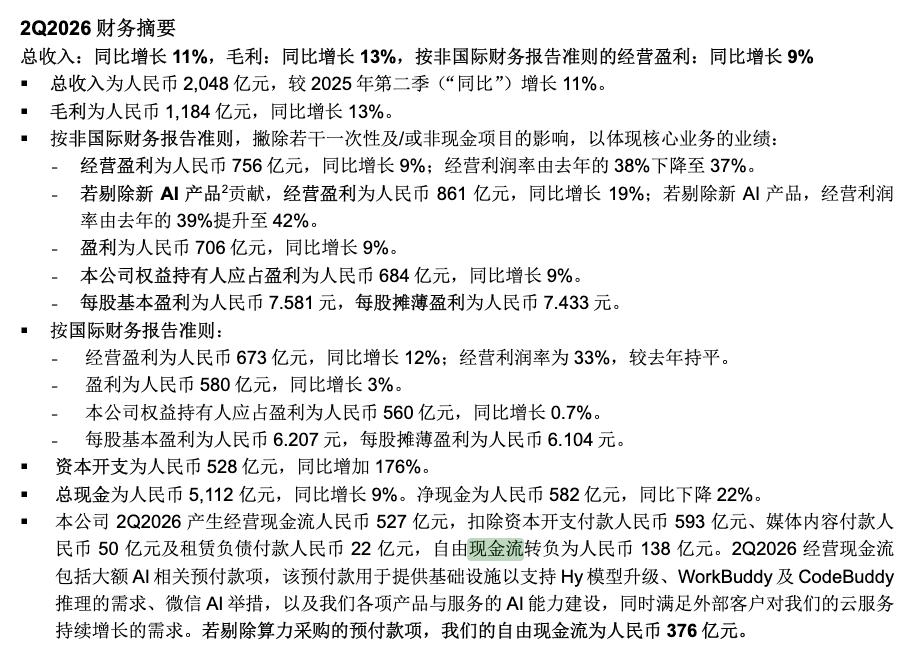
Image source: Tencent's second quarter financial report
For Alibaba, the combined performance of the first and second quarters shows that the revenue is about 500 billion RMB, and the capital expenditure is about 90 billion RMB. Among them, the revenue in the first quarter was 243.380 billion RMB, and the capital expenditure was 26.887 billion RMB; the revenue in the second quarter was 268.953 billion RMB, and the capital expenditure was 67.678 billion RMB.
In February 2025, Alibaba announced that it would invest 380 billion RMB in the construction of AI and cloud computing infrastructure in the next three years. Later, at Alibaba's performance conference call in 2026, Wu Yongming stated again that the funds Alibaba invested in acquiring computing power centers would far exceed the original planned 380 billion RMB. As of the end of the June quarter this year, Alibaba has invested a total of 190 billion RMB, and "we hope to maintain a more proactive attitude towards this year's investment and construction."
Where do the funds for Alibaba's AI capital expenditure mainly come from? Cash flow is a major source. Taking the second quarter as an example, Alibaba's net free cash flow outflow for the quarter was 44.7 billion RMB, compared with a net outflow of 18.8 billion RMB in the same period of the previous year. The financial report shows that the decrease in free cash flow is mainly attributed to the increased expenditure on cloud infrastructure.
In addition to cash flow, equity financing is also one of its sources of funds. In August this year, Alibaba announced on the Hong Kong Stock Exchange that the company plans to place shares to professional, institutional or other investors who are non-US persons outside the United States. The total estimated proceeds from the placement will be 80 billion Hong Kong dollars, and the net proceeds from the placement will be about 79.7 billion Hong Kong dollars. 100% of the net proceeds from this placement will be used to invest in full-stack AI capabilities and strengthen the construction of AI infrastructure.
This new round of equity placement also reflects the shift of Alibaba's capital strategy to a certain extent. Different from the previous capital strategy of large-scale share repurchases, this new round of placement issues 710 million shares at one time, which is higher than the number of repurchases in the quarter. In terms of share repurchases, for the quarter ended June 30, 2026, Alibaba repurchased 13.4 million ordinary shares (about 1.7 million American depositary shares) at a total price of 162 million US dollars. Shen Meng, Director of Chanson Capital, believes that the investment in AI competition is large-scale and high-cost, and enterprises need to reduce financing costs as much as possible. Compared with increasing debt, equity financing is more in line with Alibaba's capital needs at the current stage.
Another source of funds includes convertible bonds: in September 2025, Alibaba completed the issuance of zero-coupon convertible preferred notes with a total principal of about 3.2 billion US dollars, and the net proceeds from the offering are used for general corporate purposes, mainly to enhance cloud infrastructure capabilities and international business operations.
It is worth noting that from the sector classification of Alibaba's financial reports in the past two quarters, we can also get a glimpse of the trend of its key AI investment. In the first quarter report, in addition to the "consumer business" such as e-commerce, "AI + cloud business" became a separate sector, which focused on several business directions, namely the Cloud Intelligence Group, model and chip design - Pingtouge.
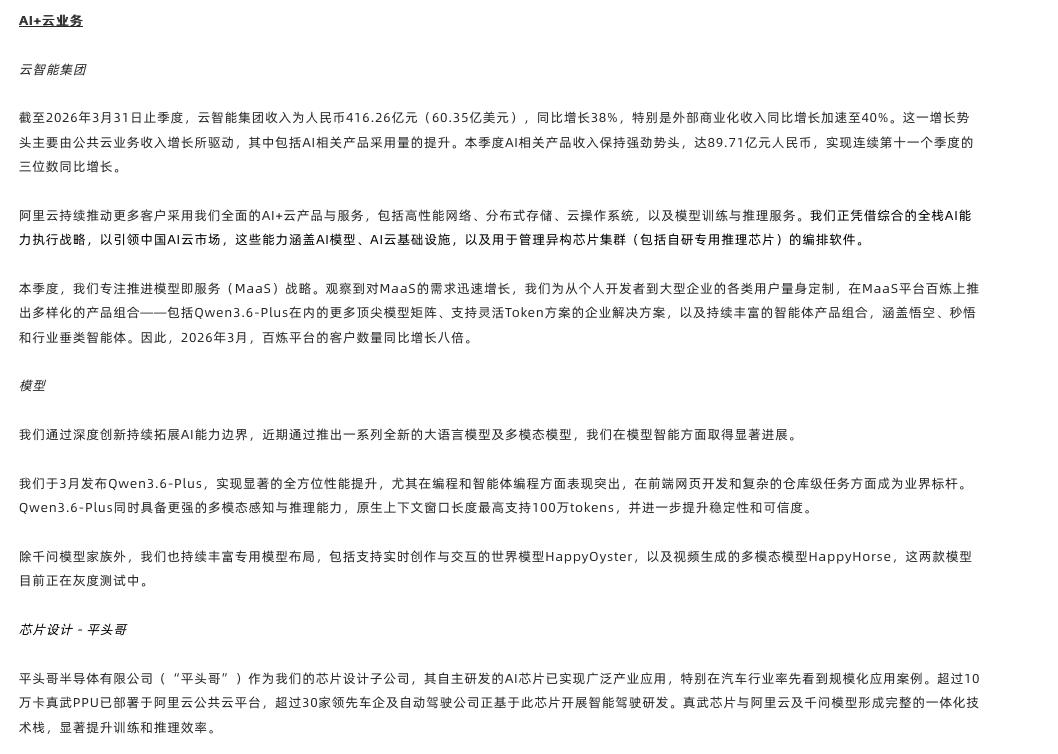
Image source: Alibaba's first quarter financial report
In the second quarter, it was directly divided into two sectors: "AI Cloud and Computing Power Services" and "AI Labs and Applications". In the AI Cloud and Computing Power Services, the key listed businesses are: cloud, chip design - Pingtouge Semiconductor ("Pingtouge"); in the AI Labs and Applications, the key listed businesses are models, Qianwen Office and Qianwen App.

Image source: Alibaba's second quarter financial report
From the perspective of financing methods, different from Tencent and Alibaba, ByteDance is not listed at present, and syndicated loans and operating cash flow are important sources of funds related to AI. From ByteDance's large-scale syndicated financing to Tencent and Alibaba's quarterly capital expenditures of tens of billions at every turn, it is not difficult to see that leading domestic technology enterprises are regarding AI infrastructure as a new round of strategic high ground.
Moreover, different from the previous model of relying on internal cash flow for rolling investment, at present, major tech companies have adopted multiple tools such as syndicated loans, equity placement, and convertible bonds to invest in AI business in a more proactive posture and seize computing power resources. As AI large models move from training to reasoning and AI applications blossom in many fields, the capital competition around data centers, chips and liquid cooling systems will continue to heat up in the future, and the diversification of financing methods and cost control capabilities will also become an important yardstick for measuring the sustainability of the AI strategies of giants.
This article is from the WeChat official account "Science and Technology Innovation Board Daily", author: Wang Nai, published with authorization from 36Kr.