Three cities in a major economic province are joining forces to build a strong deep-water port?
To fill the most prominent "short board" of this major coastal province, Jiangsu has once again set its sights on its ports.
A few days ago, Liu Xiaotao, Governor of Jiangsu Province, led a team to conduct research in Lianyungang, Yancheng and Nantong, emphasizing the acceleration of the formation of a port alliance to promote differentiated and coordinated development, and continuously enhance the radiation capacity, resource agglomeration capacity and industrial driving force of port hubs.
Subsequently, the Jiangsu International Maritime Supply and Demand Matching Conference was held, with Ma Shiguang, Vice Governor of Jiangsu Province, attending and delivering a speech. The meeting noted that all relevant departments across Jiangsu should coordinate the optimization of port functions, promote differentiated development of seaports, river ports and inland ports, and strengthen the coordinated linkage of the port cluster.
Marine-oriented development is the next growth pole that Jiangsu is betting on. A widely circulated judgment holds that the economic gap between Jiangsu and Guangdong mainly lies in the marine sector — local scholars have pointed out frankly that the difference in gross marine product between the two regions is close to one trillion yuan. If this "key indicator" can be caught up with, Jiangsu's gross domestic product will also rise accordingly.
Ports are the core engine of marine-oriented development. For a long time, Jiangsu's coastal areas have been lacking large deep-water seaports comparable to Shanghai Yangshan Port and Ningbo Zhoushan Port. In 2025, Jiangsu ranked first in total port cargo throughput, while the throughput of coastal ports accounted for less than 1/5 of the total. From the perspective of regional pattern, with Qingdao and Rizhao of Shandong to the north and Ningbo-Zhoushan of Zhejiang to the south, Jiangsu is sandwiched in the middle, always facing the challenge of insufficient outlet to the sea leading to diversion of hinterland cargo.
It is worth noting that the two recent statements at the provincial level of Jiangsu have both emphasized the promotion of differentiated, coordinated development or collaborative linkage, one focusing on the three cities of Lianyungang, Yancheng and Nantong, and the other on seaports, river ports and inland ports. Can the "province of scattered strengths" promote joint efforts to change the dilemma of weak coastal ports?
"Limping"
Jiangsu has a coastline of 954 kilometers, but this coastline has a major defect — it is largely straight. A straight coastline means a lack of natural deep-water harbors. Shandong has Qingdao, Yantai and Rizhao, Zhejiang has Ningbo-Zhoushan, and Guangdong has Shenzhen and Guangzhou. These natural high-quality ports support the marine economic landscape of their respective provinces.
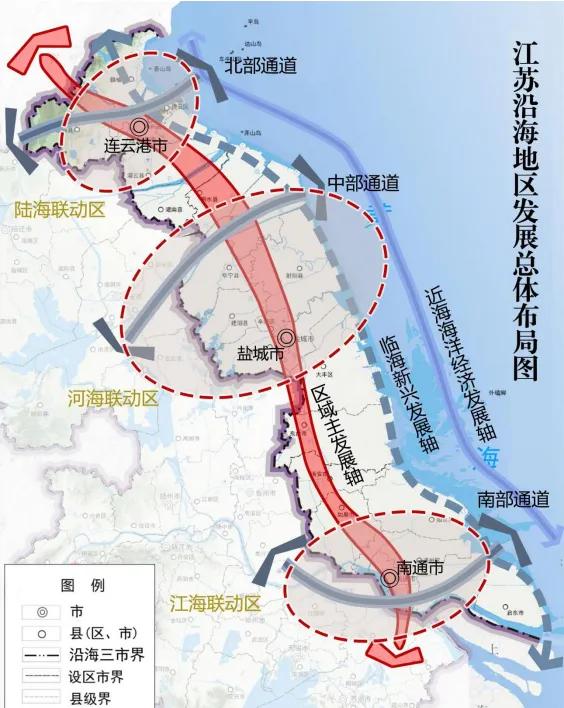
Image source: Development Plan for Jiangsu Coastal Areas (2021-2025)
Most of Jiangsu's coastal areas are silty mudflats, which lack high-quality port sites under natural conditions, and the cost of port construction is much higher than that of other coastal provinces. Ranked by port cargo throughput, Jiangsu's total port cargo throughput reached 3.71 billion tons in 2025, ranking first in China, while its coastal port cargo throughput was only 600 million tons, and the inland port part reached 3.11 billion tons. Among the top 10 ports in China in 2025, only Suzhou Port in Jiangsu is on the list, and it is the only inland port among them.
Reflected in the overall data of the marine economy, Jiangsu's gross marine product increased by 6.7% year on year in 2025, 1.4 percentage points and 1.2 percentage points higher than the growth rate of the province's gross domestic product and the national gross marine product respectively. However, compared with strong marine economic provinces such as Guangdong, Shandong and Zhejiang, the scale gap still exists. In 2025, Jiangsu's gross marine product reached 1.08 trillion yuan, about half of Guangdong's gross marine product (2.04 trillion yuan) in the same period.
To a certain extent, without developing seaports well, Jiangsu's marine economy will always be "limping". Zeng Gang, tenured professor and dean of the Institute of Urban Development of East China Normal University, told City Evolution that Jiangsu has always attached great importance to port construction, and in recent years it has been more intentional to strengthen seaports to change its relatively unfavorable position in opening-up, and enhance its discourse power and competitiveness in the global trade pattern.
Furthermore, the expansion to seaports is also an inevitable requirement after the development along the Yangtze River in Jiangsu has reached a certain stage. A typical example is Nantong, a city that "borders both the Yangtze River and the sea". About 90% of the throughput of Nantong Port used to be completed along the Yangtze River. Previously, Nantong had proposed to optimize river resources and expand to the sea, clarifying the overall master plan pattern of "one port with four districts", namely, three port areas along the Yangtze River (Rugao Port Area, Nantong Port Area, Tonghai Port Area) and one coastal port area (Tongzhouwan Port Area).
Statistics show that in 2025, the value of foreign trade goods served by Nantong's port cities reached 278.2 billion yuan, driving more than 50% of the city's foreign trade volume. However, the space along the Yangtze River has been insufficient. As stated by local media: "The ports along the Yangtze River are approaching saturation, and the incremental space must be expanded to the eastern coastal areas." Tongzhouwan is not only a key step for Nantong to "break through eastward", but also one of the key sites of Liu Xiaotao's this research trip.
In Zeng Gang's view, the Jiangsu provincial government and relevant investment institutions have invested a lot of funds in port construction in Nantong Tongzhouwan and other places in the past. In the next stage, they plan to further deepen and expand on the existing basis, coordinate port construction, and promote more efficient development. Just last month, the temporary opening of 5 berths in 4 terminals of the Tongzhouwan Port Area of Nantong Port was officially approved. Products such as high-end equipment and marine engineering can be directly shipped out to the sea without the need to detour to ports outside the region for transshipment.
Intermodal Transport
From the perspective of the national port pattern, the scale advantage of large hub ports is being further strengthened, and Jiangsu's seaport construction is facing inter-provincial competition from both the north and the south.
To the north, it is directly facing the strong squeeze from the Shandong port cluster. The hinterland of cargo sources of Lianyungang Port overlaps to a certain extent with that of Rizhao Port and Qingdao Port in Shandong. Liu Jiangchuan, Secretary of the Party Committee and researcher of Lianyungang Vocational and Technical College, and other scholars pointed out in their articles that there is still a gap between the basic conditions of Lianyungang Port and surrounding ports, and foreign trade enterprises in nearby cities such as Xuzhou still tend to choose Qingdao Port.
Statistics show that the throughput of Lianyungang Port in 2025 was only about 366 million tons, which is even less than that of Rizhao Port (645 million tons) that started half a century later nearby.
To the south, Jiangsu is deeply dependent on Shanghai Port and Ningbo Zhoushan Port to go to sea via external ports. For example, at present, key local foreign trade enterprises in Suqian such as Jiangsu Zhengxin still need to transport their export goods via railways to seaports such as Ningbo Zhoushan Port and Shanghai Port for shipment.
Facing the squeeze from both north and south, giving full play to the advantage of "river-sea linkage" is the most differentiated competitive route for Jiangsu. Jiangsu is the only province in China that has large rivers, great lakes and the sea at the same time, and also the only province in China where all prefecture-level cities are connected to inland waterways. The total mileage of inland waterways and the mileage of graded waterways in Jiangsu rank among the top in China.
Benefiting from the superior water transport resources, the proportion of total social logistics expenses in GDP of Jiangsu has dropped to 12.6%, 1.3 percentage points lower than the national average level. According to Zeng Gang, if the strong inland and Yangtze River transport networks can be efficiently connected to the seaports, a logistics cost barrier that is difficult for other provinces to replicate can be built.
However, in reality, there has long been a problem of unclear port integration and division of labor within Jiangsu. A local scholar pointed out in an article that the efficient coordination mechanism of "Water Transport Jiangsu" is weak, the functional positioning of coastal, river and inland ports overlaps, leading to disorderly competition. Zeng Gang also said that Jiangsu's ports have excellent comprehensive capabilities, cargo source conditions and investment strength, but the coordination between port authorities and economic and transportation departments is insufficient, resulting in the overall efficiency of river-sea intermodal transport not being fully exerted.
Jiangsu has obviously recognized the above problems and promoted reforms at the provincial level. The Jiangsu International Maritime Supply and Demand Matching Conference emphasized this time that it is necessary to promote differentiated development of seaports, river ports and inland ports, and strengthen the coordinated linkage of the port cluster. We will build and make good use of the public platform for multimodal transport, establish a long-term cooperation mechanism, and realize a virtuous cycle of promoting industry through ports, boosting trade through shipping, and strengthening ports through trade.
Integration
For Jiangsu, the marine economy is not only a "new space" for economic increment, but also an important engine to solve the imbalance of regional development between the north and the south of the province.
According to the Development Plan for Jiangsu Coastal Areas (2021-2025) approved by the State Council at the end of 2021, the proportion of gross domestic product of Jiangsu's coastal areas in the whole province is expected to reach around 20% by 2025.
However, according to the 2025 data, the proportion of the three cities' GDP in the province's total economic output still remains at 18%, failing to meet the set target. Restricted by their development level, the three coastal cities have relatively limited driving capacity for the regional marine economy.
How to promote differentiated development of the three regions and achieve improvement of development level? Last February, Jiangsu's first coastal zone and marine space plan was released, proposing to build an overall pattern of coastal zone and marine space development, and planning to form a "three vertical, three horizontal and three gateway" pattern for coastal areas.
Among them, the "three gateways" refer to Lianyungang as an international hub port for joint building of the Belt and Road, Yancheng as the sea outlet gateway of the Huaihe River Ecological Economic Belt, and Nantong Tongzhouwan as the new sea outlet for Yangtze River container transport.
Zeng Gang also said that the three cities should focus on their respective positioning, make up for shortcomings and strengthen characteristics in their advantageous fields. Nantong needs to focus on improving the international service capacity and competitiveness of Tongzhouwan; Lianyungang needs to accelerate the construction of the Belt and Road intersection area and reshape its hub efficiency; Yancheng needs to activate the vitality of private and foreign capital to inject stronger momentum into emerging industries.
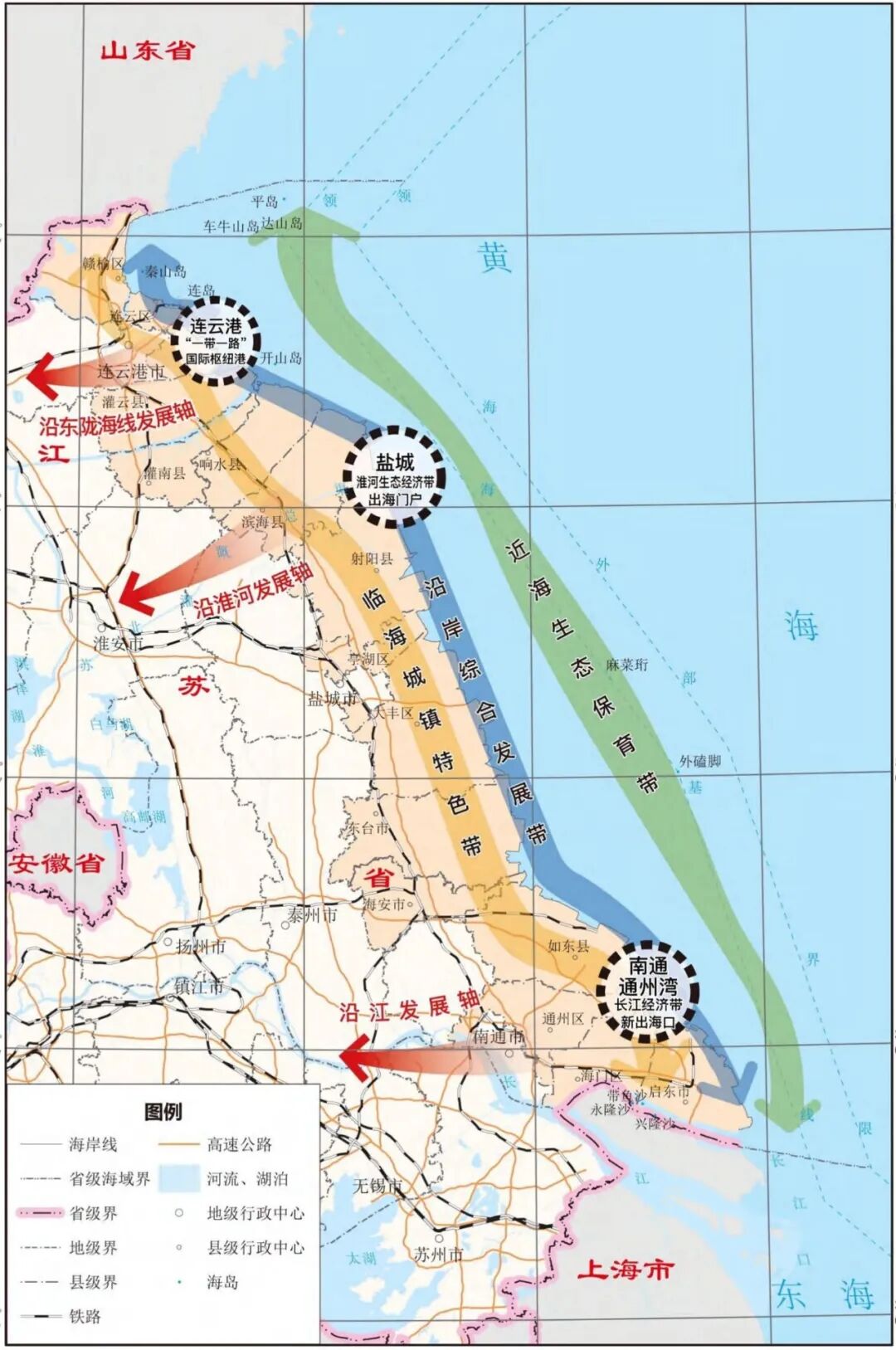
Image source: Jiangsu Provincial Coastal Zone and Marine Space Plan (2035)
The competitiveness of ports also depends on the depth of integration with industries.
During the research trip, Liu Xiaotao visited port terminals, industrial parks, logistics centers, as well as petrochemical, energy and manufacturing enterprises. He pointed out that we should promote the in-depth integration of port, industry and city, and accelerate the construction of a modern marine industrial system. We should continuously enhance the radiation capacity, resource agglomeration capacity and industrial driving force of port hubs, pay more attention to innovation-driven development, target the tackling of "stuck neck" products and key core technologies, and accelerate the leap to high-end industries and independent supply.
Zeng Gang believes that this precisely points out the core proposition of Jiangsu's seaport upgrading: ports can no longer be just simple trade channels, but should be closely connected with local industries. Taking the Belt and Road Initiative as an example, he pointed out that the fundamental reason why Lianyungang Port has not achieved expected success is the insufficient linkage between ports and industries. In contrast, the China-Europe Railway Express in Chengdu-Chongqing region and Yiwu Land Port have achieved more remarkable results precisely because their channel construction is deeply bound up with local industries such as electronic chips and small commodities.
In other words, the linkage of port, industry and city is the key to the two-way coordination between Jiangsu as a strong manufacturing province and port shipping. As the "golden signboard" of Jiangsu's marine economy, the marine engineering equipment industry has been placed in a prominent position. During the research trip, Liu Xiaotao presided over a symposium on high-quality development of coastal industries, proposing to accelerate the building of high-end port-side industrial clusters and strengthen leading industries such as marine engineering equipment.
Enterprises are another key focus of Jiangsu's port-industry linkage. The Jiangsu International Maritime Supply and Demand Matching Conference emphasized that we should pay close attention to the demands of enterprises, take the initiative to provide services, and further improve the efficiency of port operations and logistics transportation.
In fact, some arrangements have already been launched. In May this year, the vessel "Jinan" loaded with 7273 BYD new energy vehicles departed from Nantong Port Terminal for Europe. This is the first time that Nantong Port has undertaken large-scale export business of commercial vehicles. Zeng Gang said that Nantong Port has built a special terminal for automobiles for BYD, bound itself with leading enterprises, and realized joint construction, joint operation and benefit sharing.
Zeng Gang further said that following this idea, Jiangsu should take the rigid demand of leading enterprises as the most direct breakthrough for port-industry linkage, so as to finally make ports an organic part of the industrial chain.
This article is from the WeChat official account "City Evolution", author: Liu Xuqiang, authorized for release by 36Kr.