4 Flashes in 4 months, what on earth kind of bizarre game is Gemini playing?
Quadra kill, this is not a game, but Gemini has released its brand new Flash model once again.
Due to stereotypes and Google's low-key promotion, Shi Chao didn't pay much attention to this new Gemini 3.8 Flash at first.
But unexpectedly, it has received very positive feedback online, especially long-time Google fans in the editorial department all exclaimed:
Could it be that Flash is the right path after all?
If you look at the official benchmark table, you will really be impressed, because the models it is benchmarking against are already the flagship models of Claude and GPT.
The most impactful improvements are all focused on practical task performance.
In the DeepSWE benchmark, which focuses on long-cycle programming development capabilities, its performance is almost on par with Claude Opus 5, with a gap of only 0.3%.

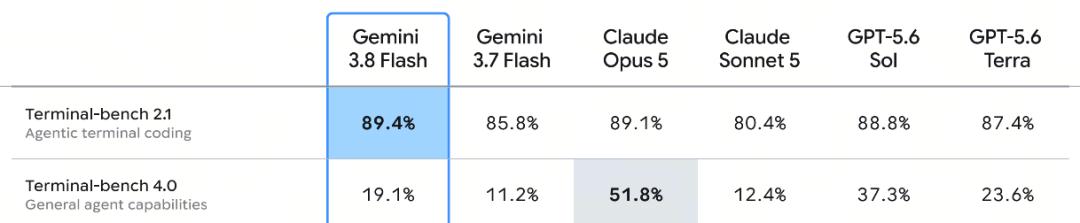
For Terminal-bench, the traditional benchmark for Agent capabilities, it also topped the ranking in the 2.1 version test, scoring 89.45%;
However, in the 4.0 version updated last month, its score dropped to 19.1%, showing unsatisfactory generalization capabilities.
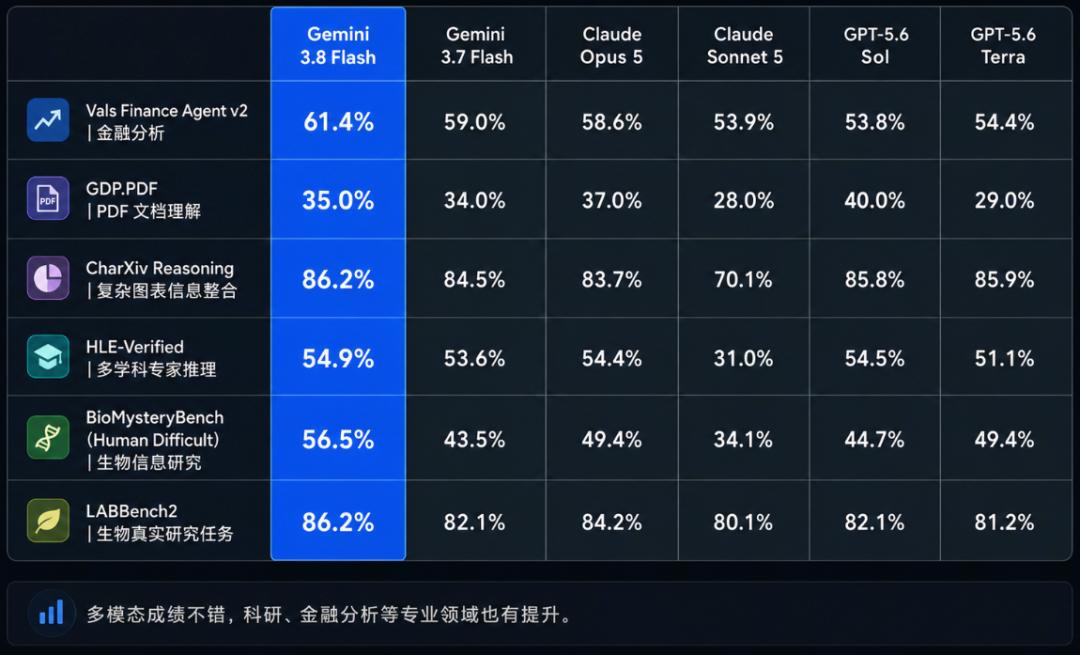
In addition, its multimodal performance remains strong, and it has also made small progress in professional fields such as scientific research and financial analysis.
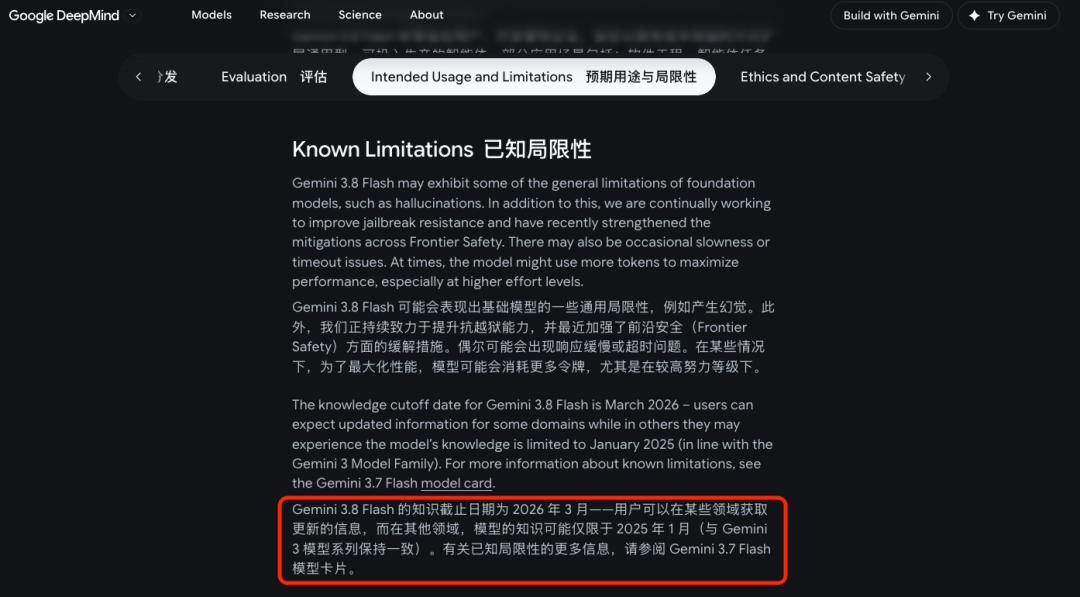
Looking at the more detailed model card, you can see that the world knowledge cutoff of 3.8 Flash is updated to March 2026, which finally incorporates new information.
But the embarrassing part is that Google quickly issued a clarification, stating that only some fields have updated knowledge, and many old fields still have a knowledge cutoff fixed at January 2025...
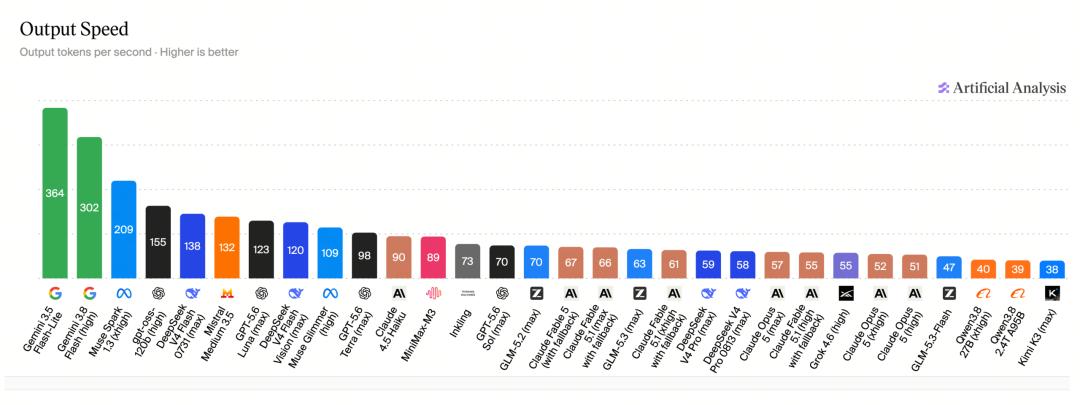
Of course, the highlight is still its cost-effectiveness. This time the performance benchmarks of 3.8 Flash have risen sharply, while its token output speed remains extremely fast.
Looking at the Artificial Analysis ranking, most models have two-digit token output speed, but this one reaches more than 300.
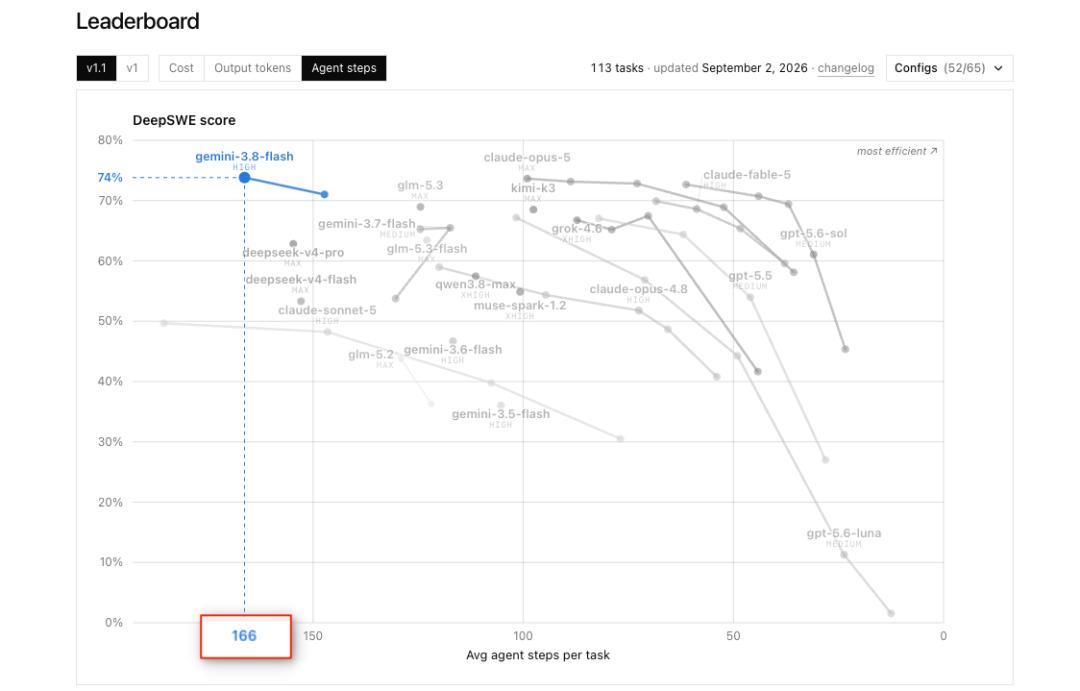
However, compared with previous versions, its task execution speed is actually slightly slower.
Because Google stated that 3.8 Flash will use tools more actively and perform more reasoning steps during work, so that tasks can be completed with higher quality, at the cost of longer delivery time.
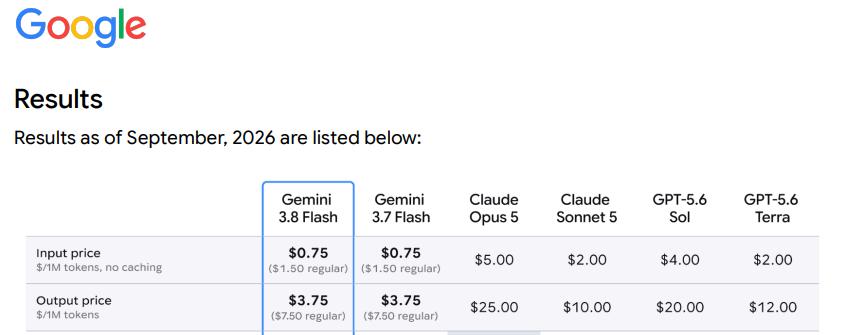
Its pricing is also very competitive. Although Flash's high cost-effectiveness is well known, it is the first time we have seen a manufacturer put the pricing information in the first two lines of the benchmark table and highlight it prominently.
We also did a simple real-world test. To cut to the chase: it is nothing but fast, it works diligently, its intelligence level is average, but the content it generates surprisingly has a very human-like touch...
For example, we asked both models to generate an article about the recent controversial content of DLSS 5.
GPT 5.6 took two and a half minutes to piece together the content before starting to write, but you can immediately sense the distinct AI-generated taste, which is very jarring.
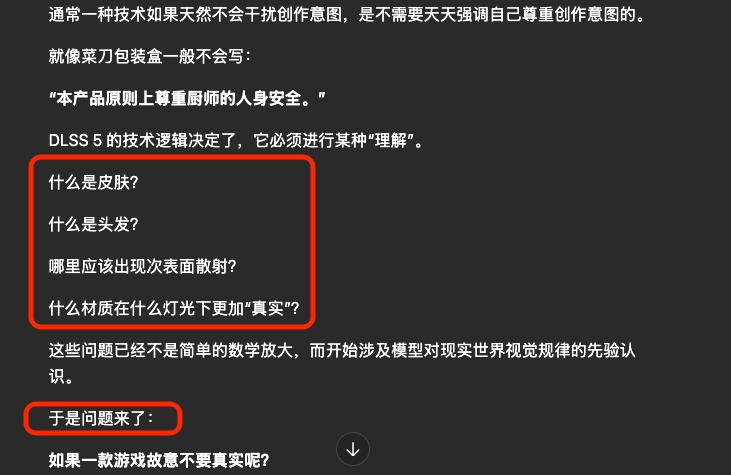
Expressions like "not... but..." that we used to complain about in old versions are gone now, replaced by sentences that are only a few words long, paired with random rhetorical questions and endless parallelism, making the text fragmented and very disjointed...
Gemini 3.8 Flash is a completely different story. It can finish a 3000-word draft in only 17 seconds, any extra second would be an insult to the Flash brand.
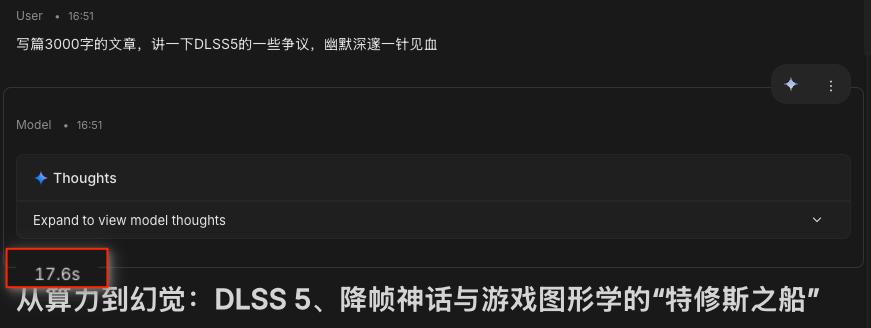
Its wording habits are also completely different, with a sharper style, and it prefers to use popular internet memes for analogies.
Although it occasionally seems to overexert itself, the scene rendering and emotional progression are much smoother, and the reading experience is more fluent, at least not that tedious.
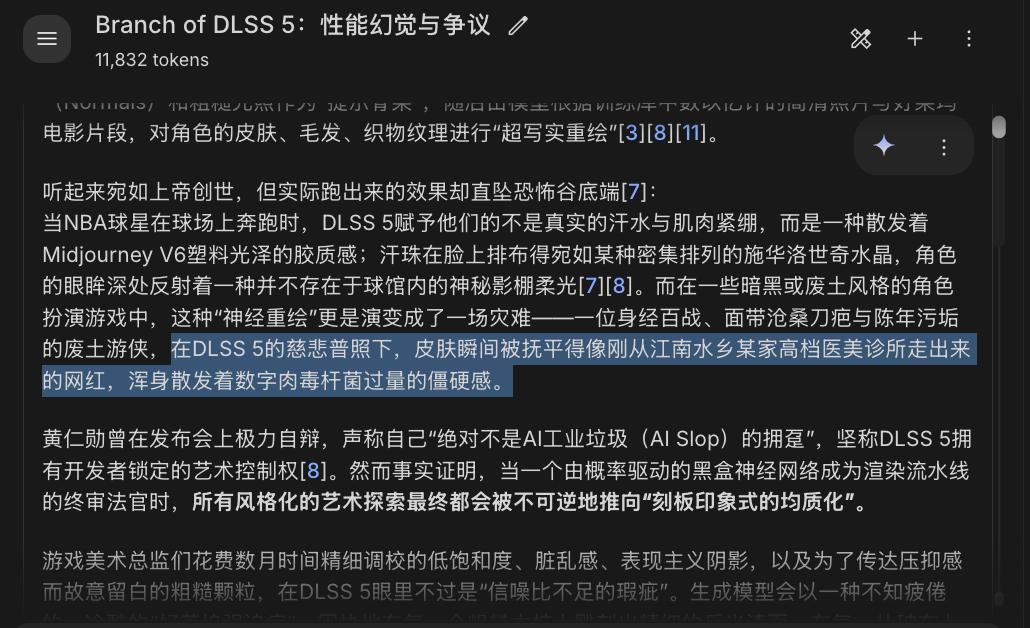
But if you read the content carefully, you will find that both of them are very specialized in their own fields. Although Gemini can write in a natural human-like way, the accuracy of its argumentation is far less rigorous than GPT.
In the following Coding test, its performance is not as outstanding as the benchmark results suggest.
We first conducted a conventional 3D scene modeling test, asking it to restore the rendering style of anime-style mobile games on a web page and create a Japanese-style convenience store.

As far as the result is concerned, it indeed cannot reach the texture of Claude Opus 5 shown in the original author's demo.
The overall structure and style of the model are basically correct, but there are far too few internal details, the light and shadow effects do not follow the prompt requirements, and the overall filter tone is also a grade lower.

For comparison, we then ran the same test with GPT 5.6 Terra and Kimi K3. Although their performance on the benchmark table is comparable, the texture of their outputs is significantly better.
The door of the convenience store can be opened, the edge of the model is added with a very iconic black outline, and there are many more stylized details that fit the anime aesthetic.
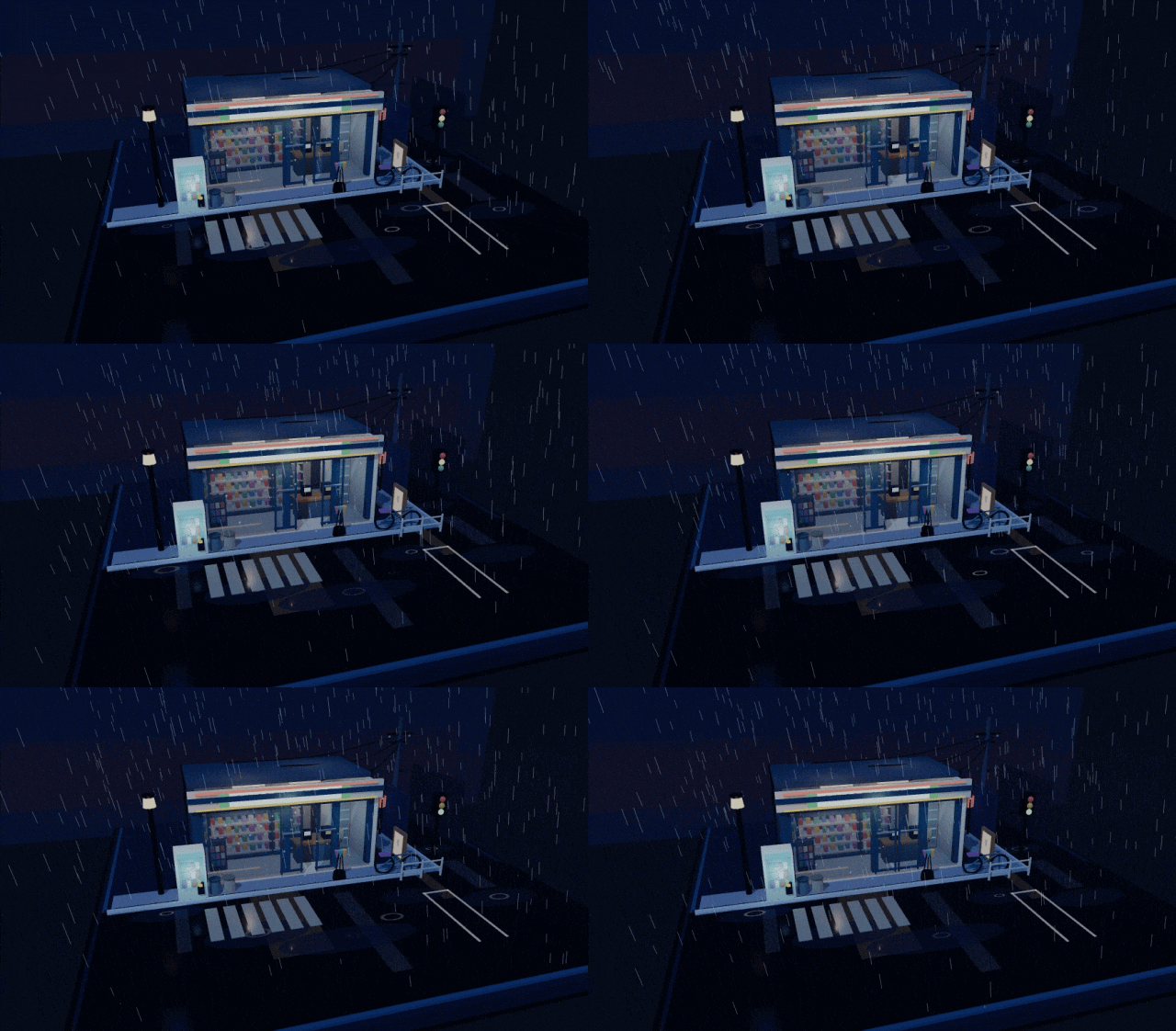

From left to right: GPT 5.6 Terra and Kimi K3
Next, we raised the difficulty level and asked it to recreate the classic Minecraft game.
If you use the web version with a one-sentence prompt, you will experience an extremely fast speed, it can generate the whole game in less than a minute.
As expected, the finished product is very basic, but fortunately there are no bugs: you can mine and place blocks, it is a very minimalist implementation.
But if you upgrade the setup with the toolset from Google AI Studio for assistance, the output quality will improve dramatically.
The details are closer to the original Minecraft, there are more types of blocks, the textures of glass and grass are very accurate, especially the functionality of the game itself is richer: the menu has more setting options, and the game also includes complex systems such as inventory.
It is obvious that Gemini 3.8 Flash with tool support and without tool support are two completely different products.
So I simply installed Antigravity, Google's official local Agent tool, to see if it can deliver better performance with the support of a more professional Harness framework.
However, I still have to complain that compared with applications like Codex and WorkBuddy, the user experience of Antigravity is very poor: no Chinese localization, no skill store, very few third-party plugins, everything looks extremely primitive...
Back to the topic, for this version of Minecraft, I asked it to combine the gameplay of Marvel's Spider-Man, so that players can swing through the city with spider webs.
This time it was not that fast, it took about 8 minutes to output the finished product.

The scene is set in Manhattan, New York, all the classic Minecraft gameplay remains, and the blocks are converted into modern textures that fit the Spider-Man theme better.
Probably because it wrote a project plan before execution, the completion degree of this version is significantly much higher.
Many landmark buildings such as the Empire State Building and the suspension bridge are well restored with blocks, there are also many small details like river-crossing bridges and street lamps, even Steve's character skin is replaced by the Spider-Man skin.
However, the physics judgment of the spider web swinging mechanic is too complex, it still has bugs after several rounds of revision: the speed of Spider-Man is abnormal, he flies up for a while, gets stuck for a while, and twitches back and forth between buildings.
Finally, I tested its code understanding ability, asking it to pull the DeepSeek Harness repository from GitHub and create a wiki that makes the code repository easier to understand.
It spent ten minutes reading the whole project from start to finish, then generated the wiki.
It did not slack off on the content, the architecture design, integrated protocols, and subsequent secondary development standards are all sorted out clearly.
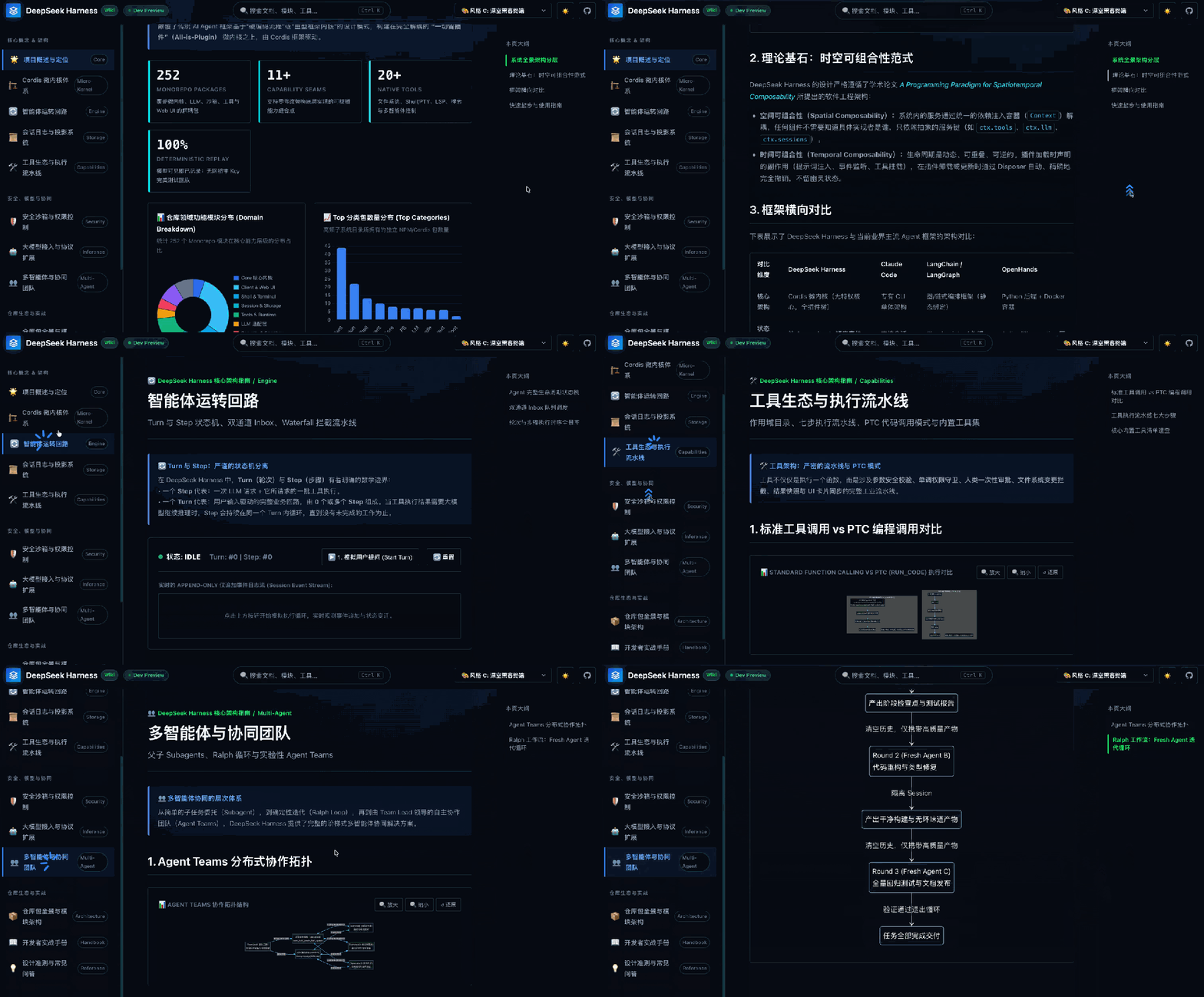
But its aesthetic design still has the inherent AI-generated awkward taste. Later I asked it to install a skill by itself and refactor the front end.
As a result, its old problem flared up again: it finished the installation and execution in 2 minutes in a perfunctory way, the so-called style refactoring was nothing but changing the color. When I checked its thought chain, I found that the skill was installed, but it only called half of the functions and arbitrarily marked the task as completed...