The hourly hotel room business is being preempted everywhere by a group of non-industry "outsiders".
Back in the days when hourly hotel rooms were mentioned, there were always people with a knowing smile, countless unspoken thoughts hidden in their eyes.
For a midday nap, a temporary stopover, or a short break, whenever people needed a private, secluded space for a few hours, their first reaction was always to book an hourly hotel room.
Data from Trip.com shows that since 2024, the booking volume of hourly hotel rooms has increased by 32% year on year, with users born in the 1990s and 2000s accounting for as high as 64%.
However, in the past two years, the business of hourly hotel rooms has been intercepted from all sides.
It is not peers in the hotel industry that are diverting the customer flow of hourly rooms, but various offline business formats that seem completely unrelated to the hotel sector.
Recently, a cinema in Xi'an specially converted two exclusive screening halls into dedicated midday nap rooms, and launched a monthly weekday midday nap card for only 39.9 yuan per person.
Calculated based on 20 working days per month, with 2.5 hours of midday rest each day, the cost is less than 2 yuan per day, which works out to a single consumption even cheaper than a bottle of mineral water.
KTVs, bath centers, internet cafes, gyms, and even midday nap halls in cinemas and shared spaces are all eyeing this lucrative market.
Interestingly, these cross-border players that are snatching orders do not rely on prime locations, fancy decoration or star-level services. Simply by offering lower prices, more freedom and more inclusive rules, they have taken away the vast majority of customer flow.
01
A group of "outsiders" start running part-time hourly room businesses
Nowadays, when people want to find a place to rest, their choices are far more than just hourly hotel rooms.
Most people's impression of KTVs is still limited to the function of singing for entertainment.
However, new types of KTVs on the market no longer generate revenue only by selling private rooms and drinks;
Many young people enter the store, book a small private room, ask the staff for a thin quilt, then lie down on the soft sofa and rest with their eyes closed for two or three hours.
The loud background music playing continuously in the private room can act as white noise, isolating all kinds of interference from the external environment.
By comparing the consumption prices of the two, we can understand why this consumption choice is so popular among young people.
For hourly rooms launched by chain hotels, the 3-hour consumption is mostly between 120 yuan and 180 yuan, and most rooms have time limits, with extra fees charged for exceeding the specified duration;
However, for ordinary KTVs on weekday afternoons, people only need to pay dozens of yuan to rent the space for the whole afternoon. The space here is more spacious, the sofa is more comfortable to sit on, and users will not be disturbed by others, nor do they need to deliberately restrict their own behavior.

Source: Xiaohongshu
Many young people have also discovered more different ways to use KTVs:
If they want to do fitness exercises along with videos, they can cast fitness workout videos on the big screen to exercise; if they want to watch TV series quietly, the viewing experience brought by the large screen is far better than that of mobile devices; if they need to handle work temporarily, the closed private room can also provide an undisturbed environment.
Even more competitive than KTVs are bath centers.
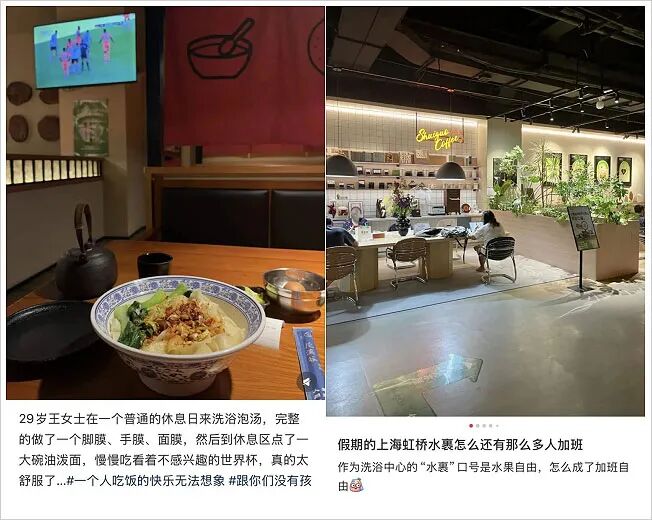
Traditional bathhouses mainly provide services such as bathing and back scrubbing, while new-style bath centers are more like urban rest venues that can meet a variety of needs.
Consumers only need to spend about 100 yuan on a ticket to get 12 hours of access to all facilities in the venue;
They can take a bath and do steam therapy, watch movies, play video games and board games, and also enjoy free snacks;
There are also quiet rest areas and single capsule beds. People can lie down to rest when they are tired, eat delicious food when they are hungry, and participate in various entertainment activities when they feel bored.
Source: Xiaohongshu
Young people are always the most clear-headed when calculating accounts.
Spending 150 yuan to book a 3-hour hourly room in a hotel, you can only stay in a small space, and can hardly do anything else besides resting.
Spending 100 yuan to enter a bath center, you can spend a whole day there, with all your needs for eating, entertainment and sleeping satisfied. The consumption advantage is very obvious in comparison.
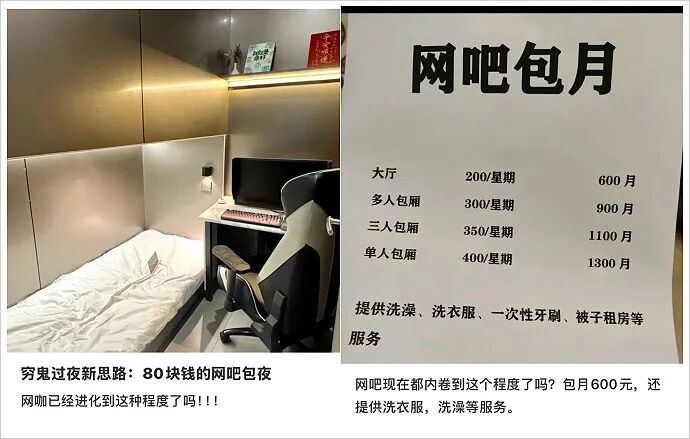
Even the declining internet cafes have quietly achieved a comeback.
For modern new-style internet cafes, the main source of income is no longer the game devices in the open hall, but almost entirely from single private rooms and double-seat private rooms.
Some high-grade internet cafes have even added shower rooms, lazy sofas and fresh air systems.
Compared with the restrictive feeling brought by hotels, the private rooms in internet cafes are more relaxing, and people do not have to worry about extra fees for overstaying. They can lie down to sleep when tired, and sit up to play on the computer after waking up. The overall atmosphere makes people feel relaxed.
Source: Xiaohongshu
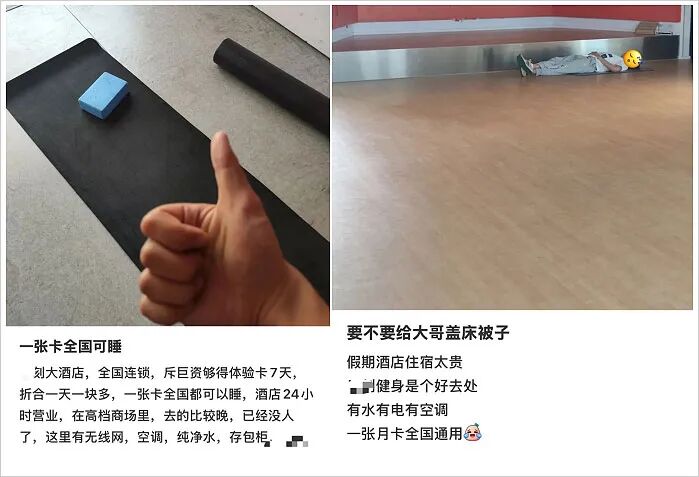
Even gyms that seem completely unrelated to this sector are getting a share of the pie.
Many people who commute long distances, go on business trips, or take short trips will specifically buy a single-visit card or a monthly card;
For only dozens of yuan, they can use the clean shower area and the rest lounge with appropriate temperature. They can not only wash and freshen up, but also store their carry-on luggage temporarily, which perfectly solves the practical problems encountered during short trips.
Source: Xiaohongshu
It can be said that these "part-time" business formats are targeting the core group of customers that used to be the main user base of hourly hotel rooms.
Passengers transferring between high-speed trains, office workers who need a short break during commuting, young people who meet in different cities and do not want to stay for a long time, and users who need to handle private matters temporarily and find a closed space for a short period.
In the past, almost all these demands were met by hourly hotel rooms. Now young people have a large number of alternative options.
02
Hourly hotel rooms start to face internal cutthroat competition
Even with external competitors constantly snatching customers, hourly hotel rooms seem to have started internal friction.
At present, the domestic hotel industry is facing great competitive pressure.
According to the *2026 China Hotel Industry Development Report* released by China Tourism Hotels Association, by the end of 2025, the total number of accommodation facilities in China reached 593,086, with a total of 20,514,799 guest rooms. Among them, there are 374,694 hotel facilities with a total of 18,736,357 guest rooms.
According to STR data, in 2025, the mainland China hotel OCC (Occupancy Rate) decreased by 3% year on year, ADR (Average Daily Rate) decreased by 1%, and RevPAR (Revenue Per Available Room) decreased by 3%.
Against the background of "increasing volume and decreasing price", the hotel industry also needs to reduce costs and increase efficiency.
Selling guest rooms by the hour instead of per night has become a practical choice to cover marginal costs and increase the overall occupancy rate.
Compared with leaving rooms vacant, the cash flow brought by hourly rooms is small, but it is enough to cover variable costs such as water and electricity fees and linen cleaning fees.
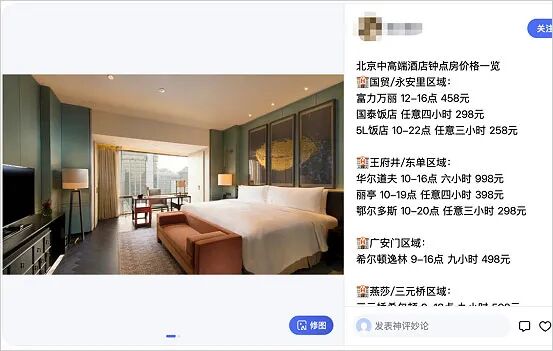
Once upon a time, hourly rooms were exclusive to economy hotels and small independent hotels, and were almost never seen in high-end hotels.
High-end hotels sell experience, privacy and identity recognition, with their core customer groups being business elites and high-net-worth vacationing families who pay for a sense of exclusivity.
Source: Xiaohongshu
However, reality is more important than saving face. Now, when you open OTA platforms, you will find that more and more high-end hotels are quietly and intensively joining the hourly room market.
Even luxury hotels are actively entering this market. Marriott has Stay for the Day, Hyatt has Office for the Day, Hilton has WorkSpaces by Hilton, etc. These international hotel groups launch daytime room services through official channels or third-party platforms, usually offering them to business travelers at a discount lower than the overnight room rate, with access to hotel facilities included.
However, as more and more hotels enter the hourly room business, many contradictions and problems have emerged.
The main problem of hourly rooms lies in operation and management.
High-frequency check-ins and check-outs in a short period of time greatly increase the frequency of guest room cleaning, and at the same time, the workload of front desk reception, room status management and system switching also increases significantly.
If the hotel does not have sufficient staff and good management capabilities, selling more hourly rooms will bring greater operational risks to the hotel.
In addition, there are sometimes demand conflicts between hourly room guests and traditional overnight guests.
The laundry room is a typical example. Hourly room guests use the washing and drying equipment in a concentrated period, leaving overnight guests unable to get their turn, which reduces the experience of both sides.
If high-end business hotels attract a large number of guests who come only to do laundry or take a short rest, it may also damage the quiet atmosphere and the brand image.
It is not cost-effective in any calculation to lose long-stay business guests with higher unit consumption just to earn a few dozen yuan.
There are cross-border business formats snatching business from outside, and multiple shackles of cost, reputation and customer complaints inside.
The hourly room business, which once seemed very profitable, is facing continuously rising profitability difficulties.
03
In the era of fragmentation, what should the hotel industry hold on to?
The fact that cross-border players have entered the short rest track in succession essentially reflects the outbreak of fragmented demands of the whole society.
Urban population mobility is accelerating, and there are more and more scenarios of transfer, commuting and temporary stay.
People no longer only have the accommodation demand of staying overnight. Paying by the hour and using the space on demand, this consumption logic is penetrating into every corner of life.
Not only rest, but also short-time work, short-time parties, short-time private stay are all spawning a large number of space products charged by the hour.
Hourly rooms are just one branch of the huge short-time space consumption market.
In the future, it will not only be KTVs, bath centers and cinemas that compete for this business. More new shared spaces, hourly room studios and smart rest capsules will keep emerging. The competition in this market will only become more and more fierce.
But this does not mean that hourly hotel rooms will completely disappear.
Cross-border alternatives have their own advantages, but they also have unavoidable shortcomings.
The bath hall lacks sufficient privacy, people can only lie down simply to rest in the cinema midday nap hall, and the e-sports private rooms have noisy environments.
They can meet light, low-cost short-term demands, but it is difficult for them to replace the complete accommodation experience brought by the standardized guest rooms of hotels.
The real problem is that the hotel industry can no longer stick to the old mindset, regarding hourly rooms as "leftover materials" of idle guest room resources.
Looking beyond the hourly room business itself, what is more worth thinking about is the attitude of the hotel industry in the face of cross-border competition.
For a long time in the past, the only competitors of hotels were other hotels. Everyone competed for locations, hardware, membership systems and prices, engaging in internal friction within the accommodation industry.
But now, competition has gone beyond the boundaries of the industry. The business that snatches your customers may not come from a newly opened hotel of the same price next door, but from merchants in completely different tracks such as cinemas, bath centers and internet cafes.
All walks of life are revitalizing idle spaces and tapping short-time consumption potential. Hotels hold a large number of standardized private spaces in cities, which is a unique advantage asset.
If hotels always operate with old-fashioned ideas, their market will be continuously eroded by external business formats.
The changes in the hourly room business are just a microcosm.
As accommodation consumption demands have become fragmented, users no longer only need to "stay for one night".
How to adapt space resources to diverse short-term demands, hold on to their own core advantages, and face competitors from cross tracks directly, will be a proposition that the hotel industry must continue to deal with in the future.
In the era of fragmentation, what can most win people's hearts is still the empathy between brands and users.
Whoever can quickly identify and amplify these fragments with emotional value will grow into an evergreen tree in the resonance of users.
This article is from the WeChat official account "Hotel Management Finance", and is authorized for release by 36Kr.