Is it still viable to expand overseas business to the Middle East?
Why have Gulf countries stopped automatically recognizing patents issued by member states? Why is the balance of power among various domestic forces in Iran quietly shifting, and how will it shape regional situations? These seemingly scattered details all point to the same question that is being redefined: is expanding business to the Middle East still a viable option?
In the past few years, "going global to the Middle East" was once simplified as a slogan: The window of opportunity has opened, Gulf capital is abundant, and energy transformation brings new tracks. Amid the changing landscape, the Middle East is evolving from an "oil production region" to a "strategic hub". For Chinese enterprises, the Middle East is not only one of the markets with the most concentrated opportunities, but also a "battlefield" with the most complex risks.
However, the US-Israel-Iran conflict since the beginning of this year has brought the complex side of this market back to the center of attention. On one hand, there is extreme sensitivity of government procurement to brands and technologies, on the other hand, local conflicts may disrupt the rhythm of the supply chain at any time; on one hand, there are opportunities brought by sovereign wealth funds totaling 6 trillion US dollars seeking allocation outlets outside Europe and the United States, on the other hand, there are compliance costs and risks brought by interrupted mutual recognition of patents, labor ratio requirements, long-arm jurisdiction and other factors.
The Middle East has never been a market that can be explained with a single narrative. It is more like a layer upon layer nested chess game. Who is setting up the game, who is playing the game, and who is just a pawn unable to control its own fate? Is there an end to geopolitical risks? Should enterprises make long-term investments in a region where conflicts have become normalized?
On August 14, at the "Jiandao" Salon event of Fudan University EMBA, Professor Sun Degang, Assistant Dean of the Institute of International Studies of Fudan University and Director of the Middle East Studies Center, Professor Shen Ning from the College of Business and Economics of United Arab Emirates University, and Associate Professor Li Zhiguo from the Department of Applied Economics of Fudan University School of Management, focused on the theme of "going global to the Middle East", and put forward three mutually verified analytical clues from three levels respectively: geopolitical deconstruction, front-line methodology and the industrial framework of Chinese enterprises' globalization.
Who is playing the chess game, and what is the game about?
Sun Degang proposed to understand the Middle East game as a "chess game": extra-regional powers such as the United States are the game setters, regional countries such as Saudi Arabia, Turkey, Iran and Israel are the chess players, non-state actors such as Hamas, Hezbollah and the Houthi armed forces are the "pawns", while countries such as Lebanon, Yemen and Iraq are the venues where the game takes place rather than the subjects, and in a sense, they are the "chessboard" itself.
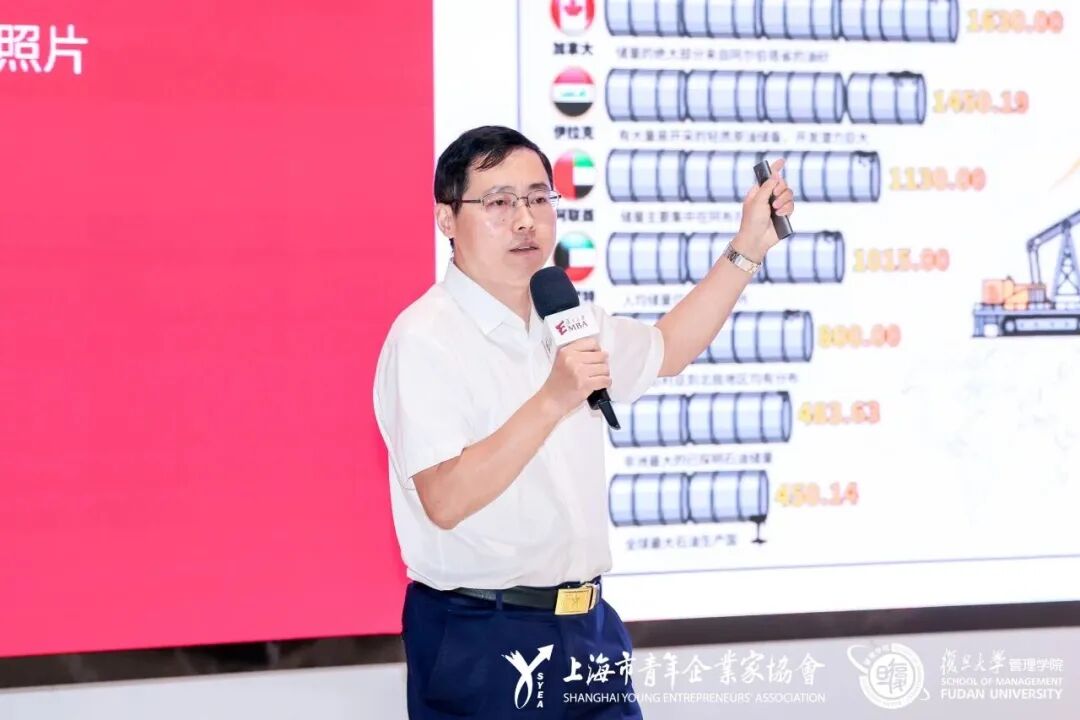
In Sun Degang's view, the reason why the Middle East has long occupied the core position of the global agenda stems from four superimposed attributes.
The first is energy politics. The Middle East concentrates about half of the global oil production capacity and about 40% of the global natural gas production capacity. In recent years, the dollar standard system with the petrodollar as the core has been threatened, and the financial war among major powers has intensified. The United States attempts to control oil resources and maintain the fundamental position of the US dollar in oil pricing and transactions by waging wars.
The second is geopolitics. One canal (Suez Canal), two oceans (Indian Ocean to Atlantic Ocean), three continents (Europe, Asia and Africa), four major ethnic groups (Arab, Jewish, Persian, Turkic), and five surrounding seas (Caspian Sea, Black Sea, Mediterranean Sea, Red Sea, Arabian Sea) make the Middle East the de facto throat of the global supply chain.
The third is religion-related politics. All three major monotheistic religions originated in Jerusalem. Within Islam, the Sunni and Shia sects have derived multiple branches respectively. The complexity of sectarian relations itself is the structural root of repeated regional conflicts.
The last is technology-related politics. Artificial intelligence and big data are rewriting the form of warfare, and technology enterprises are more deeply involved in national defense issues. Sun Degang summarized this trend as the transformation "from military-industrial complex to sci-tech industrial complex".
Sun Degang divided the recent round of US-Iran conflict into four stages: full-scale war period, period of fighting while negotiating, temporary ceasefire period, and the subsequent intermittent conflict period. At present, the conflict presents a lose-lose situation of "tactical success but unachieved strategic goal". The United States and Israel failed to achieve the strategic goal of overthrowing the Iranian regime, while Iran suffered heavy losses in air defense, naval and air forces.
At the same time, the domestic power structure in Iran is undergoing subtle shifts: The traditional power structure with the clerical group as the core has been relatively weakened, and the influence of the military group represented by the Islamic Revolutionary Guard Corps has risen. This change directly affects the toughness and predictability of negotiations.
For enterprise decision-making, Sun Degang believes that the long-term nature of the conflict itself may be the most realistic premise for understanding and entering the Middle East. Compared with a full ceasefire or a full-scale war, the Middle East is more likely to present a state of local small-scale wars or medium-scale wars.
China has maintained strategic restraint of promoting peace and negotiations in this round of conflict, which objectively creates space for foreign trade and the period of strategic opportunities. For example, in 2024, China has become the largest trading partner of most Middle Eastern countries, and the trade volume between China and Gulf countries far exceeds the trade volume between the United States and Gulf countries.
From the perspective of the capital market, the scale of sovereign wealth funds of Gulf countries exceeds 6 trillion US dollars, the vast majority of which are allocated in European and American markets. This capital structure has loosened under the reshaping of the geopolitical pattern, which is a window worthy of active efforts by cities such as Shanghai, but the window period coexists with uncertainties.
The Middle East is not "one single" market
Shen Ning has been teaching at the United Arab Emirates University for more than 20 years, and is one of the few Chinese scholars deeply involved in the research and practice of Chinese enterprises' internationalization on the front line. She believes that discussing the "Middle East" as a single market is a methodological error in itself.
This is particularly obvious after the recent conflicts. In the past, enterprises often defaulted that entering any member state of the Gulf Cooperation Council (GCC) would practically cover the entire Gulf market. However, taking recent patent applications as an example, Shen Ning pointed out that this assumption is no longer valid due to UAE's withdrawal from the GCC. Patents applied for in the UAE are no longer automatically mutually recognized by other GCC member states, and the certification subject needs to apply separately in each target country, which systematically increases compliance and operation costs. She summarized the differences in the internal markets of the Middle East along two axes:
The first is purchasing power and brand sensitivity. Gulf oil-producing countries have strong purchasing power, and are highly sensitive to brands, quality and technology, which is particularly obvious in government procurement scenarios.
The second is market capacity and business environment. Large populous countries such as Egypt have larger market capacity, but high price sensitivity and relatively low transparency of the business environment. Even within Gulf countries, there are obvious divergences among countries in terms of market scale, access system, channel structure and consumption habits. The question of "whether the Middle East market is large or not" only makes sense when broken down into two dimensions: country and industry.
Facing multiple highly heterogeneous markets, Shen Ning proposed a replicable "from outside to inside" research path.
The first step is to complete desk research using public information, including country reports released by the commercial and economic offices of Chinese embassies and consulates abroad, public information of local investment promotion departments, statistical data from institutions such as the customs and the International Monetary Fund, and channels of industry associations and the China Council for the Promotion of International Trade.
The second step is to participate in international exhibitions. There is no need to set up exhibitions in person, but more to observe the local business ecosystem and competition pattern by participating in exhibitions. She reminds enterprises that after going abroad, their real competitors are often not other Chinese enterprises, but enterprises from Europe, America, India, Japan and South Korea.
The third step is to contact Chinese enterprises that have already settled down and alumni networks through occasions such as exhibitions to collect first-hand information. On this basis, visit end customers to verify the independent judgments previously formed based on public information.
The last step is small-scale pilot, to conduct on-site verification around four dimensions: product (re-creation of physical form and positioning), price (local pricing anchor), channel (distribution structure selection), and promotion (local influencers and communication paths).
"Enterprises should negate their first conclusion", Shen Ning emphasized specially. Public information is available to everyone, and the first conclusion drawn by enterprises is often based on the same information, which easily leads to highly similar strategic paths, and eventually evolves into internal competition among enterprises going global. A differentiated strategy based on in-depth research is the real barrier.
For the question of "whether long-termism can be discussed under the normalization of conflicts", Shen Ning believes that risk and long-termism are two independent variables. Risk has never been absent in the Middle East, but this does not mean that a long-term strategy cannot be established. On the contrary, real long-termism should be built on the premise of acknowledging the existence of long-term risks, rather than relying on blind optimism. She gives three judgments that support long-term confidence:
First, the structural demand of Gulf countries for economic transformation has not disappeared due to conflicts, but has been further strengthened after the vulnerability of the single-resource export model is exposed.
Second, the comparative advantages of Chinese enterprises have expanded from pure cost to the integrity of the industrial chain, technological iteration capabilities and complex project organization capabilities.
Third, the pioneering Chinese enterprises, especially central SOEs and state-owned enterprises along the Belt and Road Initiative, have completed basic accumulation in risk tolerance, local team building, compliance and social trust, which objectively lowers the threshold for latecomers. "The old brand perception that Chinese goods are cheap and low-quality has changed."
Decent Global Expansion: From "Going Out" to "Going In"
In 1995, among the Fortune Global 500, there were 151 US enterprises, 149 Japanese enterprises, and only 3 Chinese enterprises. By around 2019, the number of Chinese enterprises on the list exceeded that of the United States for the first time. Since then, the two countries have alternately led in the range of 120 to 140 enterprises for a long time, while the number of Japanese enterprises has continued to decline to more than 30.
In Li Zhiguo's view, this list, ranked by sales revenue, hides a key problem: Large Chinese enterprises generally have two characteristics: weak profitability and excessive concentration of business in the domestic market, which are essentially different from truly globalized companies.
He disassembled the global competitiveness of enterprises into four layers of progressive capabilities: the ability to develop and control the global market, the global resource allocation capability that supports its realization, the global talent integration capability that supports market development and resource allocation, and the global influence of corporate culture that runs through the above three and determines its sustainability. He believes that Chinese enterprises going global should not just be because the domestic market is too competitive. On the contrary, If you already feel fierce competition in the domestic market, going global may not be the optimal choice. The premise for Chinese enterprises to go global is that some industries already have real global competitiveness, and going global is just a natural extension of this capability.
"The scarcest resource for Chinese enterprises going global is neither technology, orders, nor capital or talent, but trust," Li Zhiguo emphasized. The essence of the process of brands going global is a process of continuously winning the trust of end users, and trust is precisely the resource that is most difficult to purchase directly through capital or speed. Based on this, he proposed two key shifts at the strategic level.
The first is from "going out" to "going in": going out solves the problem of building factories and opening stores at the physical level, while going in means truly entering the mind and decision-making logic of end users. It is a customer-centered process that continuously extends the value realization chain. Li Zhiguo took the transformation of Yiwu small commodity market as an example: the shift from the early supply thinking of "world supermarket" to the demand thinking reflected in national pavilions and platform-based procurement mechanisms in recent years is a microcosm of this shift in the domestic market.
The second is shifting from single product export to ecological collaboration: the early product trade model has low added value and fierce homogeneous competition. The future global expansion path should cover technology export, brand building, production capacity layout and standard formulation, form a collaborative relationship at the level of the whole industrial chain, shift from competition thinking to cooperation thinking, and from industrial thinking to ecological thinking.
Li Zhiguo believes that Chinese enterprises' global expansion has entered the 3.0 stage. In the 1.0 stage from around 1980 to 2000, the market label of Chinese goods was "cheap", relying on the advantage of domestic labor cost, with export trade as the main form, which was essentially the output of low-end factors. The more than 20 years after China's accession to the WTO is the 2.0 stage, the terminal output capability has been continuously enhanced, and the category coverage has been continuously improved. Chinese products are not only "cheap" but also "easy to use", but they are also easily regarded by overseas markets as a threat to local industries.
The 3.0 stage marks Chinese enterprises that truly have global competitiveness. This stage no longer only relies on "cheap and easy to use", but needs to realize the third label in the sense of industrial upgrading, technological breakthrough, brand value and ecological collaboration: "decent". Instead of squeezing competitors out by low cost, it will expand the market and share the incremental benefits.
Back to the specific market of the Middle East, Li Zhiguo believes that there are two clear main lines of complementarity between Chinese enterprises and Gulf countries: the first is energy transformation. While maintaining oil exports, Gulf countries are accelerating the layout of photovoltaic, wind power, green hydrogen and energy storage, which exactly corresponds to China's comparative advantages in new energy manufacturing and engineering capabilities; the second is artificial intelligence and digital economy. Gulf countries regard AI as "oil in the new era", and China has realistic participation space in directions such as computing power infrastructure, high-performance computing clusters and liquid cooling technology, and joint R&D of localized large models.
For enterprises planning to actually enter the market, Li Zhiguo put forward three risk management principles: be alert to policy access barriers and the risks of long-arm jurisdiction and secondary sanctions (especially from the United States); strictly follow the local labor ratio requirements of Saudi Arabia and other countries at different stages of construction and operation; establish a multi-stakeholder alliance including the core Chinese technical team, local capital and political and business partners, and expatriate local operation teams, to bind the enterprise's own commercial success with the host country's employment, tax revenue and even industrial transformation goals, rather than just completing a one-time transaction.
This article is from the WeChat official account "Fudan Business Knowledge" (ID: BKfudan), author: Management Horizons, published with authorization from 36Kr.