Volkswagen abandons its benchmark factory, and Germany is following the old path of Detroit.
On June 26, 2020, when the sweeping first wave of the global COVID-19 pandemic had just subsided, a 7th-generation Golf R Variant was rolling off the production line in Zwickau, a small city in eastern Germany.
Major German media outlets, as well as numerous well-known bloggers from Germany and even across Europe, were invited to attend the roll-off ceremony, as this was the last internal combustion engine vehicle ever manufactured at this plant.
For this moment, Volkswagen invested approximately 1.2 billion euros to completely renovate an old factory built in 1990, turning it into Europe's first large-scale complete vehicle factory dedicated entirely to pure electric vehicles. The plant has a planned annual production capacity of 330,000 units, manufacturing the ID.3, ID.4, ID.5, Audi Q4 e-tron and Cupra Born, and it also supplies the body-in-white for the Bentley Bentayga and Lamborghini Urus.
However, only six years later, this very same factory appeared on the production suspension list in a supervisory board document. The internal board document numbered 3.5.1.2 states clearly in its main text that Zwickau is scheduled to cease vehicle production operations in 2031.
But Zwickau is far from the only plant scheduled for closure in the board's plan. Citing the document disclosed by Germany's *Wirtschaftswoche* and *Handelsblatt* on September 1, Volkswagen's production sites in Emden and Hanover, Germany, as well as Audi's plant in Neckarsulm, are also planned to halt production in 2031, 2032 and 2034 respectively. The four factories face a combined risk of around 45,000 job cuts, involving an annual total vehicle production capacity of about 750,000 units.
Such a plan is naturally "unpopular". On July 9, the day the Volkswagen Supervisory Board held its first official meeting to discuss the plan, employees of the Volkswagen Group staged simultaneous protests at more than a dozen group-owned plants across Germany. At the Wolfsburg headquarters, around 400 people gathered in front of the senior management office building, blowing whistles and waving union flags to express their dissatisfaction.
Christiane Benner, Chair of IG Metall, described the plan as an irresponsible threat. Daniela Cavallo, Chair of the Group General Works Council, directly told employees that this crisis was not caused by workers, the management must do their part, and so must politicians, as the employees have already fulfilled their obligations. She then presented a more startling calculation: according to internal notifications obtained by *Handelsblatt*, if the board moves forward with the new layoff plan and the four factories cannot find follow-up production tasks in the next decade, up to 115,000 jobs in Germany could be at risk.
The composition of this figure is no mystery. Cavallo's calculation adds up as follows: Blume recently stated for the first time that around 50,000 additional jobs will be cut globally, about half of which are in Germany, that is, around 25,000. This is on top of the previously agreed 50,000 job cuts, plus around 40,000 jobs that would be affected if the four factories have no follow-up production tasks.
In response to this statement, *Handelsblatt* that reported the incident emphasized that 115,000 is not the official target of the board, but an estimate under extreme scenarios. However, industry analysis institutions have also issued a warning from another perspective: if another 50,000 jobs are cut, more than 200,000 jobs in related suppliers, logistics providers, and even surrounding hotels and bakeries could be affected, and the risk of a Detroit-style recession is not unrealistic.
Politicians quickly made their statements. Lower Saxony's Minister-President Olaf Lies explicitly rejected the factory closures, calling on the Volkswagen Group to come up with a "European strategy to counter China's price pressure". The situation grew so large that a vehicle group's layoff and factory closure plan eventually forced German Chancellor Friedrich Merz to step forward, emphasizing that the government is committed to improving corporate competitiveness.
Academic judgments are clearly divided. Automotive expert Ferdinand Dudenhöffer believes that no factories will eventually be closed, and at most only the Neckarsulm plant will be shut down. According to optimistic estimates, the final number of layoffs implemented by the Volkswagen Group will be around 30,000 to 40,000.
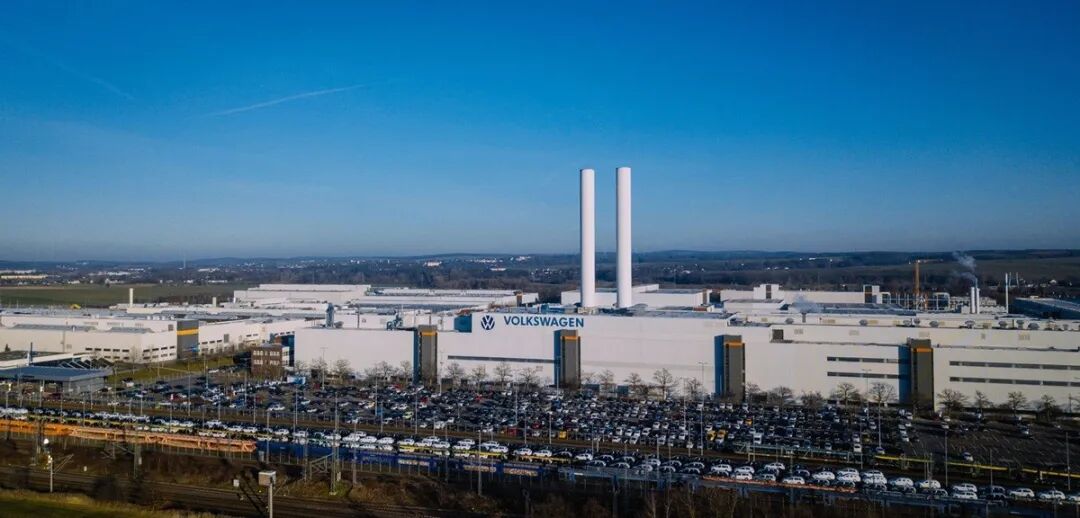
Figure | The Zwickau plant, once a model "ICE-to-EV" transformation factory upgraded by Volkswagen with huge investment
What angers German workers is not only the risk of losing their jobs, but also a glaring paradox: the facilities that may be shut down this time precisely include the factories where Volkswagen made the most determined investments in electrification and completed the most thorough transformation in past years.
A "Silent" Exit
To understand this "death list", we must first clarify the positioning of the four respective factories.
Zwickau and Emden are the model plants. The transformation of Zwickau cost around 1.2 billion euros, and Emden around 1 billion euros. Both plants were promised to become the earliest large-scale bases in Europe that produce only pure electric vehicles.
Hanover has a different positioning. It is the headquarters of Volkswagen Commercial Vehicles, which has produced the famous Bulli since 1956. Today it manufactures the T6.1, T7 Multivan and all-electric ID. Buzz at the same time, and also produces heat exchangers and cylinder head castings. Volkswagen once invested an additional 680 million euros to transform it into a multi-brand factory, which has been OEMing three pure electric SUVs for other group brands since 2024. This is a factory in the middle of transformation, with three completely separate production lines for internal combustion engine, hybrid and pure electric vehicles.
Neckarsulm is a completely different case. It is Audi's major internal combustion engine vehicle hub with 15,509 employees, producing the A5, A6, A8 and their derivative models, mainly based on the longitudinal MLB Evo platform. Electric vehicles are also produced on the premises, but that is the e-tron GT in the Böllinger Höfe workshop, which shares the J1 platform with the Porsche Taycan, is manually assembled by technicians, and has a very low output.
Therefore, it is inaccurate to generally refer to the four factories as MEB plants. Two are pure electric model plants, one is a mixed-line plant in transition, and one is a major internal combustion engine production hub. What Volkswagen is cutting is not a failed product of a certain technical route, but four production capacities that are no longer sustainable under Germany's cost structure.
The destination of the original production capacity of the aforementioned plants after the closures is also clearly stated in the internal document: The successor models of the Emden-produced ID.4 will be transferred to Mladá Boleslav in the Czech Republic, the successor models of the Zwickau-produced Q4 will be transferred to Bratislava in Slovakia, and the T8 from Hanover will be transferred to Poznań in Poland. Among the four factories, only Neckarsulm, which produces Audi models, will keep the production capacity of the successor A8 models in Germany, with plans to transfer it to Volkswagen's Leipzig plant.
The impact radius extends far beyond the factory walls. More than 60,000 people work at the main plant in Wolfsburg, where Volkswagen's headquarters is located, and the industrial identity of the entire state of Lower Saxony is almost tied to the company. When Lies visited the Hanover plant on August 24, he said, "Lower Saxony is an automotive industrial region, and it must remain so."
The weight of this statement lies in the fact that this list actually announces a loosening of Germany's post-war industrial covenant. The co-determination system, the employment security guarantee until 2030, and the no-forced-layoff commitment, these institutional arrangements that form the cornerstone of Germany's social market economy, were once regarded by the whole world as a model against unregulated capitalism.
What Volkswagen is trying to do now is to let the factories die naturally without touching the text of these institutions, then move the vast majority of production capacity of these plants out of Germany.
Another point that angers German workers is that the schedule is aligned precisely to an uncomfortable degree. The employment security agreement that prohibits forced layoffs expires on December 31, 2030, and the first wave of production suspensions is set for 2031.
German media also mentioned an untested legal interpretation that terminating production may not require supervisory board approval like a formal factory relocation. If this interpretation holds, the most powerful barrier of Germany's co-determination system will be bypassed. The management can assign successor models one by one to low-cost factories during the guarantee period, and after the guarantee period ends, let the existing models complete their life cycles, leaving the factories empty naturally. No votes, no formal closure orders, only a silent exit.
The state of Lower Saxony is not unaware of this. With 20% of the voting rights and the 80% approval threshold stipulated in the *Volkswagen Law*, the state holds a de facto veto power, and the labor representatives and state government representatives hold a total of 12 seats on the 20-seat supervisory board.
Of course, such a well-calculated, fully implemented plan that is considered extremely malicious by the labor side has actually hit a wall once before.
At the end of June this year, *Manager Magazin* first disclosed that the board was brewing an internal document named *Group Target Blueprint 2030*, which involved closing four German factories and cutting up to 100,000 jobs globally. The first reaction of German public opinion was disbelief.
At the supervisory board meeting on July 9, Blume formally submitted a 40-point restructuring plan for the supervisory board's vote. However, this restructuring plan failed to pass. According to details disclosed by Germany's *Finanzen* magazine, the meeting that ultimately vetoed the plan lasted for more than five hours, but ended without result. After the meeting, the group only announced measures that do not involve specific plants, such as gradually reducing the model lineup by up to 50%, cutting configuration complexity by three quarters, and compressing global production capacity to 9 million units per year, while the factory closures and new layoff plans were completely blocked.
That is why the vote on September 4 is called a decisive node. However, according to disclosures by *Wirtschaftswoche*, the state government's actual bottom line has loosened a little: it does not set fundamental obstacles to the plants being repurposed, provided that a future for the plant sites is preserved. The dispute is not about whether car manufacturing must continue, but about preventing the sites from turning into ruins.
Clarifying these facts, we will also find that besides job losses, what particularly angers German workers is an obvious "paradox": the factories sentenced to death this time are precisely the facilities where Volkswagen made the most determined investments and the most thorough transformation in electrification.
The Moat Drained Away
Then why does Blume push this plan forward in the face of widespread opposition? The direct reason is that the books are no longer sustainable. According to Volkswagen's official financial report, sales revenue in the first half of 2026 was 158.1 billion euros, a slight year-on-year decrease of 0.2%, operating profit was 5.931 billion euros, a year-on-year decrease of 11.6%, operating profit margin fell from 4.2% to 3.8%, and vehicle deliveries were 3.997 million units, a year-on-year decrease of 8.4%.
Arno Antlitz, Group CFO and COO, said bluntly at the earnings conference that the 3.8% operating profit margin is too low, which confirms the urgency of taking action. The Chinese market is the main drag, with deliveries falling 26% in the first half of the year.
But the truly fatal factor is not the decline in sales, but the loss of control over the cost structure. According to internal presentation materials disclosed by *Der Spiegel*, the average cost for Volkswagen to assemble a car at its German plants is close to 6,500 euros, and Blume compared this figure with the 2,000 to 2,400 euros at BYD's Hungarian plant in the same document.
The goal he put forward at the earnings call in April is to reduce the per-unit factory cost to around 3,000 euros, and he admitted that although the cost of German factories has been cut by more than 20% in 2025, Germany still has more work to do. In terms of hourly wages, data from the German Association of the Automotive Industry shows that the average hourly wage in the German automotive industry in 2023 was around 62 euros, while that in the Czech Republic was only around 21 euros.
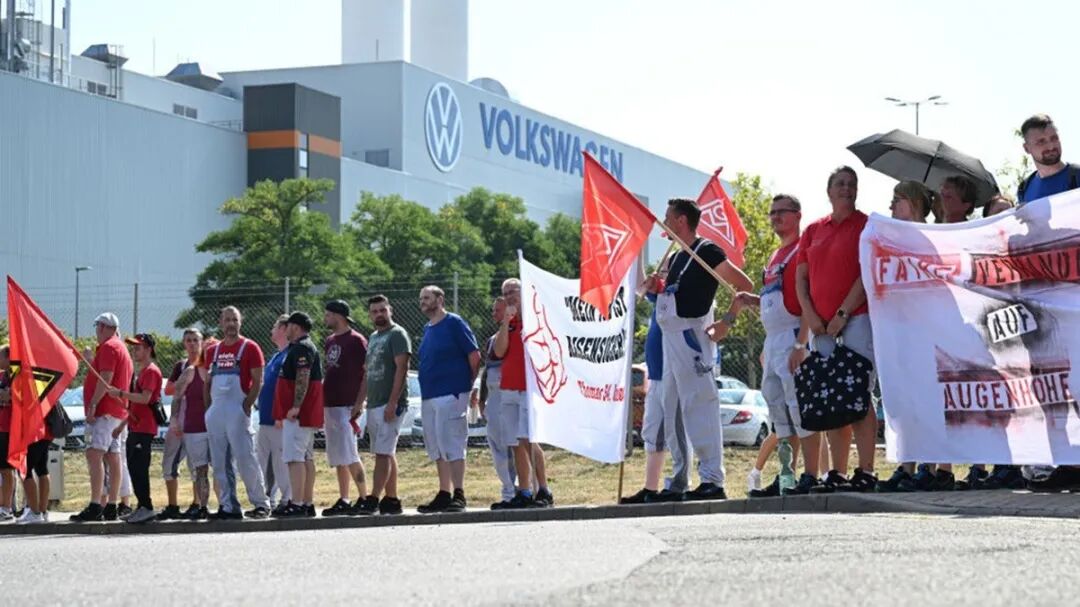
Figure | In the past two years, protests triggered by transformation and layoffs at the Volkswagen Group have occurred more than once
This gap has always existed, so why is it unsustainable now? One reason is the broken cash flow. In the past, Volkswagen could tolerate the high cost of its German domestic plants because the profits from its Chinese joint ventures could cover the gap, which was around 4.4 billion euros in 2019. According to Volkswagen's official guidance, the operating profit recognized under the equity method in China in 2026 is only in the range of 200 million to 600 million euros, and the actual figure in the first half of 2026 is only 184 million euros, a 63% drop from 506 million euros in the same period of the previous year.
Once this cash flow dries up, the high cost of German factories loses its buffer. According to *Der Spiegel*, US tariffs also draw around 5 billion euros from the group every year. The other reason is more profound and harder to admit. Electrification has not consolidated the status of German factories, but drained away the technical barriers they relied on for survival, in a more thorough way than imagined.
Data from AlixPartners cited by the International Labour Organization shows that assembling an internal combustion engine takes 6.2 working hours, and a dedicated hybrid engine takes 9.2 working hours. The drive motor of an electric vehicle, on average, only takes 3.7 working hours. But the real key is not the working hour figure itself, but who performs these working hours. Research from FEV cited by the International Council on Clean Transportation points out that the most expensive exclusive components of electric vehicles are battery packs and motors, which are purchased externally by Volkswagen, and the assembly work takes place outside Volkswagen's factories. In complete contrast, the most expensive, complex, and process-accumulation-dependent components of ICE vehicles, such as engines, gearboxes and exhaust aftertreatment systems, are mostly produced in-house at Volkswagen's German plants.
In other words, in the ICE era, German factories mastered the highest value-added part of vehicle production, and high wages were offset by high value increments. In the EV era, the highest value components are transferred to external suppliers, and what remains in German factories is mainly final assembly, which is exactly the most homogeneous part of the entire value chain and the easiest to be impacted by cost comparisons.
In short, Volkswagen has invested a total of around 2.2 billion euros in the Zwickau and Emden plants to transform them into the most advanced electric vehicle factories. The transformation itself is a success, but after the transformation, the division of labor of these two plants within the group has become more replaceable.
The capacity utilization curve pushes this logic to the extreme. According to industry data cited by Reuters, the average capacity utilization of Volkswagen's German vehicle plants this year is around 81%, and may drop to 73% by 2030. Zwickau still has 88% utilization this year, but may drop to only 42% four years later. A plant designed for an annual production capacity of 330,000 units only manufactured 212,000 vehicles in 2025. The vision of selling one million electric vehicles a year in the blueprint has not been fulfilled, so the investment in German domestic plants has become sunk cost.
There is another irony: Volkswagen has actually started this relocation long ago. Bratislava, which is designated to receive the successor Q4 models, has been producing the Audi Q7 and Q8 for many years. Audi's most profitable large SUVs were never manufactured in Germany. Now this logic is just spreading from luxury cars to mass-market models. The destination of the four factories outlines a clear hierarchy: mass-market models are transferred to the Czech Republic