Zhipu sets up a "stall" on Tmall, planning to sell Tokens in the same way as selling mobile phone top-up credits.
Zhipu has placed its products on Tmall's "shelves".
On September 2, Zhipu, known as the "first stock of large models", officially settled in Tmall and opened an official flagship store. The only product listed in the store is four Token packages at different price points. Users visiting Tmall can add AI computing power to their shopping carts and place orders just like they usually top up video memberships.
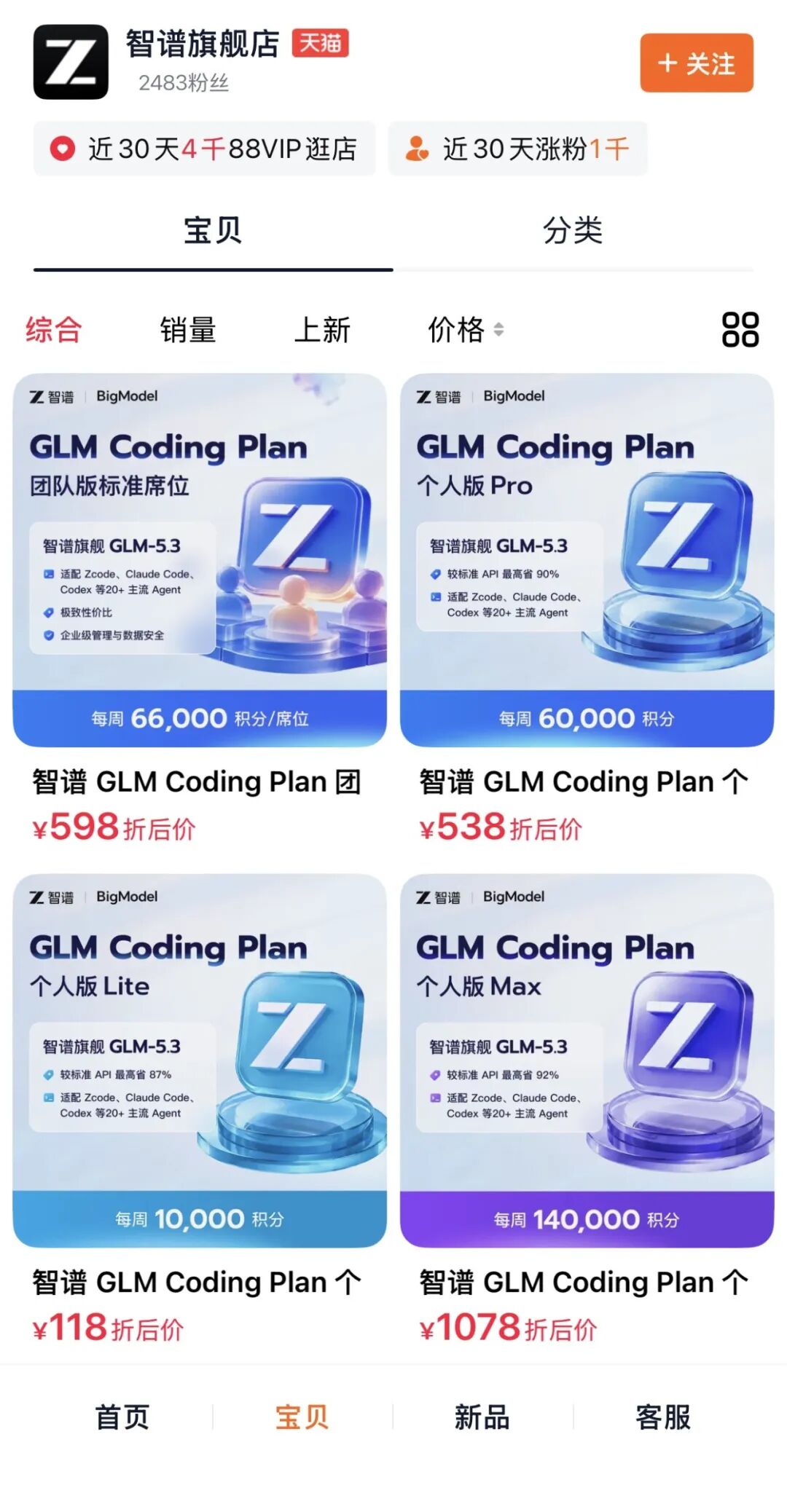
Four packages of Zhipu's Tmall flagship store Source: Tmall, screenshot by Tang Chen
Some engineers told the media, "In the future, buying Tokens can be as 'smooth' as topping up phone bills."
The difference is that after completing the payment, users will not receive physical goods. The official will directly activate the purchased package in the personal Zhipu account.
In the past, the subscription packages of large model manufacturers were almost all sold through official websites or independent channels. This is the first time that large model capabilities have been packaged as standard retail products and placed on traditional e-commerce shelves by a listed large model company.
This also means that large model subscription services have begun to enter the e-commerce consumption scenario. In the future, users can buy Tokens as easily as topping up phone bills, and even enjoy the discounts of e-commerce platform promotions.
However, it should be noted that while phone bill packages clearly mark the data volume, AI packages are purchased in points, which are redeemed for computing power consumption, but the output of the large model cannot be quantified.
For example, for the same 10,000 points in Zhipu's 118-yuan tier, some users can complete several small projects, while others may use up all points on a complex code base.
According to relevant information, the search volume of Zhipu's store surged 40 times month-on-month on its first day of opening.
Zhipu's New "Storefront"
Just one day later, Tmall officially launched the AI Space Station (Token Recharge Center) on the 3rd, where users can directly purchase subscription products from many leading large model manufacturers.
The page shows that this recharge center integrates subscription services of domestic leading large model manufacturers such as Alibaba Cloud, Zhipu, Kimi, and MiniMax. The products on sale include periodic subscription Token Plan, Coding Plan, and pay-as-you-go recharge plans, supporting two delivery methods of card password and direct recharge.
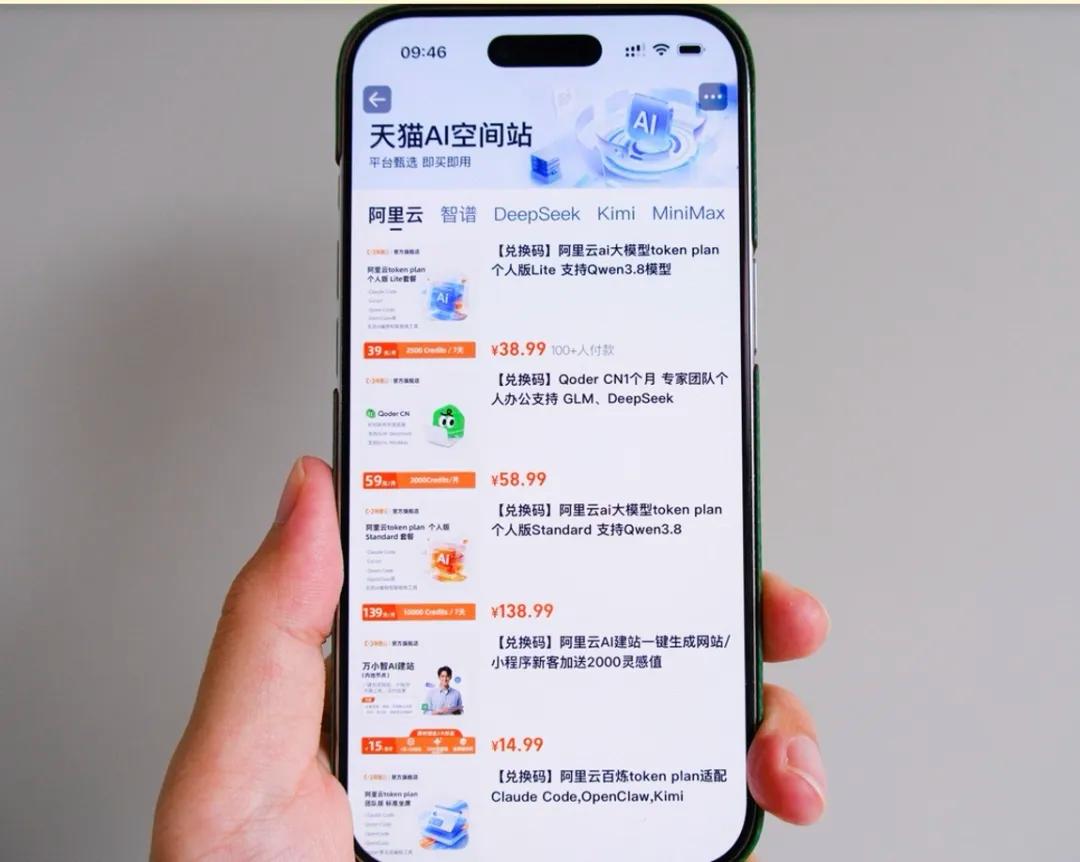
Tmall AI Space Station Source: Jiemian News
Why did Zhipu become the first large model manufacturer to settle in Tmall? In my opinion, this is closely related to the change in its revenue structure.
According to the interim performance disclosed by Zhipu on August 31, its revenue in the first half of 2026 was 954 million yuan, a year-on-year increase of 399.7%, exceeding the total of last year. The open platform and API business supported this growth rate, with a half-year revenue of 825 million yuan, a year-on-year increase of 2735.7%, and its proportion in total revenue jumped from 15.2% to 86.5%.
The contrast is obvious that the revenue of localized deployment is shrinking: the revenue related to enterprise general models was 67.04 million yuan, a year-on-year decrease of 54.6%.
What is more noteworthy is the change in revenue structure. Its open platform and API business revenue reached 825 million yuan, with a year-on-year increase of 2735.7%, which is about 28 times that of the same period last year, and its proportion in total revenue rose from 15.2% in the same period last year to 86.5%.
Zhipu is shifting from "deploying models to customer computer rooms and confirming revenue for each signed order" to "placing models on the cloud and charging continuously according to the calling volume".
The former is a traditional project-based business, which emphasizes delivery, security, operation and maintenance and customer relationship; the latter relies on model capabilities, developer ecology and reasoning costs, and has more opportunities to generate continuous and scalable revenue.
There is another set of figures in the interim report: the Token calling volume on the MaaS platform has increased by more than 40 times compared with the beginning of the year, the daily active paying users have increased by 603%, the average selling price of API has increased by about 101%, and the gross profit margin of this business has risen from -0.4% in the same period of last year to 24.6%.
It can also be said that Zhipu's revenue model is shifting from "selling projects" to "selling subscriptions", forming a business logic of "API + subscription": revenue keeps coming as long as calls do not stop; the larger the user base and the better the renewal rate, the more stable the revenue will be.
Zhipu also added a custom formula in its interim report: "AGI commercial value = upper limit of intelligence × scale of Token consumption". The logic is that the upper limit of intelligence determines what tasks the model can handle, the task boundary determines the value density of each Token, and then it is amplified by the scale of Token consumption. Tokens used for daily chatting and Tokens used for completing software engineering and discovering vulnerabilities in production systems represent different commercial values.
It also customized the "computing power multiplier" to measure how much open platform and API revenue can be generated for every 1 yuan invested in training and reasoning computing power, claiming that it increased by about 14 times year-on-year in the first half of the year. However, Zhipu did not disclose the absolute value and calculation process, and the outside world cannot independently verify it for the time being.
Geek Park commented that Zhipu's inclusion of these custom indicators in the interim report is an attempt to show that it is fighting for the right to explain the valuation of large model companies. That is, in addition to revenue, profit and cash flow, it also hopes investors pay attention to model capabilities, Token consumption, unit task cost, and the efficiency of converting computing power into revenue.
It should be noted that subscription business is a business that survives on renewal, and renewal depends on a steady stream of new users.
However, Zhipu's official ability to attract new customers is limited: professional developers are familiar with APIs and will study and configure them on their own. But a large number of individual developers, small teams, and small and medium-sized enterprises with procurement needs are difficult to reach through the official website.
What Zhipu lacks is a "storefront" with passenger flow.
One Needs New Users, the Other Needs to Seize Position
Tmall happens to have all these resources: search traffic, mature payment, order, invoicing, customer service, membership system, as well as exposure from promotions and enterprise procurement.
At the same time, the fact that large model manufacturers settle in Tmall, the leading e-commerce platform, is news in itself. This can be regarded as Zhipu proving its technical and commercial capabilities to the market after becoming the "first stock of large models".
Its confidence comes from the past 11 months, during which Zhipu has iterated six generations of flagship models from GLM-4.6 to GLM-5.3 continuously, so it has new products to update on the shelves.
For Tmall, the foundation of its existence lies in brand mindshare. I once said before that the significance of brand merchants opening stores on Tmall is not limited to selling goods, but more importantly, the improvement of brand value.
AI subscription happens to be a high-quality virtual category: high customer unit price, no logistics required, and renewal income. On the same shelf, video memberships and office software subscriptions have long been placed. Adding AI packages does not look out of place, but also brings a sense of novelty.
As early as April, Tmall cleaned up its shelves and got ready for the launch of AI model products. It specially set rules for the AI software category, releasing the "Specifications for Publishing AI Software and Application Products", which requires clearly stating the Token quota, model version, and API validity period, and banning rhetoric such as "never get banned".
The more critical consideration is to seize the position. This is the first store of large models on Tmall. After Zhipu opened the first store, Tmall got the template and category rules. Then it was logical for Tmall to launch the AI Space Station.
In my opinion, only Tmall can do the work of gathering large model manufacturers. Because Coding subscription is a search-based and planned demand, users come with clear purposes, compare different packages before placing orders.
In contrast, Pinduoduo's low-price mindshare cannot retain such customers, and Douyin's interest-driven content recommendation cannot drive such transactions. Tmall's search function plus brand stores is the main venue for such transactions.
However, I also see that neither Zhipu's official flagship store nor Tmall AI Space Station is perfect yet.
On the one hand, Zhipu's store opening only brings its official packages and prices to Tmall, without any product upgrades or preferential packages. What users feel is just an additional channel for purchase and payment.
On the other hand, cross-platform performance has virtually become a barrier. After placing an order on Tmall, users have to jump to the Zhipu platform to bind their accounts, get the API key, and then configure it in the programming tool before they can actually use it. For non-professional technical buyers, each jump step will filter out a group of people.
What is more troublesome is the blurred division of rights and responsibilities. Physical goods are confirmed for delivery after signing for logistics, while AI subscription sells the right to continuous use for a period of time. No one can clearly explain how to divide rights and responsibilities between Tmall store rules and Zhipu's service agreement. According to Zhipu's current rules, personal subscriptions do not support refunds in principle, even if the quota is not used up.
This may be a common problem of virtual goods, but in the context of Tmall and Zhipu, the user experience problem will be magnified infinitely.
Placed on Larger Shelves
If we look at it from a broader perspective, Zhipu opening a store is just a corner of a larger position-grabbing battle.
Data from the National Data Administration shows that the average daily Token calling volume in China has exceeded 140 trillion in March this year, an increase of more than 1000 times compared with the beginning of 2024.
Also in March, Token got its official Chinese name "ciyuan" (token), and the measurable, priceable and tradable computing power resource got its official "identity".
Regulators are also setting rules for such products: last September, the "Measures for the Identification of AI Generated Synthetic Content" came into effect, and eight e-commerce platforms signed the standard commitment letter.
At present, the three major operators have entered this field. On May 17, China Telecom launched the trial commercial use of Token packages, with a personal family light version priced at 9.9 yuan per month; China Mobile and China Unicom have also launched low-price packages, and some regions sell Tokens bundled with cloud computers.
Why do operators with massive users, mature payment systems and computing power networks also come to grab this business? There is only one reason: the traditional traffic business has reached its peak, and Token is the next traffic package they have found.
Data shows that the total revenue of the three major operators in 2025 was 1.966 trillion yuan, a slight increase of 0.1%, and their net profit decreased by 2.3% year-on-year.
For Zhipu, opening a store only solves the problem of where to sell. But it also needs to prove that the act of placing itself on the e-commerce shelf is feasible, which involves issues such as user activation, renewal and word-of-mouth.
This is a small step in the retailization of Tokens, and it is also a new problem for Zhipu.
In the past two years, it has supported the reputation of "the first stock" with B-end orders and capital narratives; now its stock price has experienced a roller coaster ride, and it wants to tell a C-end story to the capital market with a full shelf of subscription packages.
The key to this story is whether Zhipu can sell computing power memberships with repurchase just like selling video memberships after opening the store.
But one thing is certain: when Tokens are really sold as "new phone bills", the next competition of large models will no longer focus on who has higher parameters, but on who first turns the "top up after use" model into a stable business.
And the ecosystem of e-commerce platforms such as Tmall will also become a new traffic gold mine for large model manufacturers.
References:
Geek Park, "Zhipu and MiniMax Have Built Two Different Businesses for Large Models"
This article is from the WeChat official account "Tang Chen's Account", written by Tang Chen, and authorized for release by 36Kr.