2026 White Paper on Consumer Insights into Functional Eyeglass Frames for Chinese Children and Adolescents
Myopia among children and adolescents still features large scale, younger onset age and long-term persistence, and myopia prevention and control is shifting from one-time correction to continuous management that runs through the entire growth period. With the accelerating popularization of defocus lenses, stable wearing and optical alignment have become key variables affecting the prevention and control effect, and eyeglass frames have accordingly been upgraded from "accessories" to a professional category with independent value.
Young parents aged 31-40 are the core decision-making group. Their attention to professional fitting is constantly rising and they are willing to pay a higher price for it. However, problems such as displacement during wearing still affect the actual realization of prevention and control effects, and the industry still lacks a unified, easy-to-understand professional evaluation standard.
Looking ahead, functional integration, intelligent convergence and individual adaptation will be the three main lines of eyeglass frame products. Channels will also evolve from "selling goods" to "co-creating services", and future competition will be a competition of systematic capabilities composed of products, technology, data and channels.
01 Market Status: Severe Myopia Problem, Accelerated Independence of Eyeglass Frame Value
Myopia is becoming more "younger-onset", and prevention and control is turning into a protracted war
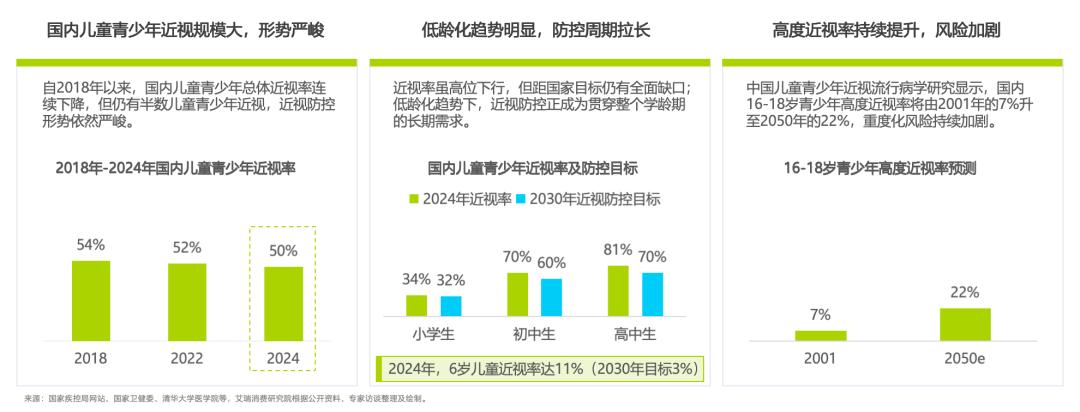
In 2024, the domestic myopia rate of children and adolescents dropped to 50%, but the myopia rate of 6-year-old children has reached 11% — myopia prevention and control is shifting from "one-time correction" to a protracted war that needs to run through the entire growth period.
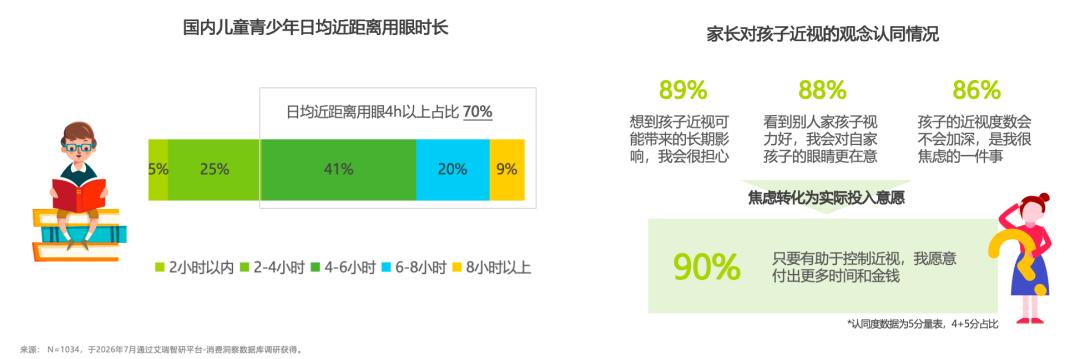
While the myopia rate has declined continuously, the risks of younger onset and severe myopia are still intensifying: the myopia rates of primary school students, junior high school students and senior high school students are 34%, 70% and 81% respectively, all higher than the 2030 prevention and control target; projections show that the high myopia rate of 16-18 year old adolescents will rise from 7% in 2001 to 22% in 2050. Correspondingly, 70% of children spend more than 4 hours on near-eye use every day, and 90% of parents say they are willing to invest more time and money as long as it helps control myopia — the persistent eye use load and parental anxiety constitute the underlying driving force for the demand of myopia prevention and control.
The popularization of defocus lenses turns eyeglass frames from "accessories" into a "professional category"
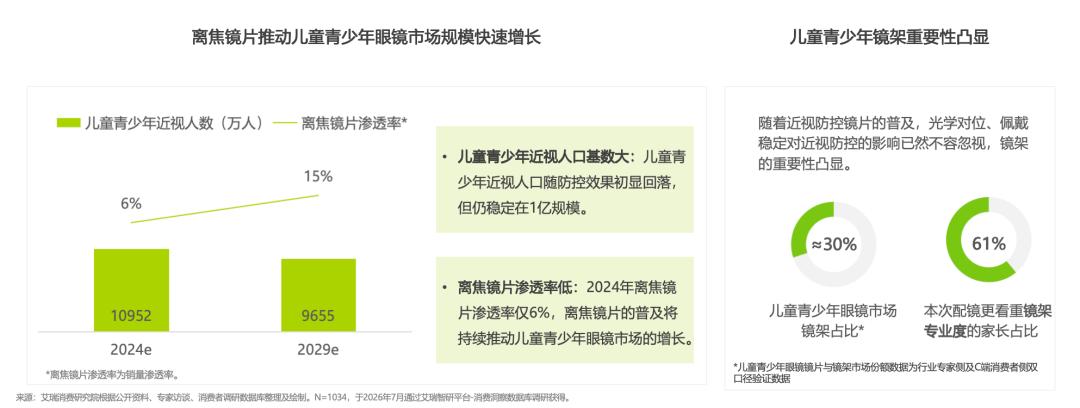
The penetration rate of defocus lens sales is expected to rise from 6% in 2024 to 15% in 2029, so the optical alignment and wearing stability of eyeglass frames have been included in the "effect responsibility chain" of myopia prevention and control.
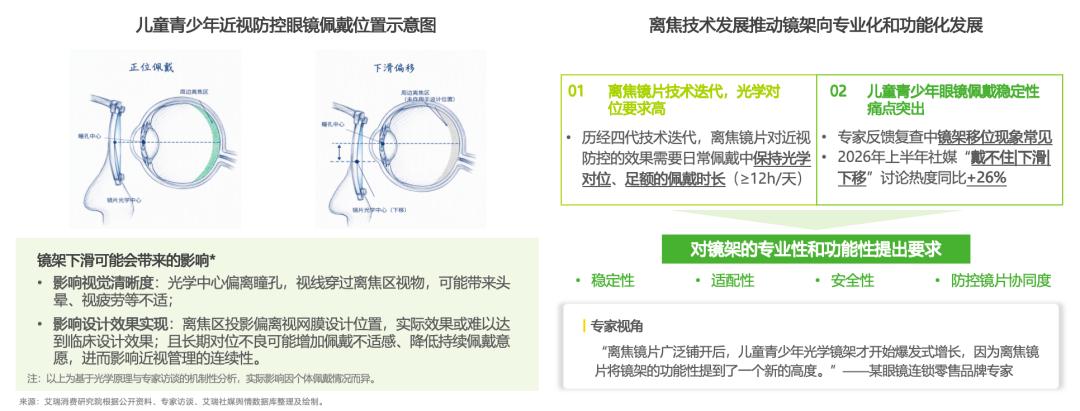
Once the eyeglass frame slides down or shifts, the projection of the defocus area will deviate from the designed position, and the prevention and control effect may be greatly reduced — in the first half of 2026, the discussion heat of related topics such as "cannot keep wearing, sliding down" on social media increased by 26% year on year. This has also fundamentally changed the role of eyeglass frames: currently, eyeglass frames account for about 30% of the children and adolescents' eyeglass market, and 61% of parents with previous eyeglass purchasing experience say they pay more attention to the professionalism of eyeglass frames in this purchase. Stability, adaptability, safety and synergy with prevention and control lenses are becoming the four core directions to measure the professional level of children's eyeglass frames.
02 Consumer Insight: Parents Are Willing to Pay for Professionalism, But Wearing Problems Still Occur Frequently
Experienced parents are willing to spend more for "professionalism"
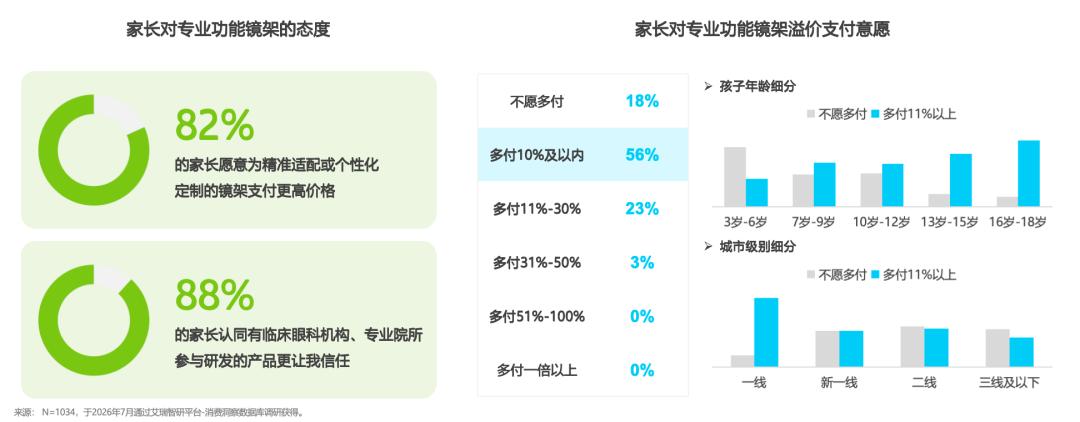
82% of parents are willing to pay a higher price for precisely adapted or custom-made eyeglass frames, but the current premium is still mainly "within 10% extra", and there is still room for market education of professional value.
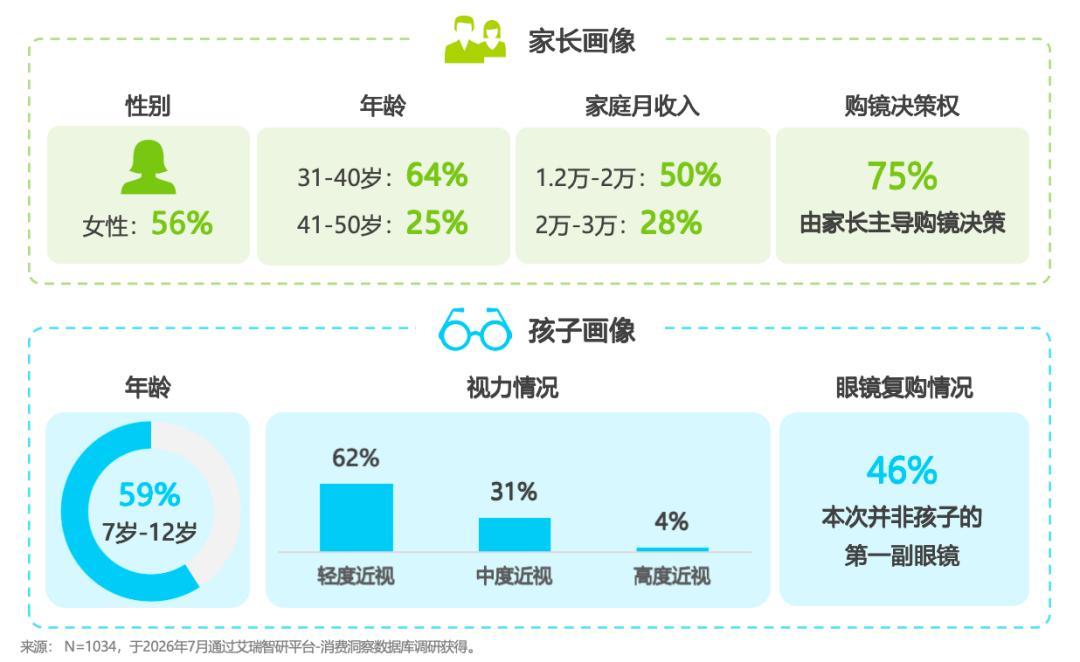
In children's eyeglass purchasing decisions, parents aged 31-40 account for 64%, and 46% of families do not buy their child's first pair of eyeglasses this time — this group of parents with eyeglass purchasing experience are more sensitive to problems such as sliding down, nose pressing, and deformation, and are more willing to pay for professionalism.
Professional adaptation is getting more and more attention, but "unstable wearing" is still a common pain point
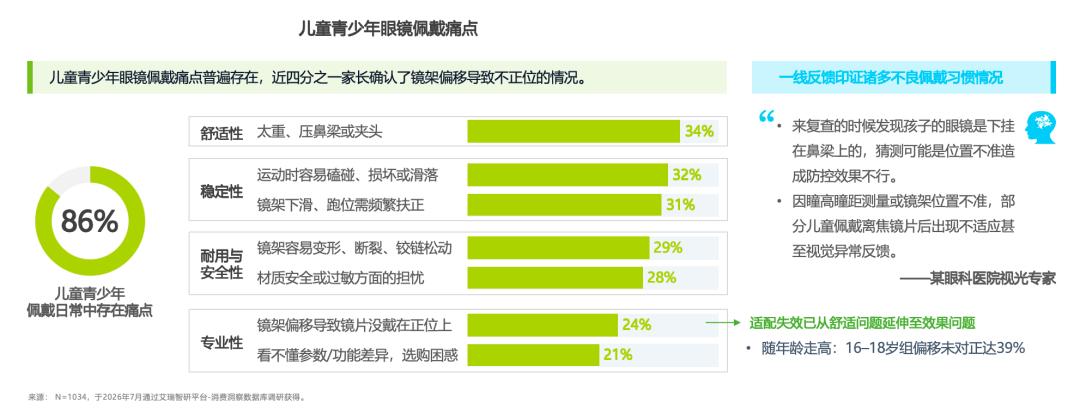
86% of parents say their children have pain points during wearing, and 24% have clearly encountered the situation that "the eyeglass frame shifts so that the lens is not worn in the correct position".
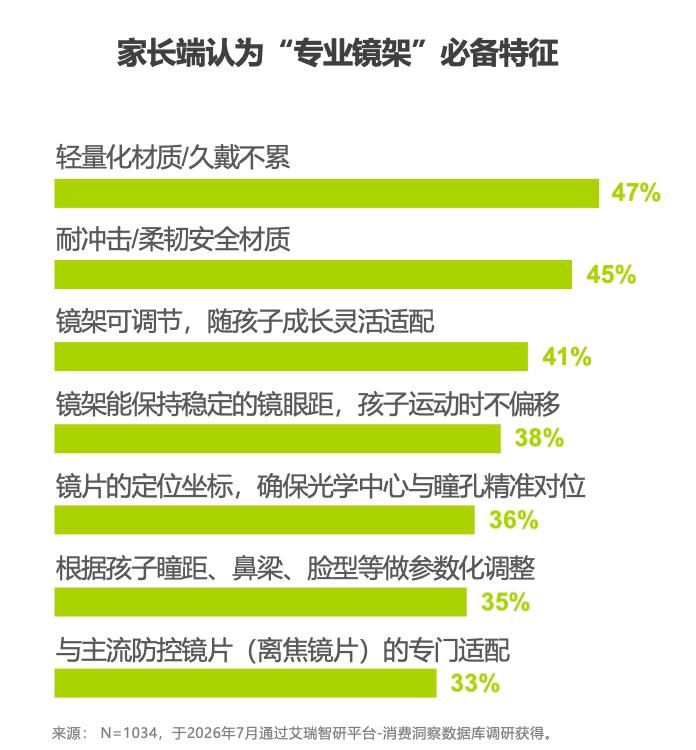
In the eyes of parents, the essential features of a "professional eyeglass frame" are lightweight material, impact-resistant safety material, adjustable to fit growth, and deeper capabilities such as stable eye-frame distance and precise optical alignment. But in reality, problems such as "too heavy to press the nose", "easy to bump and slide off during sports", "slide out of position and need to be adjusted frequently" still occur frequently, and the proportion of 16-18 year old children with "misalignment" even reaches 39% — adaptation failure is evolving from a simple comfort problem to a professional problem that directly affects the prevention and control effect.
03 Professionalization Status: Unified Evaluation Standards Are Still Missing, and Capability Gaps Need to Be Filled Through Coordination
The more "professional" the eyeglass frame is, the harder it is for parents to understand
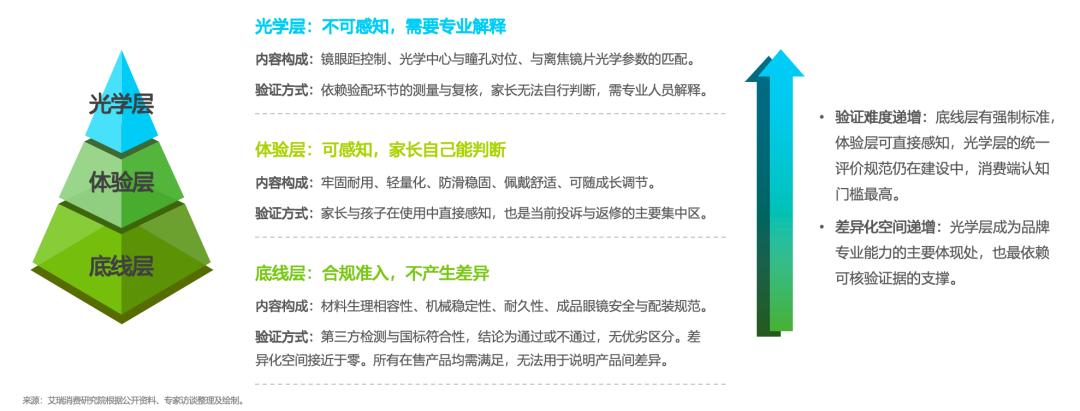
The professionalism of children's eyeglass frames can be divided into three layers: bottom-line compliance, wearing experience, and optical adaptation. The higher the layer, the higher the verification difficulty — and the most difficult to verify optical adaptation layer is exactly the core embodiment of the brand's professional capability.
The bottom-line layer (material safety, structural durability) has clear national standards to follow, the conclusion is only "qualified" or "unqualified", and the differentiation space is close to zero; the experience layer (lightweight, comfortable, anti-slip) can be directly perceived by parents, which is the current concentrated area of complaints and repairs; while the optical layer — eye-frame distance, optical center alignment, defocus lens matching — must rely on professional optometry and measurement to judge, and parents cannot verify it by themselves at all. The industry still lacks a set of unified, easy-to-understand, verifiable professional evaluation language.
Parameterized optometry is emerging, but no enterprise can "fight alone"
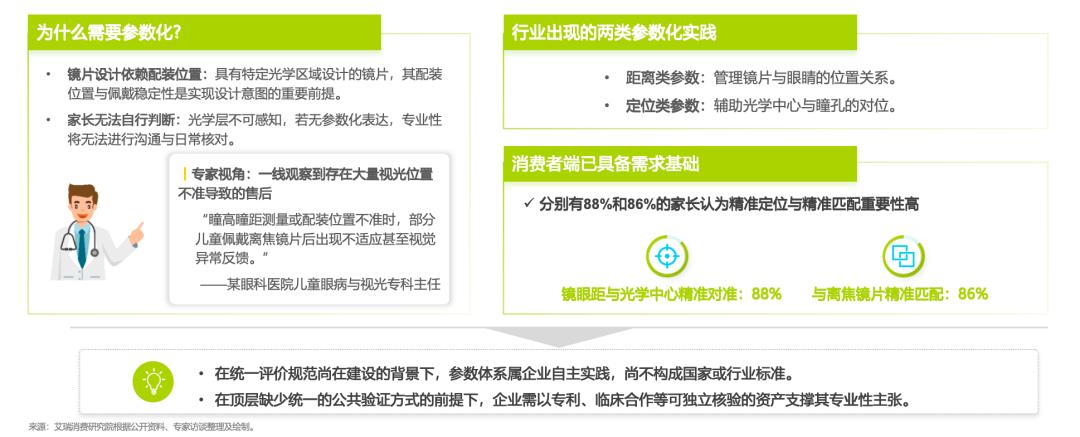
88% of parents think that the precise alignment of eye-frame distance and optical center is very important. Some enterprises in the industry have practiced parameterized optometry, but a unified public evaluation standard has not yet been formed.
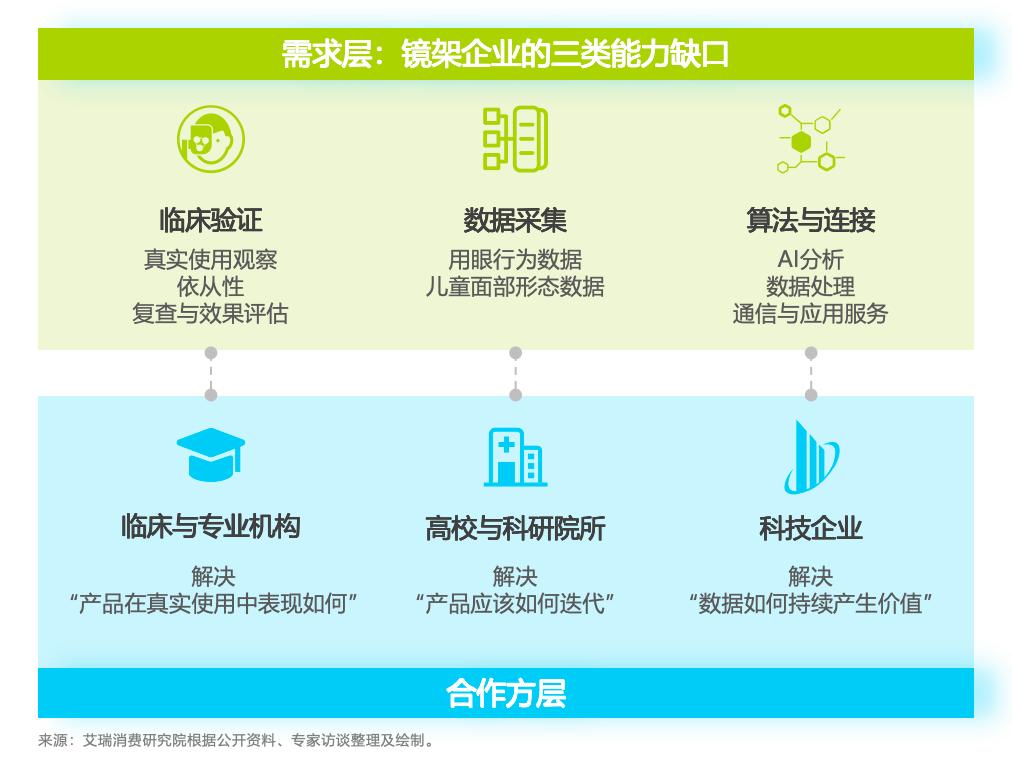
The professionalization of functional eyeglass frames is extending from "structural engineering" to "optical engineering", and the capability boundary of enterprises is also expanding continuously — children's facial and eye use data need to be collected for a long time, and the clinical use effect requires the participation of professional institutions for observation, while intelligence cannot be separated from algorithms and connection capabilities. These capabilities are difficult to be built independently by a single enterprise, and multi-party collaboration with clinical institutions, university scientific research institutes and technology enterprises is becoming a necessary foundation for the professionalization of the industry.
04 Trend Outlook: Shifting from Single-point Competition to Systematic Capability Competition
Functional integration, intelligent convergence and individual adaptation advance simultaneously
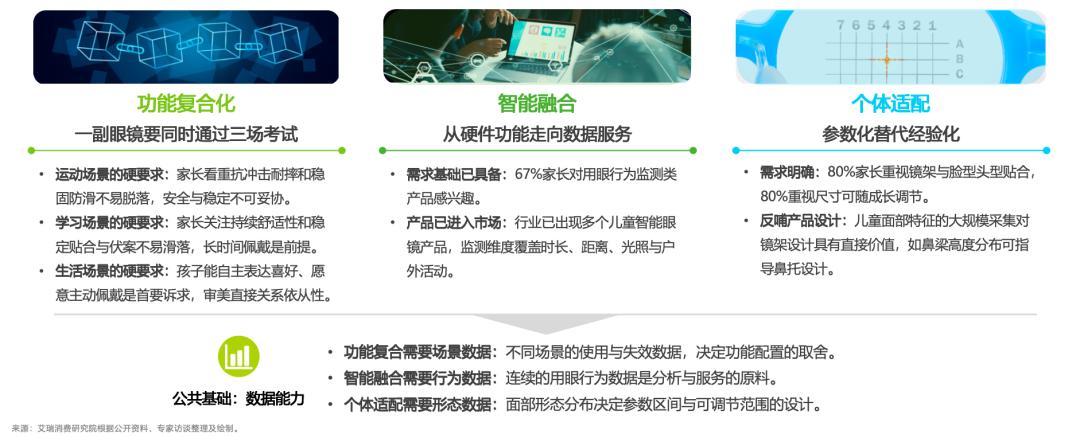
67% of parents are interested in products for eye use behavior monitoring, and 80% attach importance to whether the eyeglass frame can fit the face shape and be adjusted as the child grows — a pair of eyeglasses is evolving from "one-time eyeglass dispensing" to "continuous eye use management".
Sports scenarios require impact resistance and no falling off, learning scenarios require continuous comfort without sliding down, and life scenarios require children to take the initiative to wear them — functional integration is becoming the new normal of product design; at the same time, the industry has launched smart eyeglass products covering dimensions such as wearing duration, eye use distance, and outdoor activities, and individual adaptation is also shifting from "empirical judgment" to "parameterized design". All three main lines eventually point to the same capability: whether enterprises can continuously obtain, understand and use real data.
Channel competition is shifting from "selling goods" to "accompanying services"
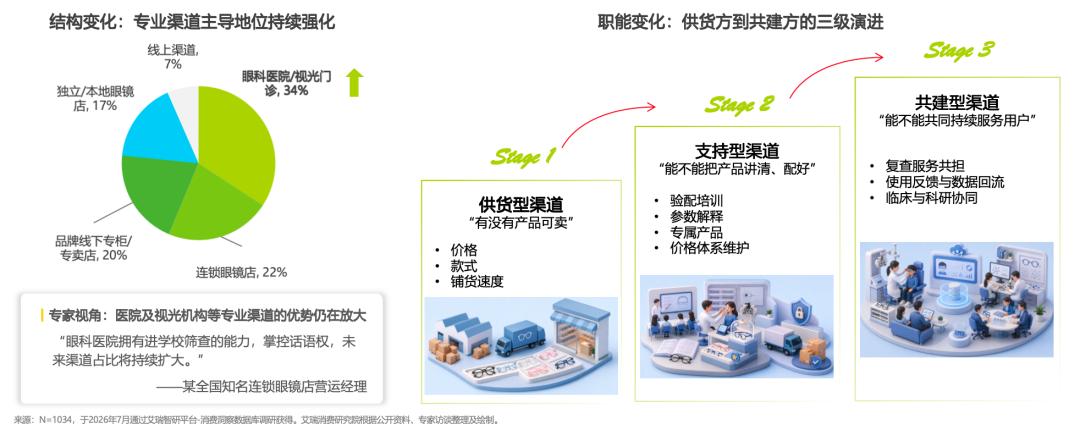
93% of the transactions of children and adolescents' eyeglasses take place offline, and the role of channels is gradually upgraded from simple supply of goods to "service co-creators" that provide optometry training, review support and even clinical collaboration.
Ophthalmic hospitals/optometry clinics are still the channels with the highest purchase proportion. They master the resources of school vision screening, and their right to speak is continuing to expand. As the value of functional eyeglass frames increasingly depends on parameter interpretation and professional optometry, who can provide more complete support for optometry, review and data feedback will determine the channel choice more than "price" and "distribution speed".
The future moat is systematic capability, not a single hit product
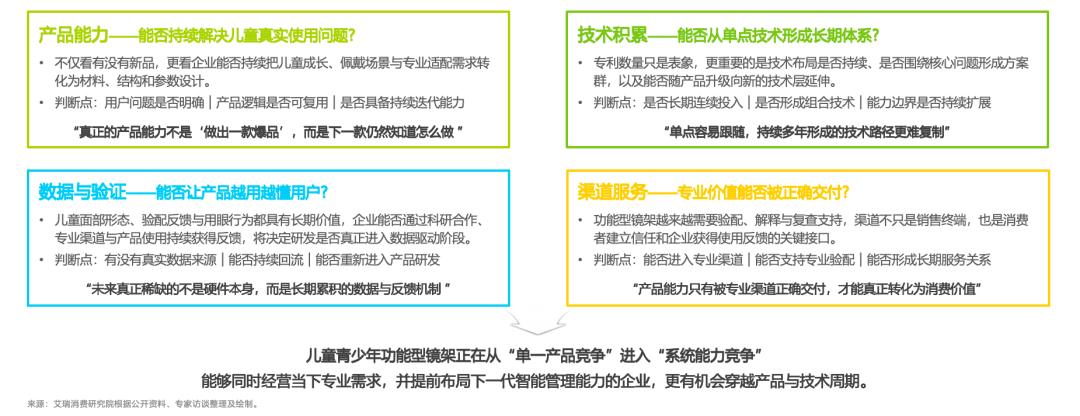
Product capability, technology accumulation, data and verification, channel services — these four types of capabilities that require long-term precipitation are determining whether enterprises can survive the replacement cycle of products and technologies.
A single new product, a single material or a single marketing investment can hardly establish a long-term advantage — what is truly scarce is the capability to continuously translate children's needs into product design, the technical path formed by consecutive multi-year investment, the data capability to continuously obtain feedback through real use, and the service capability that can be correctly delivered by professional channels. Children and adolescents' functional eyeglass frames are evolving from "single product competition" to "systematic capability competition".